Specialty Concrete -
High End Value Materials
High-Value
Concrete
High-Value Concrete
 All concrete is high value!
 Cost of material (small)
 Cost of placement (significant)
 Cost of Replacement (HIGH)
High-Value
Concrete
 High value generally associated
with High-Performance
 What is High-Performance?
 High-Early Strength Concrete
 High-Strength Concrete
 High-Durability Concrete
 Self-Consolidating Concrete
 Reactive Powder Concrete
High-Value Concrete
High-Value
Concrete
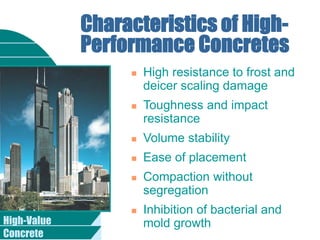
Characteristics of High-
Performance Concretes
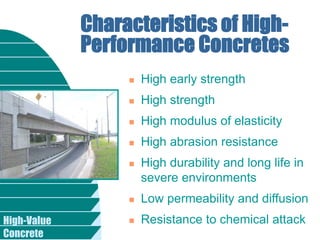
 High early strength
 High strength
 High modulus of elasticity
 High abrasion resistance
 High durability and long life in
severe environments
 Low permeability and diffusion
 Resistance to chemical attack
High-Value
Concrete
Characteristics of High-
Performance Concretes
 High resistance to frost and
deicer scaling damage
 Toughness and impact
resistance
 Volume stability
 Ease of placement
 Compaction without
segregation
 Inhibition of bacterial and
mold growth
High-Value
Concrete
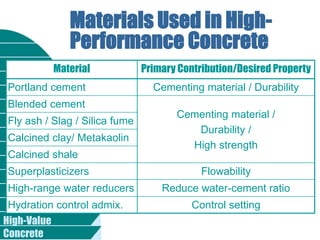
Materials Used in High-
Performance Concrete
Material Primary Contribution/Desired Property
Portland cement Cementing material / Durability
Blended cement
Cementing material /
Durability /
High strength
Fly ash / Slag / Silica fume
Calcined clay/ Metakaolin
Calcined shale
Superplasticizers Flowability
High-range water reducers Reduce water-cement ratio
Hydration control admix. Control setting
High-Value
Concrete
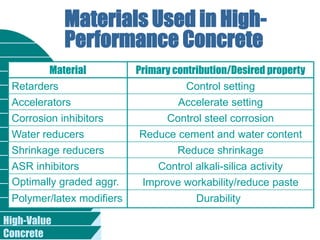
Materials Used in High-
Performance Concrete
Material Primary contribution/Desired property
Retarders Control setting
Accelerators Accelerate setting
Corrosion inhibitors Control steel corrosion
Water reducers Reduce cement and water content
Shrinkage reducers Reduce shrinkage
ASR inhibitors Control alkali-silica activity
Improve workability/reduce paste
Polymer/latex modifiers
Optimally graded aggr.
Durability
High-Value
Concrete
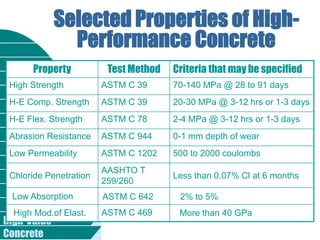
Selected Properties of High-
Performance Concrete
Property Test Method Criteria that may be specified
High Strength ASTM C 39 70-140 MPa @ 28 to 91 days
H-E Comp. Strength ASTM C 39 20-30 MPa @ 3-12 hrs or 1-3 days
H-E Flex. Strength ASTM C 78 2-4 MPa @ 3-12 hrs or 1-3 days
Abrasion Resistance ASTM C 944 0-1 mm depth of wear
Low Permeability ASTM C 1202 500 to 2000 coulombs
Chloride Penetration
AASHTO T
259/260
Less than 0.07% Cl at 6 months
Low Absorption ASTM C 642 2% to 5%
High Mod.of Elast. ASTM C 469 More than 40 GPa
High-Value
Concrete
High-Early-Strength
Concrete
 High-early compressive strength
ASTM C 39 (AASHTO T 22)
20 to 28 MPa (3000 to 4000 psi)
at 3 to 12 hours or 1 to 3 days
 High-early flexural strength
ASTM C 78 (AASHTO T 97)
2 to 4 MPa (300 to 600 psi)
at 3 to 12 hours or 1 to 3 days
High-Value
Concrete
High-Early-Strength
Concrete
 Type III or HE high-early-strength
cement
 High cement content
400 to 600 kg/m3
(675 to 1000 lb/yd3)
 Low water-cementing materials ratio
(0.20 to 0.45 by mass)
 Higher freshly mixed concrete
temperature
 Higher curing temperature
May be achieved by —
High-Value
Concrete
High-Early-Strength
Concrete
 Chemical admixtures
 Silica fume (or other SCM)
 Steam or autoclave curing
 Insulation to retain heat of
hydration
 Special rapid hardening cements
May be achieved by —
High-Value
Concrete
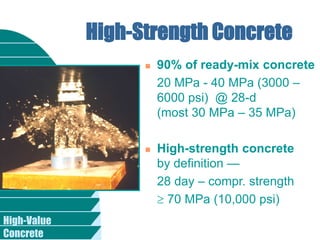
High-Strength Concrete
 90% of ready-mix concrete
20 MPa - 40 MPa (3000 –
6000 psi) @ 28-d
(most 30 MPa – 35 MPa)
 High-strength concrete
by definition —
28 day – compr. strength
 70 MPa (10,000 psi)
High-Value
Concrete
High-Strength Concrete Materials
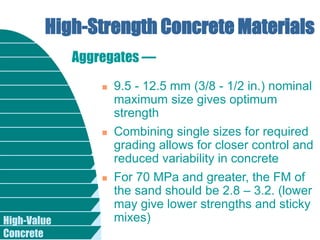
 9.5 - 12.5 mm (3/8 - 1/2 in.) nominal
maximum size gives optimum
strength
 Combining single sizes for required
grading allows for closer control and
reduced variability in concrete
 For 70 MPa and greater, the FM of
the sand should be 2.8 – 3.2. (lower
may give lower strengths and sticky
mixes)
Aggregates —
High-Value
Concrete
High-Strength Concrete Materials
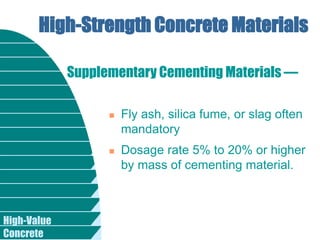
 Fly ash, silica fume, or slag often
mandatory
 Dosage rate 5% to 20% or higher
by mass of cementing material.
Supplementary Cementing Materials —
High-Value
Concrete
High-Strength Concrete Materials
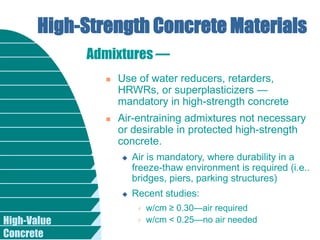
 Use of water reducers, retarders,
HRWRs, or superplasticizers —
mandatory in high-strength concrete
 Air-entraining admixtures not necessary
or desirable in protected high-strength
concrete.
 Air is mandatory, where durability in a
freeze-thaw environment is required (i.e..
bridges, piers, parking structures)
 Recent studies:
 w/cm ≥ 0.30—air required
 w/cm < 0.25—no air needed
Admixtures —
High-Value
Concrete
High-Strength Concrete
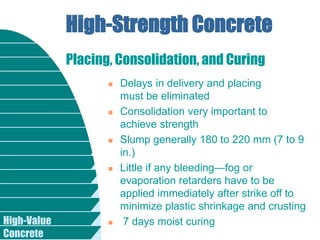
 Delays in delivery and placing
must be eliminated
 Consolidation very important to
achieve strength
 Slump generally 180 to 220 mm (7 to 9
in.)
 Little if any bleeding—fog or
evaporation retarders have to be
applied immediately after strike off to
minimize plastic shrinkage and crusting
 7 days moist curing
Placing, Consolidation, and Curing
High-Value
Concrete
High-Durability Concrete
 1970s and 1980s focus on —
High-Strength HPC
 Today focus on concretes
with high durability in severe
environments resulting in
structures with long life —
High-Durability HPC
High-Value
Concrete
High-Durability Concrete
 Abrasion Resistance
 Blast Resistance
 Permeability
 Carbonation
 Freeze-Thaw Resistance
 Chemical Attack
 Alkali-Silica Reactivity
 Corrosion rates of rebar
Durability Issues That HPC Can Address
High-Value
Concrete
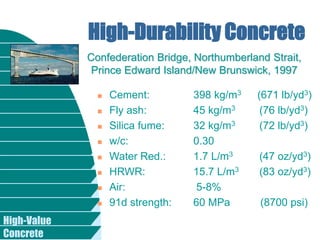
 Cement: 398 kg/m3 (671 lb/yd3)
 Fly ash: 45 kg/m3 (76 lb/yd3)
 Silica fume: 32 kg/m3 (72 lb/yd3)
 w/c: 0.30
 Water Red.: 1.7 L/m3 (47 oz/yd3)
 HRWR: 15.7 L/m3 (83 oz/yd3)
 Air: 5-8%
 91d strength: 60 MPa (8700 psi)
High-Durability Concrete
Confederation Bridge, Northumberland Strait,
Prince Edward Island/New Brunswick, 1997
High-Value
Concrete
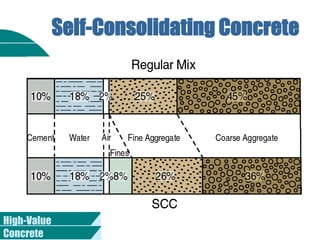
Self-Consolidating Concrete
 developed in 1980s — Japan
 Increased amount of
 Fine material
(i.e. fly ash or limestone filler)
 HRWR/Superplasticizers
 Strength and durability same as
conventional concrete
Self-consolidating concrete (SCC) also
known as self-compacting concrete —
flows and consolidates on its own
High-Value
Concrete
Self-Consolidating Concrete
High-Value
Concrete
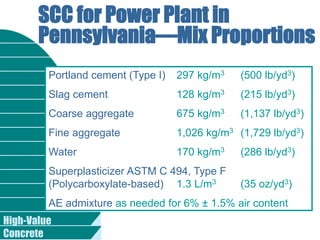
Portland cement (Type I) 297 kg/m3 (500 lb/yd3)
Slag cement 128 kg/m3 (215 lb/yd3)
Coarse aggregate 675 kg/m3 (1,137 lb/yd3)
Fine aggregate 1,026 kg/m3 (1,729 lb/yd3)
Water 170 kg/m3 (286 lb/yd3)
Superplasticizer ASTM C 494, Type F
(Polycarboxylate-based) 1.3 L/m3 (35 oz/yd3)
AE admixture as needed for 6% ± 1.5% air content
SCC for Power Plant in
Pennsylvania—Mix Proportions
High-Value
Concrete
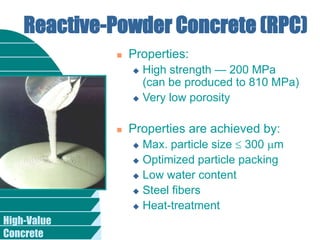
Reactive-Powder Concrete (RPC)
 Properties:
 High strength — 200 MPa
(can be produced to 810 MPa)
 Very low porosity
 Properties are achieved by:
 Max. particle size  300 m
 Optimized particle packing
 Low water content
 Steel fibers
 Heat-treatment
High-Value
Concrete
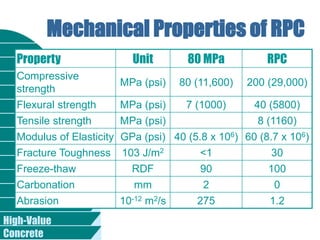
Mechanical Properties of RPC
Property Unit 80 MPa RPC
Compressive
strength
MPa (psi) 80 (11,600) 200 (29,000)
Flexural strength MPa (psi) 7 (1000) 40 (5800)
Tensile strength MPa (psi) 8 (1160)
Modulus of Elasticity GPa (psi) 40 (5.8 x 10⁶) 60 (8.7 x 10⁶)
Fracture Toughness 103 J/m2 <1 30
Freeze-thaw RDF 90 100
Carbonation mm 2 0
Abrasion 10-12 m2/s 275 1.2
High-Value
Concrete
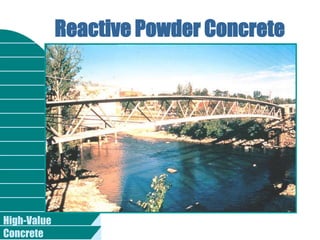
Reactive Powder Concrete
High-Value
Concrete
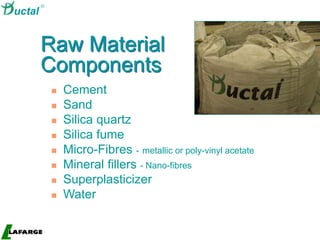
 Cement
 Sand
 Silica quartz
 Silica fume
 Micro-Fibres - metallic or poly-vinyl acetate
 Mineral fillers - Nano-fibres
 Superplasticizer
 Water
Raw Material
Components

uctal
High-Value
Concrete
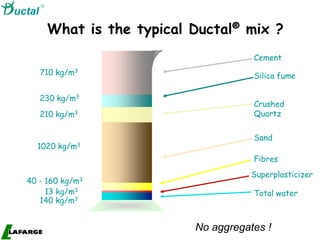
What is the typical Ductal® mix ?
230 kg/m3
710 kg/m3
210 kg/m3
40 - 160 kg/m3
13 kg/m3
140 kg/m3
1020 kg/m3
Cement
Silica fume
Crushed
Quartz
Sand
Fibres
Superplasticizer
Total water
No aggregates !

uctal
High-Value
Concrete
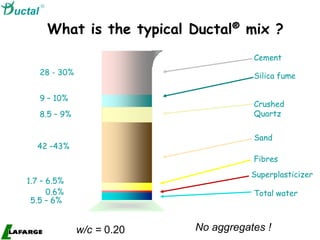
What is the typical Ductal® mix ?
9 – 10%
28 - 30%
8.5 – 9%
1.7 – 6.5%
0.6%
5.5 – 6%
42 –43%
Cement
Silica fume
Crushed
Quartz
Sand
Fibres
Superplasticizer
Total water
No aggregates !

uctal
w/c = 0.20

hvalue.ppt

  • 1.
    Specialty Concrete - HighEnd Value Materials
  • 2.
    High-Value Concrete High-Value Concrete  Allconcrete is high value!  Cost of material (small)  Cost of placement (significant)  Cost of Replacement (HIGH)
  • 3.
    High-Value Concrete  High valuegenerally associated with High-Performance  What is High-Performance?  High-Early Strength Concrete  High-Strength Concrete  High-Durability Concrete  Self-Consolidating Concrete  Reactive Powder Concrete High-Value Concrete
  • 4.
    High-Value Concrete Characteristics of High- PerformanceConcretes  High early strength  High strength  High modulus of elasticity  High abrasion resistance  High durability and long life in severe environments  Low permeability and diffusion  Resistance to chemical attack
  • 5.
    High-Value Concrete Characteristics of High- PerformanceConcretes  High resistance to frost and deicer scaling damage  Toughness and impact resistance  Volume stability  Ease of placement  Compaction without segregation  Inhibition of bacterial and mold growth
  • 6.
    High-Value Concrete Materials Used inHigh- Performance Concrete Material Primary Contribution/Desired Property Portland cement Cementing material / Durability Blended cement Cementing material / Durability / High strength Fly ash / Slag / Silica fume Calcined clay/ Metakaolin Calcined shale Superplasticizers Flowability High-range water reducers Reduce water-cement ratio Hydration control admix. Control setting
  • 7.
    High-Value Concrete Materials Used inHigh- Performance Concrete Material Primary contribution/Desired property Retarders Control setting Accelerators Accelerate setting Corrosion inhibitors Control steel corrosion Water reducers Reduce cement and water content Shrinkage reducers Reduce shrinkage ASR inhibitors Control alkali-silica activity Improve workability/reduce paste Polymer/latex modifiers Optimally graded aggr. Durability
  • 8.
    High-Value Concrete Selected Properties ofHigh- Performance Concrete Property Test Method Criteria that may be specified High Strength ASTM C 39 70-140 MPa @ 28 to 91 days H-E Comp. Strength ASTM C 39 20-30 MPa @ 3-12 hrs or 1-3 days H-E Flex. Strength ASTM C 78 2-4 MPa @ 3-12 hrs or 1-3 days Abrasion Resistance ASTM C 944 0-1 mm depth of wear Low Permeability ASTM C 1202 500 to 2000 coulombs Chloride Penetration AASHTO T 259/260 Less than 0.07% Cl at 6 months Low Absorption ASTM C 642 2% to 5% High Mod.of Elast. ASTM C 469 More than 40 GPa
  • 9.
    High-Value Concrete High-Early-Strength Concrete  High-early compressivestrength ASTM C 39 (AASHTO T 22) 20 to 28 MPa (3000 to 4000 psi) at 3 to 12 hours or 1 to 3 days  High-early flexural strength ASTM C 78 (AASHTO T 97) 2 to 4 MPa (300 to 600 psi) at 3 to 12 hours or 1 to 3 days
  • 10.
    High-Value Concrete High-Early-Strength Concrete  Type IIIor HE high-early-strength cement  High cement content 400 to 600 kg/m3 (675 to 1000 lb/yd3)  Low water-cementing materials ratio (0.20 to 0.45 by mass)  Higher freshly mixed concrete temperature  Higher curing temperature May be achieved by —
  • 11.
    High-Value Concrete High-Early-Strength Concrete  Chemical admixtures Silica fume (or other SCM)  Steam or autoclave curing  Insulation to retain heat of hydration  Special rapid hardening cements May be achieved by —
  • 12.
    High-Value Concrete High-Strength Concrete  90%of ready-mix concrete 20 MPa - 40 MPa (3000 – 6000 psi) @ 28-d (most 30 MPa – 35 MPa)  High-strength concrete by definition — 28 day – compr. strength  70 MPa (10,000 psi)
  • 13.
    High-Value Concrete High-Strength Concrete Materials 9.5 - 12.5 mm (3/8 - 1/2 in.) nominal maximum size gives optimum strength  Combining single sizes for required grading allows for closer control and reduced variability in concrete  For 70 MPa and greater, the FM of the sand should be 2.8 – 3.2. (lower may give lower strengths and sticky mixes) Aggregates —
  • 14.
    High-Value Concrete High-Strength Concrete Materials Fly ash, silica fume, or slag often mandatory  Dosage rate 5% to 20% or higher by mass of cementing material. Supplementary Cementing Materials —
  • 15.
    High-Value Concrete High-Strength Concrete Materials Use of water reducers, retarders, HRWRs, or superplasticizers — mandatory in high-strength concrete  Air-entraining admixtures not necessary or desirable in protected high-strength concrete.  Air is mandatory, where durability in a freeze-thaw environment is required (i.e.. bridges, piers, parking structures)  Recent studies:  w/cm ≥ 0.30—air required  w/cm < 0.25—no air needed Admixtures —
  • 16.
    High-Value Concrete High-Strength Concrete  Delaysin delivery and placing must be eliminated  Consolidation very important to achieve strength  Slump generally 180 to 220 mm (7 to 9 in.)  Little if any bleeding—fog or evaporation retarders have to be applied immediately after strike off to minimize plastic shrinkage and crusting  7 days moist curing Placing, Consolidation, and Curing
  • 17.
    High-Value Concrete High-Durability Concrete  1970sand 1980s focus on — High-Strength HPC  Today focus on concretes with high durability in severe environments resulting in structures with long life — High-Durability HPC
  • 18.
    High-Value Concrete High-Durability Concrete  AbrasionResistance  Blast Resistance  Permeability  Carbonation  Freeze-Thaw Resistance  Chemical Attack  Alkali-Silica Reactivity  Corrosion rates of rebar Durability Issues That HPC Can Address
  • 19.
    High-Value Concrete  Cement: 398kg/m3 (671 lb/yd3)  Fly ash: 45 kg/m3 (76 lb/yd3)  Silica fume: 32 kg/m3 (72 lb/yd3)  w/c: 0.30  Water Red.: 1.7 L/m3 (47 oz/yd3)  HRWR: 15.7 L/m3 (83 oz/yd3)  Air: 5-8%  91d strength: 60 MPa (8700 psi) High-Durability Concrete Confederation Bridge, Northumberland Strait, Prince Edward Island/New Brunswick, 1997
  • 20.
    High-Value Concrete Self-Consolidating Concrete  developedin 1980s — Japan  Increased amount of  Fine material (i.e. fly ash or limestone filler)  HRWR/Superplasticizers  Strength and durability same as conventional concrete Self-consolidating concrete (SCC) also known as self-compacting concrete — flows and consolidates on its own
  • 21.
  • 22.
    High-Value Concrete Portland cement (TypeI) 297 kg/m3 (500 lb/yd3) Slag cement 128 kg/m3 (215 lb/yd3) Coarse aggregate 675 kg/m3 (1,137 lb/yd3) Fine aggregate 1,026 kg/m3 (1,729 lb/yd3) Water 170 kg/m3 (286 lb/yd3) Superplasticizer ASTM C 494, Type F (Polycarboxylate-based) 1.3 L/m3 (35 oz/yd3) AE admixture as needed for 6% ± 1.5% air content SCC for Power Plant in Pennsylvania—Mix Proportions
  • 23.
    High-Value Concrete Reactive-Powder Concrete (RPC) Properties:  High strength — 200 MPa (can be produced to 810 MPa)  Very low porosity  Properties are achieved by:  Max. particle size  300 m  Optimized particle packing  Low water content  Steel fibers  Heat-treatment
  • 24.
    High-Value Concrete Mechanical Properties ofRPC Property Unit 80 MPa RPC Compressive strength MPa (psi) 80 (11,600) 200 (29,000) Flexural strength MPa (psi) 7 (1000) 40 (5800) Tensile strength MPa (psi) 8 (1160) Modulus of Elasticity GPa (psi) 40 (5.8 x 10⁶) 60 (8.7 x 10⁶) Fracture Toughness 103 J/m2 <1 30 Freeze-thaw RDF 90 100 Carbonation mm 2 0 Abrasion 10-12 m2/s 275 1.2
  • 25.
  • 26.
    High-Value Concrete  Cement  Sand Silica quartz  Silica fume  Micro-Fibres - metallic or poly-vinyl acetate  Mineral fillers - Nano-fibres  Superplasticizer  Water Raw Material Components  uctal
  • 27.
    High-Value Concrete What is thetypical Ductal® mix ? 230 kg/m3 710 kg/m3 210 kg/m3 40 - 160 kg/m3 13 kg/m3 140 kg/m3 1020 kg/m3 Cement Silica fume Crushed Quartz Sand Fibres Superplasticizer Total water No aggregates !  uctal
  • 28.
    High-Value Concrete What is thetypical Ductal® mix ? 9 – 10% 28 - 30% 8.5 – 9% 1.7 – 6.5% 0.6% 5.5 – 6% 42 –43% Cement Silica fume Crushed Quartz Sand Fibres Superplasticizer Total water No aggregates !  uctal w/c = 0.20