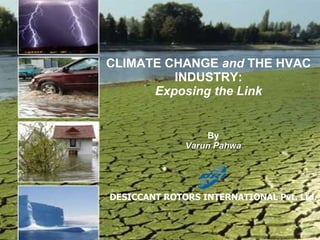
By Varun Pahwa DESICCANT ROTORS INTERNATIONAL Pvt. Ltd. CLIMATE CHANGE  and  THE HVAC INDUSTRY: Exposing the Link
CLIMATE CHANGE 101
THE EARTH IS HEATING UP.
UNITED NATIONS FRAMEWORK CONVENTION ON CLIMATE CHANGE BALI, 3 - 14 DECEMBER 2007
GLOBAL WARMING IS HERE TO STAY.
GLOBAL WARMING POTENTIAL SHARE OF EMISSIONS 2006 100% 22.2% 18.4% 11.4% 5.6% 4.9% 1.4% 1.2% 27,246 6049 5010 3115 1525 1343 374 327 WORLD USA CHINA EU RUSSIA INDIA FRANCE AUSTRALIA 1 2 - 3 4 15 19 % of total emissions Annual emission   MMT Country Rank Urban Pollution 15 - 30 ppb Ozone 6% 310 Agriculture, Combustion 275 - 310 ppb Nitrous Oxide 14% 3400+ Refrigerants 0 - 0.7 ppb Halocarbons 20% 21 Agriculture, Fuel Leakage 0.75 - 1.75 ppm Methane 60% 1 Fossil Fuel Burning, Deforestation 280 - 370 ppm Carbon Dioxide Proportion of Total Effect (Approximate) GWP Anthropogenic Sources Concentration  1800s - 2000 Greenhouse Gas
 
Consume 12% of world’s fresh water 40% of world’s energy Produce 40% of waste going to landfills 40% of emissions Electricity use is the main source of GHG emissions in commercial buildings, being responsible for 89% of all emissions. Many commercial buildings are responsible for upto 200 tonnes of greenhouse gas emissions per square meter of floor space annually. BUILDINGS  Buildings HVAC Equipment Environmental Impact - Electricity - Refrigerants - Embodied Energy - Water
Fuel Energy In Power Plant Transmission and Distribution Electric powered System or process 3.37 kWh Thermal (11,500 Btu) (Thermal equivalent assuming 33% plant efficiency) 1.1kWh 1 kWh delivered to end use CONCEPTUAL ILLUSTRATION OF CO2 EMISSIONS FROM ELECTIC END USE OF ENERGY. Coal Fuel - 1.14 KG of CO2 per KW of electricity
Carbon Emissions for Electricity Generation Coal  0.9 Kg / kwh CO2 Gas  0.6 Kg / kwh CO2 Solar, Wind, Nuclear, Hydro  < 0.05 Kg / kwh CO2 INDIA SOURCES OF POWER Coal  53.5% Gas  10.4% Hydro  26.6% T&D LOSES Average 8 – 10 % India  22% 0.8 Kg of CO2 / kwh of electricity used
- 76 million residential buildings - 5 million commercial buildings By the year 2010, another 38 million buildings are expected to be constructed. Nearly 70% of electricity produced at US power plants   is consumed by the existing residential, commercial, and industrial buildings. THE US STORY
Overall, Space conditioning accounts for 44% and 30% of the energy consumption in the US residential and commercial sector respectively.   Approximately 14.3% of all energy consumed in the US is for space conditioning in commercial and residential buildings using HVACR systems and products (includes heating, cooling and parasitic equipment)   Energy consumption characteristics of US commercial buildings HVAC systems 25% lighting 13% heating 11% cooling 6% refrigeration 6% water heating 6% ventilation 6% electronics Commercial 32% space heating 13% water heating 12% lighting 11% air conditioning 8% refrigeration 5% electronics 5% wet-clean (mostly clothes dryers) Residential Major Uses Sector
PRIMARY ENERGY USE – HVAC EQUIPMENT BREAKDOWN Cooling  Heating
PARASITIC PRIMARY ENERGY USE – EQUIPMENT BREAKDOWN Parasitic energy use in commercial building HVAC systems accounts for about 10% of commercial sector energy use.   2005 emissions in the US were  5954 MMTons   Residential sector  1243 MMT (20.8%)   commercial sector  1056 MMT (17.7%)   Space conditioning or HVACR equipment in the US for commercial & residential sectors uses energy which can be equated to approximately  700 to 900 MMTons. The commercial sector HVACR emission is approximately  373 MMTons.
India’s electricity consumption stands at 587 billion Kwh in 2006, out of which currently 8% is being used by the commercial sector and 25% in the residential segment. Commercial Buildings 32 % for ac / 60 % for lighting / 8 % others Emission in the commercial sector can be estimated between  11 and 14 MMT  on account of installed space conditioning equipment. Slated for construction by 2010 12 million homes, 600 shopping malls, 80 million square feet of offices and 200 townships, along with airports, hotels, hospitals and schools.
The central plant market in India is currently growing at 23% per year and the market for large chillers (centrifugal and screw) is expected to grow at 30% per year. In 2005, the centrifugal chillers market is estimated at 60,000 cooling tonnes and the market for screw chillers is estimated at 300,000 cooling tonnes. This new annual installed base of centrifugal and screw chillers alone in India represents an addition of over  1.2 MMTos of emissions. HVACR energy use in commercial buildings currently represents over  6% of total country emissions in US 1 to 2% of total country emissions in India However, in the case of India, this percentage is rising extremely fast on account of 12% growth in demand for electricity in commercial buildings.
- UAE is world’s second largest per capita carbon emitter after Qatar. - By 2015, power demand will double up. 70% was utilized in commercial and residential buildings.  Dubai 1985  AUSTRALIA By 2010, HVACR energy use in commercial buildings will be responsible for  21 Mt  of emissions annually or nearly 4% of Australia's total emissions.   Dubai 2005
Climate Change Global Warming Clean-Tech Carbon Credits Sustainability EVERYONE IS TALKING IN A NEW LANGUAGE :  ‘GREEN’
Building  ‘GREEN’  promotes  resource conservation , including  energy efficiency ,  renewable energy , and  water conservation  features; consider  environmental impacts and waste minimization ; create a  healthy and comfortable environment ;  reduce operation and maintenance costs ; and address issues such as  historical preservation , access to  public transportation  and other  community infrastructure systems . The entire life cycle of the building and its components should be considered, as well as the economic and environmental impact and performance.
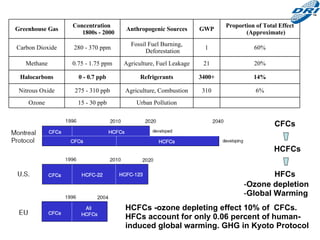
CFCs HCFCs HFCs Ozone depletion Global Warming HCFCs -ozone depleting effect 10% of  CFCs. HFCs account for only 0.06 percent of human-induced global warming. GHG in Kyoto Protocol Urban Pollution 15 - 30 ppb Ozone 6% 310 Agriculture, Combustion 275 - 310 ppb Nitrous Oxide 14% 3400+ Refrigerants 0 - 0.7 ppb Halocarbons 20% 21 Agriculture, Fuel Leakage 0.75 - 1.75 ppm Methane 60% 1 Fossil Fuel Burning, Deforestation 280 - 370 ppm Carbon Dioxide Proportion of Total Effect (Approximate) GWP Anthropogenic Sources Concentration  1800s - 2000 Greenhouse Gas
Embodied energy   is the sum total of the energy necessary - from the raw material extraction, to transport, manufacturing, assembly, installation as well as the capital and other costs of a specific material - to produce a service or product and finally its disassembly and/or deconstruction.   Different methodologies produce different understandings of the scale and scope of application and the type of energy embodied. Like operational energy, embodied energy is an indicator of the level of energy consumption for a building.   Some commercial buildings the embodied energy can be equivalent to 20 to 37 years of operational energy and consequently, it is a major source of energy consumption within a building. Material   kg carbon equivalent per tonne produced Steel  300 to 850 (depending on % scrap steel)
SAVING THE PLANET HAS SUDDENLY BECOME GOOD BUSINESS.

HVAC and CLIMATE CHANGE

  • 1.
    By Varun PahwaDESICCANT ROTORS INTERNATIONAL Pvt. Ltd. CLIMATE CHANGE and THE HVAC INDUSTRY: Exposing the Link
  • 2.
  • 3.
    THE EARTH ISHEATING UP.
  • 4.
    UNITED NATIONS FRAMEWORKCONVENTION ON CLIMATE CHANGE BALI, 3 - 14 DECEMBER 2007
  • 5.
    GLOBAL WARMING ISHERE TO STAY.
  • 6.
    GLOBAL WARMING POTENTIALSHARE OF EMISSIONS 2006 100% 22.2% 18.4% 11.4% 5.6% 4.9% 1.4% 1.2% 27,246 6049 5010 3115 1525 1343 374 327 WORLD USA CHINA EU RUSSIA INDIA FRANCE AUSTRALIA 1 2 - 3 4 15 19 % of total emissions Annual emission MMT Country Rank Urban Pollution 15 - 30 ppb Ozone 6% 310 Agriculture, Combustion 275 - 310 ppb Nitrous Oxide 14% 3400+ Refrigerants 0 - 0.7 ppb Halocarbons 20% 21 Agriculture, Fuel Leakage 0.75 - 1.75 ppm Methane 60% 1 Fossil Fuel Burning, Deforestation 280 - 370 ppm Carbon Dioxide Proportion of Total Effect (Approximate) GWP Anthropogenic Sources Concentration 1800s - 2000 Greenhouse Gas
  • 7.
  • 8.
    Consume 12% ofworld’s fresh water 40% of world’s energy Produce 40% of waste going to landfills 40% of emissions Electricity use is the main source of GHG emissions in commercial buildings, being responsible for 89% of all emissions. Many commercial buildings are responsible for upto 200 tonnes of greenhouse gas emissions per square meter of floor space annually. BUILDINGS Buildings HVAC Equipment Environmental Impact - Electricity - Refrigerants - Embodied Energy - Water
  • 9.
    Fuel Energy InPower Plant Transmission and Distribution Electric powered System or process 3.37 kWh Thermal (11,500 Btu) (Thermal equivalent assuming 33% plant efficiency) 1.1kWh 1 kWh delivered to end use CONCEPTUAL ILLUSTRATION OF CO2 EMISSIONS FROM ELECTIC END USE OF ENERGY. Coal Fuel - 1.14 KG of CO2 per KW of electricity
  • 10.
    Carbon Emissions forElectricity Generation Coal 0.9 Kg / kwh CO2 Gas 0.6 Kg / kwh CO2 Solar, Wind, Nuclear, Hydro < 0.05 Kg / kwh CO2 INDIA SOURCES OF POWER Coal 53.5% Gas 10.4% Hydro 26.6% T&D LOSES Average 8 – 10 % India 22% 0.8 Kg of CO2 / kwh of electricity used
  • 11.
    - 76 millionresidential buildings - 5 million commercial buildings By the year 2010, another 38 million buildings are expected to be constructed. Nearly 70% of electricity produced at US power plants is consumed by the existing residential, commercial, and industrial buildings. THE US STORY
  • 12.
    Overall, Space conditioningaccounts for 44% and 30% of the energy consumption in the US residential and commercial sector respectively. Approximately 14.3% of all energy consumed in the US is for space conditioning in commercial and residential buildings using HVACR systems and products (includes heating, cooling and parasitic equipment) Energy consumption characteristics of US commercial buildings HVAC systems 25% lighting 13% heating 11% cooling 6% refrigeration 6% water heating 6% ventilation 6% electronics Commercial 32% space heating 13% water heating 12% lighting 11% air conditioning 8% refrigeration 5% electronics 5% wet-clean (mostly clothes dryers) Residential Major Uses Sector
  • 13.
    PRIMARY ENERGY USE– HVAC EQUIPMENT BREAKDOWN Cooling Heating
  • 14.
    PARASITIC PRIMARY ENERGYUSE – EQUIPMENT BREAKDOWN Parasitic energy use in commercial building HVAC systems accounts for about 10% of commercial sector energy use. 2005 emissions in the US were 5954 MMTons Residential sector 1243 MMT (20.8%) commercial sector 1056 MMT (17.7%) Space conditioning or HVACR equipment in the US for commercial & residential sectors uses energy which can be equated to approximately 700 to 900 MMTons. The commercial sector HVACR emission is approximately 373 MMTons.
  • 15.
    India’s electricity consumptionstands at 587 billion Kwh in 2006, out of which currently 8% is being used by the commercial sector and 25% in the residential segment. Commercial Buildings 32 % for ac / 60 % for lighting / 8 % others Emission in the commercial sector can be estimated between 11 and 14 MMT on account of installed space conditioning equipment. Slated for construction by 2010 12 million homes, 600 shopping malls, 80 million square feet of offices and 200 townships, along with airports, hotels, hospitals and schools.
  • 16.
    The central plantmarket in India is currently growing at 23% per year and the market for large chillers (centrifugal and screw) is expected to grow at 30% per year. In 2005, the centrifugal chillers market is estimated at 60,000 cooling tonnes and the market for screw chillers is estimated at 300,000 cooling tonnes. This new annual installed base of centrifugal and screw chillers alone in India represents an addition of over 1.2 MMTos of emissions. HVACR energy use in commercial buildings currently represents over 6% of total country emissions in US 1 to 2% of total country emissions in India However, in the case of India, this percentage is rising extremely fast on account of 12% growth in demand for electricity in commercial buildings.
  • 17.
    - UAE isworld’s second largest per capita carbon emitter after Qatar. - By 2015, power demand will double up. 70% was utilized in commercial and residential buildings. Dubai 1985 AUSTRALIA By 2010, HVACR energy use in commercial buildings will be responsible for 21 Mt of emissions annually or nearly 4% of Australia's total emissions. Dubai 2005
  • 18.
    Climate Change GlobalWarming Clean-Tech Carbon Credits Sustainability EVERYONE IS TALKING IN A NEW LANGUAGE : ‘GREEN’
  • 19.
    Building ‘GREEN’ promotes resource conservation , including energy efficiency , renewable energy , and water conservation features; consider environmental impacts and waste minimization ; create a healthy and comfortable environment ; reduce operation and maintenance costs ; and address issues such as historical preservation , access to public transportation and other community infrastructure systems . The entire life cycle of the building and its components should be considered, as well as the economic and environmental impact and performance.
  • 20.
    CFCs HCFCs HFCsOzone depletion Global Warming HCFCs -ozone depleting effect 10% of CFCs. HFCs account for only 0.06 percent of human-induced global warming. GHG in Kyoto Protocol Urban Pollution 15 - 30 ppb Ozone 6% 310 Agriculture, Combustion 275 - 310 ppb Nitrous Oxide 14% 3400+ Refrigerants 0 - 0.7 ppb Halocarbons 20% 21 Agriculture, Fuel Leakage 0.75 - 1.75 ppm Methane 60% 1 Fossil Fuel Burning, Deforestation 280 - 370 ppm Carbon Dioxide Proportion of Total Effect (Approximate) GWP Anthropogenic Sources Concentration 1800s - 2000 Greenhouse Gas
  • 21.
    Embodied energy is the sum total of the energy necessary - from the raw material extraction, to transport, manufacturing, assembly, installation as well as the capital and other costs of a specific material - to produce a service or product and finally its disassembly and/or deconstruction. Different methodologies produce different understandings of the scale and scope of application and the type of energy embodied. Like operational energy, embodied energy is an indicator of the level of energy consumption for a building. Some commercial buildings the embodied energy can be equivalent to 20 to 37 years of operational energy and consequently, it is a major source of energy consumption within a building. Material kg carbon equivalent per tonne produced Steel 300 to 850 (depending on % scrap steel)
  • 22.
    SAVING THE PLANETHAS SUDDENLY BECOME GOOD BUSINESS.