Page: 1 | Mining in the Energy Transition Private and Confidential
LONDON ABERDEEN NEWYORK HOUSTON SYDNEY
Mining in the Energy Transition
Executive Insights Report
October 2021
Page: 2 | Mining in the Energy Transition Private and Confidential
Key energy transition technologies are reliant on the mining sector, including
solar PV, wind and battery storage, and demand for these commodities is on
an upwards trajectory; there are opportunities for investors to can identify
challenges and bring solutions to the industry
Introduction
Over the past 18 months Calash has seen an
increased interest in the mining sector, reflecting its
role in the energy transition, including oilfield
service companies looking to diversify. However, for
many investors, the role of mining is less clear.
Key Themes for Investors
• Carbon reduction is essential, and that an
acceleration in progress is required to limit
temperature increases.
• Mining plays a key role in the transition. Copper,
lithium, silicon and other mined commodities
are key inputs for wind turbines, solar panels
and batteries, and increasing production and
investment is required to sustain change.
• Relative to coal mining, these commodities have
complex supply chains with multiple steps, and
there are opportunties for service companies
and investors. The application of innovation to
reduce the environmental impact of these
supply chains is required.
• The combination of complex supply chains and
increased demand from the energy transition
mean increased commodity prices for transition
metals may be sustained without investment in
increased production.
• Technology applications will be required to
manage local environmental impacts (water
usage, tailings dams, methane emissions) and
reduce emissions. Technologies developed for
the oil and gas sector are increasingly being
deployed in the mining sector. For instance,
downhole ESP pumps are in service to help
manage water.
• Mining Companies are actively targeting
emissions and water use reductions, with over
$4.7 billion related spend committed by the 10
largest mining companies. This is also an
opportunity where technologies and techniques
developed in other sectors, particularly the oil
and gas industry, can be deployed to help
mitigate the impact of the mining process.
Page: 3 | Mining in the Energy Transition Private and Confidential
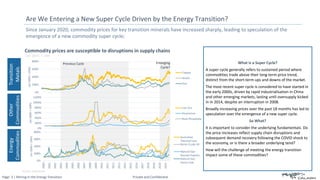
Since January 2020, commodity prices for key transition minerals have increased sharply, leading to speculation of the
emergence of a new commodity super cycle;
Are We Entering a New Super Cycle Driven by the Energy Transition?
0%
200%
400%
600%
800%
Jan
2000
=
100%
Copper
Nickel
Zinc
Commodity prices are susceptible to disruptions in supply chains
Jan 2021 = 100
Sources: Indexmundi
What is a Super Cycle?
A super cycle generally refers to sustained period where
commodities trade above their long-term price trend,
distinct from the short-term ups and downs of the market.
The most recent super cycle is considered to have started in
the early 2000s, driven by rapid industrialisation in China
and other emerging markets, lasting until oversupply kicked
in in 2014, despite an interruption in 2008.
Broadly increasing prices over the past 18 months has led to
speculation over the emergence of a new super cycle.
So What?
It is important to consider the underlying fundamentals. Do
the price increases reflect supply chain disruptions and
subsequent demand recovery following the COVID shock to
the economy, or is there a broader underlying tend?
How will the challenge of meeting the energy transition
impact some of these commodities?
0%
200%
400%
600%
800%
1000%
1200%
Jan
2000
=
100%
Iron Ore
Aluminium
Rock Phosphate
0%
200%
400%
600%
800%
2000
2001
2002
2003
2004
2005
2006
2007
2008
2009
2010
2011
2012
2013
2014
2015
2016
2017
2018
2019
2020
2021
Jan
2000
=
100%
Australian
Thermal Coal
Brent Crude Oil
Natural Gas -
Russian Exports
Natural Gas -
Henry Hub
Transition
Metals
Energy
Commodities
Other
Commodities
Previous Cycle Emerging
Cycle?
Page: 4 | Mining in the Energy Transition Private and Confidential
-
20
40
60
80
100
120
140
160
2010 2015 2020 2025 2030 2035 2040 2045 2050
2020
=
100%
Oil and Gas Business As Usual Oil and Gas (BP Net Zero Scenario
Coal Business As Usual Coal (BP Net Zero)
Copper Business as Usual Copper (IEA SDS)
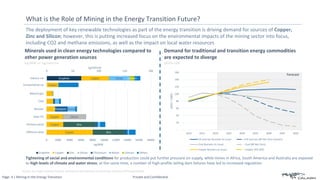
The deployment of key renewable technologies as part of the energy transition is driving demand for sources of Copper,
Zinc and Silicon; however, this is putting increased focus on the environmental impacts of the mining sector into focus,
including CO2 and methane emissions, as well as the impact on local water resources
What is the Role of Mining in the Energy Transition Future?
Copper
Copper
Copper
Zinc
Zinc
Silicon
Chromium Nickel
0 2000 4000 6000 8000 10000 12000 14000 16000 18000
Offshore wind
Onshore wind
Solar PV
Nuclear
Coal
Natural gas
kg/MW
Graphite Copper Zinc Silicon Chromium Nickel Lithium Others
Tightening of social and environmental conditions for production could put further pressure on supply, while mines in Africa, South America and Australia are exposed
to high levels of climate and water stress; at the same time, a number of high-profile tailing dam failures have led to increased regulation
Forecast
Sources: IEA Copper Demand Forecast; IEA Role of Critical Minerals in the Energy Transition; BP Energy Outlook
kg/MW or kg/vehicle
Minerals used in clean energy technologies compared to
other power generation sources
2020=100
Demand for traditional and transition energy commodities
are expected to diverge
Graphite
Copper
Copper Nickel Lithium
0 50 100 150 200
Conventional car
Electric car
kg/Vehicle
Page: 5 | Mining in the Energy Transition Private and Confidential
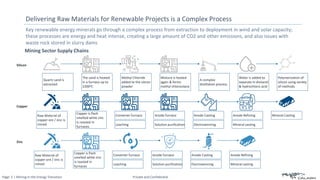
Key renewable energy minerals go through a complex process from extraction to deployment in wind and solar capacity;
these processes are energy and heat intense, creating a large amount of CO2 and other emissions, and also issues with
waste rock stored in slurry dams
Delivering Raw Materials for Renewable Projects is a Complex Process
Silicon
Quartz sand is
extracted
The sand is heated
in a furnace up to
2200oC
Methyl Chloride
added to the silicon
powder
Mixture is heated
again & forms
methyl chlorosilane
A complex
distillation process
Water is added to
separate in disilanol
& hydrochloric acid
Polymerization of
silicon using variety
of methods
Copper
Zinc
Raw Material of
copper ore / zinc is
mined
Copper is flash
smelted while zinc
is roasted in
furnaces
Converter furnace
Leaching
Anode furnace
Solution purification
Anode Casting
Electrowinning
Anode Refining
Mineral casting
Mineral Casting
Raw Material of
copper ore / zinc is
mined
Copper is flash
smelted while zinc
is roasted in
furnaces
Converter furnace
Leaching
Anode furnace
Solution purification
Anode Casting
Electrowinning
Anode Refining
Mineral casting
Mining Sector Supply Chains
Page: 6 | Mining in the Energy Transition Private and Confidential
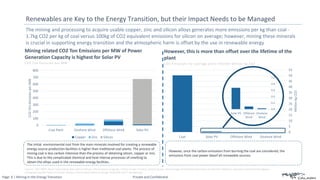
The mining and processing to acquire usable copper, zinc and silicon alloys generates more emissions per kg than coal -
1.7kg CO2 per kg of coal versus 100kg of CO2 equivalent emissions for silicon on average; however, mining these minerals
is crucial in supporting energy transition and the atmospheric harm is offset by the use in renewable energy
Renewables are Key to the Energy Transition, but their Impact Needs to be Managed
0
100
200
300
400
500
600
700
800
Coal Plant Onshore Wind Offshore Wind Solar PV
CO2
Ton
Emission
per
MW
Copper Zinc Silicon
0
5
10
15
20
25
30
35
40
45
50
55
Onshore Wind
Offshore Wind
Solar PV
Coal
Million
kg
CO2
The initial environmental cost from the main minerals involved for creating a renewable
energy source production facilities is higher than traditional coal plants. The process of
mining coal is less carbon intensive than the process of obtaining silicon, copper or zinc.
This is due to the complicated chemical and heat intense processes of smelting to
obtain the alloys used in the renewable energy facilities.
0.0
0.2
0.4
0.6
0.8
1.0
Onshore
Wind
Offshore
Wind
Solar PV
However, once the carbon emissions from burning the coal are considered, the
emissions from coal power dwarf all renewable sources.
Sources: 2017 MDPI, Basel, Switzerland; Anna Ekman Nilsson, Marta Macias Aragonés, Fatima Arroyo Torralvo, Vincent Dunon, Hanna Angel, Konstantinos Komnitsas ID and Karin Willquist; European Environmental Agency;
Intergovernmental Panel on Climate Change; Swiss Federal Office of Energy; GEM Wiki; EIA; Freeingenergy
CO2 Ton Emission per MW
Mining related CO2 Ton Emissions per MW of Power
Generation Capacity is highest for Solar PV
CO2 Emissions for average plant lifetime Million kg CO2
However, this is more than offset over the lifetime of the
plant
Page: 7 | Mining in the Energy Transition Private and Confidential
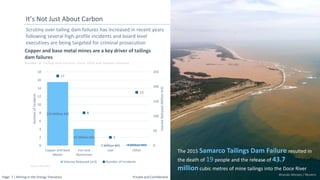
Scrutiny over tailing dam failures has increased in recent years
following several high-profile incidents and board level
executives are being targeted for criminal prosecution
It’s Not Just About Carbon
215 Million M3
57 Million M3
1 Million M3 4 Million M3
17
8
2
13
0
50
100
150
200
250
0
2
4
6
8
10
12
14
16
18
Copper and Base
Metals
Iron and
Aluminium
coal Other
Volume
Released
(Million
M3)
Number
of
Incidents
Volume Released (m3) Number of Incidents
Source: Wise 2021
The 2015 Samarco Tailings Dam Failure resulted in
the death of 19 people and the release of 43.7
million cubic metres of mine tailings into the Doce River
Ricardo Moraes / Reuters
Number of Tailing Dam Failures Since 2010 and release volumes
Copper and base metal mines are a key driver of tailings
dam failures
Page: 8 | Mining in the Energy Transition Private and Confidential
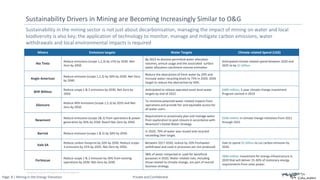
Sustainability in the mining sector is not just about decarbonisation, managing the impact of mining on water and local
biodiversity is also key; the application of technology to monitor, manage and mitigate carbon emissions, water
withdrawals and local environmental impacts is required
Sustainability Drivers in Mining are Becoming Increasingly Similar to O&G
Miners Emissions targets Water Targets Climate related Spend (US$)
Rio Tinto
Reduce emissions (scope 1,2,3) by 15% by 2030. Net-
Zero by 2050.
By 2023 to disclose permitted water allocation
volumes, annual usage and the associated surface
water allocation catchment volume estimates.
Anticipated climate related spend between 2020 and
2025 to be $1 billion
Anglo American
Reduce emission (scope 1,2,3) by 30% by 2030. Net-Zero
by 2040.
Reduce the abstraction of fresh water by 20% and
increase water-recycling levels to 75% in 2020; 2030
target to reduce the abstraction by 50%.
BHP Billiton
Reduce scope 1 & 2 emissions by 2030. Net-Zero by
2050.
Anticipated to release operated asset-level water
targets by end of 2022.
$400 million, 5-year climate change investment
Program started in 2019
Glencore
Reduce 40% emissions (scope 1,2,3) by 2035 and Net-
Zero by 2050.
To minimize potential water-related impacts from
operations and provide fair and equitable access for
all water users.
Newmont
Reduce emissions (scope 1& 2) from operations & power
generation by 30% by 2030. Reach Net-Zero by 2050.
Requirement to proactively plan and manage water
from exploration to post-closure in accordance with
Newmont’s Global Water Strategy
$500 million in climate change initiatives from 2021
through 2025
Barrick Reduce emission (scope 1 & 2) by 30% by 2030.
In 2020, 79% of water was reused and recycled
exceeding their target.
Vale SA
Reduce carbon footprint by 33% by 2030. Reduce scope-
3 emissions by 15% by 2035. Net-Zero by 2050.
Between 2017-2030, reduce by 10% freshwater
withdrawal and used in processes per ton produced.
Vale to spend $2 billion to cut carbon emission by
2030.
Fortescue
Reduce scope 1 & 2 emission by 26% from existing
operations by 2030. Net-Zero by 2030.
98% of water reinjected or used for beneficial
purposes in 2020. Water related risks, including
those related to climate change, are part of overall
business strategy
$800 million investment for energy infrastructure in
2020 that will deliver 25-30% of stationary energy
requirements from solar power.
Company Investor Relations and Annual Reports
Page: 9 | Mining in the Energy Transition Private and Confidential
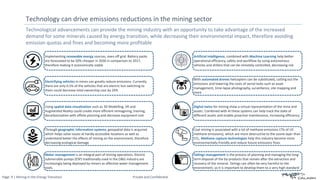
Technological advancements can provide the mining industry with an opportunity to take advantage of the increased
demand for some minerals caused by energy transition, while decreasing their environmental impact, therefore avoiding
emission quotas and fines and becoming more profitable
Technology can drive emissions reductions in the mining sector
Implementing renewable energy sources, even off grid. Battery packs
are forecasted to be 50% cheaper in 2030 in comparison to 2017,
therefore making it economically viable
Electrifying vehicles in mines can greatly reduce emissions. Currently
there are only 0.5% of the vehicles that are electric but switching to
them could decrease total ownership cost by 20%
Using spatial data visualisation such as 3D Modelling, VR and
Augmented Reality could create more efficient reimagining, training,
decarbonisation with offsite planning and decrease equipment cost
Through geographic information systems, geospatial data is acquired
which helps solve issues at hardly accessible locations as well as
understand better the effects of mining on the environment, therefore
decreasing ecological damage
Artificial Intelligence, combined with Machine Learning help better
operational efficiency, safety and workflow by using autonomous
vehicles and drillers that can be remotely controlled, decreasing risk
With automated drones helicopters can be substituted, cutting out the
emissions and lowering the costs of aerial tasks such as asset
management, time-lapse photography, surveillance, site mapping and
more
Digital twins for mining show a virtual representation of the mine and
assets. Combined with AI these systems can help track the state of
different assets and enable proactive maintenance, increasing efficiency
Coal mining is associated with a lot of methane emissions (7% of US
methane emissions), which are more destructive to the ozone layer than
CO2. Methane capture technologies help this industry become more
environmentally friendly and reduce future emissions fines
Water management is an integral part of mining operations. Electric
submersible pumps (ESP) traditionally used in the O&G industry are
increasingly being deployed by miners as effective water management
tools.
Tailings management is the process of planning and managing the long-
term disposal of the by-products that remain after the extraction and
recovery of the mineral. Tailings can often be very harmful to the
environment, so it is important to develop them to a very high standard
Page: 10 | Mining in the Energy Transition Private and Confidential
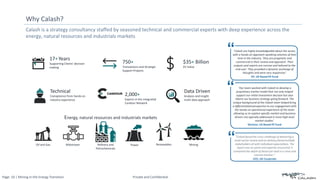
Calash is a strategy consultancy staffed by seasoned technical and commercial experts with deep experience across the
energy, natural resources and industrials markets
Why Calash?
“Calash faced the cross-challenge of delivering a
multi-sector review and on delivery faced multiple
stakeholders all with individual expectations. The
report was on-point and expertly structured; it
contained the depth of detail yet read in a clear and
concise manner.“
CEO, UK Corporate
“
“Our team worked with Calash to develop a
proprietary market model that not only helped
support our initial investment decision but also
inform our business strategy going forward. The
unique background of the Calash team helped bring
a differentiated perspective to our engagement with
the hands-on operational experience of the team
allowing us to explore specific market and business
drivers not typically addressed in more high-level
market studies“
Director, US Based PE Fund
“
“Calash are highly knowledgeable about the sector,
with a hands-on approach speaking volumes of their
time in the industry. They are pragmatic and
commercial in their review and approach. Their
outputs and reports are concise and tailored to the
end-user. They provided a dynamic exchange of
thoughts and were very responsive“
VP, UK Based PE Fund
“
Oil and Gas
Energy, natural resources and industrials markets
Power Renewables
Refinery and
Petrochemicals
Midstream
17+Years
Supporting Clients’ decision
making
$35+ Billion
EV Value
750+
Transactions and Strategic
Support Projects
Technical
Competence from hands on
industry experience
2,000+
Experts in the integrated
Candour Network
Data Driven
Analysis and insight
multi-data approach
Mining
Page: 11 | Mining in the Energy Transition Private and Confidential

Mining in Energy Transition

  • 1.
    Page: 1 |Mining in the Energy Transition Private and Confidential LONDON ABERDEEN NEWYORK HOUSTON SYDNEY Mining in the Energy Transition Executive Insights Report October 2021
  • 2.
    Page: 2 |Mining in the Energy Transition Private and Confidential Key energy transition technologies are reliant on the mining sector, including solar PV, wind and battery storage, and demand for these commodities is on an upwards trajectory; there are opportunities for investors to can identify challenges and bring solutions to the industry Introduction Over the past 18 months Calash has seen an increased interest in the mining sector, reflecting its role in the energy transition, including oilfield service companies looking to diversify. However, for many investors, the role of mining is less clear. Key Themes for Investors • Carbon reduction is essential, and that an acceleration in progress is required to limit temperature increases. • Mining plays a key role in the transition. Copper, lithium, silicon and other mined commodities are key inputs for wind turbines, solar panels and batteries, and increasing production and investment is required to sustain change. • Relative to coal mining, these commodities have complex supply chains with multiple steps, and there are opportunties for service companies and investors. The application of innovation to reduce the environmental impact of these supply chains is required. • The combination of complex supply chains and increased demand from the energy transition mean increased commodity prices for transition metals may be sustained without investment in increased production. • Technology applications will be required to manage local environmental impacts (water usage, tailings dams, methane emissions) and reduce emissions. Technologies developed for the oil and gas sector are increasingly being deployed in the mining sector. For instance, downhole ESP pumps are in service to help manage water. • Mining Companies are actively targeting emissions and water use reductions, with over $4.7 billion related spend committed by the 10 largest mining companies. This is also an opportunity where technologies and techniques developed in other sectors, particularly the oil and gas industry, can be deployed to help mitigate the impact of the mining process.
  • 3.
    Page: 3 |Mining in the Energy Transition Private and Confidential Since January 2020, commodity prices for key transition minerals have increased sharply, leading to speculation of the emergence of a new commodity super cycle; Are We Entering a New Super Cycle Driven by the Energy Transition? 0% 200% 400% 600% 800% Jan 2000 = 100% Copper Nickel Zinc Commodity prices are susceptible to disruptions in supply chains Jan 2021 = 100 Sources: Indexmundi What is a Super Cycle? A super cycle generally refers to sustained period where commodities trade above their long-term price trend, distinct from the short-term ups and downs of the market. The most recent super cycle is considered to have started in the early 2000s, driven by rapid industrialisation in China and other emerging markets, lasting until oversupply kicked in in 2014, despite an interruption in 2008. Broadly increasing prices over the past 18 months has led to speculation over the emergence of a new super cycle. So What? It is important to consider the underlying fundamentals. Do the price increases reflect supply chain disruptions and subsequent demand recovery following the COVID shock to the economy, or is there a broader underlying tend? How will the challenge of meeting the energy transition impact some of these commodities? 0% 200% 400% 600% 800% 1000% 1200% Jan 2000 = 100% Iron Ore Aluminium Rock Phosphate 0% 200% 400% 600% 800% 2000 2001 2002 2003 2004 2005 2006 2007 2008 2009 2010 2011 2012 2013 2014 2015 2016 2017 2018 2019 2020 2021 Jan 2000 = 100% Australian Thermal Coal Brent Crude Oil Natural Gas - Russian Exports Natural Gas - Henry Hub Transition Metals Energy Commodities Other Commodities Previous Cycle Emerging Cycle?
  • 4.
    Page: 4 |Mining in the Energy Transition Private and Confidential - 20 40 60 80 100 120 140 160 2010 2015 2020 2025 2030 2035 2040 2045 2050 2020 = 100% Oil and Gas Business As Usual Oil and Gas (BP Net Zero Scenario Coal Business As Usual Coal (BP Net Zero) Copper Business as Usual Copper (IEA SDS) The deployment of key renewable technologies as part of the energy transition is driving demand for sources of Copper, Zinc and Silicon; however, this is putting increased focus on the environmental impacts of the mining sector into focus, including CO2 and methane emissions, as well as the impact on local water resources What is the Role of Mining in the Energy Transition Future? Copper Copper Copper Zinc Zinc Silicon Chromium Nickel 0 2000 4000 6000 8000 10000 12000 14000 16000 18000 Offshore wind Onshore wind Solar PV Nuclear Coal Natural gas kg/MW Graphite Copper Zinc Silicon Chromium Nickel Lithium Others Tightening of social and environmental conditions for production could put further pressure on supply, while mines in Africa, South America and Australia are exposed to high levels of climate and water stress; at the same time, a number of high-profile tailing dam failures have led to increased regulation Forecast Sources: IEA Copper Demand Forecast; IEA Role of Critical Minerals in the Energy Transition; BP Energy Outlook kg/MW or kg/vehicle Minerals used in clean energy technologies compared to other power generation sources 2020=100 Demand for traditional and transition energy commodities are expected to diverge Graphite Copper Copper Nickel Lithium 0 50 100 150 200 Conventional car Electric car kg/Vehicle
  • 5.
    Page: 5 |Mining in the Energy Transition Private and Confidential Key renewable energy minerals go through a complex process from extraction to deployment in wind and solar capacity; these processes are energy and heat intense, creating a large amount of CO2 and other emissions, and also issues with waste rock stored in slurry dams Delivering Raw Materials for Renewable Projects is a Complex Process Silicon Quartz sand is extracted The sand is heated in a furnace up to 2200oC Methyl Chloride added to the silicon powder Mixture is heated again & forms methyl chlorosilane A complex distillation process Water is added to separate in disilanol & hydrochloric acid Polymerization of silicon using variety of methods Copper Zinc Raw Material of copper ore / zinc is mined Copper is flash smelted while zinc is roasted in furnaces Converter furnace Leaching Anode furnace Solution purification Anode Casting Electrowinning Anode Refining Mineral casting Mineral Casting Raw Material of copper ore / zinc is mined Copper is flash smelted while zinc is roasted in furnaces Converter furnace Leaching Anode furnace Solution purification Anode Casting Electrowinning Anode Refining Mineral casting Mining Sector Supply Chains
  • 6.
    Page: 6 |Mining in the Energy Transition Private and Confidential The mining and processing to acquire usable copper, zinc and silicon alloys generates more emissions per kg than coal - 1.7kg CO2 per kg of coal versus 100kg of CO2 equivalent emissions for silicon on average; however, mining these minerals is crucial in supporting energy transition and the atmospheric harm is offset by the use in renewable energy Renewables are Key to the Energy Transition, but their Impact Needs to be Managed 0 100 200 300 400 500 600 700 800 Coal Plant Onshore Wind Offshore Wind Solar PV CO2 Ton Emission per MW Copper Zinc Silicon 0 5 10 15 20 25 30 35 40 45 50 55 Onshore Wind Offshore Wind Solar PV Coal Million kg CO2 The initial environmental cost from the main minerals involved for creating a renewable energy source production facilities is higher than traditional coal plants. The process of mining coal is less carbon intensive than the process of obtaining silicon, copper or zinc. This is due to the complicated chemical and heat intense processes of smelting to obtain the alloys used in the renewable energy facilities. 0.0 0.2 0.4 0.6 0.8 1.0 Onshore Wind Offshore Wind Solar PV However, once the carbon emissions from burning the coal are considered, the emissions from coal power dwarf all renewable sources. Sources: 2017 MDPI, Basel, Switzerland; Anna Ekman Nilsson, Marta Macias Aragonés, Fatima Arroyo Torralvo, Vincent Dunon, Hanna Angel, Konstantinos Komnitsas ID and Karin Willquist; European Environmental Agency; Intergovernmental Panel on Climate Change; Swiss Federal Office of Energy; GEM Wiki; EIA; Freeingenergy CO2 Ton Emission per MW Mining related CO2 Ton Emissions per MW of Power Generation Capacity is highest for Solar PV CO2 Emissions for average plant lifetime Million kg CO2 However, this is more than offset over the lifetime of the plant
  • 7.
    Page: 7 |Mining in the Energy Transition Private and Confidential Scrutiny over tailing dam failures has increased in recent years following several high-profile incidents and board level executives are being targeted for criminal prosecution It’s Not Just About Carbon 215 Million M3 57 Million M3 1 Million M3 4 Million M3 17 8 2 13 0 50 100 150 200 250 0 2 4 6 8 10 12 14 16 18 Copper and Base Metals Iron and Aluminium coal Other Volume Released (Million M3) Number of Incidents Volume Released (m3) Number of Incidents Source: Wise 2021 The 2015 Samarco Tailings Dam Failure resulted in the death of 19 people and the release of 43.7 million cubic metres of mine tailings into the Doce River Ricardo Moraes / Reuters Number of Tailing Dam Failures Since 2010 and release volumes Copper and base metal mines are a key driver of tailings dam failures
  • 8.
    Page: 8 |Mining in the Energy Transition Private and Confidential Sustainability in the mining sector is not just about decarbonisation, managing the impact of mining on water and local biodiversity is also key; the application of technology to monitor, manage and mitigate carbon emissions, water withdrawals and local environmental impacts is required Sustainability Drivers in Mining are Becoming Increasingly Similar to O&G Miners Emissions targets Water Targets Climate related Spend (US$) Rio Tinto Reduce emissions (scope 1,2,3) by 15% by 2030. Net- Zero by 2050. By 2023 to disclose permitted water allocation volumes, annual usage and the associated surface water allocation catchment volume estimates. Anticipated climate related spend between 2020 and 2025 to be $1 billion Anglo American Reduce emission (scope 1,2,3) by 30% by 2030. Net-Zero by 2040. Reduce the abstraction of fresh water by 20% and increase water-recycling levels to 75% in 2020; 2030 target to reduce the abstraction by 50%. BHP Billiton Reduce scope 1 & 2 emissions by 2030. Net-Zero by 2050. Anticipated to release operated asset-level water targets by end of 2022. $400 million, 5-year climate change investment Program started in 2019 Glencore Reduce 40% emissions (scope 1,2,3) by 2035 and Net- Zero by 2050. To minimize potential water-related impacts from operations and provide fair and equitable access for all water users. Newmont Reduce emissions (scope 1& 2) from operations & power generation by 30% by 2030. Reach Net-Zero by 2050. Requirement to proactively plan and manage water from exploration to post-closure in accordance with Newmont’s Global Water Strategy $500 million in climate change initiatives from 2021 through 2025 Barrick Reduce emission (scope 1 & 2) by 30% by 2030. In 2020, 79% of water was reused and recycled exceeding their target. Vale SA Reduce carbon footprint by 33% by 2030. Reduce scope- 3 emissions by 15% by 2035. Net-Zero by 2050. Between 2017-2030, reduce by 10% freshwater withdrawal and used in processes per ton produced. Vale to spend $2 billion to cut carbon emission by 2030. Fortescue Reduce scope 1 & 2 emission by 26% from existing operations by 2030. Net-Zero by 2030. 98% of water reinjected or used for beneficial purposes in 2020. Water related risks, including those related to climate change, are part of overall business strategy $800 million investment for energy infrastructure in 2020 that will deliver 25-30% of stationary energy requirements from solar power. Company Investor Relations and Annual Reports
  • 9.
    Page: 9 |Mining in the Energy Transition Private and Confidential Technological advancements can provide the mining industry with an opportunity to take advantage of the increased demand for some minerals caused by energy transition, while decreasing their environmental impact, therefore avoiding emission quotas and fines and becoming more profitable Technology can drive emissions reductions in the mining sector Implementing renewable energy sources, even off grid. Battery packs are forecasted to be 50% cheaper in 2030 in comparison to 2017, therefore making it economically viable Electrifying vehicles in mines can greatly reduce emissions. Currently there are only 0.5% of the vehicles that are electric but switching to them could decrease total ownership cost by 20% Using spatial data visualisation such as 3D Modelling, VR and Augmented Reality could create more efficient reimagining, training, decarbonisation with offsite planning and decrease equipment cost Through geographic information systems, geospatial data is acquired which helps solve issues at hardly accessible locations as well as understand better the effects of mining on the environment, therefore decreasing ecological damage Artificial Intelligence, combined with Machine Learning help better operational efficiency, safety and workflow by using autonomous vehicles and drillers that can be remotely controlled, decreasing risk With automated drones helicopters can be substituted, cutting out the emissions and lowering the costs of aerial tasks such as asset management, time-lapse photography, surveillance, site mapping and more Digital twins for mining show a virtual representation of the mine and assets. Combined with AI these systems can help track the state of different assets and enable proactive maintenance, increasing efficiency Coal mining is associated with a lot of methane emissions (7% of US methane emissions), which are more destructive to the ozone layer than CO2. Methane capture technologies help this industry become more environmentally friendly and reduce future emissions fines Water management is an integral part of mining operations. Electric submersible pumps (ESP) traditionally used in the O&G industry are increasingly being deployed by miners as effective water management tools. Tailings management is the process of planning and managing the long- term disposal of the by-products that remain after the extraction and recovery of the mineral. Tailings can often be very harmful to the environment, so it is important to develop them to a very high standard
  • 10.
    Page: 10 |Mining in the Energy Transition Private and Confidential Calash is a strategy consultancy staffed by seasoned technical and commercial experts with deep experience across the energy, natural resources and industrials markets Why Calash? “Calash faced the cross-challenge of delivering a multi-sector review and on delivery faced multiple stakeholders all with individual expectations. The report was on-point and expertly structured; it contained the depth of detail yet read in a clear and concise manner.“ CEO, UK Corporate “ “Our team worked with Calash to develop a proprietary market model that not only helped support our initial investment decision but also inform our business strategy going forward. The unique background of the Calash team helped bring a differentiated perspective to our engagement with the hands-on operational experience of the team allowing us to explore specific market and business drivers not typically addressed in more high-level market studies“ Director, US Based PE Fund “ “Calash are highly knowledgeable about the sector, with a hands-on approach speaking volumes of their time in the industry. They are pragmatic and commercial in their review and approach. Their outputs and reports are concise and tailored to the end-user. They provided a dynamic exchange of thoughts and were very responsive“ VP, UK Based PE Fund “ Oil and Gas Energy, natural resources and industrials markets Power Renewables Refinery and Petrochemicals Midstream 17+Years Supporting Clients’ decision making $35+ Billion EV Value 750+ Transactions and Strategic Support Projects Technical Competence from hands on industry experience 2,000+ Experts in the integrated Candour Network Data Driven Analysis and insight multi-data approach Mining
  • 11.
    Page: 11 |Mining in the Energy Transition Private and Confidential