Hunger Games: Catching Fire Film Opening 
Analysis Post Apocalyptic 
Shots/Angles/movement 
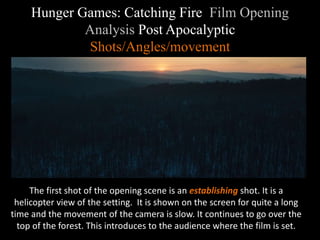
The first shot of the opening scene is an establishing shot. It is a 
helicopter view of the setting. It is shown on the screen for quite a long 
time and the movement of the camera is slow. It continues to go over the 
top of the forest. This introduces to the audience where the film is set.
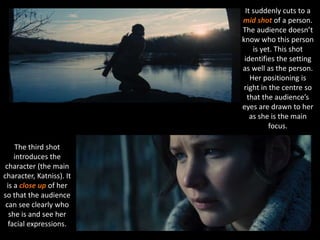
It suddenly cuts to a 
mid shot of a person. 
The audience doesn’t 
know who this person 
is yet. This shot 
identifies the setting 
as well as the person. 
Her positioning is 
right in the centre so 
that the audience’s 
eyes are drawn to her 
as she is the main 
focus. 
The third shot 
introduces the 
character (the main 
character, Katniss). It 
is a close up of her 
so that the audience 
can see clearly who 
she is and see her 
facial expressions.
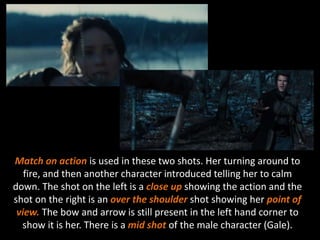
Match on action is used in these two shots. Her turning around to 
fire, and then another character introduced telling her to calm 
down. The shot on the left is a close up showing the action and the 
shot on the right is an over the shoulder shot showing her point of 
view. The bow and arrow is still present in the left hand corner to 
show it is her. There is a mid shot of the male character (Gale).
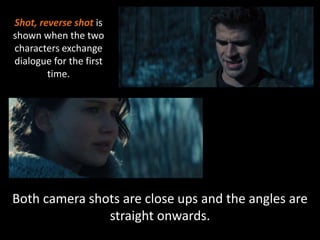
Shot, reverse shot is 
shown when the two 
characters exchange 
dialogue for the first 
time. 
Both camera shots are close ups and the angles are 
straight onwards.
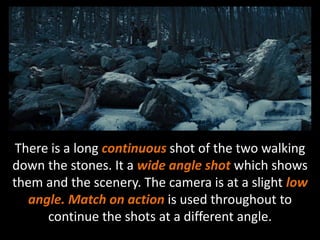
There is a long continuous shot of the two walking 
down the stones. It a wide angle shot which shows 
them and the scenery. The camera is at a slight low 
angle. Match on action is used throughout to 
continue the shots at a different angle.
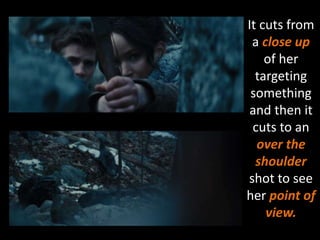
It cuts from 
a close up 
of her 
targeting 
something 
and then it 
cuts to an 
over the 
shoulder 
shot to see 
her point of 
view.
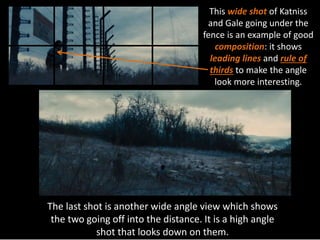
This wide shot of Katniss 
and Gale going under the 
fence is an example of good 
composition: it shows 
leading lines and rule of 
thirds to make the angle 
look more interesting. 
The last shot is another wide angle view which shows 
the two going off into the distance. It is a high angle 
shot that looks down on them.
Lighting 
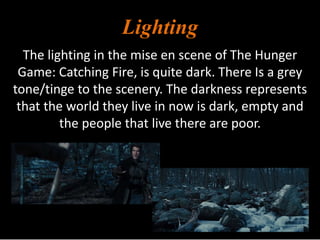
The lighting in the mise en scene of The Hunger 
Game: Catching Fire, is quite dark. There Is a grey 
tone/tinge to the scenery. The darkness represents 
that the world they live in now is dark, empty and 
the people that live there are poor.
Narrative and theories 
The Hunger Games follows Propp’s theory: that it 
has characters to suit each title. 
• Hero 
• Villain 
• Dispatcher 
• Donor 
• Helper (there is no helper in this film) 
• Heroine 
• False Hero
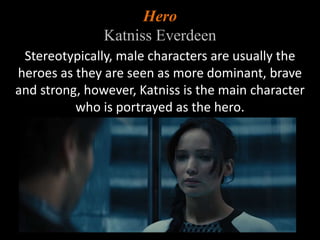
Hero 
Katniss Everdeen 
Stereotypically, male characters are usually the 
heroes as they are seen as more dominant, brave 
and strong, however, Katniss is the main character 
who is portrayed as the hero.
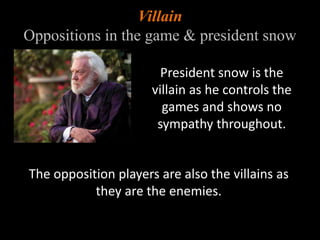
Villain 
Oppositions in the game & president snow 
President snow is the 
villain as he controls the 
games and shows no 
sympathy throughout. 
The opposition players are also the villains as 
they are the enemies.
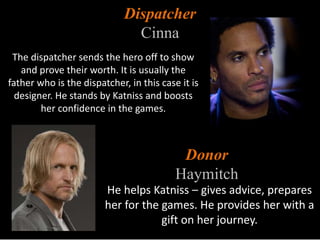
Dispatcher 
Cinna 
The dispatcher sends the hero off to show 
and prove their worth. It is usually the 
father who is the dispatcher, in this case it is 
designer. He stands by Katniss and boosts 
her confidence in the games. 
Donor 
Haymitch 
He helps Katniss – gives advice, prepares 
her for the games. He provides her with a 
gift on her journey.
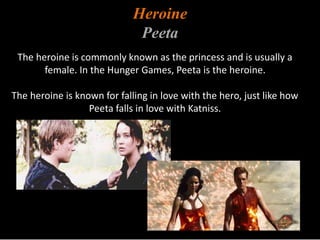
Heroine 
Peeta 
The heroine is commonly known as the princess and is usually a 
female. In the Hunger Games, Peeta is the heroine. 
The heroine is known for falling in love with the hero, just like how 
Peeta falls in love with Katniss.
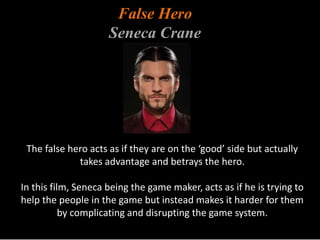
False Hero 
Seneca Crane 
The false hero acts as if they are on the ‘good’ side but actually 
takes advantage and betrays the hero. 
In this film, Seneca being the game maker, acts as if he is trying to 
help the people in the game but instead makes it harder for them 
by complicating and disrupting the game system.

Hunger games catching fire

  • 1.
    Hunger Games: CatchingFire Film Opening Analysis Post Apocalyptic Shots/Angles/movement The first shot of the opening scene is an establishing shot. It is a helicopter view of the setting. It is shown on the screen for quite a long time and the movement of the camera is slow. It continues to go over the top of the forest. This introduces to the audience where the film is set.
  • 2.
    It suddenly cutsto a mid shot of a person. The audience doesn’t know who this person is yet. This shot identifies the setting as well as the person. Her positioning is right in the centre so that the audience’s eyes are drawn to her as she is the main focus. The third shot introduces the character (the main character, Katniss). It is a close up of her so that the audience can see clearly who she is and see her facial expressions.
  • 3.
    Match on actionis used in these two shots. Her turning around to fire, and then another character introduced telling her to calm down. The shot on the left is a close up showing the action and the shot on the right is an over the shoulder shot showing her point of view. The bow and arrow is still present in the left hand corner to show it is her. There is a mid shot of the male character (Gale).
  • 4.
    Shot, reverse shotis shown when the two characters exchange dialogue for the first time. Both camera shots are close ups and the angles are straight onwards.
  • 5.
    There is along continuous shot of the two walking down the stones. It a wide angle shot which shows them and the scenery. The camera is at a slight low angle. Match on action is used throughout to continue the shots at a different angle.
  • 6.
    It cuts from a close up of her targeting something and then it cuts to an over the shoulder shot to see her point of view.
  • 7.
    This wide shotof Katniss and Gale going under the fence is an example of good composition: it shows leading lines and rule of thirds to make the angle look more interesting. The last shot is another wide angle view which shows the two going off into the distance. It is a high angle shot that looks down on them.
  • 8.
    Lighting The lightingin the mise en scene of The Hunger Game: Catching Fire, is quite dark. There Is a grey tone/tinge to the scenery. The darkness represents that the world they live in now is dark, empty and the people that live there are poor.
  • 9.
    Narrative and theories The Hunger Games follows Propp’s theory: that it has characters to suit each title. • Hero • Villain • Dispatcher • Donor • Helper (there is no helper in this film) • Heroine • False Hero
  • 10.
    Hero Katniss Everdeen Stereotypically, male characters are usually the heroes as they are seen as more dominant, brave and strong, however, Katniss is the main character who is portrayed as the hero.
  • 11.
    Villain Oppositions inthe game & president snow President snow is the villain as he controls the games and shows no sympathy throughout. The opposition players are also the villains as they are the enemies.
  • 12.
    Dispatcher Cinna Thedispatcher sends the hero off to show and prove their worth. It is usually the father who is the dispatcher, in this case it is designer. He stands by Katniss and boosts her confidence in the games. Donor Haymitch He helps Katniss – gives advice, prepares her for the games. He provides her with a gift on her journey.
  • 13.
    Heroine Peeta Theheroine is commonly known as the princess and is usually a female. In the Hunger Games, Peeta is the heroine. The heroine is known for falling in love with the hero, just like how Peeta falls in love with Katniss.
  • 14.
    False Hero SenecaCrane The false hero acts as if they are on the ‘good’ side but actually takes advantage and betrays the hero. In this film, Seneca being the game maker, acts as if he is trying to help the people in the game but instead makes it harder for them by complicating and disrupting the game system.