Performance Appraisal and Compensation
By
Harishkumar M
Deparetment of Mangement
Kristu Jayanti College
Bengaluru
Unit 3: Performance Appraisal and Compensation
Performance appraisal (PA) is the process of evaluating how well employees perform their jobs when compared to a set of
standards, and then communicating that information to those employees. Such appraisal also has been called employee rating,
employee evaluation, performance review, performance evaluation, and results appraisal.
Objectives of Performance Appraisal
Performance appraisal has two general uses in organizations; one role is to measure performance for the purpose of rewarding or
otherwise making administrative decisions about employees. Promotions or layoffs might hinge on these ratings. Another role is
development of individual potential. Emphasis is on identifying potential and planning employees’ growth opportunities and
direction.
 To improve the job performance of employees and also to identify there d evelopment potentialities.
 To diagnose the strength or weakness of individuals so as to access the area in which training is required.
 To prevent grievance and indisciplinary activities of the personnel.
 To evaluate the success of training programmes.
 To motivate the employee through fair and equitabe compensation on the basis of performance.
 To provide coaching, mentoring, counseling and career planning to employees.
 To test the effectiveness of recruitment, selection, placement and job rotation process.
 To facilitate research in personnel management.
 To provide information for making decisions regarding layoff, retrenchment etc.
 To establish harmonious relationship between employer and employees.
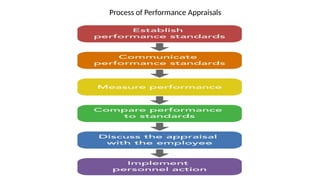
Process of Performance Appraisals
1.Establishing performance standards
The first step in the process of performance appraisal is the setting up of the standards which will be used
to as the base to compare the actual performance of the employees.
This step requires setting the criteria to judge the performance of the employees as successful or
unsuccessful and the degrees of their contribution to the organizational goals and objectives. The
standards set should be clear, easily understandable and in measurable terms.
In case the performance of the employee cannot be measured, great care should be taken to describe the
standards.
2.Communicating the standards
Once set, it is the responsibility of the management to communicate the standards to all the employees of
the organization. The employees should be informed and the standards should be clearly explained to the
employees. This will help them to understand their roles and to know what exactly is expected from them.
The standards should also be communicated to the appraisers or the evaluators and if required, the
standards can also be modified at this stage itself according to the relevant feedback from the employees or
the evaluators.
3.Measuring the actual performance
The most difficult part of the Performance appraisal process is measuring the actual performance of the
employees that is the work done by the employees during the specified period of time. It is a continuous
process which involves monitoring the performance throughout the year. This stage requires the careful
selection of the appropriate techniques of measurement, taking care that personal bias does not affect the
outcome of the process and providing assistance rather than interfering in an employees work.
4.Comparing actual performance with desired performance
The actual performance is compared with the desired or the standard performance. The comparison tells
the deviations in the performance of the employees from the standards set. The result can show the actual
performance being more than the desired performance or, the actual performance being less than the
desired performance depicting a negative deviation in the organizational performance. It includes recalling,
evaluating and analysis of data related to the employees’ performance.
5: Discuss the appraisal with the employee
This is generally the step in the process that is the most difficult for managers and employees alike and it can be a
challenge to manage emotions and expectations. Even when performance is strong, there can be differences of
opinion on the next action. A significant difference of opinion regarding performance can create an emotionally-
charged situation. If the manager is providing feedback and coaching on a regular basis, this shouldn’t be the
case. Related point: If an employee has consistently poor performance, the issue should be addressed—corrective
action taken—promptly and not deferred to an annual review.
To identify and prepare for differences of opinion, management can ask employees to complete and submit a self-
evaluation prior to the appraisal meeting. A key point to keep in mind is that the manager’s ability to remain calm
and civil will have a significant impact on the employee’s confidence, motivation and future performance.
6: Implement personnel action
The final step in the appraisal process is the discussion and/or implementation of any next steps: a reward of
some sort—a raise, promotion or coveted development opportunity—or corrective action—a performance plan or
termination. Note, however, that corrective action that might help an employee achieve expectations shouldn’t be
tabled until the next formal appraisal. As performance gaps are identified, supervisors and managers should take
the time to identify why performance is not meeting expectations and determine whether the employee can meet
expectations with additional training and/or coaching. As mentioned above, if performance is such that
termination is warranted, that action should be taken in a timely manner as well.
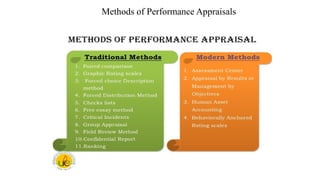
Methods of Performance Appraisals
Traditional Methods of Performance Appraisal
1.Paired Comparison Method
In this method, each employee is compared directly with every other employee in the group, one at a time,
based on a specific criterion such as leadership, efficiency, or communication skills. The better performer in each
pair receives a mark, and at the end of the process, employees are ranked based on the number of times they
were rated as superior. This method is effective for small teams but becomes complex as the number of
employees increases, making it time-consuming and impractical for large organizations.
2.Graphic Rating Scale
, leading to inconsistThis method uses a numerical or descriptive scale to assess employees on various job-
related factors such as productivity, teamwork, reliability, and initiative. A scale (e.g., 1 to 5 or poor to excellent)
is used, where managers mark the level that best represents an employee’s performance. The advantage of this
method is its simplicity and ease of use. However, it can lead to subjectivity, as different raters may interpret
rating criteria differentlyencies in evaluation.
3.Forced Choice Description Method
Here, evaluators are given a set of paired descriptive statements about employee behavior and must choose the
one that best represents the employee. The statements are designed in a way that forces an objective
evaluation, reducing bias. However, this method can be frustrating for managers, as they may not always agree
with the limited choices, and it does not provide detailed feedback to employees.
4. Forced Distribution Method
Employees are categorized into predefined performance groups, such as:
•Top 10% (high performers)
•Middle 70% (average performers)
•Bottom 20% (low performers)
This method ensures differentiation among employees but can be demotivating when good performers are forced into lower categories due
to the quota system. It may also create an overly competitive work environment, leading to employee dissatisfaction.
5. Check list
It is the simplest form of evaluation method. Under this method a list of Statement describing the job related behaviour of the
employees is given to the evaluator. There are 3 types of checklist methods namely simple checklist, weighted checklist and
forced choice method.
(i) Simple Checklist Method
In this method, the printed forms containing large number of descriptive questions about the performance of the employees are
provided to the supervisors. The supervisor has two options ‘Yes’ and ‘No’. He ticks the one according to the behaviour of the
employee and sends the filled form to the
(ii) Weighted Checklist:
In this method, the weights are allotted to the different statements to indicate their importance over the other
statements. Often the weights are not provided to the supervisors who conduct the appraisal, but computed
by someone else from the HR department. This method is used particularly with the objective of avoiding
scope of personal prejudices.
Under this method the performance ratings of the employee given by thesupervisor are multiplied by the
weights of the statements and the coefficients are added up. The cumulative coefficient is the weighted
performance score of the employee.
6. Free Essay Method
In this method, managers write a detailed, free-form evaluation about an employee’s strengths, weaknesses,
and overall job performance. This method allows for a comprehensive review but is highly subjective and
time-consuming. The quality of evaluation depends on the writing skills and perspective of the evaluator,
which can introduce bias.
7. Critical Incident Method
This approach focuses on recording specific instances where an employee exhibited particularly good
or poor performance. These incidents are collected over time and used as a basis for evaluation. The
advantage of this method is that it highlights real job-related behaviors rather than general
impressions. However, it requires continuous monitoring, and some managers may only focus on
negative incidents, leading to unfair assessments.
8. Group Appraisal Method
In this method, multiple managers or supervisors collectively evaluate an employee’s performance.
This group discussion ensures that different perspectives are considered, reducing individual bias.
However, it requires extensive coordination and may lead to disagreements among evaluators, making
it time-consuming.
9. Field Review Method
Here, an external HR specialist conducts the performance appraisal instead of the direct supervisor.
This ensures an unbiased assessment and consistency across departments. However, since the
reviewer may not be familiar with the employee’s daily work, they may overlook important aspects of
performance.
10. Confidential Report Method
Commonly used in government organizations, this method involves the manager preparing a confidential report on an
employee’s strengths, weaknesses, and overall conduct. The employee does not see this report, which can lead to a lack of
transparency and dissatisfaction. Since there is no opportunity for feedback or discussion, employees may not know what
areas they need to improve on.
11. Ranking Method
Employees are ranked from best to worst based on overall performance. While simple and easy to implement, this method
does not quantify the differences between employees. Additionally, it may create unhealthy competition and resentment
among employees, leading to workplace conflicts.
Modern Methods of Performance Appraisal
1. Assessment Centre Method: This method uses a series of exercises or tasks designed to assess the skills,
abilities, and potential of employees. It involves simulations such as role-playing, group discussions, and
in-basket exercises, and typically includes feedback from multiple assessors to get a comprehensive
evaluation of an employee's performance
Example: A company planning to promote an employee to a managerial position organizes an assessment
center. The employee is asked to participate in a group discussion, handle a conflict-resolution scenario, and
make a presentation on strategic planning. Evaluators assess their leadership, decision-making, and problem-
solving skills before making a promotion decision.
2. Human Resource Accounting Method: This method evaluates the value of employees as assets to the
organization. It involves assessing the cost of hiring, training, and retaining employees, as well as their
contribution to the company's overall performance. It helps in measuring the economic value that employees
add to the organization.
Example: A software company spends 2,00,000 on training a new developer. The employee’s productivity
₹
contributes 5,00,000 in revenue within a year. The company measures the return on investment (ROI) and
₹
determines whether the employee adds value to the business.
3. Behaviorally Anchored Rating Scale (BARS): BARS is a method that combines elements of both
qualitative and quantitative assessments. It involves rating employees based on predefined behaviors that reflect
various performance levels. These behaviors are anchored to a scale, which helps assess performance more
objectively and accurately.
 Example: A customer service representative’s performance is evaluated using the following scale:
5 (Outstanding): Always resolves customer complaints within 5 minutes and maintains a positive attitude.
4 (Good): Resolves most complaints within 10 minutes and maintains a calm manner.
3 (Average): Takes longer but eventually resolves the issue.
2 (Below Average): Requires assistance from senior staff frequently.
1 (Poor): Fails to resolve issues, leading to customer dissatisfaction.
This helps managers evaluate employees based on clearly defined behaviors rather than vague judgments.
4. Management by Objectives (MBO): In this method, both managers and employees collaboratively set
specific, measurable, and time-bound objectives. Performance is then evaluated based on the achievement of
these objectives. This method emphasizes goal alignment between individual employees and the organization’s
strategic goals.
Example: A sales executive sets a target with their manager to achieve 10,00,000 in sales within six months.
₹
Performance is reviewed based on whether they meet, exceed, or fall short of the target.
5. Psychological Appraisal Method: Psychological appraisals focus on assessing the psychological traits of
employees, such as intelligence, personality, motivation, and emotional intelligence. It often involves tests and
interviews conducted by psychologists to understand the employee’s potential, behavior, and overall suitability
for future roles.
Example: A company conducts a psychological evaluation on a team leader using personality tests, IQ tests, and
situational judgment tests to determine whether they have the emotional stability and problem-solving skills
required for a senior management role.
6. 360-Degree Appraisal Method: This method involves collecting feedback from multiple sources such as
peers, subordinates, supervisors, and sometimes customers. It provides a well-rounded perspective on an
employee’s performance and is designed to reduce bias by incorporating a variety of viewpoints.
Example: A marketing manager receives feedback from their team members, colleagues in other departments,
and direct reports. Their subordinates appreciate their guidance, but peers note a lack of collaboration with
other teams. The manager works on improving interdepartmental communication.
7. 540 -Degree Appraisal Method: 540 degree appraisal also we add more external feedback from
customers and suppliers about the particular employee.
8. 720-Degree Appraisal Method: This is an extension of the 360-degree appraisal, where the feedback
process is expanded to include even more sources—potentially involving family members, self-assessments,
and other external sources of input. It aims to provide an even more holistic view of an employee's
performance, focusing not only on their professional capabilities but also on personal life and emotional
intelligence.
Example: A senior executive receives a 360-degree evaluation, identifying weaknesses in strategic decision-
making. Six months later, a second round of feedback is conducted to assess improvements, ensuring
continuous growth.
Conclusion
 Traditional performance appraisal methods provide structured, straightforward evaluations but often suffer from
subjectivity and limited employee engagement. They focus mainly on past performance rather than future
potential. Methods like ranking and forced distribution can create unhealthy competition and demotivate
employees.
 Modern performance appraisal methods, such as MBO, BARS, and assessment centers, focus on goal alignment,
employee development, and a deeper analysis of skills. These methods provide a more objective and transparent
evaluation process. However, they require more time, effort, and resources to implement effectively.
 The best approach for organizations is to combine both traditional and modern methods based on their
workforce size, goals, and available resources. A well-structured appraisal system ensures employees receive
constructive feedback, fosters motivation, and aligns personal growth with organizational success.
Advantages of Performance Appraisal
1.A systematic appraisal system helps the managers to properly identify the performance of employees systematically
and their areas of talent and areas where they are lacking.
2.It helps the management to place the right employees for the perfect jobs depending on their skills in particular
areas.
3.It helps employees identify the areas in which they need to improve. The managers can also use this information to
provide constructive criticism of the way employees perform their work.
4. An appraisal is also useful in determining the effectiveness and results of training programmes. It can show
managers how much employees have improved after taking the training programmes. This will give managers data
on how to change and evolve the training programme.
5.It creates healthy competition among employees as they will try to improve their performance and score better
than their colleagues.
6.Managers use appraisal programmes to identify the grievances of employees and act upon them.
Disadvantages or Limitations of Performance Appraisal
1.If the factors being used in the performance appraisal are incorrect or not relevant, the appraisal will fail to provide
any useful or effective data.
2.Sometimes, equal weightage is not given to important factors when performing an appraisal.
(Factors considered in a performance appraisal include: job knowledge and skills, quality of work, productivity, communication skills,
initiative and creativity, teamwork and interpersonal relationships, attendance and punctuality, adaptability and flexibility, and goal attainment)
3. Some objective factors like attitude and initiative are very difficult to judge. There is no scientific method to
measure these factors.
4. Too much liberal and strict.
5. Rating the employees around the middle point.
6. Rating the employees based on recent actions.
Compensation
 “Employee compensation refers to all forms of payment received by employer to its employees for their
service rendered by them”.
 Compensation is the remuneration received by an employee in returns of their contribution to the
organization.
 The compensation is a substitute word of wages and salaries.
 The compensation management is an organized practice which is important for balancing the work and employee
relationship by providing monetary and non-monetary compensation to employees.
 Compensation includes all form of pay given to the employees which arise from the employment.
 Compensation = Wage or Salary + Employee Benefits + Non-recurring financial rewards + Non-financial rewards.
Objectives of Compensation
1. To Establish a Fair and Equitable Remuneration: A well-structured compensation system ensures that employees are paid
fairly based on their job roles, skills, experience, and industry standards. This fairness reduces dissatisfaction, prevents wage
discrimination, and promotes transparency within the organization. When employees feel that their remuneration is just and
equitable, they are more likely to be motivated and committed to their work.
2. To Attract Competent Personnel: Competitive compensation is essential in attracting skilled and talented individuals to an
organization. A well-designed salary structure, along with benefits and incentives, makes job offers more appealing to
potential candidates. Companies that offer attractive compensation packages have a higher chance of recruiting top talent,
which ultimately contributes to their overall success and growth.
3. To Retain the Present Employees: Retaining experienced employees is crucial for organizational stability and long-term
success. A well-planned compensation system ensures that employees feel valued and motivated to stay with the company.
Competitive salaries, periodic raises, bonuses, and other financial rewards play a significant role in reducing employee
turnover and increasing loyalty
4. To Improve Productivity: Compensation directly influences employee performance and productivity. When employees are
rewarded based on their contributions, they are more likely to be engaged and committed to achieving company goals.
Performance-based incentives, such as bonuses, commissions, and stock options, encourage employees to work harder, which
ultimately enhances overall business efficiency.
5. To Control Cost: A well-managed compensation system helps organizations balance employee wages while keeping overall
costs under control. By ensuring that salaries are in line with industry standards and productivity levels, companies can avoid
overpayment or underpayment issues. Properly structured compensation plans also help minimize financial waste while
maximizing workforce efficiency.
6. To Improve Union-Management Relations: Compensation plays a vital role in maintaining harmonious relations between
employees and management. A transparent and well-structured salary policy reduces disputes, grievances, and conflicts related to
wages and benefits. Fair compensation policies also help in smooth negotiations with labor unions, ensuring a positive and
cooperative work environment.
7. To Improve Job Satisfaction: Employee satisfaction is closely linked to compensation. When employees feel that they are
fairly compensated for their work, they experience higher job satisfaction, leading to improved morale and motivation. Satisfied
employees are more likely to be engaged, productive, and loyal to the organization, contributing to a positive workplace culture.
8. To Motivate Employees: Motivation is one of the primary objectives of compensation. Employees are encouraged to perform
better when they know their hard work will be rewarded with financial and non-financial benefits. Performance-based rewards,
promotions, and recognition programs help boost motivation levels, leading to improved efficiency and business success.
9. Peace of Mind: A well-designed compensation package provides employees with financial security, reducing stress related to
income instability. When employees have a stable and predictable income, they can focus more on their work without worrying
about financial difficulties. This peace of mind results in a more focused, efficient, and engaged workforce.
10. Increases Self-Confidence: Fair compensation contributes to an employee’s sense of self-worth and confidence. When
employees feel valued and appreciated for their contributions, they are more likely to take on new challenges and responsibilities.
This increased self-confidence not only benefits individual employees but also enhances the overall productivity and growth of the
organization.
Types of Compensation
There are two types of compensation:
1. Direct compensation (financial)
2. Indirect compensation (combination of financial and non-financial).
1. Direct compensation
Direct compensation refers to the payment made to an employee from employer directly in the form of money. Four
main types of compensation come under direct compensation.
Hourly or Wages:
Gig-workers, unskilled labor, semi-skilled labor, temporary workers, part-time employees, or contract workers often
charge their employers by the hour. They get paid for the time they work, irrespective of their output.
This can be seen in the fields of IT, construction, tourism, and logistics. When hiring labor for hourly pay, employers
typically inform them of how much time their services are required. In the event that the time taken to execute the
given task takes more time, hourly workers can often get paid overtime.
 Salary
Full-time employees, skilled employees, and those who are in senior management positions typically receive salaries. Having a fixed salary
generally indicates that the employee's company has plans to invest in this employee and work with them for the foreseeable future.
Commission
• The commission is usually a favoured way of paying sales teams. The commission percentage is usually fixed for a certain number of items sold.
It may increase if the sales targets are exceeded.
• The commission percentage varies depending on what is being sold and the profit margins involved. Typical industries where commission-based
compensations are commonplace are real-estate, automobile sales, software sales, and so on.
• Some employers offer a minimal salary package combined with an attractive commission package, encouraging workers to work harder to earn
more.
Bonuses
 Many organizations reward their employees for their contribution to the success of the business at the close of a financial year in the way of
bonuses. Some companies hand out bonuses to all employees. Others hand out bonuses to those employees that have contributed more than
others.
• Bonuses are usually paid annually but can also be paid quarterly or on a project basis.
 Merit-Based Pay:
Merit-based pay is given to employees that have met or exceeded their targets or have performed exceedingly well in
their roles.
Piecework / Project Work
Gig workers (People who work short-term) and freelancers are often paid based on projects or milestones within a
project. Writers, for example, get paid per word.
2. Indirect compensation:
The other major type of compensation is indirect compensation. Although employees may not receive cash directly,
they still stand to gain financially from some types of indirect compensation. In contrast, other types of indirect
compensation do not entail specific financial benefits.
 Equity package
Equity, or a small part of the company in the way of shares, has become an increasingly popular way of
compensating employees. Typically seen in law firms in the past, now even IT firms and large retail organizations
have started giving their employees equity.
Giving equity or shares to an employee makes the employee's loyalty increase, as the success of the company directly
ties into the employee receiving more financial benefit from having shares in the company.
 Stock options
This type of compensation allows employees to purchase a fixed number of shares at a specified price after a certain
tenure. Stock options do not mean that employees have any ownership of the company.
Other Benefits
Benefits that are given to employees usually entail healthcare benefits, health insurance, mental health benefits,
retirement plans, and so on.
Retirement funds and pension plans are also attractive benefits that could be offered to employees.
 Non-financial compensation
Non-financial compensation includes the following:
•Paid Time Off
•L&D Opportunities
•Maternity Leave
•Childcare Benefits
•Company Transport
•Company Equipment
•Meals at work
•Flexible Work Schedules
For more explanation visit: https://blog.darwinbox.com/types-of-compensation
Reward System
Organizational Reward System concerned with the selection of the types of rewards to be to use by the organization.
A “Reward system" in HRM (Human Resource Management) refers to a structured approach where an organization provides both
monetary and non-monetary incentives to employees to recognize and reward their contributions, performance, and achievements.
Aims of Reward
1.Consideration of Value
Rewards should reflect the value an employee brings to the organization. This includes recognizing contributions
such as skills, experience, innovation, and overall performance. When employees feel that their efforts are valued,
they are more likely to stay engaged and committed to their work. Fair and meaningful rewards help in reinforcing a
culture of appreciation and respect within the organization.
2. Fulfill Common Goals
The reward system should align with the organization’s mission, vision, and strategic objectives. By designing
rewards that encourage teamwork and collective achievements, companies can ensure that employees work towards
shared goals. This fosters a sense of unity and collaboration, leading to improved overall performance and
organizational success.
3. Focus on Behaviour and Outcomes: An effective reward system should not only recognize results but also the
behaviors that lead to success. Encouraging positive behaviors such as leadership, teamwork, problem-solving, and
ethical conduct helps create a strong organizational culture. By rewarding both performance and the right approach
to work, companies can drive sustainable growth and long-term success.
4. Attract and Retain Quality Employees: A well-structured reward system helps attract top talent by offering
competitive salaries, benefits, and incentives. It also plays a crucial role in retaining skilled employees by providing
career growth opportunities, recognition programs, and long-term rewards. Organizations that prioritize employee
rewards experience lower turnover rates and higher job satisfaction.
5. Motivate Employees: Motivation is a key aim of rewards, as employees who feel appreciated are more likely to
be engaged and productive. Performance-based bonuses, promotions, and recognition programs encourage
employees to put in their best efforts. When rewards are linked to achievements, employees feel a greater sense of
purpose and commitment to their work.
6. High-Performance Culture: A well-implemented reward system fosters a high-performance culture by
encouraging employees to consistently deliver their best work. Recognizing and rewarding top performers sets a
benchmark for excellence, motivating others to strive for similar success. Over time, this culture of performance
leads to increased efficiency, innovation, and overall business growth.
Types of Rewards:
1. Extrinsic Rewards: Extrinsic reward is direct or indirect financial and non-financial reward that are external to
the job and come from outside source mainly management. It is related with job context. It focuses on optimum
use of HR, maximize productivity and achieve predetermined objective.
• Extrinsic rewards include pay, fringe benefits, job security, a good working environment, supportive
supervision, status, promotion, recognition, and praise.
2. Intrinsic Rewards: Intrinsic reward is employees' personal satisfaction derived directly from these jobs. It is
related to job content. It focuses on job satisfaction high level of motivation of employees.
Intrinsic rewards are Achievement, Involvement, Independency, Participation, Self responsibility, facing
challenges, Self-Development, Work itself.
3. Financial Rewards: Financial rewards are monetary rewards to enhance employees’ financial
wellbeing. They are tangible and fulfil the financial needs of employees.
Financial rewards are Pay, allowances, fringe benefits, bonuses, profit sharing, piece rate system,
retirement benefits, prizes and awards.
4. Non-Financial Rewards: Non-financial rewards are non-monetary incentives created to add
attraction to life on the job. They are intangible and fulfil the psychological need of employees.
Non-financial rewards are achievement, recognition, appreciation, respect, praise, affiliation,
independency and participation.
Job Evaluation
Meaning: Job evaluation is the systematic process for assessing the relative worth of jobs within
an organization.
• It tries to make a systematic comparison between jobs to assess their relative worth for the
purpose of establishing a relational pay structure.
Benefits of Job evaluation:
 Links Pay with the Requirements of the Job
•Job evaluation ensures that salaries and wages are determined based on the responsibilities, skills, and effort required
for a specific role.
•This process helps maintain fairness in compensation, ensuring that employees are paid based on the complexity and
value of their jobs rather than arbitrary factors.
•It also eliminates wage inequalities, preventing overpayment or underpayment for similar roles.
 Systematic Procedure for Determining the Relative Worth of Jobs
•Job evaluation follows a structured method, such as the ranking method, point-factor method, or job classification, to
assess the value of different jobs within an organization.
•This systematic approach removes bias and subjectivity from pay decisions, ensuring consistency in job assessments.
•It provides a clear hierarchy of job roles, making it easier to define roles and responsibilities within the organization.
 Outcome is an Equitable Wage Structure
•A major advantage of job evaluation is that it leads to the creation of a fair and just wage structure within the
organization.
•Employees performing similar tasks with similar levels of responsibility receive equal pay, fostering fairness and
transparency.
•It also ensures that differences in wages between different job levels are justified based on the level of skill,
responsibility, and effort required.
 Employees and Unions Are Also an Active Part of the Job Evaluation Process
•Job evaluation is not just conducted by the management but often includes employee representatives and labor
unions.
•This participatory approach improves trust between employees and the organization, as employees feel their
opinions are valued.
•It also helps in reducing conflicts related to wage structures and job classifications since all parties are involved
in the process.
 Helps in the Evaluation of New Jobs
•When new job roles are created within an organization, job evaluation helps in determining appropriate pay and
job classification.
•It ensures that new roles fit into the existing wage structure, maintaining internal equity.
•This is especially useful when organizations undergo restructuring or introduce new job positions due to
technological advancements or market changes.
 Points Out Possibilities for More Appropriate Use of the Plant’s Labor Force
•Job evaluation helps in identifying areas where the workforce can be better utilized.
•It highlights any inefficiencies in job design and workforce distribution, leading to improvements in
productivity.
•By analyzing job responsibilities and employee capabilities, management can reallocate tasks more effectively,
reducing redundancy and improving operational efficiency.
Process of Job Evaluation
1.Gaining Acceptance: Before implementing job evaluation, it is essential to gain acceptance from
management, employees, and labor unions. This ensures transparency and trust in the process.
Communicating the purpose and benefits of job evaluation helps in reducing resistance and gaining
cooperation from all stakeholders.
2. Creating the Job Evaluation Committee: A dedicated committee consisting of HR professionals,
managers, and employee representatives is formed to conduct the evaluation. The committee is
responsible for overseeing the process, maintaining fairness, and ensuring that job assessments are
unbiased and systematic.
3. Identifying the Jobs to be Evaluated: Not all jobs in an organization may require evaluation at
once. The committee selects key job roles that represent various levels and departments. This selection
ensures that the evaluation process remains manageable while covering critical functions within the
organization.
4. Preparing Job Descriptions: A detailed job description is created for each selected job, outlining
duties, responsibilities, required skills, and working conditions. This document serves as a foundation
for evaluating jobs and comparing their worth objectively within the organization.
5. Selecting the Method of Job Evaluation: The organization chooses a suitable job evaluation
method, such as the ranking method, point-factor method, job classification, or factor comparison. The
chosen method should align with the company's goals and provide a structured way to determine job
worth.
6. Classifying Jobs: Based on the evaluation method, jobs are classified into categories or levels. This
classification helps in structuring wage scales, defining career progressions, and maintaining internal
equity. Jobs with similar responsibilities and skill requirements are grouped together.
7. Installing the Method: Once the job evaluation method is finalized, it is implemented across the
organization. The process is documented, and necessary adjustments are made to align with
organizational needs. Employees and managers are informed about the new wage structures and job
classifications.
8. Periodic Review: Job evaluation is not a one-time process; it requires regular review and updates.
Changes in job roles, industry standards, or organizational needs may necessitate reevaluation. Periodic
reviews ensure that the job evaluation system remains fair, relevant, and effective.
Job Evaluation Guidelines:
 Rate the job, not the person or employee on the job.
 Strive to collect all the facts accurately.
 Look especially for distinguish feature of jobs and relationship to other job.
 Job evaluation must be conduct systematically, based on factual and accurate
information.
Methods of Job Evaluation:
1. Ranking Method:
As per this method, jobs are arranged from highest to lowest, in order of their value or
merit to the organization.
• Job at the top has highest value and job at the lowest has the lowest value.
• Jobs are arranging in each department then department ranking are combined to develop an
organization ranking.
2. Classification Method:
• As per this method, a predetermined group of job are assign to their classification.
3. Factor Comparison Method:
• Under this method instead of ranking complete jobs, each job is ranked according to series of
factor, which includes mental effort, physical effort, skill needed, responsibility, working
condition.
• Pay will be assigned in this method by comparing the weights of factor require for each job.
4. Point Factor Method:
• Jobs are expressed in terms of key factor.
• Points assigned to each factor after prioritizing each factor in order of importance.
• The point is summed up to determine the wage rate for the job.
Human Resource Management - Performance Appraisal.pptx

Human Resource Management - Performance Appraisal.pptx

  • 1.
    Performance Appraisal andCompensation By Harishkumar M Deparetment of Mangement Kristu Jayanti College Bengaluru
  • 2.
    Unit 3: PerformanceAppraisal and Compensation Performance appraisal (PA) is the process of evaluating how well employees perform their jobs when compared to a set of standards, and then communicating that information to those employees. Such appraisal also has been called employee rating, employee evaluation, performance review, performance evaluation, and results appraisal.
  • 3.
    Objectives of PerformanceAppraisal Performance appraisal has two general uses in organizations; one role is to measure performance for the purpose of rewarding or otherwise making administrative decisions about employees. Promotions or layoffs might hinge on these ratings. Another role is development of individual potential. Emphasis is on identifying potential and planning employees’ growth opportunities and direction.  To improve the job performance of employees and also to identify there d evelopment potentialities.  To diagnose the strength or weakness of individuals so as to access the area in which training is required.  To prevent grievance and indisciplinary activities of the personnel.  To evaluate the success of training programmes.  To motivate the employee through fair and equitabe compensation on the basis of performance.  To provide coaching, mentoring, counseling and career planning to employees.  To test the effectiveness of recruitment, selection, placement and job rotation process.  To facilitate research in personnel management.  To provide information for making decisions regarding layoff, retrenchment etc.  To establish harmonious relationship between employer and employees.
  • 4.
  • 5.
    1.Establishing performance standards Thefirst step in the process of performance appraisal is the setting up of the standards which will be used to as the base to compare the actual performance of the employees. This step requires setting the criteria to judge the performance of the employees as successful or unsuccessful and the degrees of their contribution to the organizational goals and objectives. The standards set should be clear, easily understandable and in measurable terms. In case the performance of the employee cannot be measured, great care should be taken to describe the standards. 2.Communicating the standards Once set, it is the responsibility of the management to communicate the standards to all the employees of the organization. The employees should be informed and the standards should be clearly explained to the employees. This will help them to understand their roles and to know what exactly is expected from them. The standards should also be communicated to the appraisers or the evaluators and if required, the standards can also be modified at this stage itself according to the relevant feedback from the employees or the evaluators.
  • 6.
    3.Measuring the actualperformance The most difficult part of the Performance appraisal process is measuring the actual performance of the employees that is the work done by the employees during the specified period of time. It is a continuous process which involves monitoring the performance throughout the year. This stage requires the careful selection of the appropriate techniques of measurement, taking care that personal bias does not affect the outcome of the process and providing assistance rather than interfering in an employees work. 4.Comparing actual performance with desired performance The actual performance is compared with the desired or the standard performance. The comparison tells the deviations in the performance of the employees from the standards set. The result can show the actual performance being more than the desired performance or, the actual performance being less than the desired performance depicting a negative deviation in the organizational performance. It includes recalling, evaluating and analysis of data related to the employees’ performance.
  • 7.
    5: Discuss theappraisal with the employee This is generally the step in the process that is the most difficult for managers and employees alike and it can be a challenge to manage emotions and expectations. Even when performance is strong, there can be differences of opinion on the next action. A significant difference of opinion regarding performance can create an emotionally- charged situation. If the manager is providing feedback and coaching on a regular basis, this shouldn’t be the case. Related point: If an employee has consistently poor performance, the issue should be addressed—corrective action taken—promptly and not deferred to an annual review. To identify and prepare for differences of opinion, management can ask employees to complete and submit a self- evaluation prior to the appraisal meeting. A key point to keep in mind is that the manager’s ability to remain calm and civil will have a significant impact on the employee’s confidence, motivation and future performance. 6: Implement personnel action The final step in the appraisal process is the discussion and/or implementation of any next steps: a reward of some sort—a raise, promotion or coveted development opportunity—or corrective action—a performance plan or termination. Note, however, that corrective action that might help an employee achieve expectations shouldn’t be tabled until the next formal appraisal. As performance gaps are identified, supervisors and managers should take the time to identify why performance is not meeting expectations and determine whether the employee can meet expectations with additional training and/or coaching. As mentioned above, if performance is such that termination is warranted, that action should be taken in a timely manner as well.
  • 8.
  • 9.
    Traditional Methods ofPerformance Appraisal 1.Paired Comparison Method In this method, each employee is compared directly with every other employee in the group, one at a time, based on a specific criterion such as leadership, efficiency, or communication skills. The better performer in each pair receives a mark, and at the end of the process, employees are ranked based on the number of times they were rated as superior. This method is effective for small teams but becomes complex as the number of employees increases, making it time-consuming and impractical for large organizations. 2.Graphic Rating Scale , leading to inconsistThis method uses a numerical or descriptive scale to assess employees on various job- related factors such as productivity, teamwork, reliability, and initiative. A scale (e.g., 1 to 5 or poor to excellent) is used, where managers mark the level that best represents an employee’s performance. The advantage of this method is its simplicity and ease of use. However, it can lead to subjectivity, as different raters may interpret rating criteria differentlyencies in evaluation. 3.Forced Choice Description Method Here, evaluators are given a set of paired descriptive statements about employee behavior and must choose the one that best represents the employee. The statements are designed in a way that forces an objective evaluation, reducing bias. However, this method can be frustrating for managers, as they may not always agree with the limited choices, and it does not provide detailed feedback to employees.
  • 10.
    4. Forced DistributionMethod Employees are categorized into predefined performance groups, such as: •Top 10% (high performers) •Middle 70% (average performers) •Bottom 20% (low performers) This method ensures differentiation among employees but can be demotivating when good performers are forced into lower categories due to the quota system. It may also create an overly competitive work environment, leading to employee dissatisfaction. 5. Check list It is the simplest form of evaluation method. Under this method a list of Statement describing the job related behaviour of the employees is given to the evaluator. There are 3 types of checklist methods namely simple checklist, weighted checklist and forced choice method. (i) Simple Checklist Method In this method, the printed forms containing large number of descriptive questions about the performance of the employees are provided to the supervisors. The supervisor has two options ‘Yes’ and ‘No’. He ticks the one according to the behaviour of the employee and sends the filled form to the
  • 11.
    (ii) Weighted Checklist: Inthis method, the weights are allotted to the different statements to indicate their importance over the other statements. Often the weights are not provided to the supervisors who conduct the appraisal, but computed by someone else from the HR department. This method is used particularly with the objective of avoiding scope of personal prejudices. Under this method the performance ratings of the employee given by thesupervisor are multiplied by the weights of the statements and the coefficients are added up. The cumulative coefficient is the weighted performance score of the employee. 6. Free Essay Method In this method, managers write a detailed, free-form evaluation about an employee’s strengths, weaknesses, and overall job performance. This method allows for a comprehensive review but is highly subjective and time-consuming. The quality of evaluation depends on the writing skills and perspective of the evaluator, which can introduce bias.
  • 12.
    7. Critical IncidentMethod This approach focuses on recording specific instances where an employee exhibited particularly good or poor performance. These incidents are collected over time and used as a basis for evaluation. The advantage of this method is that it highlights real job-related behaviors rather than general impressions. However, it requires continuous monitoring, and some managers may only focus on negative incidents, leading to unfair assessments. 8. Group Appraisal Method In this method, multiple managers or supervisors collectively evaluate an employee’s performance. This group discussion ensures that different perspectives are considered, reducing individual bias. However, it requires extensive coordination and may lead to disagreements among evaluators, making it time-consuming. 9. Field Review Method Here, an external HR specialist conducts the performance appraisal instead of the direct supervisor. This ensures an unbiased assessment and consistency across departments. However, since the reviewer may not be familiar with the employee’s daily work, they may overlook important aspects of performance.
  • 13.
    10. Confidential ReportMethod Commonly used in government organizations, this method involves the manager preparing a confidential report on an employee’s strengths, weaknesses, and overall conduct. The employee does not see this report, which can lead to a lack of transparency and dissatisfaction. Since there is no opportunity for feedback or discussion, employees may not know what areas they need to improve on. 11. Ranking Method Employees are ranked from best to worst based on overall performance. While simple and easy to implement, this method does not quantify the differences between employees. Additionally, it may create unhealthy competition and resentment among employees, leading to workplace conflicts.
  • 14.
    Modern Methods ofPerformance Appraisal 1. Assessment Centre Method: This method uses a series of exercises or tasks designed to assess the skills, abilities, and potential of employees. It involves simulations such as role-playing, group discussions, and in-basket exercises, and typically includes feedback from multiple assessors to get a comprehensive evaluation of an employee's performance Example: A company planning to promote an employee to a managerial position organizes an assessment center. The employee is asked to participate in a group discussion, handle a conflict-resolution scenario, and make a presentation on strategic planning. Evaluators assess their leadership, decision-making, and problem- solving skills before making a promotion decision. 2. Human Resource Accounting Method: This method evaluates the value of employees as assets to the organization. It involves assessing the cost of hiring, training, and retaining employees, as well as their contribution to the company's overall performance. It helps in measuring the economic value that employees add to the organization. Example: A software company spends 2,00,000 on training a new developer. The employee’s productivity ₹ contributes 5,00,000 in revenue within a year. The company measures the return on investment (ROI) and ₹ determines whether the employee adds value to the business.
  • 15.
    3. Behaviorally AnchoredRating Scale (BARS): BARS is a method that combines elements of both qualitative and quantitative assessments. It involves rating employees based on predefined behaviors that reflect various performance levels. These behaviors are anchored to a scale, which helps assess performance more objectively and accurately.  Example: A customer service representative’s performance is evaluated using the following scale: 5 (Outstanding): Always resolves customer complaints within 5 minutes and maintains a positive attitude. 4 (Good): Resolves most complaints within 10 minutes and maintains a calm manner. 3 (Average): Takes longer but eventually resolves the issue. 2 (Below Average): Requires assistance from senior staff frequently. 1 (Poor): Fails to resolve issues, leading to customer dissatisfaction. This helps managers evaluate employees based on clearly defined behaviors rather than vague judgments.
  • 16.
    4. Management byObjectives (MBO): In this method, both managers and employees collaboratively set specific, measurable, and time-bound objectives. Performance is then evaluated based on the achievement of these objectives. This method emphasizes goal alignment between individual employees and the organization’s strategic goals. Example: A sales executive sets a target with their manager to achieve 10,00,000 in sales within six months. ₹ Performance is reviewed based on whether they meet, exceed, or fall short of the target. 5. Psychological Appraisal Method: Psychological appraisals focus on assessing the psychological traits of employees, such as intelligence, personality, motivation, and emotional intelligence. It often involves tests and interviews conducted by psychologists to understand the employee’s potential, behavior, and overall suitability for future roles. Example: A company conducts a psychological evaluation on a team leader using personality tests, IQ tests, and situational judgment tests to determine whether they have the emotional stability and problem-solving skills required for a senior management role.
  • 17.
    6. 360-Degree AppraisalMethod: This method involves collecting feedback from multiple sources such as peers, subordinates, supervisors, and sometimes customers. It provides a well-rounded perspective on an employee’s performance and is designed to reduce bias by incorporating a variety of viewpoints. Example: A marketing manager receives feedback from their team members, colleagues in other departments, and direct reports. Their subordinates appreciate their guidance, but peers note a lack of collaboration with other teams. The manager works on improving interdepartmental communication. 7. 540 -Degree Appraisal Method: 540 degree appraisal also we add more external feedback from customers and suppliers about the particular employee. 8. 720-Degree Appraisal Method: This is an extension of the 360-degree appraisal, where the feedback process is expanded to include even more sources—potentially involving family members, self-assessments, and other external sources of input. It aims to provide an even more holistic view of an employee's performance, focusing not only on their professional capabilities but also on personal life and emotional intelligence. Example: A senior executive receives a 360-degree evaluation, identifying weaknesses in strategic decision- making. Six months later, a second round of feedback is conducted to assess improvements, ensuring continuous growth.
  • 18.
    Conclusion  Traditional performanceappraisal methods provide structured, straightforward evaluations but often suffer from subjectivity and limited employee engagement. They focus mainly on past performance rather than future potential. Methods like ranking and forced distribution can create unhealthy competition and demotivate employees.  Modern performance appraisal methods, such as MBO, BARS, and assessment centers, focus on goal alignment, employee development, and a deeper analysis of skills. These methods provide a more objective and transparent evaluation process. However, they require more time, effort, and resources to implement effectively.  The best approach for organizations is to combine both traditional and modern methods based on their workforce size, goals, and available resources. A well-structured appraisal system ensures employees receive constructive feedback, fosters motivation, and aligns personal growth with organizational success.
  • 19.
    Advantages of PerformanceAppraisal 1.A systematic appraisal system helps the managers to properly identify the performance of employees systematically and their areas of talent and areas where they are lacking. 2.It helps the management to place the right employees for the perfect jobs depending on their skills in particular areas. 3.It helps employees identify the areas in which they need to improve. The managers can also use this information to provide constructive criticism of the way employees perform their work. 4. An appraisal is also useful in determining the effectiveness and results of training programmes. It can show managers how much employees have improved after taking the training programmes. This will give managers data on how to change and evolve the training programme. 5.It creates healthy competition among employees as they will try to improve their performance and score better than their colleagues. 6.Managers use appraisal programmes to identify the grievances of employees and act upon them.
  • 20.
    Disadvantages or Limitationsof Performance Appraisal 1.If the factors being used in the performance appraisal are incorrect or not relevant, the appraisal will fail to provide any useful or effective data. 2.Sometimes, equal weightage is not given to important factors when performing an appraisal. (Factors considered in a performance appraisal include: job knowledge and skills, quality of work, productivity, communication skills, initiative and creativity, teamwork and interpersonal relationships, attendance and punctuality, adaptability and flexibility, and goal attainment) 3. Some objective factors like attitude and initiative are very difficult to judge. There is no scientific method to measure these factors. 4. Too much liberal and strict. 5. Rating the employees around the middle point. 6. Rating the employees based on recent actions.
  • 21.
    Compensation  “Employee compensationrefers to all forms of payment received by employer to its employees for their service rendered by them”.  Compensation is the remuneration received by an employee in returns of their contribution to the organization.  The compensation is a substitute word of wages and salaries.  The compensation management is an organized practice which is important for balancing the work and employee relationship by providing monetary and non-monetary compensation to employees.  Compensation includes all form of pay given to the employees which arise from the employment.  Compensation = Wage or Salary + Employee Benefits + Non-recurring financial rewards + Non-financial rewards.
  • 22.
    Objectives of Compensation 1.To Establish a Fair and Equitable Remuneration: A well-structured compensation system ensures that employees are paid fairly based on their job roles, skills, experience, and industry standards. This fairness reduces dissatisfaction, prevents wage discrimination, and promotes transparency within the organization. When employees feel that their remuneration is just and equitable, they are more likely to be motivated and committed to their work. 2. To Attract Competent Personnel: Competitive compensation is essential in attracting skilled and talented individuals to an organization. A well-designed salary structure, along with benefits and incentives, makes job offers more appealing to potential candidates. Companies that offer attractive compensation packages have a higher chance of recruiting top talent, which ultimately contributes to their overall success and growth. 3. To Retain the Present Employees: Retaining experienced employees is crucial for organizational stability and long-term success. A well-planned compensation system ensures that employees feel valued and motivated to stay with the company. Competitive salaries, periodic raises, bonuses, and other financial rewards play a significant role in reducing employee turnover and increasing loyalty
  • 23.
    4. To ImproveProductivity: Compensation directly influences employee performance and productivity. When employees are rewarded based on their contributions, they are more likely to be engaged and committed to achieving company goals. Performance-based incentives, such as bonuses, commissions, and stock options, encourage employees to work harder, which ultimately enhances overall business efficiency. 5. To Control Cost: A well-managed compensation system helps organizations balance employee wages while keeping overall costs under control. By ensuring that salaries are in line with industry standards and productivity levels, companies can avoid overpayment or underpayment issues. Properly structured compensation plans also help minimize financial waste while maximizing workforce efficiency. 6. To Improve Union-Management Relations: Compensation plays a vital role in maintaining harmonious relations between employees and management. A transparent and well-structured salary policy reduces disputes, grievances, and conflicts related to wages and benefits. Fair compensation policies also help in smooth negotiations with labor unions, ensuring a positive and cooperative work environment.
  • 24.
    7. To ImproveJob Satisfaction: Employee satisfaction is closely linked to compensation. When employees feel that they are fairly compensated for their work, they experience higher job satisfaction, leading to improved morale and motivation. Satisfied employees are more likely to be engaged, productive, and loyal to the organization, contributing to a positive workplace culture. 8. To Motivate Employees: Motivation is one of the primary objectives of compensation. Employees are encouraged to perform better when they know their hard work will be rewarded with financial and non-financial benefits. Performance-based rewards, promotions, and recognition programs help boost motivation levels, leading to improved efficiency and business success. 9. Peace of Mind: A well-designed compensation package provides employees with financial security, reducing stress related to income instability. When employees have a stable and predictable income, they can focus more on their work without worrying about financial difficulties. This peace of mind results in a more focused, efficient, and engaged workforce. 10. Increases Self-Confidence: Fair compensation contributes to an employee’s sense of self-worth and confidence. When employees feel valued and appreciated for their contributions, they are more likely to take on new challenges and responsibilities. This increased self-confidence not only benefits individual employees but also enhances the overall productivity and growth of the organization.
  • 25.
    Types of Compensation Thereare two types of compensation: 1. Direct compensation (financial) 2. Indirect compensation (combination of financial and non-financial). 1. Direct compensation Direct compensation refers to the payment made to an employee from employer directly in the form of money. Four main types of compensation come under direct compensation. Hourly or Wages: Gig-workers, unskilled labor, semi-skilled labor, temporary workers, part-time employees, or contract workers often charge their employers by the hour. They get paid for the time they work, irrespective of their output. This can be seen in the fields of IT, construction, tourism, and logistics. When hiring labor for hourly pay, employers typically inform them of how much time their services are required. In the event that the time taken to execute the given task takes more time, hourly workers can often get paid overtime.
  • 26.
     Salary Full-time employees,skilled employees, and those who are in senior management positions typically receive salaries. Having a fixed salary generally indicates that the employee's company has plans to invest in this employee and work with them for the foreseeable future. Commission • The commission is usually a favoured way of paying sales teams. The commission percentage is usually fixed for a certain number of items sold. It may increase if the sales targets are exceeded. • The commission percentage varies depending on what is being sold and the profit margins involved. Typical industries where commission-based compensations are commonplace are real-estate, automobile sales, software sales, and so on. • Some employers offer a minimal salary package combined with an attractive commission package, encouraging workers to work harder to earn more. Bonuses  Many organizations reward their employees for their contribution to the success of the business at the close of a financial year in the way of bonuses. Some companies hand out bonuses to all employees. Others hand out bonuses to those employees that have contributed more than others. • Bonuses are usually paid annually but can also be paid quarterly or on a project basis.
  • 27.
     Merit-Based Pay: Merit-basedpay is given to employees that have met or exceeded their targets or have performed exceedingly well in their roles. Piecework / Project Work Gig workers (People who work short-term) and freelancers are often paid based on projects or milestones within a project. Writers, for example, get paid per word. 2. Indirect compensation: The other major type of compensation is indirect compensation. Although employees may not receive cash directly, they still stand to gain financially from some types of indirect compensation. In contrast, other types of indirect compensation do not entail specific financial benefits.  Equity package Equity, or a small part of the company in the way of shares, has become an increasingly popular way of compensating employees. Typically seen in law firms in the past, now even IT firms and large retail organizations have started giving their employees equity. Giving equity or shares to an employee makes the employee's loyalty increase, as the success of the company directly ties into the employee receiving more financial benefit from having shares in the company.
  • 28.
     Stock options Thistype of compensation allows employees to purchase a fixed number of shares at a specified price after a certain tenure. Stock options do not mean that employees have any ownership of the company. Other Benefits Benefits that are given to employees usually entail healthcare benefits, health insurance, mental health benefits, retirement plans, and so on. Retirement funds and pension plans are also attractive benefits that could be offered to employees.  Non-financial compensation Non-financial compensation includes the following: •Paid Time Off •L&D Opportunities •Maternity Leave •Childcare Benefits •Company Transport •Company Equipment •Meals at work •Flexible Work Schedules For more explanation visit: https://blog.darwinbox.com/types-of-compensation
  • 29.
    Reward System Organizational RewardSystem concerned with the selection of the types of rewards to be to use by the organization. A “Reward system" in HRM (Human Resource Management) refers to a structured approach where an organization provides both monetary and non-monetary incentives to employees to recognize and reward their contributions, performance, and achievements. Aims of Reward 1.Consideration of Value Rewards should reflect the value an employee brings to the organization. This includes recognizing contributions such as skills, experience, innovation, and overall performance. When employees feel that their efforts are valued, they are more likely to stay engaged and committed to their work. Fair and meaningful rewards help in reinforcing a culture of appreciation and respect within the organization. 2. Fulfill Common Goals The reward system should align with the organization’s mission, vision, and strategic objectives. By designing rewards that encourage teamwork and collective achievements, companies can ensure that employees work towards shared goals. This fosters a sense of unity and collaboration, leading to improved overall performance and organizational success.
  • 30.
    3. Focus onBehaviour and Outcomes: An effective reward system should not only recognize results but also the behaviors that lead to success. Encouraging positive behaviors such as leadership, teamwork, problem-solving, and ethical conduct helps create a strong organizational culture. By rewarding both performance and the right approach to work, companies can drive sustainable growth and long-term success. 4. Attract and Retain Quality Employees: A well-structured reward system helps attract top talent by offering competitive salaries, benefits, and incentives. It also plays a crucial role in retaining skilled employees by providing career growth opportunities, recognition programs, and long-term rewards. Organizations that prioritize employee rewards experience lower turnover rates and higher job satisfaction. 5. Motivate Employees: Motivation is a key aim of rewards, as employees who feel appreciated are more likely to be engaged and productive. Performance-based bonuses, promotions, and recognition programs encourage employees to put in their best efforts. When rewards are linked to achievements, employees feel a greater sense of purpose and commitment to their work. 6. High-Performance Culture: A well-implemented reward system fosters a high-performance culture by encouraging employees to consistently deliver their best work. Recognizing and rewarding top performers sets a benchmark for excellence, motivating others to strive for similar success. Over time, this culture of performance leads to increased efficiency, innovation, and overall business growth.
  • 31.
    Types of Rewards: 1.Extrinsic Rewards: Extrinsic reward is direct or indirect financial and non-financial reward that are external to the job and come from outside source mainly management. It is related with job context. It focuses on optimum use of HR, maximize productivity and achieve predetermined objective. • Extrinsic rewards include pay, fringe benefits, job security, a good working environment, supportive supervision, status, promotion, recognition, and praise. 2. Intrinsic Rewards: Intrinsic reward is employees' personal satisfaction derived directly from these jobs. It is related to job content. It focuses on job satisfaction high level of motivation of employees. Intrinsic rewards are Achievement, Involvement, Independency, Participation, Self responsibility, facing challenges, Self-Development, Work itself.
  • 32.
    3. Financial Rewards:Financial rewards are monetary rewards to enhance employees’ financial wellbeing. They are tangible and fulfil the financial needs of employees. Financial rewards are Pay, allowances, fringe benefits, bonuses, profit sharing, piece rate system, retirement benefits, prizes and awards. 4. Non-Financial Rewards: Non-financial rewards are non-monetary incentives created to add attraction to life on the job. They are intangible and fulfil the psychological need of employees. Non-financial rewards are achievement, recognition, appreciation, respect, praise, affiliation, independency and participation.
  • 33.
    Job Evaluation Meaning: Jobevaluation is the systematic process for assessing the relative worth of jobs within an organization. • It tries to make a systematic comparison between jobs to assess their relative worth for the purpose of establishing a relational pay structure.
  • 34.
    Benefits of Jobevaluation:  Links Pay with the Requirements of the Job •Job evaluation ensures that salaries and wages are determined based on the responsibilities, skills, and effort required for a specific role. •This process helps maintain fairness in compensation, ensuring that employees are paid based on the complexity and value of their jobs rather than arbitrary factors. •It also eliminates wage inequalities, preventing overpayment or underpayment for similar roles.  Systematic Procedure for Determining the Relative Worth of Jobs •Job evaluation follows a structured method, such as the ranking method, point-factor method, or job classification, to assess the value of different jobs within an organization. •This systematic approach removes bias and subjectivity from pay decisions, ensuring consistency in job assessments. •It provides a clear hierarchy of job roles, making it easier to define roles and responsibilities within the organization.  Outcome is an Equitable Wage Structure •A major advantage of job evaluation is that it leads to the creation of a fair and just wage structure within the organization. •Employees performing similar tasks with similar levels of responsibility receive equal pay, fostering fairness and transparency. •It also ensures that differences in wages between different job levels are justified based on the level of skill, responsibility, and effort required.
  • 35.
     Employees andUnions Are Also an Active Part of the Job Evaluation Process •Job evaluation is not just conducted by the management but often includes employee representatives and labor unions. •This participatory approach improves trust between employees and the organization, as employees feel their opinions are valued. •It also helps in reducing conflicts related to wage structures and job classifications since all parties are involved in the process.  Helps in the Evaluation of New Jobs •When new job roles are created within an organization, job evaluation helps in determining appropriate pay and job classification. •It ensures that new roles fit into the existing wage structure, maintaining internal equity. •This is especially useful when organizations undergo restructuring or introduce new job positions due to technological advancements or market changes.  Points Out Possibilities for More Appropriate Use of the Plant’s Labor Force •Job evaluation helps in identifying areas where the workforce can be better utilized. •It highlights any inefficiencies in job design and workforce distribution, leading to improvements in productivity. •By analyzing job responsibilities and employee capabilities, management can reallocate tasks more effectively, reducing redundancy and improving operational efficiency.
  • 36.
    Process of JobEvaluation 1.Gaining Acceptance: Before implementing job evaluation, it is essential to gain acceptance from management, employees, and labor unions. This ensures transparency and trust in the process. Communicating the purpose and benefits of job evaluation helps in reducing resistance and gaining cooperation from all stakeholders. 2. Creating the Job Evaluation Committee: A dedicated committee consisting of HR professionals, managers, and employee representatives is formed to conduct the evaluation. The committee is responsible for overseeing the process, maintaining fairness, and ensuring that job assessments are unbiased and systematic. 3. Identifying the Jobs to be Evaluated: Not all jobs in an organization may require evaluation at once. The committee selects key job roles that represent various levels and departments. This selection ensures that the evaluation process remains manageable while covering critical functions within the organization. 4. Preparing Job Descriptions: A detailed job description is created for each selected job, outlining duties, responsibilities, required skills, and working conditions. This document serves as a foundation for evaluating jobs and comparing their worth objectively within the organization.
  • 37.
    5. Selecting theMethod of Job Evaluation: The organization chooses a suitable job evaluation method, such as the ranking method, point-factor method, job classification, or factor comparison. The chosen method should align with the company's goals and provide a structured way to determine job worth. 6. Classifying Jobs: Based on the evaluation method, jobs are classified into categories or levels. This classification helps in structuring wage scales, defining career progressions, and maintaining internal equity. Jobs with similar responsibilities and skill requirements are grouped together. 7. Installing the Method: Once the job evaluation method is finalized, it is implemented across the organization. The process is documented, and necessary adjustments are made to align with organizational needs. Employees and managers are informed about the new wage structures and job classifications. 8. Periodic Review: Job evaluation is not a one-time process; it requires regular review and updates. Changes in job roles, industry standards, or organizational needs may necessitate reevaluation. Periodic reviews ensure that the job evaluation system remains fair, relevant, and effective.
  • 38.
    Job Evaluation Guidelines: Rate the job, not the person or employee on the job.  Strive to collect all the facts accurately.  Look especially for distinguish feature of jobs and relationship to other job.  Job evaluation must be conduct systematically, based on factual and accurate information.
  • 39.
    Methods of JobEvaluation: 1. Ranking Method: As per this method, jobs are arranged from highest to lowest, in order of their value or merit to the organization. • Job at the top has highest value and job at the lowest has the lowest value. • Jobs are arranging in each department then department ranking are combined to develop an organization ranking. 2. Classification Method: • As per this method, a predetermined group of job are assign to their classification.
  • 40.
    3. Factor ComparisonMethod: • Under this method instead of ranking complete jobs, each job is ranked according to series of factor, which includes mental effort, physical effort, skill needed, responsibility, working condition. • Pay will be assigned in this method by comparing the weights of factor require for each job. 4. Point Factor Method: • Jobs are expressed in terms of key factor. • Points assigned to each factor after prioritizing each factor in order of importance. • The point is summed up to determine the wage rate for the job.