Human Physiology
Physiology – Introduction
• Claude Bernard (1813 – 1878)
• The first to establish scientific methodology in
medicine
• Introduced experimental medicine and specifically
“blind studies” to ensure objectivity
• Introduced “Milieu interieur” which was the initial
concept of homeostasis
• “The constancy of the internal environment is the
condition for a free and independent life”
• Furthered in the next century by William Bradford Canon
Physiology – Introduction
• Walter Bradford Cannon (1871 – 1945)
• Chaired the Department of Physiology at
Harvard Medical School
• Coined the term “fight or flight”
• Did work with x-rays and different metals
to improve x-ray quality of bowels (today’s
barium meal is a direct result)
• Given credit for concept of homeostasis,
published it in 1932
Physiology - Introduction
• Organization
• Homeostasis & Controls
• Communication
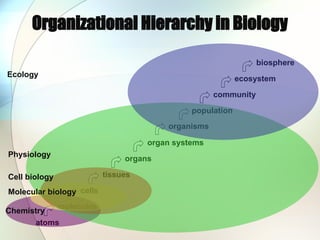
Organizational Hierarchy in Biology
atoms
molecules
cells
tissues
organs
organ systems
organisms
population
community
ecosystem
biosphere
Chemistry
Ecology
Physiology
Cell biology
Molecular biology
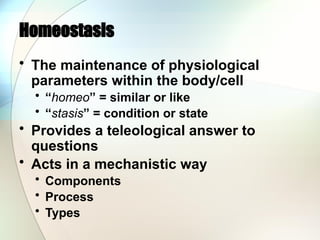
Homeostasis
• The maintenance of physiological
parameters within the body/cell
• “homeo” = similar or like
• “stasis” = condition or state
• Provides a teleological answer to
questions
• Acts in a mechanistic way
• Components
• Process
• Types
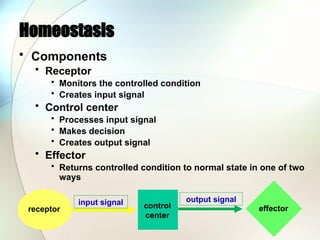
Homeostasis
• Components
• Receptor
• Monitors the controlled condition
• Creates input signal
• Control center
• Processes input signal
• Makes decision
• Creates output signal
• Effector
• Returns controlled condition to normal state in one of two
ways
receptor control
center
effector
input signal output signal
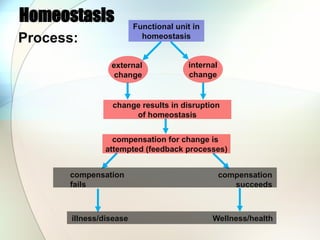
Homeostasis Functional unit in
homeostasis
external
change
internal
change
change results in disruption
of homeostasis
compensation for change is
attempted (feedback processes)
compensation
fails
compensation
succeeds
illness/disease Wellness/health
Process:
Homeostasis
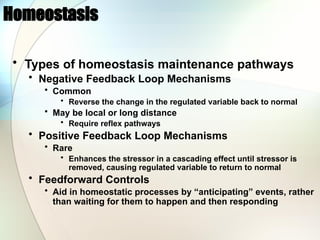
• Types of homeostasis maintenance pathways
• Negative Feedback Loop Mechanisms
• Common
• Reverse the change in the regulated variable back to normal
• May be local or long distance
• Require reflex pathways
• Positive Feedback Loop Mechanisms
• Rare
• Enhances the stressor in a cascading effect until stressor is
removed, causing regulated variable to return to normal
• Feedforward Controls
• Aid in homeostatic processes by “anticipating” events, rather
than waiting for them to happen and then responding
Homeostasis
• Negative Feedback Control Example: blood Ca2+
levels
regulated variable
blood levels of calcium
normal value 8.5 – 10.5
mg/dl
drop in blood
levels of Ca2+
rise in blood
levels of Ca2+
PTH secretion is
stimulated
PTH secretion is
inhibited
Vit D
synth
esis
Ca2+
release
from bone
blood Ca2+
levels normalize
Ca2+
uptake
in GI tract
Ca2+
reabsorptio
n in kidney
Vit
D
synth
esis
Ca2+
uptake
by bone
Ca2+
uptake in GI
tract
Ca2+
secretion
by kidney
change
causes
Homeostasis
• Other Negative Feedback Examples?
Blood glucose levels
Body temperature
maintenance
pH controls
Blood pressure
regulation
Ventilation rates
Thyroid hormone
levels
Cell cycle
GI motility &
secretion CO2 levels
Receptors in plasma
membrane
Urine concentration/
dilution
Homeostasis
• positive feed back control example: childbirth
(parturition)
Regulated variable
female reproductive tract
Change
End of term fetus, uterus contracts,
increases pressure on the cervix
pressure causes release of
oxytocin
Oxytocin causes increased contraction of the uterus &
relaxation of cervix
Process continues until the cervix is dilated enough and the
uterus contractions expel the fetus
Homeostasis
• Other examples of positive feedback loops?
Some enzyme production
Hemostasis (blood clotting)
Lactation
Homeostasis
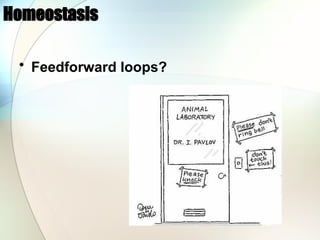
• Feedforward loops?
Communication
• Major theme in physiology
• Forms
• Electrical
• Chemical
• Between
• Cell/cells
• Tissues
• Organs…
• Communication allows for the
integration of physiology!
Cell Physiology
• The “Inner Life of a Cell”
• Components and their functions
• Cell to Cell Junctions - Forming
Tissues
• How it’s Integrated
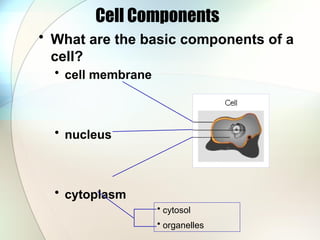
Cell Components
• What are the basic components of a
cell?
• cell membrane
• nucleus
• cytoplasm
• cytosol
• organelles
Cell Components The Cell Membrane
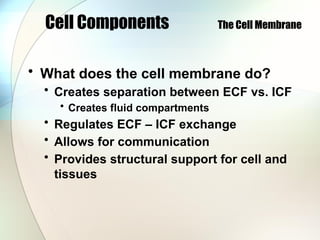
• What does the cell membrane do?
• Creates separation between ECF vs. ICF
• Creates fluid compartments
• Regulates ECF – ICF exchange
• Allows for communication
• Provides structural support for cell and
tissues
Cell Components The Cell Membrane
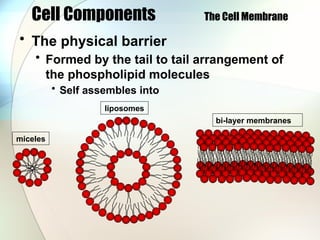
• The physical barrier
• Formed by the tail to tail arrangement of
the phospholipid molecules
• Self assembles into
miceles
liposomes
bi-layer membranes
Cell Components The Cell Membrane
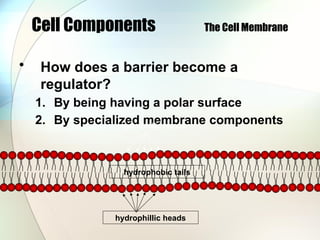
• How does a barrier become a
regulator?
1. By being having a polar surface
2. By specialized membrane components
hydrophillic heads
hydrophillic heads
hydrophobic tails
Cell Components The Cell Membrane
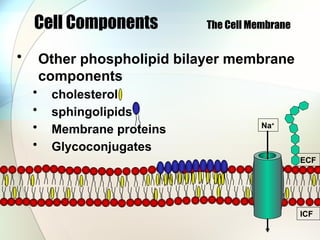
• Other phospholipid bilayer membrane
components
• cholesterol
• sphingolipids
• Membrane proteins
• Glycoconjugates
ECF
ICF
Na+
Cell Components The Cell Membrane
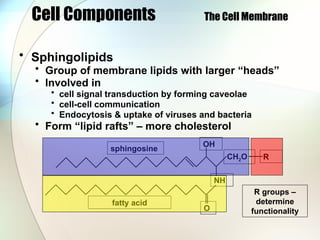
• Sphingolipids
• Group of membrane lipids with larger “heads”
• Involved in
• cell signal transduction by forming caveolae
• cell-cell communication
• Endocytosis & uptake of viruses and bacteria
• Form “lipid rafts” – more cholesterol
fatty acid
OH
NH
CH2O R
O
sphingosine
R groups –
determine
functionality
Cell Components The Cell Membrane
• Membrane Proteins
• 3 categories
• transmembrane proteins
• peripheral proteins
• lipid anchored (amphitropic) proteins
Cell Components The Cell Membrane
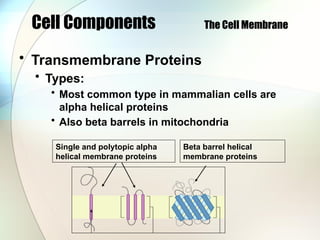
• Transmembrane Proteins
• Types:
• Most common type in mammalian cells are
alpha helical proteins
• Also beta barrels in mitochondria
Single and polytopic alpha
helical membrane proteins
Beta barrel helical
membrane proteins
Cell Components The Cell Membrane
• Functions of transmembrane
proteins
• Transport function
• Enzyme function
• Gated Ion channel formation
• Receptor function/signal transduction
Cell Components The Cell Membrane
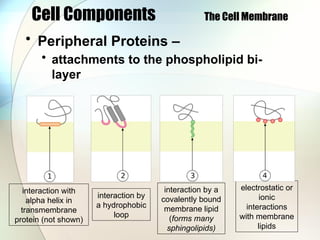
• Peripheral Proteins –
• attachments to the phospholipid bi-
layer
interaction with
alpha helix in
transmembrane
protein (not shown)
interaction by
a hydrophobic
loop
interaction by a
covalently bound
membrane lipid
(forms many
sphingolipids)
electrostatic or
ionic
interactions
with membrane
lipids
Cell Components The Cell Membrane
• Peripheral Protein Functions
• Enzyme function
• Mediate chemical reactions
• Structural
• Mediate attachment
• Transporters
• Between/among cell membrane proteins
• Electron carriers
• In electron transport chain
• Regulators
• Such as apoptosis

Human Physiology 1.pptx for cell physiology

  • 1.
  • 2.
    Physiology – Introduction •Claude Bernard (1813 – 1878) • The first to establish scientific methodology in medicine • Introduced experimental medicine and specifically “blind studies” to ensure objectivity • Introduced “Milieu interieur” which was the initial concept of homeostasis • “The constancy of the internal environment is the condition for a free and independent life” • Furthered in the next century by William Bradford Canon
  • 3.
    Physiology – Introduction •Walter Bradford Cannon (1871 – 1945) • Chaired the Department of Physiology at Harvard Medical School • Coined the term “fight or flight” • Did work with x-rays and different metals to improve x-ray quality of bowels (today’s barium meal is a direct result) • Given credit for concept of homeostasis, published it in 1932
  • 4.
    Physiology - Introduction •Organization • Homeostasis & Controls • Communication
  • 5.
    Organizational Hierarchy inBiology atoms molecules cells tissues organs organ systems organisms population community ecosystem biosphere Chemistry Ecology Physiology Cell biology Molecular biology
  • 6.
    Homeostasis • The maintenanceof physiological parameters within the body/cell • “homeo” = similar or like • “stasis” = condition or state • Provides a teleological answer to questions • Acts in a mechanistic way • Components • Process • Types
  • 7.
    Homeostasis • Components • Receptor •Monitors the controlled condition • Creates input signal • Control center • Processes input signal • Makes decision • Creates output signal • Effector • Returns controlled condition to normal state in one of two ways receptor control center effector input signal output signal
  • 8.
    Homeostasis Functional unitin homeostasis external change internal change change results in disruption of homeostasis compensation for change is attempted (feedback processes) compensation fails compensation succeeds illness/disease Wellness/health Process:
  • 9.
    Homeostasis • Types ofhomeostasis maintenance pathways • Negative Feedback Loop Mechanisms • Common • Reverse the change in the regulated variable back to normal • May be local or long distance • Require reflex pathways • Positive Feedback Loop Mechanisms • Rare • Enhances the stressor in a cascading effect until stressor is removed, causing regulated variable to return to normal • Feedforward Controls • Aid in homeostatic processes by “anticipating” events, rather than waiting for them to happen and then responding
  • 10.
    Homeostasis • Negative FeedbackControl Example: blood Ca2+ levels regulated variable blood levels of calcium normal value 8.5 – 10.5 mg/dl drop in blood levels of Ca2+ rise in blood levels of Ca2+ PTH secretion is stimulated PTH secretion is inhibited Vit D synth esis Ca2+ release from bone blood Ca2+ levels normalize Ca2+ uptake in GI tract Ca2+ reabsorptio n in kidney Vit D synth esis Ca2+ uptake by bone Ca2+ uptake in GI tract Ca2+ secretion by kidney change causes
  • 11.
    Homeostasis • Other NegativeFeedback Examples? Blood glucose levels Body temperature maintenance pH controls Blood pressure regulation Ventilation rates Thyroid hormone levels Cell cycle GI motility & secretion CO2 levels Receptors in plasma membrane Urine concentration/ dilution
  • 12.
    Homeostasis • positive feedback control example: childbirth (parturition) Regulated variable female reproductive tract Change End of term fetus, uterus contracts, increases pressure on the cervix pressure causes release of oxytocin Oxytocin causes increased contraction of the uterus & relaxation of cervix Process continues until the cervix is dilated enough and the uterus contractions expel the fetus
  • 13.
    Homeostasis • Other examplesof positive feedback loops? Some enzyme production Hemostasis (blood clotting) Lactation
  • 14.
  • 15.
    Communication • Major themein physiology • Forms • Electrical • Chemical • Between • Cell/cells • Tissues • Organs… • Communication allows for the integration of physiology!
  • 16.
    Cell Physiology • The“Inner Life of a Cell” • Components and their functions • Cell to Cell Junctions - Forming Tissues • How it’s Integrated
  • 17.
    Cell Components • Whatare the basic components of a cell? • cell membrane • nucleus • cytoplasm • cytosol • organelles
  • 18.
    Cell Components TheCell Membrane • What does the cell membrane do? • Creates separation between ECF vs. ICF • Creates fluid compartments • Regulates ECF – ICF exchange • Allows for communication • Provides structural support for cell and tissues
  • 19.
    Cell Components TheCell Membrane • The physical barrier • Formed by the tail to tail arrangement of the phospholipid molecules • Self assembles into miceles liposomes bi-layer membranes
  • 20.
    Cell Components TheCell Membrane • How does a barrier become a regulator? 1. By being having a polar surface 2. By specialized membrane components hydrophillic heads hydrophillic heads hydrophobic tails
  • 21.
    Cell Components TheCell Membrane • Other phospholipid bilayer membrane components • cholesterol • sphingolipids • Membrane proteins • Glycoconjugates ECF ICF Na+
  • 22.
    Cell Components TheCell Membrane • Sphingolipids • Group of membrane lipids with larger “heads” • Involved in • cell signal transduction by forming caveolae • cell-cell communication • Endocytosis & uptake of viruses and bacteria • Form “lipid rafts” – more cholesterol fatty acid OH NH CH2O R O sphingosine R groups – determine functionality
  • 23.
    Cell Components TheCell Membrane • Membrane Proteins • 3 categories • transmembrane proteins • peripheral proteins • lipid anchored (amphitropic) proteins
  • 24.
    Cell Components TheCell Membrane • Transmembrane Proteins • Types: • Most common type in mammalian cells are alpha helical proteins • Also beta barrels in mitochondria Single and polytopic alpha helical membrane proteins Beta barrel helical membrane proteins
  • 25.
    Cell Components TheCell Membrane • Functions of transmembrane proteins • Transport function • Enzyme function • Gated Ion channel formation • Receptor function/signal transduction
  • 26.
    Cell Components TheCell Membrane • Peripheral Proteins – • attachments to the phospholipid bi- layer interaction with alpha helix in transmembrane protein (not shown) interaction by a hydrophobic loop interaction by a covalently bound membrane lipid (forms many sphingolipids) electrostatic or ionic interactions with membrane lipids
  • 27.
    Cell Components TheCell Membrane • Peripheral Protein Functions • Enzyme function • Mediate chemical reactions • Structural • Mediate attachment • Transporters • Between/among cell membrane proteins • Electron carriers • In electron transport chain • Regulators • Such as apoptosis