1
General Introduction
 Physiology: The biological science dealing with the normal life phenomena exhibited by
all living organisms.
 The science of body function.
 Human physiology: The basic sciences dealing with normal life phenomena of the
human body.
 Goal of physiology:
 Explain the physical and chemical factors that are responsible for the origin,
development and progression of life.
 Physiology has a strong link with other disciplines
-Highly related to anatomy, Biochemistry, Pathology, Pharmcology, etc
2
Composition of human body
 The basic level include atoms and molecules.
 Both living and non-living things are composed of molecules made
from chemical elements such as Hydrogen, Oxygen, Carbon and
Nitrogen.
3
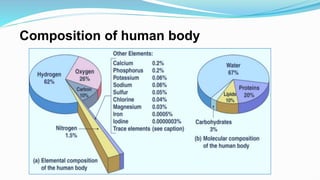
Composition of human body
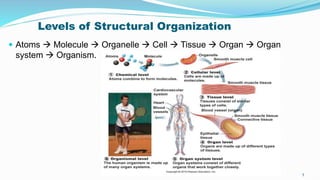
Levels of Structural Organization
 Atoms  Molecule  Organelle  Cell  Tissue  Organ  Organ
system  Organism.
5
6
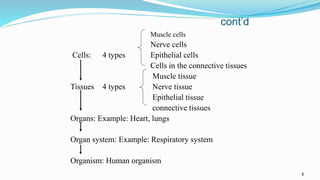
cont’d
Muscle cells
Nerve cells
Cells: 4 types Epithelial cells
Cells in the connective tissues
Muscle tissue
Tissues 4 types Nerve tissue
Epithelial tissue
connective tissues
Organs: Example: Heart, lungs
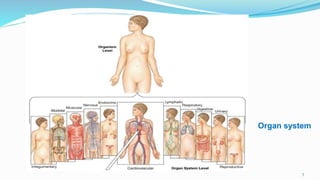
Organ system: Example: Respiratory system
Organism: Human organism
7
Organ system
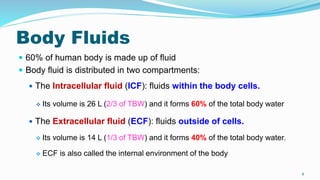
Body Fluids
 60% of human body is made up of fluid
 Body fluid is distributed in two compartments:
 The Intracellular fluid (ICF): fluids within the body cells.
 Its volume is 26 L (2/3 of TBW) and it forms 60% of the total body water
 The Extracellular fluid (ECF): fluids outside of cells.
 Its volume is 14 L (1/3 of TBW) and it forms 40% of the total body water.
 ECF is also called the internal environment of the body
8
9
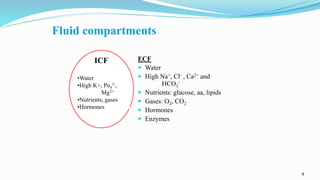
Fluid compartments
ECF
 Water
 High Na+, Cl- , Ca2+ and
HCO3
-
 Nutrients: glucose, aa, lipids
 Gases: O2, CO2
 Hormones
 Enzymes
•Water
•High K+, Po4
3-,
Mg2+
•Nutrients, gases
•Hormones
ICF
Homeostasis
 Homeostasis literally means “same state” and it refers to the
process of keeping the internal body environment in a relatively
steady state
 The body’s ability to maintain relatively stable internal environment
though there are changes in the external environment.
 Maintenance of nearly constant conditions in the internal environment.
10
 Essentially all organs of the body perform their functions to
maintain constant conditions in the ECF.
For example
 Lungs maintain the normal concentration of respiratory gases in
blood.
 The CVS transports required substances and removes waste
products,
 The kidneys maintain constant ionic concentration
 The GIT provides nutrients
11
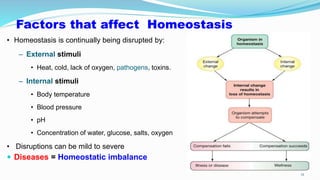
Factors that affect Homeostasis
• Homeostasis is continually being disrupted by:
– External stimuli
• Heat, cold, lack of oxygen, pathogens, toxins.
– Internal stimuli
• Body temperature
• Blood pressure
• pH
• Concentration of water, glucose, salts, oxygen
• Disruptions can be mild to severe
 Diseases = Homeostatic imbalance
12
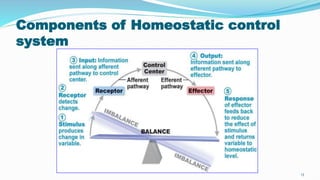
Components of Homeostatic control
system
13
14
Regulation of the Body Functions
 Regulation: the ability of an organism to maintain a stable internal
conditions in a continually changing environment.
 Mechanism of regulation can be synergestic effect of the three types:
 Chemical (hormonal) Regulation,
 Nervous Regulation and
 Autoregulation
15
Regulation of the Body Functions
 The three regulations have coordinated action and acts as one system,
“feedback control system” Or Feed-forward control system.
 Feedback Control
 Feed-forward Control
16
 A feedback system is a cycle of events in which the status of a
body condition is monitored, evaluated, changed, reevaluated,
and so on.
 Refers to responses made after change has been detected
 Feedback control mechanism consists of two forms:
 Negative feedback control: reduces effect of stimulus
 Positive feedback control: increases the response
Feedback Control
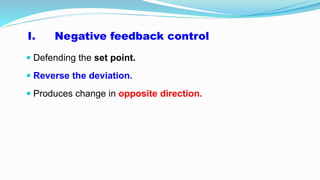
I. Negative feedback control
 Defending the set point.
 Reverse the deviation.
 Produces change in opposite direction.
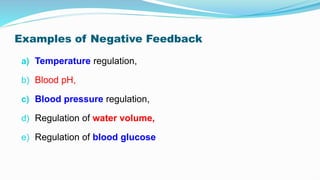
Examples of Negative Feedback
a) Temperature regulation,
b) Blood pH,
c) Blood pressure regulation,
d) Regulation of water volume,
e) Regulation of blood glucose
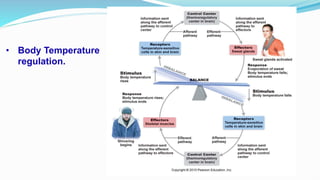
• Body Temperature
regulation.
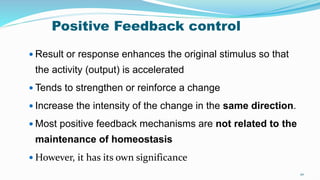
Positive Feedback control
 Result or response enhances the original stimulus so that
the activity (output) is accelerated
 Tends to strengthen or reinforce a change
 Increase the intensity of the change in the same direction.
 Most positive feedback mechanisms are not related to the
maintenance of homeostasis
 However, it has its own significance
20
Cont’d
Examples
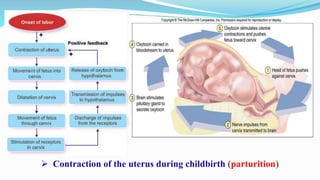
 Parturition
 Blood coagulation
 Milk ejection
 Voltage gated Na+ channels(depolarization).
21
 Contraction of the uterus during childbirth (parturition)
23
Feed-forward control
 Direct effect of stimulus on the control system before the action of feedback
signal occurs.
 Starts the response loop before the change has occurred
Example: Shivering before diving into the cold water.
 Significance of Feed-forward:
 Adaptive feedback control
 Makes the human body to foresee and adapt the environment promptly and
exactly.
 Prepare the body for the change.
Cellular Physiology
 Cell is defined as the basic structural and functional unit
of the living body.
 The Cell is the Fundamental unit of Life.
The body of an average human adult is composed of
nearly 100 trillion cells ( RBCs=> 25 trillion).
24
 All of these cells can be classified into about 200 different cell types.
 broadly categorized into 4 groups:
 Epithelial cells,
 Connective tissue cells,
 Muscle cells and
 Nerve cells.
25
26
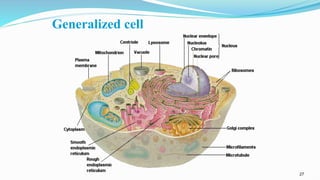
Generalized cell
 A typical cell has two parts: nucleus and cytoplasm.
 The nucleus is separated from the cytoplasm by a nuclear
membrane
 The cytoplasm is separated from the surrounding fluid (ECF) by the
plasma membrane
27
Generalized cell
 Organelles: are subcellular structures within the cytoplasm that
performs specific functions in the cell.
 Protoplasm:
 Different substances that make up the cell are collectively called as
Protoplasm.
 It is the colorless material comprising the living part of a cell, including the
nucleus, cytoplasm, and other organelles.
 Cytoplasm:
 The material or protoplasm within a living cell, excluding the nucleus.
• Cytosol:
• The fluid portion of the cytoplasm that surrounds organelles
• Constitutes about 55% of total cell volume.
• Semigelatinous intracellular fluid(ICF)
CELL MEMBRANE
 Cell membrane is a protective sheath, enveloping the cell body.
 It is also known as plasma membrane or plasmalemma.
 This membrane separates the fluid outside the cell called
extracellular fluid (ECF) and intracellular fluid (ICF).
 The cell membrane is a semipermeable(selective/partial)
membrane
 Need to allow some materials; but not all to pass through the membrane
29
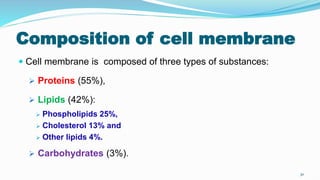
Composition of cell membrane
 Cell membrane is composed of three types of substances:
 Proteins (55%),
 Lipids (42%):
 Phospholipids 25%,
 Cholesterol 13% and
 Other lipids 4%.
 Carbohydrates (3%).
30
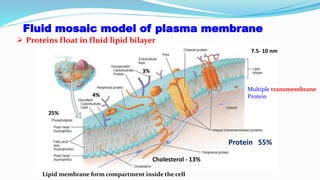
Fluid mosaic model of plasma membrane
Cholesterol - 13%
7.5- 10 nm
25%
Protein 55%
4%
Multiple transmembrane
Protein
3%
Lipid membrane form compartment inside the cell
 Proteins float in fluid lipid bilayer
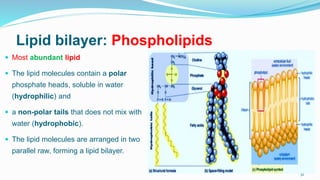
Lipid bilayer: Phospholipids
 Most abundant lipid
 The lipid molecules contain a polar
phosphate heads, soluble in water
(hydrophilic) and
 a non-polar tails that does not mix with
water (hydrophobic).
 The lipid molecules are arranged in two
parallel raw, forming a lipid bilayer.
32
33
cont’d
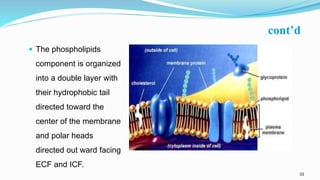
 The phospholipids
component is organized
into a double layer with
their hydrophobic tail
directed toward the
center of the membrane
and polar heads
directed out ward facing
ECF and ICF.
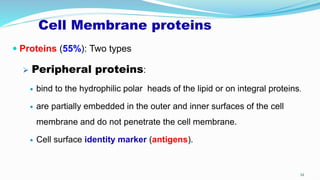
 Proteins (55%): Two types
 Peripheral proteins:
 bind to the hydrophilic polar heads of the lipid or on integral proteins.
 are partially embedded in the outer and inner surfaces of the cell
membrane and do not penetrate the cell membrane.
 Cell surface identity marker (antigens).
34
Cell Membrane proteins
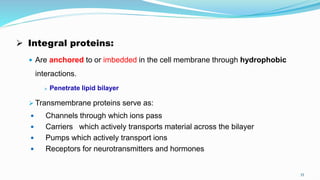
 Integral proteins:
 Are anchored to or imbedded in the cell membrane through hydrophobic
interactions.
 Penetrate lipid bilayer
 Transmembrane proteins serve as:
 Channels through which ions pass
 Carriers which actively transports material across the bilayer
 Pumps which actively transport ions
 Receptors for neurotransmitters and hormones
35
36
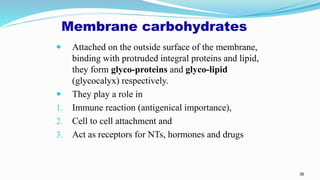
Membrane carbohydrates
 Attached on the outside surface of the membrane,
binding with protruded integral proteins and lipid,
they form glyco-proteins and glyco-lipid
(glycocalyx) respectively.
 They play a role in
1. Immune reaction (antigenical importance),
2. Cell to cell attachment and
3. Act as receptors for NTs, hormones and drugs
FUNCTIONS OF CELL MEMBRANE
 Protective function
 Selective permeability
 Absorptive function
 Excretory function
 Exchange of gases
 Maintenance of shape and size of the cell
37
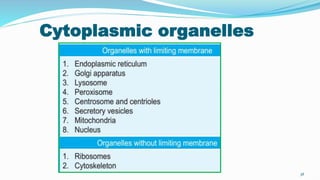
Cytoplasmic organelles
38
Nucleus
 Nucleus is the most prominent and the largest cellular organelle
 Nucleus is present in all body cells except the matured red blood cells.
 The cells with nucleus are called eukaryotes.
 Most of the cells have only one nucleus (uninucleated cells).
 Few types of cells like skeletal muscle cells have many nuclei (multinucleated
cells).
 Contains DNA which directs the activity of the cell – Blueprint
39
 Nucleus is covered by a membrane called nuclear membrane.
 Major components of nucleus are
 nucleoplasm,
 chromatin and
 nucleolus
40
Function of Nucleus
 Storage of hereditary information in genes (DNA)
Regulate and Control of all activities of the cell
 Synthesis of mRNA
 Sending genetic instruction to cytoplasm for protein synthesis
 Control of cell division
Formation of subunits of ribosomes
41
The Endoplasmic reticulum (ER)
 The ER is a membranous synthesis and transport organelle that is
an extension of the nuclear envelope.
• There are two distinct ER:
a) The rough (Granular) ER is so named because the cytoplasmic
surface is covered with ribosomes.
b) The smooth (Agranular) ER appears smooth since its
cytoplasmic surface lacks ribosomes.
42
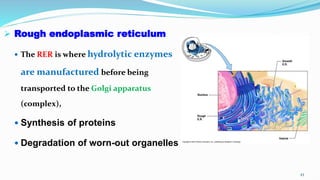
 Rough endoplasmic reticulum
 The RER is where hydrolytic enzymes
are manufactured before being
transported to the Golgi apparatus
(complex),
 Synthesis of proteins
 Degradation of worn-out organelles
43
 Smooth endoplasmic reticulum
 Synthesis of lipids and steroids hormones
 Storage and metabolism of calcium
 Detoxification
44
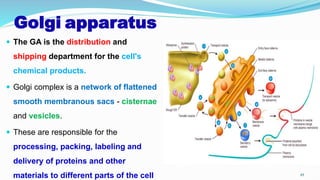
Golgi apparatus
 The GA is the distribution and
shipping department for the cell's
chemical products.
 Golgi complex is a network of flattened
smooth membranous sacs - cisternae
and vesicles.
 These are responsible for the
processing, packing, labeling and
delivery of proteins and other
materials to different parts of the cell 45
Lysosomes
 "Lysosome" was the name given because of these enzymes' ability to "lyse" the cell.
 Initially referred to as "suicide bags”
 Function:
 Degradation of macromolecules.
Peroxisomes
 Peroxisome has oxidative enzymes that detoxify various wastes,
 Breakdown of excess fatty acids,
 Detoxification of hydrogen peroxide and other metabolic products.
46
Centrosome
 Centrosome is the membrane-bound cellular organelle situated
almost in the center of cell, close to nucleus.
 It consists of two cylindrical structures called centrioles which
are made up of proteins.
 Centrioles are responsible for the movement of chromosomes
during cell division.
47
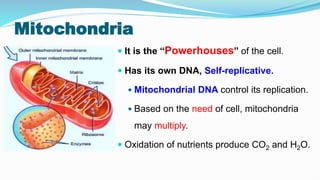
Mitochondria
 It is the “Powerhouses” of the cell.
 Has its own DNA, Self-replicative.
 Mitochondrial DNA control its replication.
 Based on the need of cell, mitochondria
may multiply.
 Oxidation of nutrients produce CO2 and H2O.
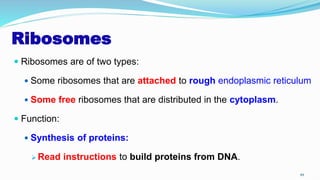
Ribosomes
 Ribosomes are of two types:
 Some ribosomes that are attached to rough endoplasmic reticulum
 Some free ribosomes that are distributed in the cytoplasm.
 Function:
 Synthesis of proteins:
 Read instructions to build proteins from DNA.
49
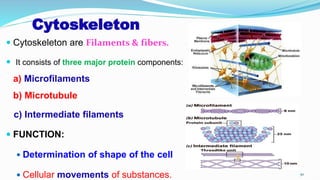
Cytoskeleton
 Cytoskeleton are Filaments & fibers.
 It consists of three major protein components:
a) Microfilaments
b) Microtubule
c) Intermediate filaments
 FUNCTION:
 Determination of shape of the cell
 Cellular movements of substances. 50
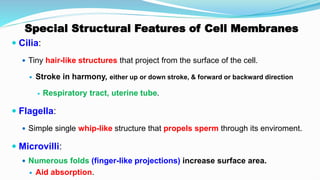
Special Structural Features of Cell Membranes
 Cilia:
 Tiny hair-like structures that project from the surface of the cell.
 Stroke in harmony, either up or down stroke, & forward or backward direction
 Respiratory tract, uterine tube.
 Flagella:
 Simple single whip-like structure that propels sperm through its enviroment.
 Microvilli:
 Numerous folds (finger-like projections) increase surface area.
 Aid absorption.
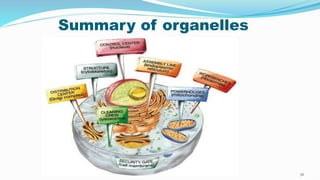
Summary of organelles
52
Transport through the cell membrane
 Substances are transported through the cell membrane by:
 Passive transport:
 Diffusion
 Simple diffusion
 Facilitated diffusion
 Osmosis
 Active transport:
 Protein pump transport
 Vesicular transport
 Endocytosis and
 Exocytosis
53
Passive Transport: Downhill
 Transport of substances along the concentration gradient or electrical gradient or
both (electrochemical gradient)
 Move from High to Low concentration of solute
 DIFFUSION: random molecular movement of substances down concentration
gradient, either through intermolecular spaces in the membrane or in combination
with a carrier protein.
Simple diffusion
 A passive process in which substances move across the lipid bilayer of the
plasma membrane without the help of membrane transport proteins.
 No ATP(energy) needed
 Two types:
 Diffusion directly through lipid layer:
 Lipid soluble substances
 Example: Oxygen, CO2, Alcohol
55
Cont’d
 Diffusion through a protein channel :
 Small water soluble substances
 Protein channels allow substances in & out.
 Specific channels allow specific material in & out.
 Channel proteins are embedded in the cell membrane & have a
pore for materials to cross.
56
Facilitated diffusion
 Carrier-Mediated transport
 Transport across cell membrane by protein carriers.
 Carrier proteins can change shape to move(shift) material from one
side of the membrane to the other.
Example: Glucose, amino acids (macromolecules)
57
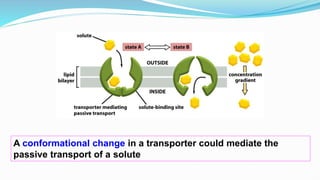
A conformational change in a transporter could mediate the
passive transport of a solute
 Characteristics of protein carriers:
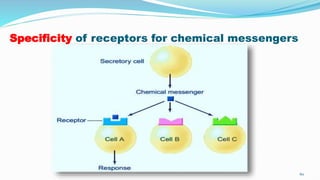
 Specificity:
 The ability of a receptor to bind only one type or a limited
number of structurally related types of chemical messengers.
 Saturation:
 The degree to which receptors are occupied by messengers.
 Competition:
 Occurs between molecules with similar chemical structures
that enter the cell to compete for carrier site.
59
Specificity of receptors for chemical messengers
60
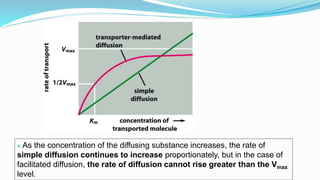
 As the concentration of the diffusing substance increases, the rate of
simple diffusion continues to increase proportionately, but in the case of
facilitated diffusion, the rate of diffusion cannot rise greater than the Vmax
level.
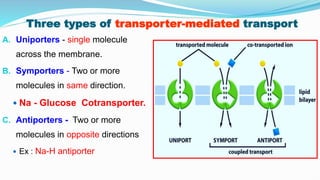
Three types of transporter-mediated transport
A. Uniporters - single molecule
across the membrane.
B. Symporters - Two or more
molecules in same direction.
 Na - Glucose Cotransporter.
C. Antiporters - Two or more
molecules in opposite directions
 Ex : Na-H antiporter
63
Factors affecting the rate of transport
 The concentration gradient(ΔC)
 Size of the ion
 Temperature
 Permeability of the Cell
Membrane
 Charge of ions
 Solubility: in lipid
 Thickness of the membrane
64
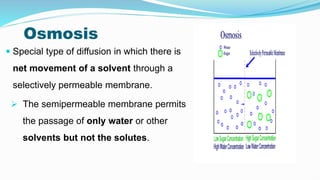
Osmosis
 Special type of diffusion in which there is
net movement of a solvent through a
selectively permeable membrane.
 The semipermeable membrane permits
the passage of only water or other
solvents but not the solutes.
66
Active transport
 Substances are transported against concentration,
electrochemical gradient, up hill direction.
 Used for the transport of Na+, K+, Ca2+, Fe2+, H+, Cl-,
glucose
 Consumes energy in the form of ATP
Primary active transport
 Carrier protein is involved
 Consumes energy from hydrolysis of ATP
Common examples
1. Na+ - K+ ATPase
2. H+ pump
3. Ca2+ ATPase
67
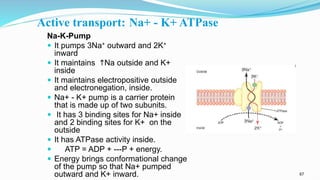
Active transport: Na+ - K+ ATPase
Na-K-Pump
 It pumps 3Na+ outward and 2K+
inward
 It maintains Na outside and K+
inside
 It maintains electropositive outside
and electronegation, inside.
 Na+ - K+ pump is a carrier protein
that is made up of two subunits.
 It has 3 binding sites for Na+ inside
and 2 binding sites for K+ on the
outside
 It has ATPase activity inside.
 ATP = ADP + ---P + energy.
 Energy brings conformational change
of the pump so that Na+ pumped
outward and K+ inward.
Secondary active transport
 Carrier protein is involved
 Consumes energy
 The energy is derived secondarily from energy that has been
stored in the form of ionic concentration differences of secondary
molecular or ionic substances
 It is of two types:
1. Cotransport
2. Counter transport.
68
69
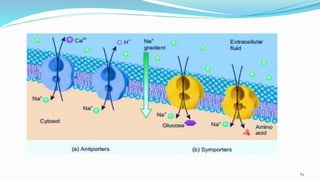
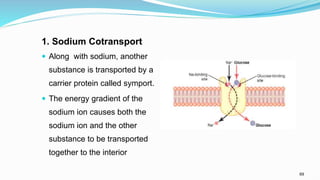
1. Sodium Cotransport
 Along with sodium, another
substance is transported by a
carrier protein called symport.
 The energy gradient of the
sodium ion causes both the
sodium ion and the other
substance to be transported
together to the interior
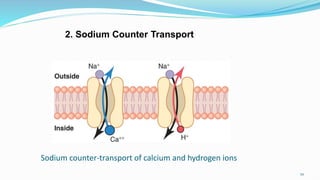
Sodium counter-transport of calcium and hydrogen ions
70
2. Sodium Counter Transport
Vesicular transport
 A vesicle is a small, spherical membrane bound sac.
 Endocytosis : mechanism by which the macromolecules enter
the cell.
 macromolecules cannot pass through the cell membrane either by active or
by passive transport mechanism.
 Exocytosis : Materials move out of a cell by the fusion with the
plasma membrane of vesicles formed inside the cell.
 Endocytosis and Exocytosis require energy supplied by ATP.
Types of Endocytosis
1. Phagocytosis (cell eating),
2. Pinocytosis (cell drinking),
3. Receptor-mediated endocytosis.
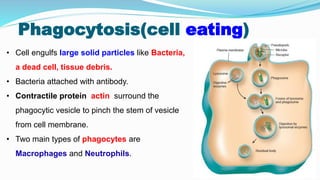
Phagocytosis(cell eating)
• Cell engulfs large solid particles like Bacteria,
a dead cell, tissue debris.
• Bacteria attached with antibody.
• Contractile protein actin surround the
phagocytic vesicle to pinch the stem of vesicle
from cell membrane.
• Two main types of phagocytes are
Macrophages and Neutrophils.
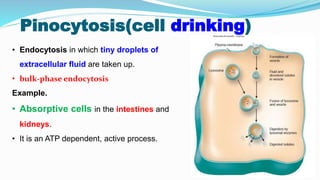
Pinocytosis(cell drinking)
• Endocytosis in which tiny droplets of
extracellular fluid are taken up.
• bulk-phase endocytosis
Example.
• Absorptive cells in the intestines and
kidneys.
• It is an ATP dependent, active process.
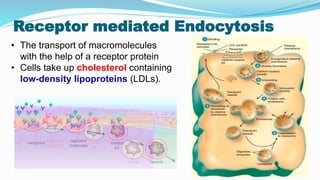
Receptor mediated Endocytosis
• The transport of macromolecules
with the help of a receptor protein
• Cells take up cholesterol containing
low-density lipoproteins (LDLs).
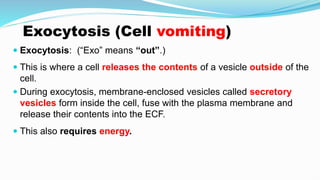
Exocytosis (Cell vomiting)
 Exocytosis: (“Exo” means “out”.)
 This is where a cell releases the contents of a vesicle outside of the
cell.
 During exocytosis, membrane-enclosed vesicles called secretory
vesicles form inside the cell, fuse with the plasma membrane and
release their contents into the ECF.
 This also requires energy.
77
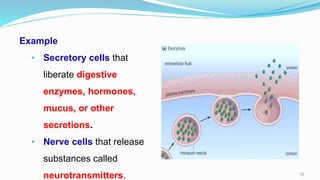
Example
• Secretory cells that
liberate digestive
enzymes, hormones,
mucus, or other
secretions.
• Nerve cells that release
substances called
neurotransmitters.
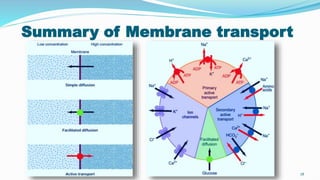
Summary of Membrane transport
78

chapter 1 cellular physiology power point

  • 1.
  • 2.
    General Introduction  Physiology:The biological science dealing with the normal life phenomena exhibited by all living organisms.  The science of body function.  Human physiology: The basic sciences dealing with normal life phenomena of the human body.  Goal of physiology:  Explain the physical and chemical factors that are responsible for the origin, development and progression of life.  Physiology has a strong link with other disciplines -Highly related to anatomy, Biochemistry, Pathology, Pharmcology, etc 2
  • 3.
    Composition of humanbody  The basic level include atoms and molecules.  Both living and non-living things are composed of molecules made from chemical elements such as Hydrogen, Oxygen, Carbon and Nitrogen. 3
  • 4.
  • 5.
    Levels of StructuralOrganization  Atoms  Molecule  Organelle  Cell  Tissue  Organ  Organ system  Organism. 5
  • 6.
    6 cont’d Muscle cells Nerve cells Cells:4 types Epithelial cells Cells in the connective tissues Muscle tissue Tissues 4 types Nerve tissue Epithelial tissue connective tissues Organs: Example: Heart, lungs Organ system: Example: Respiratory system Organism: Human organism
  • 7.
  • 8.
    Body Fluids  60%of human body is made up of fluid  Body fluid is distributed in two compartments:  The Intracellular fluid (ICF): fluids within the body cells.  Its volume is 26 L (2/3 of TBW) and it forms 60% of the total body water  The Extracellular fluid (ECF): fluids outside of cells.  Its volume is 14 L (1/3 of TBW) and it forms 40% of the total body water.  ECF is also called the internal environment of the body 8
  • 9.
    9 Fluid compartments ECF  Water High Na+, Cl- , Ca2+ and HCO3 -  Nutrients: glucose, aa, lipids  Gases: O2, CO2  Hormones  Enzymes •Water •High K+, Po4 3-, Mg2+ •Nutrients, gases •Hormones ICF
  • 10.
    Homeostasis  Homeostasis literallymeans “same state” and it refers to the process of keeping the internal body environment in a relatively steady state  The body’s ability to maintain relatively stable internal environment though there are changes in the external environment.  Maintenance of nearly constant conditions in the internal environment. 10
  • 11.
     Essentially allorgans of the body perform their functions to maintain constant conditions in the ECF. For example  Lungs maintain the normal concentration of respiratory gases in blood.  The CVS transports required substances and removes waste products,  The kidneys maintain constant ionic concentration  The GIT provides nutrients 11
  • 12.
    Factors that affectHomeostasis • Homeostasis is continually being disrupted by: – External stimuli • Heat, cold, lack of oxygen, pathogens, toxins. – Internal stimuli • Body temperature • Blood pressure • pH • Concentration of water, glucose, salts, oxygen • Disruptions can be mild to severe  Diseases = Homeostatic imbalance 12
  • 13.
    Components of Homeostaticcontrol system 13
  • 14.
    14 Regulation of theBody Functions  Regulation: the ability of an organism to maintain a stable internal conditions in a continually changing environment.  Mechanism of regulation can be synergestic effect of the three types:  Chemical (hormonal) Regulation,  Nervous Regulation and  Autoregulation
  • 15.
    15 Regulation of theBody Functions  The three regulations have coordinated action and acts as one system, “feedback control system” Or Feed-forward control system.  Feedback Control  Feed-forward Control
  • 16.
    16  A feedbacksystem is a cycle of events in which the status of a body condition is monitored, evaluated, changed, reevaluated, and so on.  Refers to responses made after change has been detected  Feedback control mechanism consists of two forms:  Negative feedback control: reduces effect of stimulus  Positive feedback control: increases the response Feedback Control
  • 17.
    I. Negative feedbackcontrol  Defending the set point.  Reverse the deviation.  Produces change in opposite direction.
  • 18.
    Examples of NegativeFeedback a) Temperature regulation, b) Blood pH, c) Blood pressure regulation, d) Regulation of water volume, e) Regulation of blood glucose
  • 19.
  • 20.
    Positive Feedback control Result or response enhances the original stimulus so that the activity (output) is accelerated  Tends to strengthen or reinforce a change  Increase the intensity of the change in the same direction.  Most positive feedback mechanisms are not related to the maintenance of homeostasis  However, it has its own significance 20
  • 21.
    Cont’d Examples  Parturition  Bloodcoagulation  Milk ejection  Voltage gated Na+ channels(depolarization). 21
  • 22.
     Contraction ofthe uterus during childbirth (parturition)
  • 23.
    23 Feed-forward control  Directeffect of stimulus on the control system before the action of feedback signal occurs.  Starts the response loop before the change has occurred Example: Shivering before diving into the cold water.  Significance of Feed-forward:  Adaptive feedback control  Makes the human body to foresee and adapt the environment promptly and exactly.  Prepare the body for the change.
  • 24.
    Cellular Physiology  Cellis defined as the basic structural and functional unit of the living body.  The Cell is the Fundamental unit of Life. The body of an average human adult is composed of nearly 100 trillion cells ( RBCs=> 25 trillion). 24
  • 25.
     All ofthese cells can be classified into about 200 different cell types.  broadly categorized into 4 groups:  Epithelial cells,  Connective tissue cells,  Muscle cells and  Nerve cells. 25
  • 26.
    26 Generalized cell  Atypical cell has two parts: nucleus and cytoplasm.  The nucleus is separated from the cytoplasm by a nuclear membrane  The cytoplasm is separated from the surrounding fluid (ECF) by the plasma membrane
  • 27.
  • 28.
     Organelles: aresubcellular structures within the cytoplasm that performs specific functions in the cell.  Protoplasm:  Different substances that make up the cell are collectively called as Protoplasm.  It is the colorless material comprising the living part of a cell, including the nucleus, cytoplasm, and other organelles.  Cytoplasm:  The material or protoplasm within a living cell, excluding the nucleus. • Cytosol: • The fluid portion of the cytoplasm that surrounds organelles • Constitutes about 55% of total cell volume. • Semigelatinous intracellular fluid(ICF)
  • 29.
    CELL MEMBRANE  Cellmembrane is a protective sheath, enveloping the cell body.  It is also known as plasma membrane or plasmalemma.  This membrane separates the fluid outside the cell called extracellular fluid (ECF) and intracellular fluid (ICF).  The cell membrane is a semipermeable(selective/partial) membrane  Need to allow some materials; but not all to pass through the membrane 29
  • 30.
    Composition of cellmembrane  Cell membrane is composed of three types of substances:  Proteins (55%),  Lipids (42%):  Phospholipids 25%,  Cholesterol 13% and  Other lipids 4%.  Carbohydrates (3%). 30
  • 31.
    Fluid mosaic modelof plasma membrane Cholesterol - 13% 7.5- 10 nm 25% Protein 55% 4% Multiple transmembrane Protein 3% Lipid membrane form compartment inside the cell  Proteins float in fluid lipid bilayer
  • 32.
    Lipid bilayer: Phospholipids Most abundant lipid  The lipid molecules contain a polar phosphate heads, soluble in water (hydrophilic) and  a non-polar tails that does not mix with water (hydrophobic).  The lipid molecules are arranged in two parallel raw, forming a lipid bilayer. 32
  • 33.
    33 cont’d  The phospholipids componentis organized into a double layer with their hydrophobic tail directed toward the center of the membrane and polar heads directed out ward facing ECF and ICF.
  • 34.
     Proteins (55%):Two types  Peripheral proteins:  bind to the hydrophilic polar heads of the lipid or on integral proteins.  are partially embedded in the outer and inner surfaces of the cell membrane and do not penetrate the cell membrane.  Cell surface identity marker (antigens). 34 Cell Membrane proteins
  • 35.
     Integral proteins: Are anchored to or imbedded in the cell membrane through hydrophobic interactions.  Penetrate lipid bilayer  Transmembrane proteins serve as:  Channels through which ions pass  Carriers which actively transports material across the bilayer  Pumps which actively transport ions  Receptors for neurotransmitters and hormones 35
  • 36.
    36 Membrane carbohydrates  Attachedon the outside surface of the membrane, binding with protruded integral proteins and lipid, they form glyco-proteins and glyco-lipid (glycocalyx) respectively.  They play a role in 1. Immune reaction (antigenical importance), 2. Cell to cell attachment and 3. Act as receptors for NTs, hormones and drugs
  • 37.
    FUNCTIONS OF CELLMEMBRANE  Protective function  Selective permeability  Absorptive function  Excretory function  Exchange of gases  Maintenance of shape and size of the cell 37
  • 38.
  • 39.
    Nucleus  Nucleus isthe most prominent and the largest cellular organelle  Nucleus is present in all body cells except the matured red blood cells.  The cells with nucleus are called eukaryotes.  Most of the cells have only one nucleus (uninucleated cells).  Few types of cells like skeletal muscle cells have many nuclei (multinucleated cells).  Contains DNA which directs the activity of the cell – Blueprint 39
  • 40.
     Nucleus iscovered by a membrane called nuclear membrane.  Major components of nucleus are  nucleoplasm,  chromatin and  nucleolus 40
  • 41.
    Function of Nucleus Storage of hereditary information in genes (DNA) Regulate and Control of all activities of the cell  Synthesis of mRNA  Sending genetic instruction to cytoplasm for protein synthesis  Control of cell division Formation of subunits of ribosomes 41
  • 42.
    The Endoplasmic reticulum(ER)  The ER is a membranous synthesis and transport organelle that is an extension of the nuclear envelope. • There are two distinct ER: a) The rough (Granular) ER is so named because the cytoplasmic surface is covered with ribosomes. b) The smooth (Agranular) ER appears smooth since its cytoplasmic surface lacks ribosomes. 42
  • 43.
     Rough endoplasmicreticulum  The RER is where hydrolytic enzymes are manufactured before being transported to the Golgi apparatus (complex),  Synthesis of proteins  Degradation of worn-out organelles 43
  • 44.
     Smooth endoplasmicreticulum  Synthesis of lipids and steroids hormones  Storage and metabolism of calcium  Detoxification 44
  • 45.
    Golgi apparatus  TheGA is the distribution and shipping department for the cell's chemical products.  Golgi complex is a network of flattened smooth membranous sacs - cisternae and vesicles.  These are responsible for the processing, packing, labeling and delivery of proteins and other materials to different parts of the cell 45
  • 46.
    Lysosomes  "Lysosome" wasthe name given because of these enzymes' ability to "lyse" the cell.  Initially referred to as "suicide bags”  Function:  Degradation of macromolecules. Peroxisomes  Peroxisome has oxidative enzymes that detoxify various wastes,  Breakdown of excess fatty acids,  Detoxification of hydrogen peroxide and other metabolic products. 46
  • 47.
    Centrosome  Centrosome isthe membrane-bound cellular organelle situated almost in the center of cell, close to nucleus.  It consists of two cylindrical structures called centrioles which are made up of proteins.  Centrioles are responsible for the movement of chromosomes during cell division. 47
  • 48.
    Mitochondria  It isthe “Powerhouses” of the cell.  Has its own DNA, Self-replicative.  Mitochondrial DNA control its replication.  Based on the need of cell, mitochondria may multiply.  Oxidation of nutrients produce CO2 and H2O.
  • 49.
    Ribosomes  Ribosomes areof two types:  Some ribosomes that are attached to rough endoplasmic reticulum  Some free ribosomes that are distributed in the cytoplasm.  Function:  Synthesis of proteins:  Read instructions to build proteins from DNA. 49
  • 50.
    Cytoskeleton  Cytoskeleton areFilaments & fibers.  It consists of three major protein components: a) Microfilaments b) Microtubule c) Intermediate filaments  FUNCTION:  Determination of shape of the cell  Cellular movements of substances. 50
  • 51.
    Special Structural Featuresof Cell Membranes  Cilia:  Tiny hair-like structures that project from the surface of the cell.  Stroke in harmony, either up or down stroke, & forward or backward direction  Respiratory tract, uterine tube.  Flagella:  Simple single whip-like structure that propels sperm through its enviroment.  Microvilli:  Numerous folds (finger-like projections) increase surface area.  Aid absorption.
  • 52.
  • 53.
    Transport through thecell membrane  Substances are transported through the cell membrane by:  Passive transport:  Diffusion  Simple diffusion  Facilitated diffusion  Osmosis  Active transport:  Protein pump transport  Vesicular transport  Endocytosis and  Exocytosis 53
  • 54.
    Passive Transport: Downhill Transport of substances along the concentration gradient or electrical gradient or both (electrochemical gradient)  Move from High to Low concentration of solute  DIFFUSION: random molecular movement of substances down concentration gradient, either through intermolecular spaces in the membrane or in combination with a carrier protein.
  • 55.
    Simple diffusion  Apassive process in which substances move across the lipid bilayer of the plasma membrane without the help of membrane transport proteins.  No ATP(energy) needed  Two types:  Diffusion directly through lipid layer:  Lipid soluble substances  Example: Oxygen, CO2, Alcohol 55
  • 56.
    Cont’d  Diffusion througha protein channel :  Small water soluble substances  Protein channels allow substances in & out.  Specific channels allow specific material in & out.  Channel proteins are embedded in the cell membrane & have a pore for materials to cross. 56
  • 57.
    Facilitated diffusion  Carrier-Mediatedtransport  Transport across cell membrane by protein carriers.  Carrier proteins can change shape to move(shift) material from one side of the membrane to the other. Example: Glucose, amino acids (macromolecules) 57
  • 58.
    A conformational changein a transporter could mediate the passive transport of a solute
  • 59.
     Characteristics ofprotein carriers:  Specificity:  The ability of a receptor to bind only one type or a limited number of structurally related types of chemical messengers.  Saturation:  The degree to which receptors are occupied by messengers.  Competition:  Occurs between molecules with similar chemical structures that enter the cell to compete for carrier site. 59
  • 60.
    Specificity of receptorsfor chemical messengers 60
  • 61.
     As theconcentration of the diffusing substance increases, the rate of simple diffusion continues to increase proportionately, but in the case of facilitated diffusion, the rate of diffusion cannot rise greater than the Vmax level.
  • 62.
    Three types oftransporter-mediated transport A. Uniporters - single molecule across the membrane. B. Symporters - Two or more molecules in same direction.  Na - Glucose Cotransporter. C. Antiporters - Two or more molecules in opposite directions  Ex : Na-H antiporter
  • 63.
  • 64.
    Factors affecting therate of transport  The concentration gradient(ΔC)  Size of the ion  Temperature  Permeability of the Cell Membrane  Charge of ions  Solubility: in lipid  Thickness of the membrane 64
  • 65.
    Osmosis  Special typeof diffusion in which there is net movement of a solvent through a selectively permeable membrane.  The semipermeable membrane permits the passage of only water or other solvents but not the solutes.
  • 66.
    66 Active transport  Substancesare transported against concentration, electrochemical gradient, up hill direction.  Used for the transport of Na+, K+, Ca2+, Fe2+, H+, Cl-, glucose  Consumes energy in the form of ATP Primary active transport  Carrier protein is involved  Consumes energy from hydrolysis of ATP Common examples 1. Na+ - K+ ATPase 2. H+ pump 3. Ca2+ ATPase
  • 67.
    67 Active transport: Na+- K+ ATPase Na-K-Pump  It pumps 3Na+ outward and 2K+ inward  It maintains Na outside and K+ inside  It maintains electropositive outside and electronegation, inside.  Na+ - K+ pump is a carrier protein that is made up of two subunits.  It has 3 binding sites for Na+ inside and 2 binding sites for K+ on the outside  It has ATPase activity inside.  ATP = ADP + ---P + energy.  Energy brings conformational change of the pump so that Na+ pumped outward and K+ inward.
  • 68.
    Secondary active transport Carrier protein is involved  Consumes energy  The energy is derived secondarily from energy that has been stored in the form of ionic concentration differences of secondary molecular or ionic substances  It is of two types: 1. Cotransport 2. Counter transport. 68
  • 69.
    69 1. Sodium Cotransport Along with sodium, another substance is transported by a carrier protein called symport.  The energy gradient of the sodium ion causes both the sodium ion and the other substance to be transported together to the interior
  • 70.
    Sodium counter-transport ofcalcium and hydrogen ions 70 2. Sodium Counter Transport
  • 71.
    Vesicular transport  Avesicle is a small, spherical membrane bound sac.  Endocytosis : mechanism by which the macromolecules enter the cell.  macromolecules cannot pass through the cell membrane either by active or by passive transport mechanism.  Exocytosis : Materials move out of a cell by the fusion with the plasma membrane of vesicles formed inside the cell.  Endocytosis and Exocytosis require energy supplied by ATP.
  • 72.
    Types of Endocytosis 1.Phagocytosis (cell eating), 2. Pinocytosis (cell drinking), 3. Receptor-mediated endocytosis.
  • 73.
    Phagocytosis(cell eating) • Cellengulfs large solid particles like Bacteria, a dead cell, tissue debris. • Bacteria attached with antibody. • Contractile protein actin surround the phagocytic vesicle to pinch the stem of vesicle from cell membrane. • Two main types of phagocytes are Macrophages and Neutrophils.
  • 74.
    Pinocytosis(cell drinking) • Endocytosisin which tiny droplets of extracellular fluid are taken up. • bulk-phase endocytosis Example. • Absorptive cells in the intestines and kidneys. • It is an ATP dependent, active process.
  • 75.
    Receptor mediated Endocytosis •The transport of macromolecules with the help of a receptor protein • Cells take up cholesterol containing low-density lipoproteins (LDLs).
  • 76.
    Exocytosis (Cell vomiting) Exocytosis: (“Exo” means “out”.)  This is where a cell releases the contents of a vesicle outside of the cell.  During exocytosis, membrane-enclosed vesicles called secretory vesicles form inside the cell, fuse with the plasma membrane and release their contents into the ECF.  This also requires energy.
  • 77.
    77 Example • Secretory cellsthat liberate digestive enzymes, hormones, mucus, or other secretions. • Nerve cells that release substances called neurotransmitters.
  • 78.
    Summary of Membranetransport 78