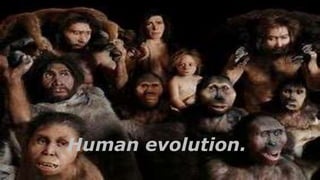
Human evolution.
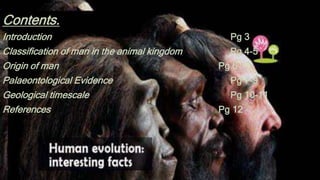
Contents.
Introduction Pg 3
Classification of man in the animal kingdom Pg 4-5
Origin of man Pg 6
Palaeontological Evidence Pg 7-9
Geological timescale Pg 10-11
References Pg 12
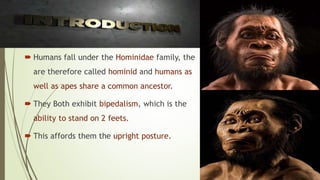
 Humans fall under the Hominidae family, the
are therefore called hominid and humans as
well as apes share a common ancestor.
 They Both exhibit bipedalism, which is the
ability to stand on 2 feets.
 This affords them the upright posture.
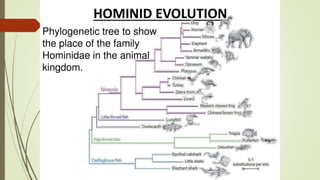
Classification of Man in the animal Kingdom
 The classification of the human species (scientific name: Homo sapiens,
Latin for "wise man") within zoological taxonomy is known as human
taxonomy.
 Homo is a taxonomic genus that is intended to encompass both
anatomically contemporary humans and extinct archaic human types.
 Homo sapiens is the name given to the subspecies of modern humans,
which some researchers believe distinguishes them from their immediate
predecessor, Homo sapiens idaltu.
 However, other studies place idaltu and modern humans in the same
subspecies.
• The early human migration and Homo sapiens earliest modern humans.
• Homo sapiens, descended from their primitive ape ancestors between 200,000 and
300,000 years ago.
• They first acquired the ability to speak some 50,000 years ago.
• Around 70,000–100,000 years ago, the first modern people started leaving Africa12.
• Humans descended from extinct primates on Earth, and they most likely first appeared in
Africa about 315,000 years ago2.
• About 85 million years ago, primates split off from other mammals, and their earliest
fossils first appeared approximately 55 million years ago3.
• Old English "mann," which basically meant "person" or "human," grew from the Germanic
word "man" to become the English word "man"4.
Palaeontological Evidence
o Paleoanthropologists today research many facets of
early human history.
o They give particular consideration to the biological
and cultural aspects of early humans.
o Paleoanthropologists use artifacts, fossilized
ancestral bones, and the environments in which these
specimens are located as proof to investigate these
dimensions.
Continuation
 Behavior: ancient footprints, stone tools, earliest symbols and art,
similarities and differences in the behavior of other primate species.
 The evolutionary connections between various human species and their
ancestors are shown by the human family tree.3D collection: digital
models of fossils and artifacts.
 Dating: methods to determine the age of fossils and artifacts.
 Human family tree: the evolutionary relationships between different
species of humans and their ancestors.
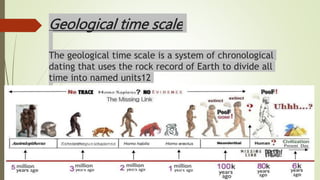
Geological time scale
The geological time scale is a system of chronological
dating that uses the rock record of Earth to divide all
time into named units12
References.
 https://www.slideshare.net/Akumpaul/human-evolution-48555299
 https://www.slideshare.net/100000752091558/4human-evolution
 https://www.slideshare.net/DilkashAmbreen1/evolution-of-man-73224474
 https://www.slideshare.net/Vinayc8/evolution-of-manpalaeontological-evidence
 https://www.slideshare.net/pramodgpramod/evolution-of-man-74665654

Human Evolution.pptx

  • 1.
  • 2.
    Contents. Introduction Pg 3 Classificationof man in the animal kingdom Pg 4-5 Origin of man Pg 6 Palaeontological Evidence Pg 7-9 Geological timescale Pg 10-11 References Pg 12
  • 3.
     Humans fallunder the Hominidae family, the are therefore called hominid and humans as well as apes share a common ancestor.  They Both exhibit bipedalism, which is the ability to stand on 2 feets.  This affords them the upright posture.
  • 4.
    Classification of Manin the animal Kingdom  The classification of the human species (scientific name: Homo sapiens, Latin for "wise man") within zoological taxonomy is known as human taxonomy.  Homo is a taxonomic genus that is intended to encompass both anatomically contemporary humans and extinct archaic human types.  Homo sapiens is the name given to the subspecies of modern humans, which some researchers believe distinguishes them from their immediate predecessor, Homo sapiens idaltu.  However, other studies place idaltu and modern humans in the same subspecies.
  • 6.
    • The earlyhuman migration and Homo sapiens earliest modern humans. • Homo sapiens, descended from their primitive ape ancestors between 200,000 and 300,000 years ago. • They first acquired the ability to speak some 50,000 years ago. • Around 70,000–100,000 years ago, the first modern people started leaving Africa12. • Humans descended from extinct primates on Earth, and they most likely first appeared in Africa about 315,000 years ago2. • About 85 million years ago, primates split off from other mammals, and their earliest fossils first appeared approximately 55 million years ago3. • Old English "mann," which basically meant "person" or "human," grew from the Germanic word "man" to become the English word "man"4.
  • 7.
    Palaeontological Evidence o Paleoanthropologiststoday research many facets of early human history. o They give particular consideration to the biological and cultural aspects of early humans. o Paleoanthropologists use artifacts, fossilized ancestral bones, and the environments in which these specimens are located as proof to investigate these dimensions.
  • 8.
    Continuation  Behavior: ancientfootprints, stone tools, earliest symbols and art, similarities and differences in the behavior of other primate species.  The evolutionary connections between various human species and their ancestors are shown by the human family tree.3D collection: digital models of fossils and artifacts.  Dating: methods to determine the age of fossils and artifacts.  Human family tree: the evolutionary relationships between different species of humans and their ancestors.
  • 10.
    Geological time scale Thegeological time scale is a system of chronological dating that uses the rock record of Earth to divide all time into named units12
  • 12.
    References.  https://www.slideshare.net/Akumpaul/human-evolution-48555299  https://www.slideshare.net/100000752091558/4human-evolution https://www.slideshare.net/DilkashAmbreen1/evolution-of-man-73224474  https://www.slideshare.net/Vinayc8/evolution-of-manpalaeontological-evidence  https://www.slideshare.net/pramodgpramod/evolution-of-man-74665654