IQBAL TIGER Institute University of Agriculture Faisalabad (2021-Official)
Presented By: ZAIN IQBAL
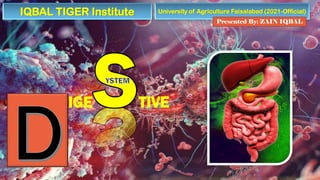
IGE TIVE
YSTEM
University of Agriculture Faisalabad (2021-Official)
Presented By: ZAIN IQBAL
ENZYMES GLANDS
0
HORMONE
DIET BIOLOGICAL ORGANIZATIOM
CARBOHYDRATES (Milk, Potatoes)
PROTEINS (Meat, Fish, Eggs)
LIPIDS (Butter, Cheese, Nuts, Oil)
WATER
IQBAL TIGER Institute
University of Agriculture Faisalabad (2021-Official)
Presented By: ZAIN IQBAL
1
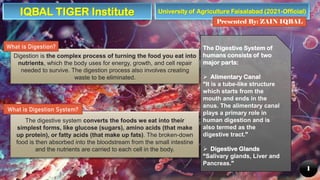
The digestive system converts the foods we eat into their
simplest forms, like glucose (sugars), amino acids (that make
up protein), or fatty acids (that make up fats). The broken-down
food is then absorbed into the bloodstream from the small intestine
and the nutrients are carried to each cell in the body.
Digestion is the complex process of turning the food you eat into
nutrients, which the body uses for energy, growth, and cell repair
needed to survive. The digestion process also involves creating
waste to be eliminated.
What is Digestion?
What is Digestion System?
The Digestive System of
humans consists of two
major parts:
➢ Alimentary Canal
“It is a tube-like structure
which starts from the
mouth and ends in the
anus. The alimentary canal
plays a primary role in
human digestion and is
also termed as the
digestive tract.”
➢ Digestive Glands
“Salivary glands, Liver and
Pancreas.”
IQBAL TIGER Institute
University of Agriculture Faisalabad (2021-Official)
Presented By: ZAIN IQBAL
2
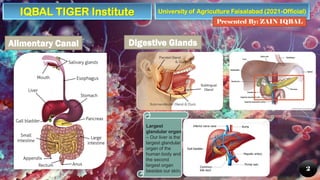
Alimentary Canal Digestive Glands
Largest
glandular organ
– Our liver is the
largest glandular
organ of the
human body and
the second
largest organ
besides our skin.
IQBAL TIGER Institute
University of Agriculture Faisalabad (2021-Official)
Presented By: ZAIN IQBAL
3
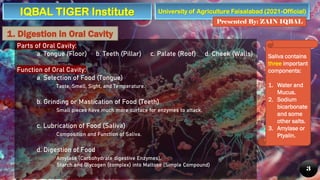
Parts of Oral Cavity:
a. Tongue (Floor) b. Teeth (Pillar) c. Palate (Roof) d. Cheek (Walls)
Function of Oral Cavity:
a. Selection of Food (Tongue)
Taste, Smell, Sight, and Temperature.
b. Grinding or Mastication of Food (Teeth)
Small pieces have much more surface for enzymes to attack.
c. Lubrication of Food (Saliva)
Composition and Function of Saliva.
d. Digestion of Food
Amylase (Carbohydrate digestive Enzymes).
Starch and Glycogen (complex) into Maltose (Simple Compound)
1. Digestion in Oral Cavity
Saliva contains
three important
components:
1. Water and
Mucus.
2. Sodium
bicarbonate
and some
other salts.
3. Amylase or
Ptyalin.
IQBAL TIGER Institute
University of Agriculture Faisalabad (2021-Official)
Presented By: ZAIN IQBAL
4
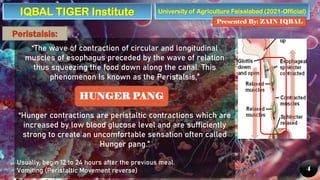
“The wave of contraction of circular and longitudinal
muscles of esophagus preceded by the wave of relation
thus squeezing the food down along the canal. This
phenomenon Is known as the Peristalsis,”
“Hunger contractions are peristaltic contractions which are
increased by low blood glucose level and are sufficiently
strong to create an uncomfortable sensation often called
Hunger pang.”
Usually, begin 12 to 24 hours after the previous meal.
Vomiting (Peristaltic Movement reverse)
Peristalsis:
HUNGER PANG
IQBAL TIGER Institute
University of Agriculture Faisalabad (2021-Official)
Presented By: ZAIN IQBAL
5
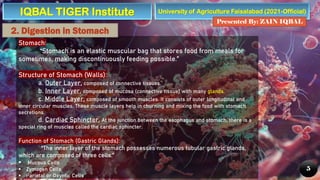
Stomach:
“Stomach is an elastic muscular bag that stores food from meals for
sometimes, making discontinuously feeding possible.”
Structure of Stomach (Walls):
a. Outer Layer, composed of connective tissues.
b. Inner Layer, composed of mucosa (connective tissue) with many glands.
c. Middle Layer, composed of smooth muscles. It consists of outer longitudinal and
inner circular muscles. These muscle layers help in churning and mixing the food with stomach
secretions.
d. Cardiac Sphincter, At the junction between the esophagus and stomach, there is a
special ring of muscles called the cardiac sphincter.
Function of Stomach (Gastric Glands):
“The inner layer of the stomach possesses numerous tubular gastric glands,
which are composed of three cells.”
▪ Mucous Cells
▪ Zymogen Cells
▪ Parietal or Oxyntic Cells
2. Digestion in Stomach
IQBAL TIGER Institute
University of Agriculture Faisalabad (2021-Official)
Presented By: ZAIN IQBAL
6
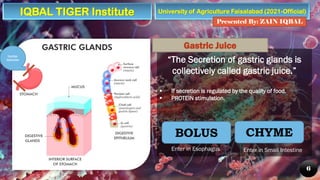
“The Secretion of gastric glands is
collectively called gastric juice.”
▪ If secretion is regulated by the quality of food.
▪ PROTEIN stimulation.
Gastric Juice
BOLUS CHYME
Cardiac
Sphincter
Enter in Esophagus Enter in Small Intestine
IQBAL TIGER Institute
University of Agriculture Faisalabad (2021-Official)
Presented By: ZAIN IQBAL
7
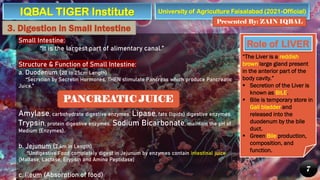
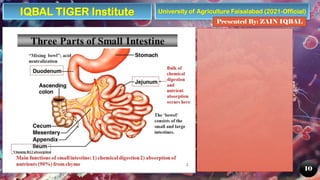
Small Intestine:
“It is the largest part of alimentary canal.”
Structure & Function of Small Intestine:
a. Duodenum (20 to 25cm Length)
“Secretion by Secretin Hormones, THEN stimulate Pancreas which produce Pancreatic
Juice.”
Amylase, carbohydrate digestive enzymes. Lipase, fats (lipids) digestive enzymes.
Trypsin, protein digestive enzymes. Sodium Bicarbonate, maintain the pH of
Medium (Enzymes).
b. Jejunum (2.4m in Length)
“Undigestive Food completely digest in Jejunum by enzymes contain intestinal juice
(Maltase, Lactase, Erypsin and Amino Peptidase)
c. Ileum (Absorption of food)
3. Digestion in Small Intestine
PANCREATIC JUICE
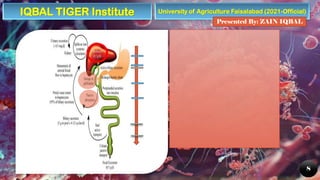
“The Liver is a reddish
brown large gland present
in the anterior part of the
body cavity.”
▪ Secretion of the Liver is
known as BILE.
▪ Bile is temporary store in
Gall bladder and
released into the
duodenum by the bile
duct.
▪ Green Bile production,
composition, and
function.
Role of LIVER
IQBAL TIGER Institute
University of Agriculture Faisalabad (2021-Official)
Presented By: ZAIN IQBAL
8
IQBAL TIGER Institute
University of Agriculture Faisalabad (2021-Official)
Presented By: ZAIN IQBAL
9
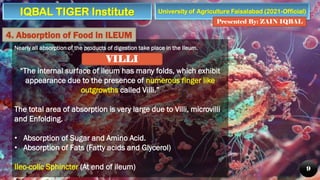
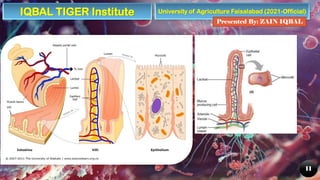
Nearly all absorption of the products of digestion take place in the Ileum.
“The internal surface of ileum has many folds, which exhibit
appearance due to the presence of numerous finger like
outgrowths called Villi.”
The total area of absorption is very large due to Villi, microvilli
and Enfolding.
• Absorption of Sugar and Amino Acid.
• Absorption of Fats (Fatty acids and Glycerol)
Ileo-colic Sphincter (At end of ileum)
4. Absorption of Food in ILEUM
VILLI
IQBAL TIGER Institute
University of Agriculture Faisalabad (2021-Official)
Presented By: ZAIN IQBAL
10
IQBAL TIGER Institute
University of Agriculture Faisalabad (2021-Official)
Presented By: ZAIN IQBAL
11
IQBAL TIGER Institute
University of Agriculture Faisalabad (2021-Official)
Presented By: ZAIN IQBAL
12
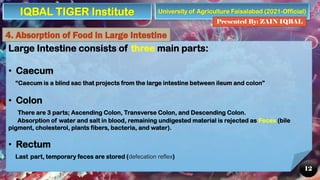
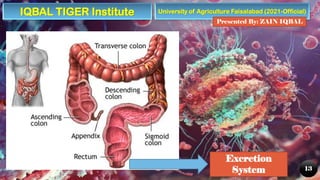
Large Intestine consists of three main parts:
• Caecum
“Caecum is a blind sac that projects from the large intestine between ileum and colon”
• Colon
There are 3 parts; Ascending Colon, Transverse Colon, and Descending Colon.
Absorption of water and salt in blood, remaining undigested material is rejected as Feces (bile
pigment, cholesterol, plants fibers, bacteria, and water).
• Rectum
Last part, temporary feces are stored (defecation reflex)
4. Absorption of Food in Large Intestine
IQBAL TIGER Institute
University of Agriculture Faisalabad (2021-Official)
Presented By: ZAIN IQBAL
13
Excretion
System
IQBAL TIGER Institute
University of Agriculture Faisalabad (2021-Official)
Presented By: ZAIN IQBAL
14
Why is Digestive Health Important?
The digestive system plays a major role in your overall health as it brings nutrients to your body. Without
good digestive health, you will experience a host of uncomfortable symptoms such as abdominal pain, bloating,
indigestion, and more.
What would happen if you have no digestive system?
If you had no digestive system, you would have no ability to get the nutrients and sugars in food, and you
would die.
For better digestive health, follow these simple tips:
1.Eat a high-fiber diet. ...
2.Be sure you're getting both soluble and insoluble fiber. ...
3.Minimize your intake of foods high in fat. ...
4.Select lean meats. ...
5.Add probiotics to your diet. ...
6.Follow a regular eating schedule. ...
7.Drink plenty of water.
IQBAL TIGER Institute
University of Agriculture Faisalabad (2021-Official)
Presented By: ZAIN IQBAL
15
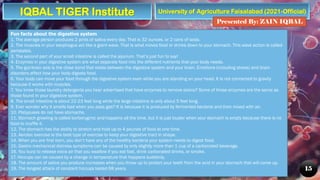
Fun facts about the digestive system
1. The average person produces 2 pints of saliva every day. That is 32 ounces, or 2 cans of soda.
2. The muscles in your esophagus act like a giant wave. That is what moves food or drinks down to your stomach. This wave action is called
peristalsis.
3. The second part of your small intestine is called the jejunum. That’s just fun to say!
4. Enzymes in your digestive system are what separate food into the different nutrients that your body needs.
5. The gut-brain axis is the close bond that exists between the digestive system and your brain. Emotions (including stress) and brain
disorders affect how your body digests food.
6. Your body can move your food through the digestive system even while you are standing on your head. It is not connected to gravity
because it works with muscles.
7. You know those laundry detergents you hear advertised that have enzymes to remove stains? Some of those enzymes are the same as
those found in your digestive system.
8. The small intestine is about 22-23 feet long while the large intestine is only about 5 feet long.
9. Ever wonder why it smells bad when you pass gas? It is because it is produced by fermented bacteria and then mixed with air.
10. Platypuses do not have stomachs.
11. Stomach growling is called borborygmic and happens all the time, but it is just louder when your stomach is empty because there is no
food to muffle it.
12. The stomach has the ability to stretch and hold up to 4 pounds of food at one time.
13. Aerobic exercise is the best type of exercise to keep your digestive tract in shape.
14. When you are first born, you don’t have any of the healthy bacteria your system needs to digest food.
15. Gastro mechanical distress symptoms can be caused by only slightly more than 1 cup of a carbonated beverage.
16. You burp to release extra air that you swallow if you eat fast, drink carbonated drinks, or smoke.
17. Hiccups can be caused by a change in temperature that happens suddenly.
18. The amount of saliva you produce increases when you throw up to protect your teeth from the acid in your stomach that will come up.
19. The longest attack of constant hiccups lasted 68 years.
IQBAL TIGER Institute

Human Digestive System Structure, Composition, and Function(Enzymes, Glands, and Hormones)

  • 1.
    IQBAL TIGER InstituteUniversity of Agriculture Faisalabad (2021-Official) Presented By: ZAIN IQBAL IGE TIVE YSTEM
  • 2.
    University of AgricultureFaisalabad (2021-Official) Presented By: ZAIN IQBAL ENZYMES GLANDS 0 HORMONE DIET BIOLOGICAL ORGANIZATIOM CARBOHYDRATES (Milk, Potatoes) PROTEINS (Meat, Fish, Eggs) LIPIDS (Butter, Cheese, Nuts, Oil) WATER IQBAL TIGER Institute
  • 3.
    University of AgricultureFaisalabad (2021-Official) Presented By: ZAIN IQBAL 1 The digestive system converts the foods we eat into their simplest forms, like glucose (sugars), amino acids (that make up protein), or fatty acids (that make up fats). The broken-down food is then absorbed into the bloodstream from the small intestine and the nutrients are carried to each cell in the body. Digestion is the complex process of turning the food you eat into nutrients, which the body uses for energy, growth, and cell repair needed to survive. The digestion process also involves creating waste to be eliminated. What is Digestion? What is Digestion System? The Digestive System of humans consists of two major parts: ➢ Alimentary Canal “It is a tube-like structure which starts from the mouth and ends in the anus. The alimentary canal plays a primary role in human digestion and is also termed as the digestive tract.” ➢ Digestive Glands “Salivary glands, Liver and Pancreas.” IQBAL TIGER Institute
  • 4.
    University of AgricultureFaisalabad (2021-Official) Presented By: ZAIN IQBAL 2 Alimentary Canal Digestive Glands Largest glandular organ – Our liver is the largest glandular organ of the human body and the second largest organ besides our skin. IQBAL TIGER Institute
  • 5.
    University of AgricultureFaisalabad (2021-Official) Presented By: ZAIN IQBAL 3 Parts of Oral Cavity: a. Tongue (Floor) b. Teeth (Pillar) c. Palate (Roof) d. Cheek (Walls) Function of Oral Cavity: a. Selection of Food (Tongue) Taste, Smell, Sight, and Temperature. b. Grinding or Mastication of Food (Teeth) Small pieces have much more surface for enzymes to attack. c. Lubrication of Food (Saliva) Composition and Function of Saliva. d. Digestion of Food Amylase (Carbohydrate digestive Enzymes). Starch and Glycogen (complex) into Maltose (Simple Compound) 1. Digestion in Oral Cavity Saliva contains three important components: 1. Water and Mucus. 2. Sodium bicarbonate and some other salts. 3. Amylase or Ptyalin. IQBAL TIGER Institute
  • 6.
    University of AgricultureFaisalabad (2021-Official) Presented By: ZAIN IQBAL 4 “The wave of contraction of circular and longitudinal muscles of esophagus preceded by the wave of relation thus squeezing the food down along the canal. This phenomenon Is known as the Peristalsis,” “Hunger contractions are peristaltic contractions which are increased by low blood glucose level and are sufficiently strong to create an uncomfortable sensation often called Hunger pang.” Usually, begin 12 to 24 hours after the previous meal. Vomiting (Peristaltic Movement reverse) Peristalsis: HUNGER PANG IQBAL TIGER Institute
  • 7.
    University of AgricultureFaisalabad (2021-Official) Presented By: ZAIN IQBAL 5 Stomach: “Stomach is an elastic muscular bag that stores food from meals for sometimes, making discontinuously feeding possible.” Structure of Stomach (Walls): a. Outer Layer, composed of connective tissues. b. Inner Layer, composed of mucosa (connective tissue) with many glands. c. Middle Layer, composed of smooth muscles. It consists of outer longitudinal and inner circular muscles. These muscle layers help in churning and mixing the food with stomach secretions. d. Cardiac Sphincter, At the junction between the esophagus and stomach, there is a special ring of muscles called the cardiac sphincter. Function of Stomach (Gastric Glands): “The inner layer of the stomach possesses numerous tubular gastric glands, which are composed of three cells.” ▪ Mucous Cells ▪ Zymogen Cells ▪ Parietal or Oxyntic Cells 2. Digestion in Stomach IQBAL TIGER Institute
  • 8.
    University of AgricultureFaisalabad (2021-Official) Presented By: ZAIN IQBAL 6 “The Secretion of gastric glands is collectively called gastric juice.” ▪ If secretion is regulated by the quality of food. ▪ PROTEIN stimulation. Gastric Juice BOLUS CHYME Cardiac Sphincter Enter in Esophagus Enter in Small Intestine IQBAL TIGER Institute
  • 9.
    University of AgricultureFaisalabad (2021-Official) Presented By: ZAIN IQBAL 7 Small Intestine: “It is the largest part of alimentary canal.” Structure & Function of Small Intestine: a. Duodenum (20 to 25cm Length) “Secretion by Secretin Hormones, THEN stimulate Pancreas which produce Pancreatic Juice.” Amylase, carbohydrate digestive enzymes. Lipase, fats (lipids) digestive enzymes. Trypsin, protein digestive enzymes. Sodium Bicarbonate, maintain the pH of Medium (Enzymes). b. Jejunum (2.4m in Length) “Undigestive Food completely digest in Jejunum by enzymes contain intestinal juice (Maltase, Lactase, Erypsin and Amino Peptidase) c. Ileum (Absorption of food) 3. Digestion in Small Intestine PANCREATIC JUICE “The Liver is a reddish brown large gland present in the anterior part of the body cavity.” ▪ Secretion of the Liver is known as BILE. ▪ Bile is temporary store in Gall bladder and released into the duodenum by the bile duct. ▪ Green Bile production, composition, and function. Role of LIVER IQBAL TIGER Institute
  • 10.
    University of AgricultureFaisalabad (2021-Official) Presented By: ZAIN IQBAL 8 IQBAL TIGER Institute
  • 11.
    University of AgricultureFaisalabad (2021-Official) Presented By: ZAIN IQBAL 9 Nearly all absorption of the products of digestion take place in the Ileum. “The internal surface of ileum has many folds, which exhibit appearance due to the presence of numerous finger like outgrowths called Villi.” The total area of absorption is very large due to Villi, microvilli and Enfolding. • Absorption of Sugar and Amino Acid. • Absorption of Fats (Fatty acids and Glycerol) Ileo-colic Sphincter (At end of ileum) 4. Absorption of Food in ILEUM VILLI IQBAL TIGER Institute
  • 12.
    University of AgricultureFaisalabad (2021-Official) Presented By: ZAIN IQBAL 10 IQBAL TIGER Institute
  • 13.
    University of AgricultureFaisalabad (2021-Official) Presented By: ZAIN IQBAL 11 IQBAL TIGER Institute
  • 14.
    University of AgricultureFaisalabad (2021-Official) Presented By: ZAIN IQBAL 12 Large Intestine consists of three main parts: • Caecum “Caecum is a blind sac that projects from the large intestine between ileum and colon” • Colon There are 3 parts; Ascending Colon, Transverse Colon, and Descending Colon. Absorption of water and salt in blood, remaining undigested material is rejected as Feces (bile pigment, cholesterol, plants fibers, bacteria, and water). • Rectum Last part, temporary feces are stored (defecation reflex) 4. Absorption of Food in Large Intestine IQBAL TIGER Institute
  • 15.
    University of AgricultureFaisalabad (2021-Official) Presented By: ZAIN IQBAL 13 Excretion System IQBAL TIGER Institute
  • 16.
    University of AgricultureFaisalabad (2021-Official) Presented By: ZAIN IQBAL 14 Why is Digestive Health Important? The digestive system plays a major role in your overall health as it brings nutrients to your body. Without good digestive health, you will experience a host of uncomfortable symptoms such as abdominal pain, bloating, indigestion, and more. What would happen if you have no digestive system? If you had no digestive system, you would have no ability to get the nutrients and sugars in food, and you would die. For better digestive health, follow these simple tips: 1.Eat a high-fiber diet. ... 2.Be sure you're getting both soluble and insoluble fiber. ... 3.Minimize your intake of foods high in fat. ... 4.Select lean meats. ... 5.Add probiotics to your diet. ... 6.Follow a regular eating schedule. ... 7.Drink plenty of water. IQBAL TIGER Institute
  • 17.
    University of AgricultureFaisalabad (2021-Official) Presented By: ZAIN IQBAL 15 Fun facts about the digestive system 1. The average person produces 2 pints of saliva every day. That is 32 ounces, or 2 cans of soda. 2. The muscles in your esophagus act like a giant wave. That is what moves food or drinks down to your stomach. This wave action is called peristalsis. 3. The second part of your small intestine is called the jejunum. That’s just fun to say! 4. Enzymes in your digestive system are what separate food into the different nutrients that your body needs. 5. The gut-brain axis is the close bond that exists between the digestive system and your brain. Emotions (including stress) and brain disorders affect how your body digests food. 6. Your body can move your food through the digestive system even while you are standing on your head. It is not connected to gravity because it works with muscles. 7. You know those laundry detergents you hear advertised that have enzymes to remove stains? Some of those enzymes are the same as those found in your digestive system. 8. The small intestine is about 22-23 feet long while the large intestine is only about 5 feet long. 9. Ever wonder why it smells bad when you pass gas? It is because it is produced by fermented bacteria and then mixed with air. 10. Platypuses do not have stomachs. 11. Stomach growling is called borborygmic and happens all the time, but it is just louder when your stomach is empty because there is no food to muffle it. 12. The stomach has the ability to stretch and hold up to 4 pounds of food at one time. 13. Aerobic exercise is the best type of exercise to keep your digestive tract in shape. 14. When you are first born, you don’t have any of the healthy bacteria your system needs to digest food. 15. Gastro mechanical distress symptoms can be caused by only slightly more than 1 cup of a carbonated beverage. 16. You burp to release extra air that you swallow if you eat fast, drink carbonated drinks, or smoke. 17. Hiccups can be caused by a change in temperature that happens suddenly. 18. The amount of saliva you produce increases when you throw up to protect your teeth from the acid in your stomach that will come up. 19. The longest attack of constant hiccups lasted 68 years. IQBAL TIGER Institute