INTRODUCTION:
POPULAR NOTIONS
A. HumanIntelligence is Fixed -
This Intelligent is measured through
intelligence quotient (IQ) tests.
B. Human Intelligence is changes -
Individual learn new things.
Emphasize the role of experience in
shaping the human brain.
4.
Learning happens insidethe
brain because:
• Neural Networks - Look like a
spider webs. There are billions of
interacting neurons that form
neural connections.
• Neural Connections - Shaped by
our exposure to social
interactions and the changing
environment.
5.
VIEWS ON THEHUMAN BRAIN
• For many years,it was believed
that the human brain has fixed
memory, processing speed,and
Intelligence.
• "HARDWIRED", permanently
connected circular location.
LATELY,
BRAIN PLASTICITY DEVELOPMENTAL
PLASTICITY
Thebrain's capacity to
change itself structurally
and functionally
throughout the duration
of one's life because of
the influence of one's
environment as well as
genetic and biological
factors.
The brain has a period of
intense,during this
period the first 25 years
or so of life. Beyond this
stage,it is more difficult
to learn a specific
behavior.
8.
THE BRAIN THATCHANGE ITSELF (2007)-"The
brain is not an inanimate vessel that we fill; rather it
is more like a living creature with an appetite,one
that can grow and change itself with proper
nourishment and exercise
ABOUT BRAIN PLASTICITY:
NEUROSCIENCE NEUROPLASTICITY
This research is engaged
in deepening our
knowledge of the brain's
ability to adapt and
change itself.
This created avenues for
developing a set of
cognitive therapies and
treatments for different
issues sorrounding the
function and structure of
the brain.
9.
NEURON AND NEURALNETWORK
• Brain is composed of 80 to 100.billion
neurons or nerve cells.
• Clusters of Neurons that connect to each other
can be referred to as Biological Neural
Networks, with different networks connecting to
each other in circuits called Neural Pathways.
DONALD HEBB(1904-1985)
Hebb's Rule: "The neurons that
fire together wire together"
10.
• Neural Connections- Made inside the
brain.
• Neural Interaction - Reinforced
resulting in Myelination of circuits when
actions are repeteadly done which is
exemplified in learning a complex skill.
• Myelination - process where a fatty
coating called myelin wraps around the
axon of a neuron.
12.
SYNAPTIC CONNECTION BETWEENTWO
NEURONS
NEURON HAVE THREE MAIN PARTS:
• Dendrites - Relay signals to the cell body.
• Cell body - if the signals are strong
enough when they reach the cell body,
trigger an electrical signal called an action
potential.
• Axon - Prompt the release of chemical
signals to the other cells.
13.
PRESYNAPTIC
- A neuronthat is sending information
POSTSYNAPTIC
- A neuron that is receiving information
SYNAPTIC CLEFT
- Small Spaces between the axon of
presynaptic neuron and the dendrites of a
postsynaptic neuron.
14.
ARTIFICIAL NEURAL NETWORK
•Artificial Neural Networks (ANN)
- a system of reasoning based on the
human brain.
• OECD 2018 - "It is a type of
Artificial Intelligence that attempts
to replicate the way human brain
works".
15.
DR. ROBERT HECHT-NIELSEN
-An Inventor of one of the first
neurocomputers, defined ANN as
a system that uses interconnecting
networks in processing information
to generate an output.
• Computer Scientist - "Machines can
mimic the way the human brain
processes information through the use of
computer software or electronic circuits."
ARTIFICIAL
NEURAL
NETWORKS
BIOLOGICAL
NEURAL
NETWORKS
• Using simplified
mathematicalmodels.
• Information in the brain is
processed when signals can be
received from dendrites and
sent down the axon once
enough signals were received
• Fixed Mathematical equation
• Requires a massive volume of
data and computation power
and time
• Neural Networks im human
brains are shaped by one's
experiences which affect one's
decisions and actions.
• Human neural networks
functions a more complex way.
• We process experience
differently because we are
situated in diverse social
contexts.
Triune Brain ismade up of:
A. Hindbrain
B. Midbrain
C. Cortex(Forebrain)
1. Hindbrain – the oldest part, responsible for basic
survival functions like breathing, heartbeat, and
balance.
2. Midbrain – controls simple movement, coordination,
and some reflexes.
3. Cortex (forebrain) – the newest part evolutionarily,
responsible for complex thinking, reasoning, problem-
solving, language, and planning.
21.
• Focuses hasnow shifted from
Modularization to connectivity between
different areas.
• Learning to master a particular
skill involves more Neural
Connections between various
brain regions.
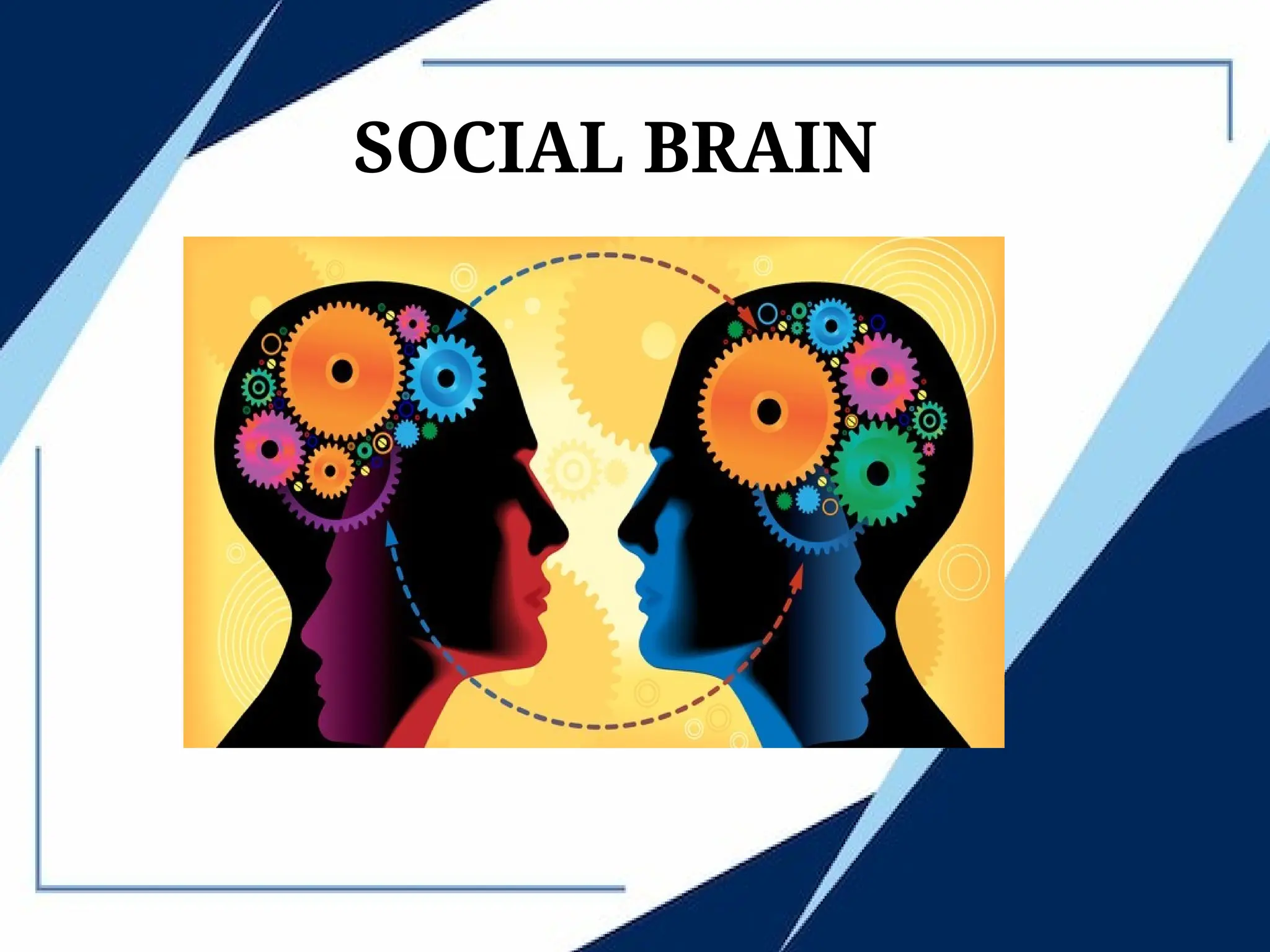
• Brain isthe Social Organ of
the body
• It is responsible for discharging
intelligence and emotions,
carrying out a primary role in our
Socialization
• Responding to the
environment around us with
both rational thought and
feelings