Greek & Roman Humanities
Prof.	
  Will	
  Adams	
  ·∙	
  Osceola	
  Campus	
  –	
  Building	
  1,	
  Room	
  104·∙	
  Mondays	
  &	
  Wednesdays,	
  12:00	
  –	
  1:15	
  PM
	
  
Research Project Description
	
  
For	
  your	
  research	
  assignment,	
  you	
  will	
  be	
  tasked	
  with	
  researching	
  a	
  piece	
  of	
  art,	
  analyzing	
  it	
  in	
  the	
  form	
  of	
  a	
  4-­‐
page	
  research	
  essay,	
  and	
  then	
  reinterpreting	
  it	
  in	
  your	
  own	
  creative	
  way.	
  The	
  following	
  will	
  guide	
  you	
  through	
  the	
  
recommended	
  process	
  to	
  complete	
  your	
  assignment:	
  
1. You	
  will	
  choose	
  your	
  piece	
  of	
  art	
  by	
  drawing	
  a	
  topic,	
  at	
  random,	
  from	
  a	
  hat.	
  
2. Once	
  you’ve	
  chosen	
  your	
  piece	
  of	
  art,	
  perform	
  research	
  on	
  it.	
  	
  
a. For	
  a	
  four-­‐page	
  research	
  project,	
  you	
  should	
  use	
  no	
  fewer	
  than	
  6	
  credible	
  sources.	
  	
  
b. With	
  the	
  exception	
  of	
  the	
  databases	
  available	
  through	
  Valencia’s	
  libraries,	
  none	
  of	
  your	
  sources	
  may	
  
come	
  from	
  the	
  Internet.	
  
3. After	
  you’ve	
  completed	
  your	
  research	
  and	
  have	
  a	
  good	
  understanding	
  of	
  the	
  piece	
  of	
  art’s	
  meaning,	
  use	
  what	
  
you’ve	
  learned	
  to	
  create	
  your	
  own	
  interpretation	
  of	
  it.	
  	
  
• You	
  may,	
  and	
  in	
  fact	
  are	
  encouraged	
  to,	
  change	
  the	
  medium	
  from	
  the	
  original	
  work	
  of	
  art	
  to	
  
your	
  own.	
  	
  
• For	
  instance,	
  if	
  you	
  choose	
  a	
  painting,	
  you	
  may	
  reinterpret	
  that	
  as	
  a	
  painting,	
  a	
  song,	
  a	
  film,	
  etc.	
  	
  
• Be	
  sure	
  the	
  medium	
  you	
  choose	
  caters	
  to	
  your	
  own	
  abilities	
  and	
  interests,	
  not	
  the	
  original	
  
artist’s.	
  
• Possible	
  media	
  to	
  consider	
  for	
  your	
  interpretation	
  include	
  photography,	
  fashion	
  design,	
  
painting,	
  dance,	
  sculpture,	
  modeling,	
  film,	
  or	
  poetry.	
  	
  
• Be	
  creative	
  and	
  “think	
  outside	
  the	
  box”!	
  	
  
4. Finally,	
  write	
  a	
  research	
  essay	
  that	
  first	
  discusses	
  the	
  original	
  artwork	
  as	
  you	
  understand	
  it	
  from	
  your	
  
research.	
  	
  
• This	
  section	
  should	
  make	
  up	
  the	
  bulk	
  of	
  your	
  paper’s	
  length	
  –	
  at	
  least	
  4	
  pages.	
  	
  
• In	
  addition,	
  you	
  should	
  not	
  use	
  first	
  or	
  second	
  person	
  point-­‐of-­‐view	
  when	
  writing	
  this	
  section	
  of	
  
your	
  paper.	
  
• After	
  discussing	
  the	
  original	
  artwork,	
  then	
  discuss	
  your	
  own	
  interpretation.	
  Be	
  sure	
  to	
  explain	
  
your	
  own	
  perspective	
  and	
  artistic	
  choices.	
  This	
  is	
  the	
  only	
  section	
  of	
  your	
  paper	
  in	
  which	
  you	
  are	
  
allowed	
  to	
  use	
  first-­‐person	
  point-­‐of-­‐view	
  (i.e.	
  “After	
  completing	
  my	
  research	
  on	
  Michelangelo,	
  I	
  
concluded	
  that…”).	
  
• Collectively,	
  the	
  written	
  body	
  of	
  your	
  essay	
  should	
  total	
  5	
  full	
  pages.	
  
• Your	
  text	
  should	
  be	
  double-­‐spaced,	
  set	
  in	
  Arial	
  size	
  12	
  font,	
  and	
  have	
  standard	
  1”	
  margins.	
  Use	
  
proper	
  MLA	
  style	
  citation	
  for	
  in-­‐text	
  citations,	
  the	
  Works	
  Cited	
  page,	
  and	
  the	
  cover	
  page	
  (refer	
  
to	
  attached	
  MLA	
  style	
  guide	
  for	
  help).	
  
5. OPTIONAL:	
  You	
  may	
  email	
  in	
  a	
  draft	
  of	
  your	
  project	
  for	
  my	
  feedback	
  on	
  Wednesday,	
  November	
  18
th
	
  to	
  
wadams5@valenciacollege.edu.	
  
6. You	
  will	
  submit	
  both	
  the	
  artistic	
  and	
  the	
  written	
  components	
  of	
  your	
  project	
  in	
  class	
  on	
  Wednesday,	
  
December	
  2
nd
.	
  
In	
  conclusion:	
  Have	
  as	
  much	
  fun	
  as	
  you	
  can	
  with	
  this!	
  This	
  assignment	
  isn’t	
  meant	
  as	
  a	
  punishment,	
  but	
  
rather	
  as	
  an	
  opportunity	
  for	
  you	
  to	
  synthesize	
  academic	
  skills	
  with	
  personal	
  expression.	
  The	
  more	
  passionate	
  you	
  
are	
  about	
  your	
  chosen	
  topic,	
  that	
  less	
  “work”	
  this	
  assignment	
  will	
  be.	
  
Go to http://www.andyspinks.com/mla/ for more information. © 2000-2009, Andrew Spinks. Duplicate freely for nonprofit educational use.   __________  


Research papers always contain information compiled from other sources.
When you write a research paper, you must cite the sources of your
information. In other words, you must give proper credit to the original
authors of the information and let your readers know how to find the
information for themselves. There are many different ways to cite the sources
of our information, but this guide is designed to help you learn “MLA style,”
outlined in the Modern Language Association’s MLA Handbook for Writers of
Research Papers (http://mlahandbook.org).
Before you start your research, you may want to print copies of the Citation
Data Form from http://andyspinks.com/mla/ and use them to collect the
bibliographic information for each of your sources.
There are three main parts to MLA citation:
1.The Information Itself (quoting and paraphrasing properly)
2.The In-Text Citation (giving the source of each bit of information)
3.The “Works Cited” Page (creating a list of the sources you used)
Make sure to read the information at the beginning of all three sections before
you begin.
PPaarrtt 11:: TThhee IInnffoorrmmaattiioonn IIttsseellff
All research papers contain information from other sources. When you use
information that has been previously published by someone else, it is
important that you avoid plagiarism – presenting someone else's ideas as your
own. (Plagiarism is not just cheating; it is also stealing.) There are two ways
that you can include other people's ideas and words in your paper without
plagiarizing: paraphrasing and quotation.
Paraphrasing
You can include someone else's ideas in your paper by putting those ideas into
your own words. This is called paraphrasing. Here are a few things to
remember when paraphrasing:
 Always cite the source of the paraphrased information with in-text citation
(see Part 2) and list the source on your Works Cited page (see Part 3).
 Restate the information using your own words and your own sentences.
Never use the same sentence structure as the original author.
 Combine information from different sources. Try not to paraphrase more
than one or two sentences in a row from the same source.
Short Quotations (Up to Four Lines)
Picasso's attraction to art came at an early age; in fact, he “was able to
draw before he could speak, and he could speak long before he was
able to walk” (Bernadac and Bouchet 19).
Long Quotations (More than Four Lines)
One critic adeptly summarized the mainstreaming of the punk genre:
For punk rock, the 1990s were a watershed and a nightmare.
The mainstream commercial success in that decade of bands
like Green Day, Rancid, and Blink 182 was unprecedented
for a genre that survived the Reagan-Bush era on $3 concerts,
indie labels, and the relatively limited broadcast range of
college radio. (Matula 19)
This commercialization was simultaneously the rise and fall of punk.
PPaarrtt 22:: TThhee IInn--TTeexxtt CCiittaattiioonn
When you include information from other sources in your paper, you must
include a citation that tells where the information came from (regardless of
whether you quoted it or paraphrased it). At one time, MLA Style required
that these citations be listed as footnotes at the bottom of the page. Now you
can just insert a shortened citation immediately after the information you
have quoted or paraphrased. (Since the citations appear in the text of your
paper, they are called “in-text” citations. Since they are enclosed in
parentheses, they are sometimes called "parenthetical" citations.)
The citation should direct the reader to that source's entry on the Works
Cited page of your report. For print sources, you normally only need to
include the Author and Page Number in your citation. For multi-volume works
like encyclopedias, include the Author, Volume Number, and Page Number
(with a colon separating the volume and page). For internet sites and other
sources without specific page numbers, just include the Author . If the author
is not given, use the first few words of the title (in quotation marks).
Book or Signed Article
Encouraged by the government, tourism is one of the largest
industries in Greece (Arnold 45-46).
Book or Signed Article (Author Mentioned in Text)
Arnold states that tourism, encouraged by the government, is one of
Greece's largest industries (45-46).
Book or Signed Article (Two Authors)
Picasso's attraction to art came at an early age; in fact, he “was able
to draw before he could speak, and he could speak long before he
was able to walk” (Bernadac and Bouchet 19).
Article in a Multi-Volume Reference Book
The abundance of natural resource in Great Britain and its colonies
was one factor that allowed the industrial revolution to begin there
(Lampard 10:248).
Article in a Multi-Volume Reference Book (No Author)
Globally, no other infectious disease kills more people than
tuberculosis (“Tuberculosis” 3:875).
Online Source (No Page Numbers)
Hinduism and its mythology are a mixture, resulting from centuries
of cross-cultural integration (Naylor).
Online Source (No Author or Page Numbers)
Available as a free download, OpenOffice is a popular open source
alternative to Microsoft Office (“OpenOffice 3.0”).
Quotation
You can also use someone else's exact words in your paper; you just have to
clearly indicate that the words are a quotation and give proper credit to the
original author. This is very useful when the original author has phrased the
idea in a powerful, clever, or unique way. If the quoted text is four lines or
less, you should put it in quotation marks and include it in line with the rest of
your paper. If the quoted text is more than four lines, you should put it in a
separate paragraph (without quotation marks) and indent it by one inch.
Either way, you should introduce the quotation and make sure to explain how
the information relates to your paper.
Original Encyclopedia Text:
“The industrial revolution began in
Great Britain for several reasons.
The country had large deposits of
coal and iron, the two natural re-
sources on which early industrializa-
tion largely depended. Other indus-
trial raw materials came from Great
Britain's Colonies.”
Paraphrase:
The abundance of natural
resources in Great Britain
and its colonies was one
factor that allowed the
industrial revolution to begin
there (Lampard 10:248).
Go to http://www.andyspinks.com/mla/ for more information. © 2000-2009, Andrew Spinks. Duplicate freely for nonprofit educational use.   __________  


Reference or Encyclopedia Article (from a database)
Author. “Title of Article.” Title of Book. Editor. Volume. City of
Publication: Publisher, Year. Database Title. Format. Date of
Access.
Rickards, Joseph. “Photorealism.” Encyclopedia Americana. 2009.
Grolier Online. Web. 21 Oct. 2009.
Henningfeld, Diane. “Overview of The Bluest Eye.” EXPLORING
Novels. Detroit: Gale, 2003. Student Resource Center – Gold.
Web. 21 Oct. 2009.
Magazine or Newspaper Article (Print)
Author. “Title of Article.” Magazine or Newspaper Date: Pages.
Format.
Johnston, Richard. “Martin History Revisited.” Acoustic Guitar July
2009: 60-69. Print.
Magazine or Newspaper Article (from a database)
Author. “Title of Article.” Magazine or Newspaper Date: Pages.
Database Title. Format. Date of Access.
Faure, Gaelle. “Managing Your Online Afterlife.” Time 14 Sep. 2009:
51-52. MAS Ultra - School Edition. Web. 21 Oct. 2009.
Academic Journal Article (from a database)
Author. “Title of Article.” Journal Title Volume.Issue (Year): Pages.
Database Title. Format. Date of Access.
Matula, Theodore. “Pow! to the People: The Make-Up's
Reorganization of Punk Rhetoric.” Popular Music & Society 30.1
(2007): 19-38. Academic Search Complete. Web. 27 Oct. 2009.
Web Page
Author. “Title of Page.” Title of Web Site. Publisher or Sponsor, Date
of Publication. Format. Date of Access.
“Adderall.” PDRhealth. PDR Network, 2009. Web. 21 Oct. 2009.
Naylor, Stephen. “Hindu Mythology.” Encyclopedia Mythica.
N.p., 8 Apr. 2006. Web. 21 Oct. 2009.
“OpenOffice 3.0.” Osalt.com. N.p., n.d. Web. 6 Nov. 2009.
Online Photograph, Illustration, or Image
Artist. Image Title. Date of Publication. Collection or Institution.
Website or database. Format. Date of Access.
Adams, Ansel. Guayle Field, Manzanar Relocation Center. 1943.
Library of Congress. American Memory. Web. 27 Oct. 2009.
Song or Sound Recording (from a CD or MP3)
Specific Contributor. “Song Title.” Other Major Contributors. Album
Title. Publisher, Year. Format.
Copeland, Aaron. “Fanfare for the Common Man.” Perf. New York
Philharmonic. Cond. Leonard Bernstein. Sing America. Warner
Bros., 1999. CD.
Jimi Hendrix Experience. “All Along the Watchtower.” By Bob
Dylan. Electric Ladyland. MCA, 1968. MP3.
Video or Movie (on DVD or VHS)
Specific Contributor. Title. Other Major Contributors. Distributor,
Year. Format.
Brando, Marlon, perf. A Streetcar Named Desire. By Tennessee
Williams. Dir. Elia Kazan. Warner Bros., 2006. DVD.
Video or Movie (Online)
Specific Contributor. Title. Other Major Contributors. Publisher or
Distributor, Year. Website or database. Format. Date of Access.
Ivers, Louise, narr. Haiti: Malnutrition. Harvard University, 2009.
YouTube. Web. 27 Oct. 2009.
Book (Print)
Author. Title of Book. City of Publication: Publisher, Year. Format.
Arnold, Francis. Greece. Austin: Steck-Vaughn, 1992. Print.
Bernadac, Marie-Laure, and Paule Bouchet. Picasso: Master of the New
Idea. New York: Abrams, 1993. Print.
eBook (from a database)
Author. Title of Book. City of Publication: Publisher, Year. Database Title.
Format. Date of Access.
Katz, Mark. Capturing Sound: How Technology Has Changed Music.
Berkley: U of California P, 2004. netLibrary. Web. 15 Feb. 2006.
Article in a Reference Book or Edited Collection (Print)
Author. “Title of Article.” Title of Book. Editor. Volume. City of
Publication: Publisher, Year. Pages. Format.
Bewley, Marius. “The True Heir of the American Dream.” Readings on
The Great Gatsby. Ed. Katie de Koster. San Diego: Greenhaven, 1998.
96-103. Print.
Lampard, Eric Edwin. “Industrial Revolution.” World Book Encyclopedia.
Vol. 10. Chicago: World Book, 2000. 246-255. Print.
“Tuberculosis.” Human Diseases and Conditions. Ed. Neil Izenberg. Vol.
3. New York: Scribner's, 2000. 875-880. Print.
PPaarrtt 33:: TThhee ““WWoorrkkss CCiitteedd”” PPaaggee
The final part of MLA citation is a list of the works cited. The list should include
all of the sources cited in the text of the paper and only those cited in the paper.
(See Part 2: The In-Text Citation)
Creating and Formatting a Works Cited Page
Creating a Works Cited page is easy: Begin by creating a new document or
inserting a “page break” at the end of your paper. At the top of the new page,
type the words “Works Cited” and center them. Below this title, type a list of the
sources you referred to in your report, in alphabetical order. Enter each source in
its own separate paragraph, each one formatted with a ½ inch hanging indent.
(A “hanging indent” means that the first line of the paragraph starts at the left
margin, but all other lines are indented.) Also, your list should be double-spaced,
but with no extra spaces in between. (Check the help file of your word processor
for more information on page breaks, hanging indents, and double-spacing.)
Creating and Formatting Works Cited Entries
The Works Cited entry for each source should include enough information to
allow readers to look up the original source and to distinguish it from other
sources with the same author and/or title.
Authors/Contributors: Begin each entry with the author or primary
contributor, if known. When citing one person’s specific contribution to the
work (the illustrator’s work in a graphic novel, for example), list that person
first, before the title. If a source has several major contributors (names listed
on the title page or front cover) include them after the title.
Titles/Publication Information: Each entry should also include the title(s)
of the source and the relevant information about its publication. Include the
year of publication for all sources (for magazines and newspapers, also give
the month and if known, the day.) For web pages, include the date of the
most recent update. If necessary, you can use the abbreviation “n.d.” for “no
date given” and/or “n.p.” for “no publisher given.”
Access Information: MLA style no longer requires a URL for online sources,
but it does now require that you include the format (i.e., Print, DVD, MP3) for
every source. For all online sources, MLA style also requires that you list the
title of the database or website and the date you accessed the information.
(The media format for all online sources and databases is “Web” – even if the
source is a PDF or JPEG file.)
Use the following examples to help format entries for specific sources. If you
have questions, consult the MLA Handbook or ask your teacher or library media
specialist for help.
Go to http://www.andyspinks.com/ for more information. © 2000-2009, Andrew Spinks. Duplicate freely for nonprofit educational use.
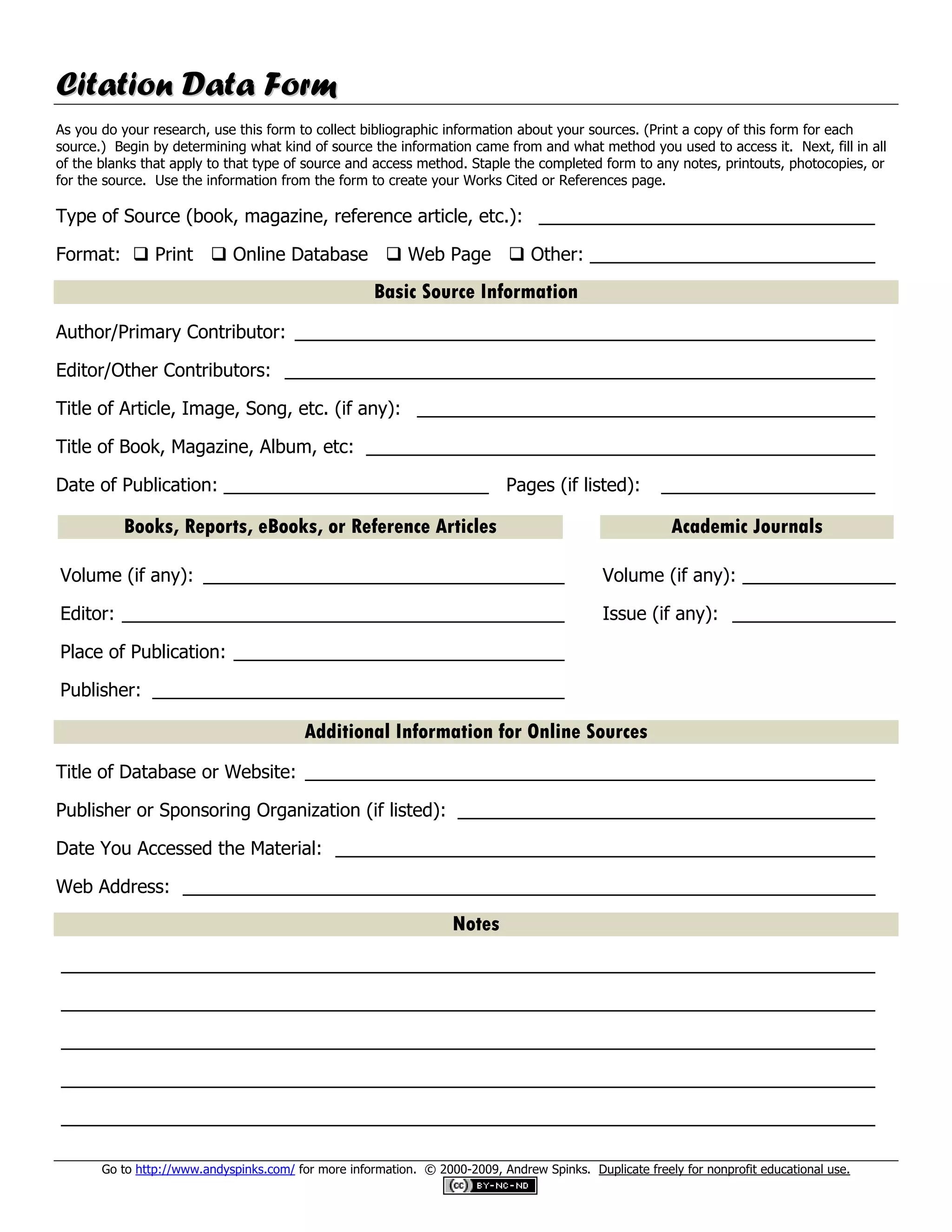
CCiittaattiioonn DDaattaa FFoorrmm
As you do your research, use this form to collect bibliographic information about your sources. (Print a copy of this form for each
source.) Begin by determining what kind of source the information came from and what method you used to access it. Next, fill in all
of the blanks that apply to that type of source and access method. Staple the completed form to any notes, printouts, photocopies, or
for the source. Use the information from the form to create your Works Cited or References page.
Type of Source (book, magazine, reference article, etc.): _________________________________
Format:  Print  Online Database  Web Page  Other: ____________________________
Basic Source Information
Author/Primary Contributor: _________________________________________________________
Editor/Other Contributors: __________________________________________________________
Title of Article, Image, Song, etc. (if any): _____________________________________________
Title of Book, Magazine, Album, etc: __________________________________________________
Date of Publication: __________________________ Pages (if listed): _____________________
Books, Reports, eBooks, or Reference Articles Academic Journals
Volume (if any): ____________________________________
Editor: ____________________________________________
Place of Publication: _________________________________
Publisher: _________________________________________
Volume (if any): ________________
Issue (if any): _________________
Additional Information for Online Sources
Title of Database or Website: ________________________________________________________
Publisher or Sponsoring Organization (if listed): _________________________________________
Date You Accessed the Material: _____________________________________________________
Web Address: ____________________________________________________________________
Notes
________________________________________________________________________________
________________________________________________________________________________
________________________________________________________________________________
________________________________________________________________________________
________________________________________________________________________________
Go to http://www.andyspinks.com/ for more information. © 2000-2009, Andrew Spinks. Duplicate freely for nonprofit educational use.
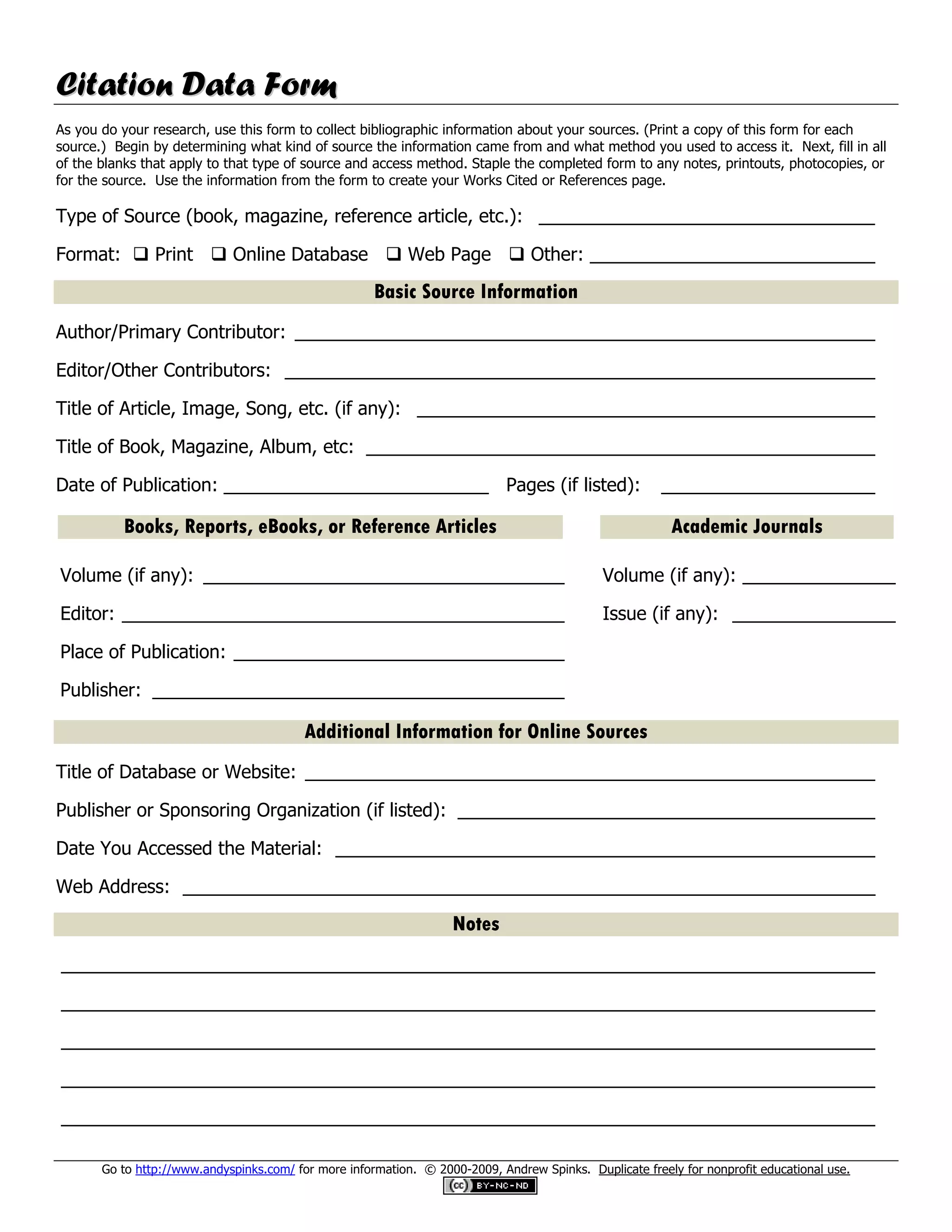
CCiittaattiioonn DDaattaa FFoorrmm
As you do your research, use this form to collect bibliographic information about your sources. (Print a copy of this form for each
source.) Begin by determining what kind of source the information came from and what method you used to access it. Next, fill in all
of the blanks that apply to that type of source and access method. Staple the completed form to any notes, printouts, photocopies, or
for the source. Use the information from the form to create your Works Cited or References page.
Type of Source (book, magazine, reference article, etc.): _________________________________
Format:  Print  Online Database  Web Page  Other: ____________________________
Basic Source Information
Author/Primary Contributor: _________________________________________________________
Editor/Other Contributors: __________________________________________________________
Title of Article, Image, Song, etc. (if any): _____________________________________________
Title of Book, Magazine, Album, etc: __________________________________________________
Date of Publication: __________________________ Pages (if listed): _____________________
Books, Reports, eBooks, or Reference Articles Academic Journals
Volume (if any): ____________________________________
Editor: ____________________________________________
Place of Publication: _________________________________
Publisher: _________________________________________
Volume (if any): ________________
Issue (if any): _________________
Additional Information for Online Sources
Title of Database or Website: ________________________________________________________
Publisher or Sponsoring Organization (if listed): _________________________________________
Date You Accessed the Material: _____________________________________________________
Web Address: ____________________________________________________________________
Notes
________________________________________________________________________________
________________________________________________________________________________
________________________________________________________________________________
________________________________________________________________________________
________________________________________________________________________________

Hum2220 fa2015 research project packet

  • 1.
    Greek & RomanHumanities Prof.  Will  Adams  ·∙  Osceola  Campus  –  Building  1,  Room  104·∙  Mondays  &  Wednesdays,  12:00  –  1:15  PM   Research Project Description   For  your  research  assignment,  you  will  be  tasked  with  researching  a  piece  of  art,  analyzing  it  in  the  form  of  a  4-­‐ page  research  essay,  and  then  reinterpreting  it  in  your  own  creative  way.  The  following  will  guide  you  through  the   recommended  process  to  complete  your  assignment:   1. You  will  choose  your  piece  of  art  by  drawing  a  topic,  at  random,  from  a  hat.   2. Once  you’ve  chosen  your  piece  of  art,  perform  research  on  it.     a. For  a  four-­‐page  research  project,  you  should  use  no  fewer  than  6  credible  sources.     b. With  the  exception  of  the  databases  available  through  Valencia’s  libraries,  none  of  your  sources  may   come  from  the  Internet.   3. After  you’ve  completed  your  research  and  have  a  good  understanding  of  the  piece  of  art’s  meaning,  use  what   you’ve  learned  to  create  your  own  interpretation  of  it.     • You  may,  and  in  fact  are  encouraged  to,  change  the  medium  from  the  original  work  of  art  to   your  own.     • For  instance,  if  you  choose  a  painting,  you  may  reinterpret  that  as  a  painting,  a  song,  a  film,  etc.     • Be  sure  the  medium  you  choose  caters  to  your  own  abilities  and  interests,  not  the  original   artist’s.   • Possible  media  to  consider  for  your  interpretation  include  photography,  fashion  design,   painting,  dance,  sculpture,  modeling,  film,  or  poetry.     • Be  creative  and  “think  outside  the  box”!     4. Finally,  write  a  research  essay  that  first  discusses  the  original  artwork  as  you  understand  it  from  your   research.     • This  section  should  make  up  the  bulk  of  your  paper’s  length  –  at  least  4  pages.     • In  addition,  you  should  not  use  first  or  second  person  point-­‐of-­‐view  when  writing  this  section  of   your  paper.   • After  discussing  the  original  artwork,  then  discuss  your  own  interpretation.  Be  sure  to  explain   your  own  perspective  and  artistic  choices.  This  is  the  only  section  of  your  paper  in  which  you  are   allowed  to  use  first-­‐person  point-­‐of-­‐view  (i.e.  “After  completing  my  research  on  Michelangelo,  I   concluded  that…”).   • Collectively,  the  written  body  of  your  essay  should  total  5  full  pages.  
  • 2.
    • Your  text  should  be  double-­‐spaced,  set  in  Arial  size  12  font,  and  have  standard  1”  margins.  Use   proper  MLA  style  citation  for  in-­‐text  citations,  the  Works  Cited  page,  and  the  cover  page  (refer   to  attached  MLA  style  guide  for  help).   5. OPTIONAL:  You  may  email  in  a  draft  of  your  project  for  my  feedback  on  Wednesday,  November  18 th  to   wadams5@valenciacollege.edu.   6. You  will  submit  both  the  artistic  and  the  written  components  of  your  project  in  class  on  Wednesday,   December  2 nd .   In  conclusion:  Have  as  much  fun  as  you  can  with  this!  This  assignment  isn’t  meant  as  a  punishment,  but   rather  as  an  opportunity  for  you  to  synthesize  academic  skills  with  personal  expression.  The  more  passionate  you   are  about  your  chosen  topic,  that  less  “work”  this  assignment  will  be.  
  • 3.
    Go to http://www.andyspinks.com/mla/for more information. © 2000-2009, Andrew Spinks. Duplicate freely for nonprofit educational use.   __________                       Research papers always contain information compiled from other sources. When you write a research paper, you must cite the sources of your information. In other words, you must give proper credit to the original authors of the information and let your readers know how to find the information for themselves. There are many different ways to cite the sources of our information, but this guide is designed to help you learn “MLA style,” outlined in the Modern Language Association’s MLA Handbook for Writers of Research Papers (http://mlahandbook.org). Before you start your research, you may want to print copies of the Citation Data Form from http://andyspinks.com/mla/ and use them to collect the bibliographic information for each of your sources. There are three main parts to MLA citation: 1.The Information Itself (quoting and paraphrasing properly) 2.The In-Text Citation (giving the source of each bit of information) 3.The “Works Cited” Page (creating a list of the sources you used) Make sure to read the information at the beginning of all three sections before you begin. PPaarrtt 11:: TThhee IInnffoorrmmaattiioonn IIttsseellff All research papers contain information from other sources. When you use information that has been previously published by someone else, it is important that you avoid plagiarism – presenting someone else's ideas as your own. (Plagiarism is not just cheating; it is also stealing.) There are two ways that you can include other people's ideas and words in your paper without plagiarizing: paraphrasing and quotation. Paraphrasing You can include someone else's ideas in your paper by putting those ideas into your own words. This is called paraphrasing. Here are a few things to remember when paraphrasing:  Always cite the source of the paraphrased information with in-text citation (see Part 2) and list the source on your Works Cited page (see Part 3).  Restate the information using your own words and your own sentences. Never use the same sentence structure as the original author.  Combine information from different sources. Try not to paraphrase more than one or two sentences in a row from the same source. Short Quotations (Up to Four Lines) Picasso's attraction to art came at an early age; in fact, he “was able to draw before he could speak, and he could speak long before he was able to walk” (Bernadac and Bouchet 19). Long Quotations (More than Four Lines) One critic adeptly summarized the mainstreaming of the punk genre: For punk rock, the 1990s were a watershed and a nightmare. The mainstream commercial success in that decade of bands like Green Day, Rancid, and Blink 182 was unprecedented for a genre that survived the Reagan-Bush era on $3 concerts, indie labels, and the relatively limited broadcast range of college radio. (Matula 19) This commercialization was simultaneously the rise and fall of punk. PPaarrtt 22:: TThhee IInn--TTeexxtt CCiittaattiioonn When you include information from other sources in your paper, you must include a citation that tells where the information came from (regardless of whether you quoted it or paraphrased it). At one time, MLA Style required that these citations be listed as footnotes at the bottom of the page. Now you can just insert a shortened citation immediately after the information you have quoted or paraphrased. (Since the citations appear in the text of your paper, they are called “in-text” citations. Since they are enclosed in parentheses, they are sometimes called "parenthetical" citations.) The citation should direct the reader to that source's entry on the Works Cited page of your report. For print sources, you normally only need to include the Author and Page Number in your citation. For multi-volume works like encyclopedias, include the Author, Volume Number, and Page Number (with a colon separating the volume and page). For internet sites and other sources without specific page numbers, just include the Author . If the author is not given, use the first few words of the title (in quotation marks). Book or Signed Article Encouraged by the government, tourism is one of the largest industries in Greece (Arnold 45-46). Book or Signed Article (Author Mentioned in Text) Arnold states that tourism, encouraged by the government, is one of Greece's largest industries (45-46). Book or Signed Article (Two Authors) Picasso's attraction to art came at an early age; in fact, he “was able to draw before he could speak, and he could speak long before he was able to walk” (Bernadac and Bouchet 19). Article in a Multi-Volume Reference Book The abundance of natural resource in Great Britain and its colonies was one factor that allowed the industrial revolution to begin there (Lampard 10:248). Article in a Multi-Volume Reference Book (No Author) Globally, no other infectious disease kills more people than tuberculosis (“Tuberculosis” 3:875). Online Source (No Page Numbers) Hinduism and its mythology are a mixture, resulting from centuries of cross-cultural integration (Naylor). Online Source (No Author or Page Numbers) Available as a free download, OpenOffice is a popular open source alternative to Microsoft Office (“OpenOffice 3.0”). Quotation You can also use someone else's exact words in your paper; you just have to clearly indicate that the words are a quotation and give proper credit to the original author. This is very useful when the original author has phrased the idea in a powerful, clever, or unique way. If the quoted text is four lines or less, you should put it in quotation marks and include it in line with the rest of your paper. If the quoted text is more than four lines, you should put it in a separate paragraph (without quotation marks) and indent it by one inch. Either way, you should introduce the quotation and make sure to explain how the information relates to your paper. Original Encyclopedia Text: “The industrial revolution began in Great Britain for several reasons. The country had large deposits of coal and iron, the two natural re- sources on which early industrializa- tion largely depended. Other indus- trial raw materials came from Great Britain's Colonies.” Paraphrase: The abundance of natural resources in Great Britain and its colonies was one factor that allowed the industrial revolution to begin there (Lampard 10:248).
  • 4.
    Go to http://www.andyspinks.com/mla/for more information. © 2000-2009, Andrew Spinks. Duplicate freely for nonprofit educational use.   __________                 Reference or Encyclopedia Article (from a database) Author. “Title of Article.” Title of Book. Editor. Volume. City of Publication: Publisher, Year. Database Title. Format. Date of Access. Rickards, Joseph. “Photorealism.” Encyclopedia Americana. 2009. Grolier Online. Web. 21 Oct. 2009. Henningfeld, Diane. “Overview of The Bluest Eye.” EXPLORING Novels. Detroit: Gale, 2003. Student Resource Center – Gold. Web. 21 Oct. 2009. Magazine or Newspaper Article (Print) Author. “Title of Article.” Magazine or Newspaper Date: Pages. Format. Johnston, Richard. “Martin History Revisited.” Acoustic Guitar July 2009: 60-69. Print. Magazine or Newspaper Article (from a database) Author. “Title of Article.” Magazine or Newspaper Date: Pages. Database Title. Format. Date of Access. Faure, Gaelle. “Managing Your Online Afterlife.” Time 14 Sep. 2009: 51-52. MAS Ultra - School Edition. Web. 21 Oct. 2009. Academic Journal Article (from a database) Author. “Title of Article.” Journal Title Volume.Issue (Year): Pages. Database Title. Format. Date of Access. Matula, Theodore. “Pow! to the People: The Make-Up's Reorganization of Punk Rhetoric.” Popular Music & Society 30.1 (2007): 19-38. Academic Search Complete. Web. 27 Oct. 2009. Web Page Author. “Title of Page.” Title of Web Site. Publisher or Sponsor, Date of Publication. Format. Date of Access. “Adderall.” PDRhealth. PDR Network, 2009. Web. 21 Oct. 2009. Naylor, Stephen. “Hindu Mythology.” Encyclopedia Mythica. N.p., 8 Apr. 2006. Web. 21 Oct. 2009. “OpenOffice 3.0.” Osalt.com. N.p., n.d. Web. 6 Nov. 2009. Online Photograph, Illustration, or Image Artist. Image Title. Date of Publication. Collection or Institution. Website or database. Format. Date of Access. Adams, Ansel. Guayle Field, Manzanar Relocation Center. 1943. Library of Congress. American Memory. Web. 27 Oct. 2009. Song or Sound Recording (from a CD or MP3) Specific Contributor. “Song Title.” Other Major Contributors. Album Title. Publisher, Year. Format. Copeland, Aaron. “Fanfare for the Common Man.” Perf. New York Philharmonic. Cond. Leonard Bernstein. Sing America. Warner Bros., 1999. CD. Jimi Hendrix Experience. “All Along the Watchtower.” By Bob Dylan. Electric Ladyland. MCA, 1968. MP3. Video or Movie (on DVD or VHS) Specific Contributor. Title. Other Major Contributors. Distributor, Year. Format. Brando, Marlon, perf. A Streetcar Named Desire. By Tennessee Williams. Dir. Elia Kazan. Warner Bros., 2006. DVD. Video or Movie (Online) Specific Contributor. Title. Other Major Contributors. Publisher or Distributor, Year. Website or database. Format. Date of Access. Ivers, Louise, narr. Haiti: Malnutrition. Harvard University, 2009. YouTube. Web. 27 Oct. 2009. Book (Print) Author. Title of Book. City of Publication: Publisher, Year. Format. Arnold, Francis. Greece. Austin: Steck-Vaughn, 1992. Print. Bernadac, Marie-Laure, and Paule Bouchet. Picasso: Master of the New Idea. New York: Abrams, 1993. Print. eBook (from a database) Author. Title of Book. City of Publication: Publisher, Year. Database Title. Format. Date of Access. Katz, Mark. Capturing Sound: How Technology Has Changed Music. Berkley: U of California P, 2004. netLibrary. Web. 15 Feb. 2006. Article in a Reference Book or Edited Collection (Print) Author. “Title of Article.” Title of Book. Editor. Volume. City of Publication: Publisher, Year. Pages. Format. Bewley, Marius. “The True Heir of the American Dream.” Readings on The Great Gatsby. Ed. Katie de Koster. San Diego: Greenhaven, 1998. 96-103. Print. Lampard, Eric Edwin. “Industrial Revolution.” World Book Encyclopedia. Vol. 10. Chicago: World Book, 2000. 246-255. Print. “Tuberculosis.” Human Diseases and Conditions. Ed. Neil Izenberg. Vol. 3. New York: Scribner's, 2000. 875-880. Print. PPaarrtt 33:: TThhee ““WWoorrkkss CCiitteedd”” PPaaggee The final part of MLA citation is a list of the works cited. The list should include all of the sources cited in the text of the paper and only those cited in the paper. (See Part 2: The In-Text Citation) Creating and Formatting a Works Cited Page Creating a Works Cited page is easy: Begin by creating a new document or inserting a “page break” at the end of your paper. At the top of the new page, type the words “Works Cited” and center them. Below this title, type a list of the sources you referred to in your report, in alphabetical order. Enter each source in its own separate paragraph, each one formatted with a ½ inch hanging indent. (A “hanging indent” means that the first line of the paragraph starts at the left margin, but all other lines are indented.) Also, your list should be double-spaced, but with no extra spaces in between. (Check the help file of your word processor for more information on page breaks, hanging indents, and double-spacing.) Creating and Formatting Works Cited Entries The Works Cited entry for each source should include enough information to allow readers to look up the original source and to distinguish it from other sources with the same author and/or title. Authors/Contributors: Begin each entry with the author or primary contributor, if known. When citing one person’s specific contribution to the work (the illustrator’s work in a graphic novel, for example), list that person first, before the title. If a source has several major contributors (names listed on the title page or front cover) include them after the title. Titles/Publication Information: Each entry should also include the title(s) of the source and the relevant information about its publication. Include the year of publication for all sources (for magazines and newspapers, also give the month and if known, the day.) For web pages, include the date of the most recent update. If necessary, you can use the abbreviation “n.d.” for “no date given” and/or “n.p.” for “no publisher given.” Access Information: MLA style no longer requires a URL for online sources, but it does now require that you include the format (i.e., Print, DVD, MP3) for every source. For all online sources, MLA style also requires that you list the title of the database or website and the date you accessed the information. (The media format for all online sources and databases is “Web” – even if the source is a PDF or JPEG file.) Use the following examples to help format entries for specific sources. If you have questions, consult the MLA Handbook or ask your teacher or library media specialist for help.
  • 5.
    Go to http://www.andyspinks.com/for more information. © 2000-2009, Andrew Spinks. Duplicate freely for nonprofit educational use. CCiittaattiioonn DDaattaa FFoorrmm As you do your research, use this form to collect bibliographic information about your sources. (Print a copy of this form for each source.) Begin by determining what kind of source the information came from and what method you used to access it. Next, fill in all of the blanks that apply to that type of source and access method. Staple the completed form to any notes, printouts, photocopies, or for the source. Use the information from the form to create your Works Cited or References page. Type of Source (book, magazine, reference article, etc.): _________________________________ Format:  Print  Online Database  Web Page  Other: ____________________________ Basic Source Information Author/Primary Contributor: _________________________________________________________ Editor/Other Contributors: __________________________________________________________ Title of Article, Image, Song, etc. (if any): _____________________________________________ Title of Book, Magazine, Album, etc: __________________________________________________ Date of Publication: __________________________ Pages (if listed): _____________________ Books, Reports, eBooks, or Reference Articles Academic Journals Volume (if any): ____________________________________ Editor: ____________________________________________ Place of Publication: _________________________________ Publisher: _________________________________________ Volume (if any): ________________ Issue (if any): _________________ Additional Information for Online Sources Title of Database or Website: ________________________________________________________ Publisher or Sponsoring Organization (if listed): _________________________________________ Date You Accessed the Material: _____________________________________________________ Web Address: ____________________________________________________________________ Notes ________________________________________________________________________________ ________________________________________________________________________________ ________________________________________________________________________________ ________________________________________________________________________________ ________________________________________________________________________________
  • 6.
    Go to http://www.andyspinks.com/for more information. © 2000-2009, Andrew Spinks. Duplicate freely for nonprofit educational use. CCiittaattiioonn DDaattaa FFoorrmm As you do your research, use this form to collect bibliographic information about your sources. (Print a copy of this form for each source.) Begin by determining what kind of source the information came from and what method you used to access it. Next, fill in all of the blanks that apply to that type of source and access method. Staple the completed form to any notes, printouts, photocopies, or for the source. Use the information from the form to create your Works Cited or References page. Type of Source (book, magazine, reference article, etc.): _________________________________ Format:  Print  Online Database  Web Page  Other: ____________________________ Basic Source Information Author/Primary Contributor: _________________________________________________________ Editor/Other Contributors: __________________________________________________________ Title of Article, Image, Song, etc. (if any): _____________________________________________ Title of Book, Magazine, Album, etc: __________________________________________________ Date of Publication: __________________________ Pages (if listed): _____________________ Books, Reports, eBooks, or Reference Articles Academic Journals Volume (if any): ____________________________________ Editor: ____________________________________________ Place of Publication: _________________________________ Publisher: _________________________________________ Volume (if any): ________________ Issue (if any): _________________ Additional Information for Online Sources Title of Database or Website: ________________________________________________________ Publisher or Sponsoring Organization (if listed): _________________________________________ Date You Accessed the Material: _____________________________________________________ Web Address: ____________________________________________________________________ Notes ________________________________________________________________________________ ________________________________________________________________________________ ________________________________________________________________________________ ________________________________________________________________________________ ________________________________________________________________________________