


HTML5: NextGen Web
Development
<presenter name>
What is HTML?
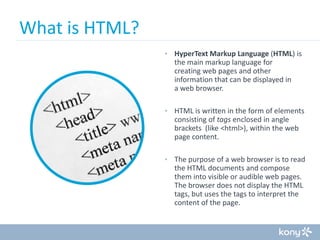
• HyperText Markup Language (HTML) is

the main markup language for
creating web pages and other
information that can be displayed in
a web browser.
• HTML is written in the form of elements

consisting of tags enclosed in angle
brackets (like <html>), within the web
page content.
• The purpose of a web browser is to read

the HTML documents and compose
them into visible or audible web pages.
The browser does not display the HTML
tags, but uses the tags to interpret the
content of the page.
What is HTML5?
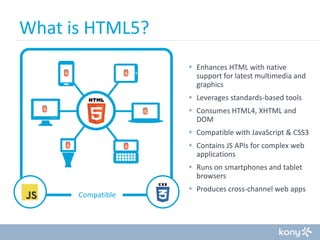
 Enhances HTML with native
support for latest multimedia and
graphics
 Leverages standards-based tools
 Consumes HTML4, XHTML and
DOM
 Compatible with JavaScript & CSS3
 Contains JS APIs for complex web
applications
 Runs on smartphones and tablet
browsers
Compatible

 Produces cross-channel web apps
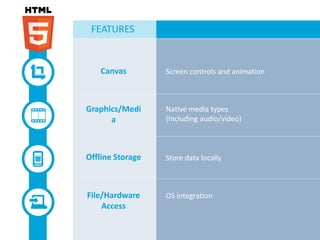
FEATURES

Canvas

Screen controls and animation

Graphics/Medi
a

Native media types
(Including audio/video)

Offline Storage

Store data locally

File/Hardware
Access

OS Integration
HTML5 Flavors
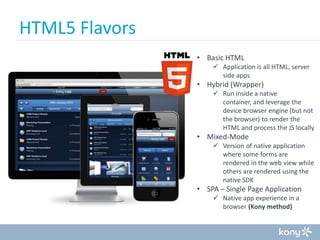
• Basic HTML
 Application is all HTML, server
side apps

• Hybrid (Wrapper)
 Run inside a native
container, and leverage the
device browser engine (but not
the browser) to render the
HTML and process the JS locally

• Mixed-Mode
 Version of native application
where some forms are
rendered in the web view while
others are rendered using the
native SDK

• SPA – Single Page Application
 Native app experience in a
browser (Kony method)
Road to HTML5

JavaScript
HTML

CSS1

1991

CSS2

1996

1998

Tableless
Web Design

2002

2009

1994
HTML2

1997

HTML4

2000
XHTML1

2005
AJAX
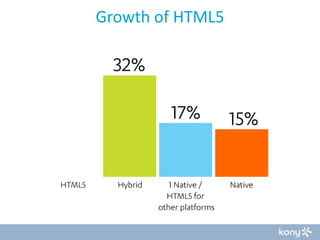
Growth of HTML5
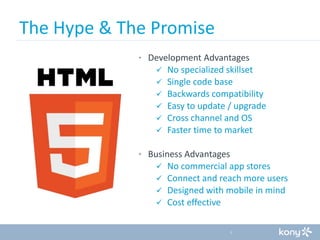
The Hype & The Promise
• Development Advantages








No specialized skillset
Single code base
Backwards compatibility
Easy to update / upgrade
Cross channel and OS
Faster time to market

• Business Advantages

No commercial app stores
 Connect and reach more users
 Designed with mobile in mind
 Cost effective


8
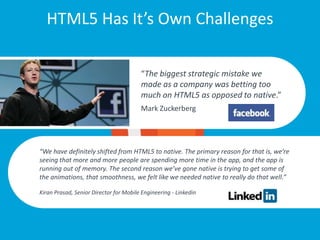
HTML5 Has It’s Own Challenges
“The biggest strategic mistake we
made as a company was betting too
much on HTML5 as opposed to native.”
Mark Zuckerberg

“We have definitely shifted from HTML5 to native. The primary reason for that is, we’re
seeing that more and more people are spending more time in the app, and the app is
running out of memory. The second reason we’ve gone native is trying to get some of
the animations, that smoothness, we felt like we needed native to really do that well.”
Kiran Prasad, Senior Director for Mobile Engineering - Linkedin
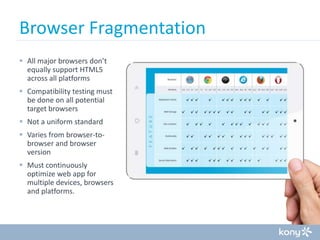
Browser Fragmentation
 All major browsers don’t
equally support HTML5
across all platforms
 Compatibility testing must
be done on all potential
target browsers

 Not a uniform standard
 Varies from browser-tobrowser and browser
version
 Must continuously
optimize web app for
multiple devices, browsers
and platforms.
HTML5 Development Approach
Challenges
• Less stable than native
• Pulls in data much more slowly
than native
• Browser fragmentation
• No app store discoverability
• May take longer to generate
revenue
• Scarcity of mobile web developers
• Less offline capabilities
• Poor gaming capabilities
• Not as UI rich as native
• Less device access capabilities

Advantages
• Leverage effective web search
technology for discoverability
• Native mobile developers are
getting more expensive
• More capable than HTML4
• Multimedia support
• Cost efficient
• Cross-platform
• Less maintenance
• Multivariate testing
• Faster time-to-market
• Smaller device footprint
• Easy to update / upgrade
• Can be wrapped in hybrid format
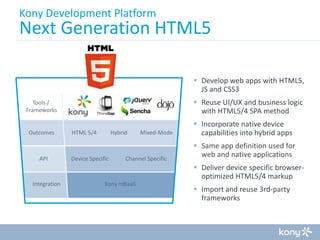
Kony Development Platform

Next Generation HTML5
 Develop web apps with HTML5,
JS and CSS3
 Reuse UI/UX and business logic
with HTML5/4 SPA method

Tools /
Frameworks

Outcomes

API

HTML 5/4

Hybrid

Device Specific

Mixed-Mode

Channel Specific

 Incorporate native device
capabilities into hybrid apps
 Same app definition used for
web and native applications
 Deliver device specific browseroptimized HTML5/4 markup

Integration

Kony mBaaS

 Import and reuse 3rd-party
frameworks
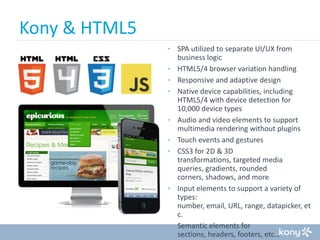
Kony & HTML5
• SPA utilized to separate UI/UX from
•
•
•

•
•
•

•

•

business logic
HTML5/4 browser variation handling
Responsive and adaptive design
Native device capabilities, including
HTML5/4 with device detection for
10,000 device types
Audio and video elements to support
multimedia rendering without plugins
Touch events and gestures
CSS3 for 2D & 3D
transformations, targeted media
queries, gradients, rounded
corners, shadows, and more
Input elements to support a variety of
types:
number, email, URL, range, datapicker, et
c.
Semantic elements for
sections, headers, footers, etc…
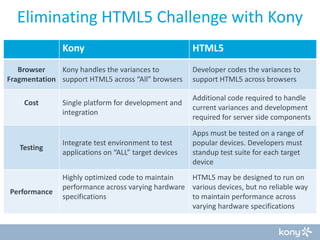
Eliminating HTML5 Challenge with Kony
Kony
Browser
Kony handles the variances to
Fragmentation support HTML5 across “All” browsers
Cost

Testing

Performance

HTML5
Developer codes the variances to
support HTML5 across browsers

Single platform for development and
integration

Additional code required to handle
current variances and development
required for server side components

Integrate test environment to test
applications on “ALL” target devices

Apps must be tested on a range of
popular devices. Developers must
standup test suite for each target
device

Highly optimized code to maintain
HTML5 may be designed to run on
performance across varying hardware various devices, but no reliable way
specifications
to maintain performance across
varying hardware specifications
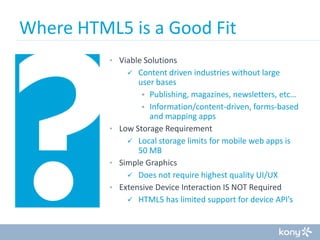
Where HTML5 is a Good Fit
• Viable Solutions

Content driven industries without large
user bases
 Publishing, magazines, newsletters, etc…
 Information/content-driven, forms-based
and mapping apps
• Low Storage Requirement
 Local storage limits for mobile web apps is
50 MB
• Simple Graphics
 Does not require highest quality UI/UX
• Extensive Device Interaction IS NOT Required
 HTML5 has limited support for device API’s

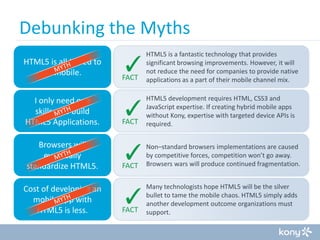
Debunking the Myths

?
?
?
?

HTML5 is all I need to
go mobile.
I only need one
skillset to build
HTML5 Applications.
Browsers will
eventually
standardize HTML5.
Cost of developing an
mobile app with
HTML5 is less.

✓

HTML5 is a fantastic technology that provides
significant browsing improvements. However, it will
not reduce the need for companies to provide native
applications as a part of their mobile channel mix.

✓

HTML5 development requires HTML, CSS3 and
JavaScript expertise. If creating hybrid mobile apps
without Kony, expertise with targeted device APIs is
required.

✓

Non–standard browsers implementations are caused
by competitive forces, competition won’t go away.
Browsers wars will produce continued fragmentation.

✓

Many technologists hope HTML5 will be the silver
bullet to tame the mobile chaos. HTML5 simply adds
another development outcome organizations must
support.

FACT

FACT

FACT

FACT
Summary
• Determine if HTML5 satisfies your business

and user needs. It may be the right answer
for your development efforts.
• Companies wanting to compete effectively in

the mobile marketplace can’t rely on browser
technology alone.
• With Kony, supporting new technologies like

HTML5 becomes a business decision because
we handle the mobile chaos for you.
• No need to gamble on the future of the

mobile industry.
HTML5: Next Generation Web Development

HTML5: Next Generation Web Development

  • 1.
  • 2.
    What is HTML? •HyperText Markup Language (HTML) is the main markup language for creating web pages and other information that can be displayed in a web browser. • HTML is written in the form of elements consisting of tags enclosed in angle brackets (like <html>), within the web page content. • The purpose of a web browser is to read the HTML documents and compose them into visible or audible web pages. The browser does not display the HTML tags, but uses the tags to interpret the content of the page.
  • 3.
    What is HTML5? Enhances HTML with native support for latest multimedia and graphics  Leverages standards-based tools  Consumes HTML4, XHTML and DOM  Compatible with JavaScript & CSS3  Contains JS APIs for complex web applications  Runs on smartphones and tablet browsers Compatible  Produces cross-channel web apps
  • 4.
    FEATURES Canvas Screen controls andanimation Graphics/Medi a Native media types (Including audio/video) Offline Storage Store data locally File/Hardware Access OS Integration
  • 5.
    HTML5 Flavors • BasicHTML  Application is all HTML, server side apps • Hybrid (Wrapper)  Run inside a native container, and leverage the device browser engine (but not the browser) to render the HTML and process the JS locally • Mixed-Mode  Version of native application where some forms are rendered in the web view while others are rendered using the native SDK • SPA – Single Page Application  Native app experience in a browser (Kony method)
  • 6.
    Road to HTML5 JavaScript HTML CSS1 1991 CSS2 1996 1998 Tableless WebDesign 2002 2009 1994 HTML2 1997 HTML4 2000 XHTML1 2005 AJAX
  • 7.
  • 8.
    The Hype &The Promise • Development Advantages       No specialized skillset Single code base Backwards compatibility Easy to update / upgrade Cross channel and OS Faster time to market • Business Advantages No commercial app stores  Connect and reach more users  Designed with mobile in mind  Cost effective  8
  • 9.
    HTML5 Has It’sOwn Challenges “The biggest strategic mistake we made as a company was betting too much on HTML5 as opposed to native.” Mark Zuckerberg “We have definitely shifted from HTML5 to native. The primary reason for that is, we’re seeing that more and more people are spending more time in the app, and the app is running out of memory. The second reason we’ve gone native is trying to get some of the animations, that smoothness, we felt like we needed native to really do that well.” Kiran Prasad, Senior Director for Mobile Engineering - Linkedin
  • 10.
    Browser Fragmentation  Allmajor browsers don’t equally support HTML5 across all platforms  Compatibility testing must be done on all potential target browsers  Not a uniform standard  Varies from browser-tobrowser and browser version  Must continuously optimize web app for multiple devices, browsers and platforms.
  • 11.
    HTML5 Development Approach Challenges •Less stable than native • Pulls in data much more slowly than native • Browser fragmentation • No app store discoverability • May take longer to generate revenue • Scarcity of mobile web developers • Less offline capabilities • Poor gaming capabilities • Not as UI rich as native • Less device access capabilities Advantages • Leverage effective web search technology for discoverability • Native mobile developers are getting more expensive • More capable than HTML4 • Multimedia support • Cost efficient • Cross-platform • Less maintenance • Multivariate testing • Faster time-to-market • Smaller device footprint • Easy to update / upgrade • Can be wrapped in hybrid format
  • 12.
    Kony Development Platform NextGeneration HTML5  Develop web apps with HTML5, JS and CSS3  Reuse UI/UX and business logic with HTML5/4 SPA method Tools / Frameworks Outcomes API HTML 5/4 Hybrid Device Specific Mixed-Mode Channel Specific  Incorporate native device capabilities into hybrid apps  Same app definition used for web and native applications  Deliver device specific browseroptimized HTML5/4 markup Integration Kony mBaaS  Import and reuse 3rd-party frameworks
  • 13.
    Kony & HTML5 •SPA utilized to separate UI/UX from • • • • • • • • business logic HTML5/4 browser variation handling Responsive and adaptive design Native device capabilities, including HTML5/4 with device detection for 10,000 device types Audio and video elements to support multimedia rendering without plugins Touch events and gestures CSS3 for 2D & 3D transformations, targeted media queries, gradients, rounded corners, shadows, and more Input elements to support a variety of types: number, email, URL, range, datapicker, et c. Semantic elements for sections, headers, footers, etc…
  • 14.
    Eliminating HTML5 Challengewith Kony Kony Browser Kony handles the variances to Fragmentation support HTML5 across “All” browsers Cost Testing Performance HTML5 Developer codes the variances to support HTML5 across browsers Single platform for development and integration Additional code required to handle current variances and development required for server side components Integrate test environment to test applications on “ALL” target devices Apps must be tested on a range of popular devices. Developers must standup test suite for each target device Highly optimized code to maintain HTML5 may be designed to run on performance across varying hardware various devices, but no reliable way specifications to maintain performance across varying hardware specifications
  • 15.
    Where HTML5 isa Good Fit • Viable Solutions Content driven industries without large user bases  Publishing, magazines, newsletters, etc…  Information/content-driven, forms-based and mapping apps • Low Storage Requirement  Local storage limits for mobile web apps is 50 MB • Simple Graphics  Does not require highest quality UI/UX • Extensive Device Interaction IS NOT Required  HTML5 has limited support for device API’s 
  • 16.
    Debunking the Myths ? ? ? ? HTML5is all I need to go mobile. I only need one skillset to build HTML5 Applications. Browsers will eventually standardize HTML5. Cost of developing an mobile app with HTML5 is less. ✓ HTML5 is a fantastic technology that provides significant browsing improvements. However, it will not reduce the need for companies to provide native applications as a part of their mobile channel mix. ✓ HTML5 development requires HTML, CSS3 and JavaScript expertise. If creating hybrid mobile apps without Kony, expertise with targeted device APIs is required. ✓ Non–standard browsers implementations are caused by competitive forces, competition won’t go away. Browsers wars will produce continued fragmentation. ✓ Many technologists hope HTML5 will be the silver bullet to tame the mobile chaos. HTML5 simply adds another development outcome organizations must support. FACT FACT FACT FACT
  • 17.
    Summary • Determine ifHTML5 satisfies your business and user needs. It may be the right answer for your development efforts. • Companies wanting to compete effectively in the mobile marketplace can’t rely on browser technology alone. • With Kony, supporting new technologies like HTML5 becomes a business decision because we handle the mobile chaos for you. • No need to gamble on the future of the mobile industry.

Editor's Notes

  • #4 Kony HTML5/4, Legacy, Adaptive or REsponsive
  • #5 Kony HTML5/4, Legacy, Adaptive or REsponsive
  • #6 Kony HTML5/4, Legacy, Adaptive or REsponsive
  • #7 CSS stands for Cascading Style Sheets Styles - define how to display HTML elementsXHTML is HTML defined as an XML applicationAjax (sometimes called Asynchronous JavaScript and XML) is a way of programming for the Web that gets rid of the hourglass. Data, content, and design are merged together into a seamless whole.
  • #8 Kony HTML5/4, Legacy, Adaptive or REsponsive
  • #10 Problems with Facebook – Tooling (Testing) debugging tools in mobile browsers don&apos;t provide enough visibility into what is happening with memory in particular. The nature of Facebook&apos;s app contributes to the difficulties it encounters with scrolling performance across mobile devices. Facebook&apos;s newsfeed and Timeline in particular experience slow and inconsistent performance because they implement an &quot;infinite scrolling&quot; model in which content is pre-fetched and appended as the user reaches its location. The number of objects in memory, including graphics, can grow quite large. Different browsers make different tradeoffs in these extreme situations, resulting in inconsistent frame-rates, exhaustion of GPU buffers, lagging of UI threads, etc.GPUs tend to be black boxes to the app developer (and that the GPU makers, for their own reasons, like it that way). In an app like Facebook, with the size of the data being handled so far outstripping the size of GPU buffers.
  • #11 Kony HTML5/4, Legacy, Adaptive or REsponsive