OSHAX.org - The Unofficial Guide To the OSHA 1
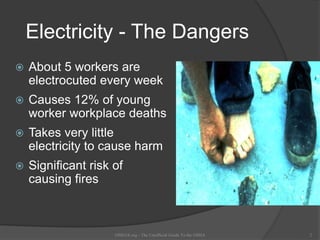
Electricity - The Dangers
 About 5 workers are
electrocuted every week
 Causes 12% of young
worker workplace deaths
 Takes very little
electricity to cause harm
 Significant risk of
causing fires
OSHAX.org - The Unofficial Guide To the OSHA 2
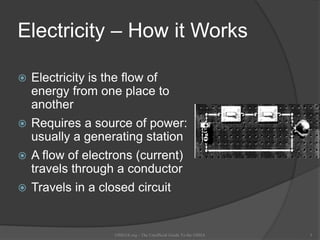
Electricity – How it Works
 Electricity is the flow of
energy from one place to
another
 Requires a source of power:
usually a generating station
 A flow of electrons (current)
travels through a conductor
 Travels in a closed circuit
OSHAX.org - The Unofficial Guide To the OSHA 3
Electrical Terms
 Current -- electrical movement (measured in amps)
 Circuit -- complete path of the current. Includes
electricity source, a conductor, and the output device or
load (such as a lamp, tool, or heater)
 Resistance -- restriction to electrical flow
 Conductors – substances, like metals, with little resistance
to electricity that allow electricity to flow
 Grounding – a conductive connection to the earth which
acts as a protective measure
 Insulators -- substances with high resistance to electricity
like glass, porcelain, plastic, and dry wood that prevent
electricity from getting to unwanted areas
OSHAX.org - The Unofficial Guide To the OSHA 4
Electrical Injuries
There are four main types of electrical injuries:
 Direct:
Electrocution or death due to electrical shock
Electrical shock
Burns
 Indirect - Falls
OSHAX.org - The Unofficial Guide To the OSHA 5
Electrical Shock
An electrical shock is received when electrical
current passes through the body.
You will get an electrical shock if a part of your
body completes an electrical circuit by…
 Touching a live wire and an electrical ground,
or
 Touching a live wire and another wire at a
different voltage.
OSHAX.org - The Unofficial Guide To the OSHA 6
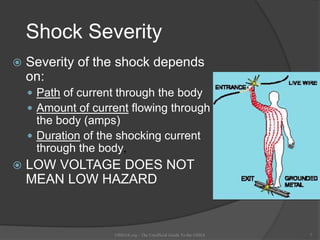
Shock Severity
 Severity of the shock depends
on:
 Path of current through the body
 Amount of current flowing through
the body (amps)
 Duration of the shocking current
through the body,
 LOW VOLTAGE DOES NOT
MEAN LOW HAZARD
OSHAX.org - The Unofficial Guide To the OSHA 7
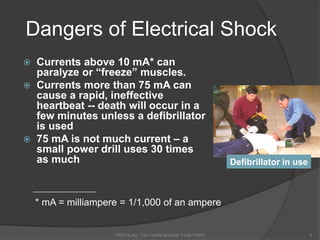
Dangers of Electrical Shock
 Currents above 10 mA* can
paralyze or “freeze” muscles.
 Currents more than 75 mA can
cause a rapid, ineffective
heartbeat -- death will occur in a
few minutes unless a defibrillator
is used
 75 mA is not much current – a
small power drill uses 30 times
as much
OSHAX.org - The Unofficial Guide To the OSHA 8
* mA = milliampere = 1/1,000 of an ampere
Defibrillator in use
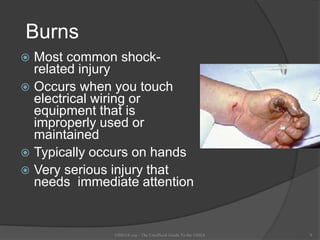
Burns
 Most common shock-
related injury
 Occurs when you touch
electrical wiring or
equipment that is
improperly used or
maintained
 Typically occurs on hands
 Very serious injury that
needs immediate attention
OSHAX.org - The Unofficial Guide To the OSHA 9
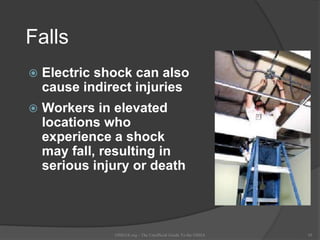
Falls
 Electric shock can also
cause indirect injuries
 Workers in elevated
locations who
experience a shock
may fall, resulting in
serious injury or death
OSHAX.org - The Unofficial Guide To the OSHA 10
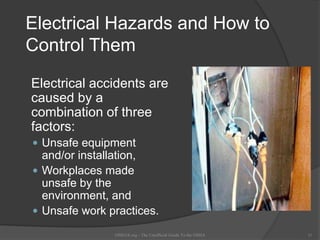
Electrical Hazards and How to
Control Them
Electrical accidents are
caused by a
combination of three
factors:
 Unsafe equipment
and/or installation,
 Workplaces made
unsafe by the
environment, and
 Unsafe work practices.
OSHAX.org - The Unofficial Guide To the OSHA 11
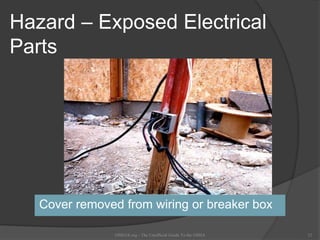
Hazard – Exposed Electrical
Parts
Cover removed from wiring or breaker box
OSHAX.org - The Unofficial Guide To the OSHA 12
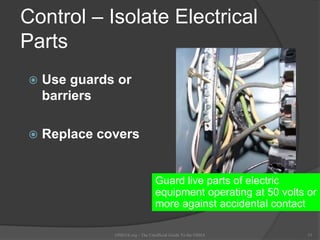
Control – Isolate Electrical
Parts
 Use guards or
barriers
 Replace covers
OSHAX.org - The Unofficial Guide To the OSHA 13
Guard live parts of electric
equipment operating at 50 volts or
more against accidental contact
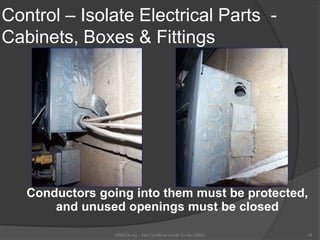
Control – Isolate Electrical Parts -
Cabinets, Boxes & Fittings
Conductors going into them must be protected,
and unused openings must be closed
OSHAX.org - The Unofficial Guide To the OSHA 14
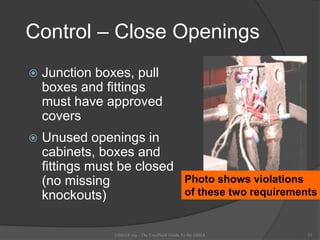
Control – Close Openings
 Junction boxes, pull
boxes and fittings
must have approved
covers
 Unused openings in
cabinets, boxes and
fittings must be closed
(no missing
knockouts)
OSHAX.org - The Unofficial Guide To the OSHA 15
Photo shows violations
of these two requirements
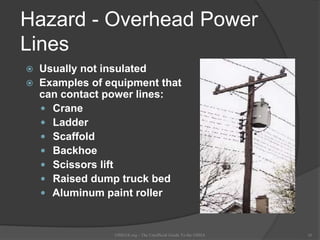
Hazard - Overhead Power
Lines
 Usually not insulated
 Examples of equipment that
can contact power lines:
 Crane
 Ladder
 Scaffold
 Backhoe
 Scissors lift
 Raised dump truck bed
 Aluminum paint roller
OSHAX.org - The Unofficial Guide To the OSHA 16
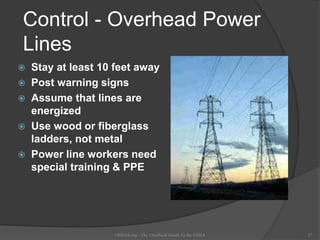
Control - Overhead Power
Lines
 Stay at least 10 feet away
 Post warning signs
 Assume that lines are
energized
 Use wood or fiberglass
ladders, not metal
 Power line workers need
special training & PPE
OSHAX.org - The Unofficial Guide To the OSHA 17
Hazard - Inadequate Wiring
 Hazard - wire too small for the
current
 Example - portable tool with an
extension cord that has a wire too
small for the tool
 The tool will draw more current than
the cord can handle, causing
overheating and a possible fire
without tripping the circuit breaker
 The circuit breaker could be the right
size for the circuit but not for the
smaller-wire extension cord
OSHAX.org - The Unofficial Guide To the OSHA 18
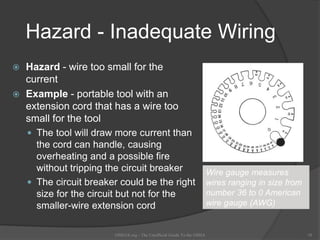
Wire Gauge
WIRE
Wire gauge measures
wires ranging in size from
number 36 to 0 American
wire gauge (AWG)
Control – Use the Correct
Wire
 Wire used depends on operation, building materials,
electrical load, and environmental factors
 Use fixed cords rather than flexible cords
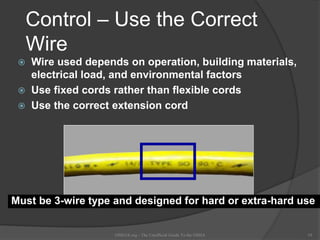
 Use the correct extension cord
OSHAX.org - The Unofficial Guide To the OSHA 19
Must be 3-wire type and designed for hard or extra-hard use
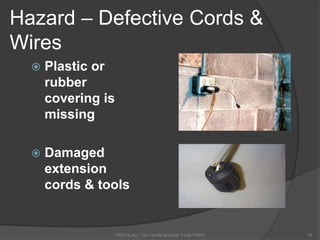
Hazard – Defective Cords &
Wires
 Plastic or
rubber
covering is
missing
 Damaged
extension
cords & tools
OSHAX.org - The Unofficial Guide To the OSHA 20
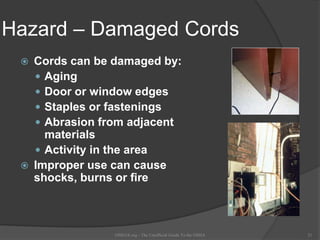
Hazard – Damaged Cords
 Cords can be damaged by:
 Aging
 Door or window edges
 Staples or fastenings
 Abrasion from adjacent
materials
 Activity in the area
 Improper use can cause
shocks, burns or fire
OSHAX.org - The Unofficial Guide To the OSHA 21
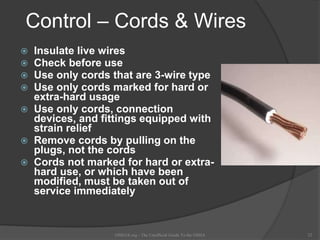
Control – Cords & Wires
 Insulate live wires
 Check before use
 Use only cords that are 3-wire type
 Use only cords marked for hard or
extra-hard usage
 Use only cords, connection
devices, and fittings equipped with
strain relief
 Remove cords by pulling on the
plugs, not the cords
 Cords not marked for hard or extra-
hard use, or which have been
modified, must be taken out of
service immediately
OSHAX.org - The Unofficial Guide To the OSHA 22
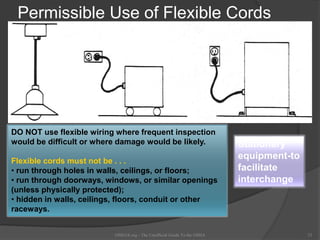
Permissible Use of Flexible Cords
OSHAX.org - The Unofficial Guide To the OSHA 23
Stationary
equipment-to
facilitate
interchange
DO NOT use flexible wiring where frequent inspection
would be difficult or where damage would be likely.
Flexible cords must not be . . .
• run through holes in walls, ceilings, or floors;
• run through doorways, windows, or similar openings
(unless physically protected);
• hidden in walls, ceilings, floors, conduit or other
raceways.
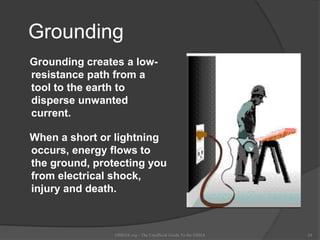
Grounding
Grounding creates a low-
resistance path from a
tool to the earth to
disperse unwanted
current.
When a short or lightning
occurs, energy flows to
the ground, protecting you
from electrical shock,
injury and death.
OSHAX.org - The Unofficial Guide To the OSHA 24
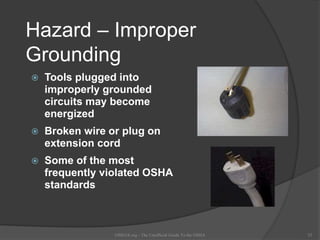
Hazard – Improper
Grounding
 Tools plugged into
improperly grounded
circuits may become
energized
 Broken wire or plug on
extension cord
 Some of the most
frequently violated OSHA
standards
OSHAX.org - The Unofficial Guide To the OSHA 25
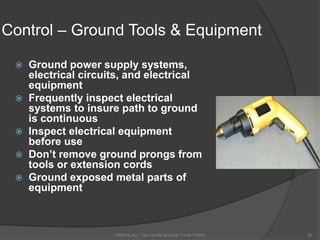
Control – Ground Tools & Equipment
 Ground power supply systems,
electrical circuits, and electrical
equipment
 Frequently inspect electrical
systems to insure path to ground
is continuous
 Inspect electrical equipment
before use
 Don’t remove ground prongs from
tools or extension cords
 Ground exposed metal parts of
equipment
OSHAX.org - The Unofficial Guide To the OSHA 26
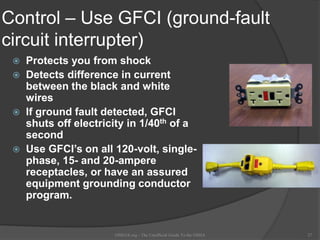
Control – Use GFCI (ground-fault
circuit interrupter)
 Protects you from shock
 Detects difference in current
between the black and white
wires
 If ground fault detected, GFCI
shuts off electricity in 1/40th of a
second
 Use GFCI’s on all 120-volt, single-
phase, 15- and 20-ampere
receptacles, or have an assured
equipment grounding conductor
program.
OSHAX.org - The Unofficial Guide To the OSHA 27
Control - Assured Equipment
Grounding Conductor Program
Program must cover:
 All cord sets
 Receptacles not part of a building or structure
 Equipment connected by plug and cord
Program requirements include:
 Specific procedures adopted by the employer
 Competent person to implement the program
 Visual inspection for damage of equipment
connected by cord and plug
OSHAX.org - The Unofficial Guide To the OSHA 28
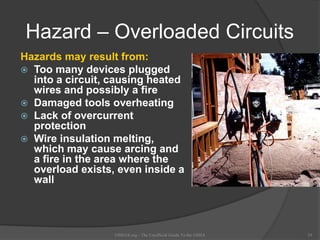
Hazard – Overloaded Circuits
Hazards may result from:
 Too many devices plugged
into a circuit, causing heated
wires and possibly a fire
 Damaged tools overheating
 Lack of overcurrent
protection
 Wire insulation melting,
which may cause arcing and
a fire in the area where the
overload exists, even inside a
wall
OSHAX.org - The Unofficial Guide To the OSHA 29
Control - Electrical Protective Devices
 Automatically opens circuit if
excess current from overload
or ground-fault is detected –
shutting off electricity
 Includes GFCI’s, fuses, and
circuit breakers
 Fuses and circuit breakers are
overcurrent devices. When too
much current:
 Fuses melt
 Circuit breakers trip open
OSHAX.org - The Unofficial Guide To the OSHA 30
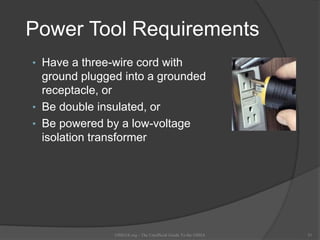
Power Tool Requirements
• Have a three-wire cord with
ground plugged into a grounded
receptacle, or
• Be double insulated, or
• Be powered by a low-voltage
isolation transformer
OSHAX.org - The Unofficial Guide To the OSHA 31
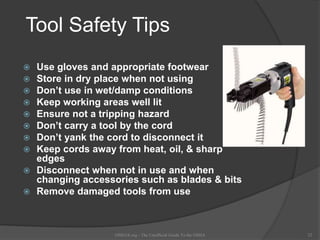
Tool Safety Tips
 Use gloves and appropriate footwear
 Store in dry place when not using
 Don’t use in wet/damp conditions
 Keep working areas well lit
 Ensure not a tripping hazard
 Don’t carry a tool by the cord
 Don’t yank the cord to disconnect it
 Keep cords away from heat, oil, & sharp
edges
 Disconnect when not in use and when
changing accessories such as blades & bits
 Remove damaged tools from use
OSHAX.org - The Unofficial Guide To the OSHA 32
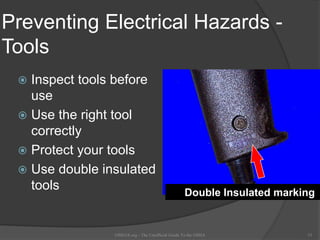
Preventing Electrical Hazards -
Tools
 Inspect tools before
use
 Use the right tool
correctly
 Protect your tools
 Use double insulated
tools
OSHAX.org - The Unofficial Guide To the OSHA 33
Double Insulated marking
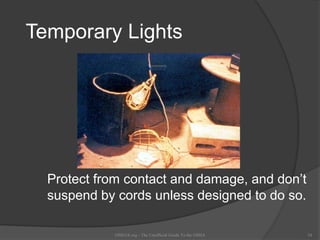
Temporary Lights
Protect from contact and damage, and don’t
suspend by cords unless designed to do so.
OSHAX.org - The Unofficial Guide To the OSHA 34
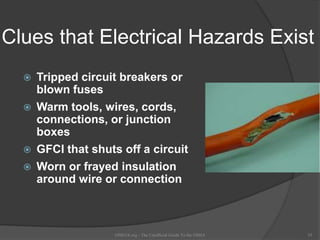
Clues that Electrical Hazards Exist
 Tripped circuit breakers or
blown fuses
 Warm tools, wires, cords,
connections, or junction
boxes
 GFCI that shuts off a circuit
 Worn or frayed insulation
around wire or connection
OSHAX.org - The Unofficial Guide To the OSHA 35
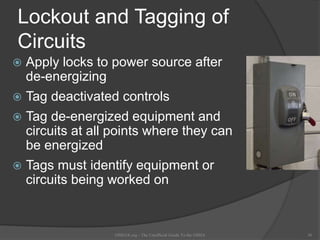
Lockout and Tagging of
Circuits
 Apply locks to power source after
de-energizing
 Tag deactivated controls
 Tag de-energized equipment and
circuits at all points where they can
be energized
 Tags must identify equipment or
circuits being worked on
OSHAX.org - The Unofficial Guide To the OSHA 36
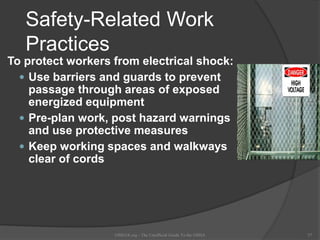
Safety-Related Work
Practices
To protect workers from electrical shock:
 Use barriers and guards to prevent
passage through areas of exposed
energized equipment
 Pre-plan work, post hazard warnings
and use protective measures
 Keep working spaces and walkways
clear of cords
OSHAX.org - The Unofficial Guide To the OSHA 37
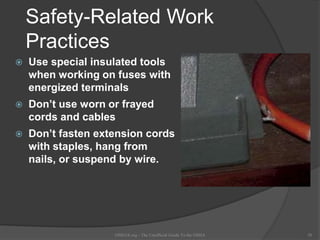
Safety-Related Work
Practices
 Use special insulated tools
when working on fuses with
energized terminals
 Don’t use worn or frayed
cords and cables
 Don’t fasten extension cords
with staples, hang from
nails, or suspend by wire.
OSHAX.org - The Unofficial Guide To the OSHA 38
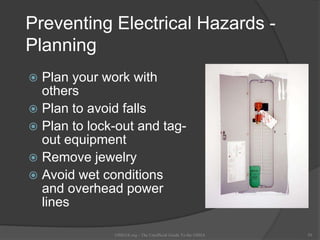
Preventing Electrical Hazards -
Planning
 Plan your work with
others
 Plan to avoid falls
 Plan to lock-out and tag-
out equipment
 Remove jewelry
 Avoid wet conditions
and overhead power
lines
OSHAX.org - The Unofficial Guide To the OSHA 39
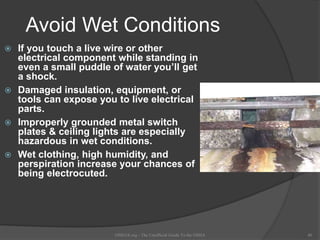
Avoid Wet Conditions
 If you touch a live wire or other
electrical component while standing in
even a small puddle of water you’ll get
a shock.
 Damaged insulation, equipment, or
tools can expose you to live electrical
parts.
 Improperly grounded metal switch
plates & ceiling lights are especially
hazardous in wet conditions.
 Wet clothing, high humidity, and
perspiration increase your chances of
being electrocuted.
OSHAX.org - The Unofficial Guide To the OSHA 40
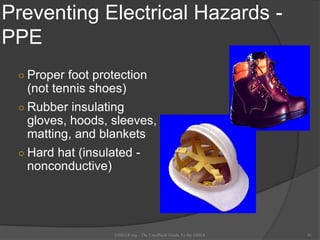
Preventing Electrical Hazards -
PPE
○ Proper foot protection
(not tennis shoes)
○ Rubber insulating
gloves, hoods, sleeves,
matting, and blankets
○ Hard hat (insulated -
nonconductive)
OSHAX.org - The Unofficial Guide To the OSHA 41
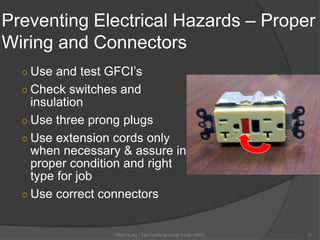
Preventing Electrical Hazards – Proper
Wiring and Connectors
○ Use and test GFCI’s
○ Check switches and
insulation
○ Use three prong plugs
○ Use extension cords only
when necessary & assure in
proper condition and right
type for job
○ Use correct connectors
OSHAX.org - The Unofficial Guide To the OSHA 42
Training
 Deenergize electric equipment before
inspecting or repairing
 Using cords, cables, and electric tools that
are in good repair
 Lockout / Tagout recognition and
procedures
 Use appropriate protective equipment
OSHAX.org - The Unofficial Guide To the OSHA 43
Train employees working with electric
equipment in safe work practices, including:
Summary – Hazards & Protections
Hazards
 Inadequate wiring
 Exposed electrical parts
 Wires with bad insulation
 Ungrounded electrical systems
and tools
 Overloaded circuits
 Damaged power tools and
equipment
 Using the wrong PPE and
tools
 Overhead powerlines
 All hazards are made worse in
wet conditions
Protective Measures
 Proper grounding
 Use GFCI’s
 Use fuses and circuit
breakers
 Guard live parts
 Lockout/Tagout
 Proper use of flexible
cords
 Close electric panels
 Training
OSHAX.org - The Unofficial Guide To the OSHA 44
Summary
Electrical equipment must be:
 Listed and labeled
 Free from hazards
 Used in the proper manner
If you use electrical tools you must be:
 Protected from electrical shock
 Provided necessary safety equipment
OSHAX.org - The Unofficial Guide To the OSHA 45

Electrical Construction Hazards - Presentation Research Material.ppt

  • 1.
    OSHAX.org - TheUnofficial Guide To the OSHA 1
  • 2.
    Electricity - TheDangers  About 5 workers are electrocuted every week  Causes 12% of young worker workplace deaths  Takes very little electricity to cause harm  Significant risk of causing fires OSHAX.org - The Unofficial Guide To the OSHA 2
  • 3.
    Electricity – Howit Works  Electricity is the flow of energy from one place to another  Requires a source of power: usually a generating station  A flow of electrons (current) travels through a conductor  Travels in a closed circuit OSHAX.org - The Unofficial Guide To the OSHA 3
  • 4.
    Electrical Terms  Current-- electrical movement (measured in amps)  Circuit -- complete path of the current. Includes electricity source, a conductor, and the output device or load (such as a lamp, tool, or heater)  Resistance -- restriction to electrical flow  Conductors – substances, like metals, with little resistance to electricity that allow electricity to flow  Grounding – a conductive connection to the earth which acts as a protective measure  Insulators -- substances with high resistance to electricity like glass, porcelain, plastic, and dry wood that prevent electricity from getting to unwanted areas OSHAX.org - The Unofficial Guide To the OSHA 4
  • 5.
    Electrical Injuries There arefour main types of electrical injuries:  Direct: Electrocution or death due to electrical shock Electrical shock Burns  Indirect - Falls OSHAX.org - The Unofficial Guide To the OSHA 5
  • 6.
    Electrical Shock An electricalshock is received when electrical current passes through the body. You will get an electrical shock if a part of your body completes an electrical circuit by…  Touching a live wire and an electrical ground, or  Touching a live wire and another wire at a different voltage. OSHAX.org - The Unofficial Guide To the OSHA 6
  • 7.
    Shock Severity  Severityof the shock depends on:  Path of current through the body  Amount of current flowing through the body (amps)  Duration of the shocking current through the body,  LOW VOLTAGE DOES NOT MEAN LOW HAZARD OSHAX.org - The Unofficial Guide To the OSHA 7
  • 8.
    Dangers of ElectricalShock  Currents above 10 mA* can paralyze or “freeze” muscles.  Currents more than 75 mA can cause a rapid, ineffective heartbeat -- death will occur in a few minutes unless a defibrillator is used  75 mA is not much current – a small power drill uses 30 times as much OSHAX.org - The Unofficial Guide To the OSHA 8 * mA = milliampere = 1/1,000 of an ampere Defibrillator in use
  • 9.
    Burns  Most commonshock- related injury  Occurs when you touch electrical wiring or equipment that is improperly used or maintained  Typically occurs on hands  Very serious injury that needs immediate attention OSHAX.org - The Unofficial Guide To the OSHA 9
  • 10.
    Falls  Electric shockcan also cause indirect injuries  Workers in elevated locations who experience a shock may fall, resulting in serious injury or death OSHAX.org - The Unofficial Guide To the OSHA 10
  • 11.
    Electrical Hazards andHow to Control Them Electrical accidents are caused by a combination of three factors:  Unsafe equipment and/or installation,  Workplaces made unsafe by the environment, and  Unsafe work practices. OSHAX.org - The Unofficial Guide To the OSHA 11
  • 12.
    Hazard – ExposedElectrical Parts Cover removed from wiring or breaker box OSHAX.org - The Unofficial Guide To the OSHA 12
  • 13.
    Control – IsolateElectrical Parts  Use guards or barriers  Replace covers OSHAX.org - The Unofficial Guide To the OSHA 13 Guard live parts of electric equipment operating at 50 volts or more against accidental contact
  • 14.
    Control – IsolateElectrical Parts - Cabinets, Boxes & Fittings Conductors going into them must be protected, and unused openings must be closed OSHAX.org - The Unofficial Guide To the OSHA 14
  • 15.
    Control – CloseOpenings  Junction boxes, pull boxes and fittings must have approved covers  Unused openings in cabinets, boxes and fittings must be closed (no missing knockouts) OSHAX.org - The Unofficial Guide To the OSHA 15 Photo shows violations of these two requirements
  • 16.
    Hazard - OverheadPower Lines  Usually not insulated  Examples of equipment that can contact power lines:  Crane  Ladder  Scaffold  Backhoe  Scissors lift  Raised dump truck bed  Aluminum paint roller OSHAX.org - The Unofficial Guide To the OSHA 16
  • 17.
    Control - OverheadPower Lines  Stay at least 10 feet away  Post warning signs  Assume that lines are energized  Use wood or fiberglass ladders, not metal  Power line workers need special training & PPE OSHAX.org - The Unofficial Guide To the OSHA 17
  • 18.
    Hazard - InadequateWiring  Hazard - wire too small for the current  Example - portable tool with an extension cord that has a wire too small for the tool  The tool will draw more current than the cord can handle, causing overheating and a possible fire without tripping the circuit breaker  The circuit breaker could be the right size for the circuit but not for the smaller-wire extension cord OSHAX.org - The Unofficial Guide To the OSHA 18 Wire Gauge WIRE Wire gauge measures wires ranging in size from number 36 to 0 American wire gauge (AWG)
  • 19.
    Control – Usethe Correct Wire  Wire used depends on operation, building materials, electrical load, and environmental factors  Use fixed cords rather than flexible cords  Use the correct extension cord OSHAX.org - The Unofficial Guide To the OSHA 19 Must be 3-wire type and designed for hard or extra-hard use
  • 20.
    Hazard – DefectiveCords & Wires  Plastic or rubber covering is missing  Damaged extension cords & tools OSHAX.org - The Unofficial Guide To the OSHA 20
  • 21.
    Hazard – DamagedCords  Cords can be damaged by:  Aging  Door or window edges  Staples or fastenings  Abrasion from adjacent materials  Activity in the area  Improper use can cause shocks, burns or fire OSHAX.org - The Unofficial Guide To the OSHA 21
  • 22.
    Control – Cords& Wires  Insulate live wires  Check before use  Use only cords that are 3-wire type  Use only cords marked for hard or extra-hard usage  Use only cords, connection devices, and fittings equipped with strain relief  Remove cords by pulling on the plugs, not the cords  Cords not marked for hard or extra- hard use, or which have been modified, must be taken out of service immediately OSHAX.org - The Unofficial Guide To the OSHA 22
  • 23.
    Permissible Use ofFlexible Cords OSHAX.org - The Unofficial Guide To the OSHA 23 Stationary equipment-to facilitate interchange DO NOT use flexible wiring where frequent inspection would be difficult or where damage would be likely. Flexible cords must not be . . . • run through holes in walls, ceilings, or floors; • run through doorways, windows, or similar openings (unless physically protected); • hidden in walls, ceilings, floors, conduit or other raceways.
  • 24.
    Grounding Grounding creates alow- resistance path from a tool to the earth to disperse unwanted current. When a short or lightning occurs, energy flows to the ground, protecting you from electrical shock, injury and death. OSHAX.org - The Unofficial Guide To the OSHA 24
  • 25.
    Hazard – Improper Grounding Tools plugged into improperly grounded circuits may become energized  Broken wire or plug on extension cord  Some of the most frequently violated OSHA standards OSHAX.org - The Unofficial Guide To the OSHA 25
  • 26.
    Control – GroundTools & Equipment  Ground power supply systems, electrical circuits, and electrical equipment  Frequently inspect electrical systems to insure path to ground is continuous  Inspect electrical equipment before use  Don’t remove ground prongs from tools or extension cords  Ground exposed metal parts of equipment OSHAX.org - The Unofficial Guide To the OSHA 26
  • 27.
    Control – UseGFCI (ground-fault circuit interrupter)  Protects you from shock  Detects difference in current between the black and white wires  If ground fault detected, GFCI shuts off electricity in 1/40th of a second  Use GFCI’s on all 120-volt, single- phase, 15- and 20-ampere receptacles, or have an assured equipment grounding conductor program. OSHAX.org - The Unofficial Guide To the OSHA 27
  • 28.
    Control - AssuredEquipment Grounding Conductor Program Program must cover:  All cord sets  Receptacles not part of a building or structure  Equipment connected by plug and cord Program requirements include:  Specific procedures adopted by the employer  Competent person to implement the program  Visual inspection for damage of equipment connected by cord and plug OSHAX.org - The Unofficial Guide To the OSHA 28
  • 29.
    Hazard – OverloadedCircuits Hazards may result from:  Too many devices plugged into a circuit, causing heated wires and possibly a fire  Damaged tools overheating  Lack of overcurrent protection  Wire insulation melting, which may cause arcing and a fire in the area where the overload exists, even inside a wall OSHAX.org - The Unofficial Guide To the OSHA 29
  • 30.
    Control - ElectricalProtective Devices  Automatically opens circuit if excess current from overload or ground-fault is detected – shutting off electricity  Includes GFCI’s, fuses, and circuit breakers  Fuses and circuit breakers are overcurrent devices. When too much current:  Fuses melt  Circuit breakers trip open OSHAX.org - The Unofficial Guide To the OSHA 30
  • 31.
    Power Tool Requirements •Have a three-wire cord with ground plugged into a grounded receptacle, or • Be double insulated, or • Be powered by a low-voltage isolation transformer OSHAX.org - The Unofficial Guide To the OSHA 31
  • 32.
    Tool Safety Tips Use gloves and appropriate footwear  Store in dry place when not using  Don’t use in wet/damp conditions  Keep working areas well lit  Ensure not a tripping hazard  Don’t carry a tool by the cord  Don’t yank the cord to disconnect it  Keep cords away from heat, oil, & sharp edges  Disconnect when not in use and when changing accessories such as blades & bits  Remove damaged tools from use OSHAX.org - The Unofficial Guide To the OSHA 32
  • 33.
    Preventing Electrical Hazards- Tools  Inspect tools before use  Use the right tool correctly  Protect your tools  Use double insulated tools OSHAX.org - The Unofficial Guide To the OSHA 33 Double Insulated marking
  • 34.
    Temporary Lights Protect fromcontact and damage, and don’t suspend by cords unless designed to do so. OSHAX.org - The Unofficial Guide To the OSHA 34
  • 35.
    Clues that ElectricalHazards Exist  Tripped circuit breakers or blown fuses  Warm tools, wires, cords, connections, or junction boxes  GFCI that shuts off a circuit  Worn or frayed insulation around wire or connection OSHAX.org - The Unofficial Guide To the OSHA 35
  • 36.
    Lockout and Taggingof Circuits  Apply locks to power source after de-energizing  Tag deactivated controls  Tag de-energized equipment and circuits at all points where they can be energized  Tags must identify equipment or circuits being worked on OSHAX.org - The Unofficial Guide To the OSHA 36
  • 37.
    Safety-Related Work Practices To protectworkers from electrical shock:  Use barriers and guards to prevent passage through areas of exposed energized equipment  Pre-plan work, post hazard warnings and use protective measures  Keep working spaces and walkways clear of cords OSHAX.org - The Unofficial Guide To the OSHA 37
  • 38.
    Safety-Related Work Practices  Usespecial insulated tools when working on fuses with energized terminals  Don’t use worn or frayed cords and cables  Don’t fasten extension cords with staples, hang from nails, or suspend by wire. OSHAX.org - The Unofficial Guide To the OSHA 38
  • 39.
    Preventing Electrical Hazards- Planning  Plan your work with others  Plan to avoid falls  Plan to lock-out and tag- out equipment  Remove jewelry  Avoid wet conditions and overhead power lines OSHAX.org - The Unofficial Guide To the OSHA 39
  • 40.
    Avoid Wet Conditions If you touch a live wire or other electrical component while standing in even a small puddle of water you’ll get a shock.  Damaged insulation, equipment, or tools can expose you to live electrical parts.  Improperly grounded metal switch plates & ceiling lights are especially hazardous in wet conditions.  Wet clothing, high humidity, and perspiration increase your chances of being electrocuted. OSHAX.org - The Unofficial Guide To the OSHA 40
  • 41.
    Preventing Electrical Hazards- PPE ○ Proper foot protection (not tennis shoes) ○ Rubber insulating gloves, hoods, sleeves, matting, and blankets ○ Hard hat (insulated - nonconductive) OSHAX.org - The Unofficial Guide To the OSHA 41
  • 42.
    Preventing Electrical Hazards– Proper Wiring and Connectors ○ Use and test GFCI’s ○ Check switches and insulation ○ Use three prong plugs ○ Use extension cords only when necessary & assure in proper condition and right type for job ○ Use correct connectors OSHAX.org - The Unofficial Guide To the OSHA 42
  • 43.
    Training  Deenergize electricequipment before inspecting or repairing  Using cords, cables, and electric tools that are in good repair  Lockout / Tagout recognition and procedures  Use appropriate protective equipment OSHAX.org - The Unofficial Guide To the OSHA 43 Train employees working with electric equipment in safe work practices, including:
  • 44.
    Summary – Hazards& Protections Hazards  Inadequate wiring  Exposed electrical parts  Wires with bad insulation  Ungrounded electrical systems and tools  Overloaded circuits  Damaged power tools and equipment  Using the wrong PPE and tools  Overhead powerlines  All hazards are made worse in wet conditions Protective Measures  Proper grounding  Use GFCI’s  Use fuses and circuit breakers  Guard live parts  Lockout/Tagout  Proper use of flexible cords  Close electric panels  Training OSHAX.org - The Unofficial Guide To the OSHA 44
  • 45.
    Summary Electrical equipment mustbe:  Listed and labeled  Free from hazards  Used in the proper manner If you use electrical tools you must be:  Protected from electrical shock  Provided necessary safety equipment OSHAX.org - The Unofficial Guide To the OSHA 45