HR Planning at the City Hotel

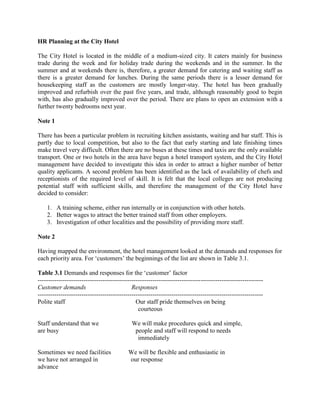
The City Hotel is located in the middle of a medium-sized city. It caters mainly for business
trade during the week and for holiday trade during the weekends and in the summer. In the
summer and at weekends there is, therefore, a greater demand for catering and waiting staff as
there is a greater demand for lunches. During the same periods there is a lesser demand for
housekeeping staff as the customers are mostly longer-stay. The hotel has been gradually
improved and refurbish over the past five years, and trade, although reasonably good to begin
with, has also gradually improved over the period. There are plans to open an extension with a
further twenty bedrooms next year.

Note 1

There has been a particular problem in recruiting kitchen assistants, waiting and bar staff. This is
partly due to local competition, but also to the fact that early starting and late finishing times
make travel very difficult. Often there are no buses at these times and taxis are the only available
transport. One or two hotels in the area have begun a hotel transport system, and the City Hotel
management have decided to investigate this idea in order to attract a higher number of better
quality applicants. A second problem has been identified as the lack of availability of chefs and
receptionists of the required level of skill. It is felt that the local colleges are not producing
potential staff with sufficient skills, and therefore the management of the City Hotel have
decided to consider:

    1. A training scheme, either run internally or in conjunction with other hotels.
    2. Better wages to attract the better trained staff from other employers.
    3. Investigation of other localities and the possibility of providing more staff.

Note 2

Having mapped the environment, the hotel management looked at the demands and responses for
each priority area. For ‘customers’ the beginnings of the list are shown in Table 3.1.

Table 3.1 Demands and responses for the ‘customer’ factor
------------------------------------------------------------------------------------------------------------
Customer demands                             Responses
------------------------------------------------------------------------------------------------------------
Polite staff                                   Our staff pride themselves on being
                                                courteous

Staff understand that we                     We will make procedures quick and simple,
are busy                                      people and staff will respond to needs
                                               immediately

Sometimes we need facilities               We will be flexible and enthusiastic in
we have not arranged in                    our response
advance
And so on.
------------------------------------------------------------------------------------------------------------

Note 3

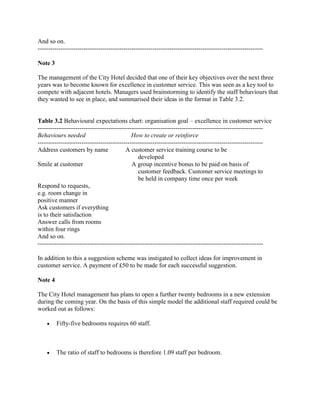
The management of the City Hotel decided that one of their key objectives over the next three
years was to become known for excellence in customer service. This was seen as a key tool to
compete with adjacent hotels. Managers used brainstorming to identify the staff behaviours that
they wanted to see in place, and summarised their ideas in the format in Table 3.2.


Table 3.2 Behavioural expectations chart: organisation goal – excellence in customer service
------------------------------------------------------------------------------------------------------------
Behaviours needed                            How to create or reinforce
------------------------------------------------------------------------------------------------------------
Address customers by name                 A customer service training course to be
                                                developed
Smile at customer                            A group incentive bonus to be paid on basis of
                                                customer feedback. Customer service meetings to
                                                be held in company time once per week
Respond to requests,
e.g. room change in
positive manner
Ask customers if everything
is to their satisfaction
Answer calls from rooms
within four rings
And so on.
------------------------------------------------------------------------------------------------------------

In addition to this a suggestion scheme was instigated to collect ideas for improvement in
customer service. A payment of £50 to be made for each successful suggestion.

Note 4

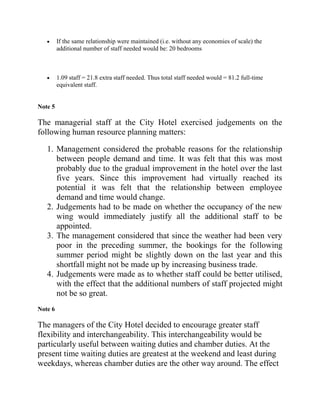
The City Hotel management has plans to open a further twenty bedrooms in a new extension
during the coming year. On the basis of this simple model the additional staff required could be
worked out as follows:

         Fifty-five bedrooms requires 60 staff.


         The ratio of staff to bedrooms is therefore 1.09 staff per bedroom.
If the same relationship were maintained (i.e. without any economies of scale) the
         additional number of staff needed would be: 20 bedrooms


         1.09 staff = 21.8 extra staff needed. Thus total staff needed would = 81.2 full-time
         equivalent staff.


Note 5

The managerial staff at the City Hotel exercised judgements on the
following human resource planning matters:

   1. Management considered the probable reasons for the relationship
      between people demand and time. It was felt that this was most
      probably due to the gradual improvement in the hotel over the last
      five years. Since this improvement had virtually reached its
      potential it was felt that the relationship between employee
      demand and time would change.
   2. Judgements had to be made on whether the occupancy of the new
      wing would immediately justify all the additional staff to be
      appointed.
   3. The management considered that since the weather had been very
      poor in the preceding summer, the bookings for the following
      summer period might be slightly down on the last year and this
      shortfall might not be made up by increasing business trade.
   4. Judgements were made as to whether staff could be better utilised,
      with the effect that the additional numbers of staff projected might
      not be so great.
Note 6

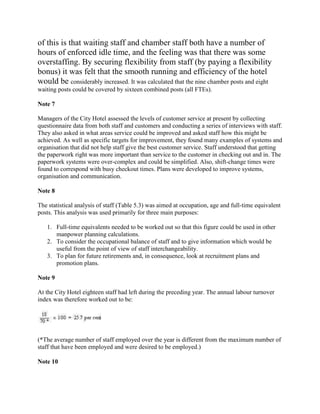
The managers of the City Hotel decided to encourage greater staff
flexibility and interchangeability. This interchangeability would be
particularly useful between waiting duties and chamber duties. At the
present time waiting duties are greatest at the weekend and least during
weekdays, whereas chamber duties are the other way around. The effect
of this is that waiting staff and chamber staff both have a number of
hours of enforced idle time, and the feeling was that there was some
overstaffing. By securing flexibility from staff (by paying a flexibility
bonus) it was felt that the smooth running and efficiency of the hotel
would be considerably increased. It was calculated that the nine chamber posts and eight
waiting posts could be covered by sixteen combined posts (all FTEs).

Note 7

Managers of the City Hotel assessed the levels of customer service at present by collecting
questionnaire data from both staff and customers and conducting a series of interviews with staff.
They also asked in what areas service could be improved and asked staff how this might be
achieved. As well as specific targets for improvement, they found many examples of systems and
organisation that did not help staff give the best customer service. Staff understood that getting
the paperwork right was more important than service to the customer in checking out and in. The
paperwork systems were over-complex and could be simplified. Also, shift-change times were
found to correspond with busy checkout times. Plans were developed to improve systems,
organisation and communication.

Note 8

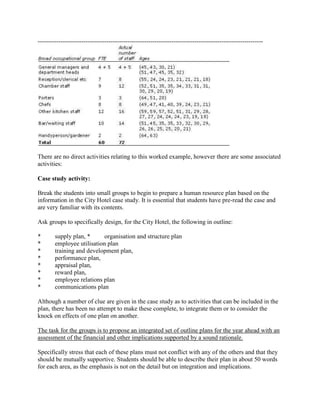
The statistical analysis of staff (Table 5.3) was aimed at occupation, age and full-time equivalent
posts. This analysis was used primarily for three main purposes:

   1. Full-time equivalents needed to be worked out so that this figure could be used in other
      manpower planning calculations.
   2. To consider the occupational balance of staff and to give information which would be
      useful from the point of view of staff interchangeability.
   3. To plan for future retirements and, in consequence, look at recruitment plans and
      promotion plans.

Note 9

At the City Hotel eighteen staff had left during the preceding year. The annual labour turnover
index was therefore worked out to be:


(*The average number of staff employed over the year is different from the maximum number of
staff that have been employed and were desired to be employed.)

Note 10
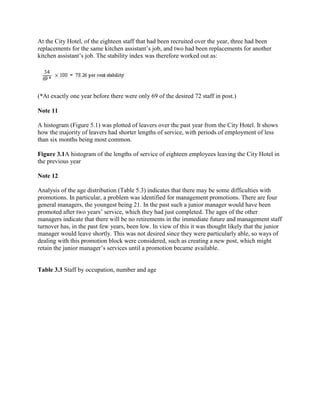
At the City Hotel, of the eighteen staff that had been recruited over the year, three had been
replacements for the same kitchen assistant’s job, and two had been replacements for another
kitchen assistant’s job. The stability index was therefore worked out as:


(*At exactly one year before there were only 69 of the desired 72 staff in post.)

Note 11

A histogram (Figure 5.1) was plotted of leavers over the past year from the City Hotel. It shows
how the majority of leavers had shorter lengths of service, with periods of employment of less
than six months being most common.

Figure 3.1A histogram of the lengths of service of eighteen employees leaving the City Hotel in
the previous year

Note 12

Analysis of the age distribution (Table 5.3) indicates that there may be some difficulties with
promotions. In particular, a problem was identified for management promotions. There are four
general managers, the youngest being 21. In the past such a junior manager would have been
promoted after two years’ service, which they had just completed. The ages of the other
managers indicate that there will be no retirements in the immediate future and management staff
turnover has, in the past few years, been low. In view of this it was thought likely that the junior
manager would leave shortly. This was not desired since they were particularly able, so ways of
dealing with this promotion block were considered, such as creating a new post, which might
retain the junior manager’s services until a promotion became available.


Table 3.3 Staff by occupation, number and age
------------------------------------------------------------------------------------------------------------


There are no direct activities relating to this worked example, however there are some associated
activities:

Case study activity:

Break the students into small groups to begin to prepare a human resource plan based on the
information in the City Hotel case study. It is essential that students have pre-read the case and
are very familiar with its contents.

Ask groups to specifically design, for the City Hotel, the following in outline:

*       supply plan, *      organisation and structure plan
*       employee utilisation plan
*       training and development plan,
*       performance plan,
*       appraisal plan,
*       reward plan,
*       employee relations plan
*       communications plan

Although a number of clue are given in the case study as to activities that can be included in the
plan, there has been no attempt to make these complete, to integrate them or to consider the
knock on effects of one plan on another.

The task for the groups is to propose an integrated set of outline plans for the year ahead with an
assessment of the financial and other implications supported by a sound rationale.

Specifically stress that each of these plans must not conflict with any of the others and that they
should be mutually supportive. Students should be able to describe their plan in about 50 words
for each area, as the emphasis is not on the detail but on integration and implications.
Allow plenty of time for groups to discuss, as this is a demanding task. Report back could be in
either of two forms:

Option 1

Give each group the opportunity to present their plan to the whole group and allow for time to
question and compare different approaches to the same issues. (The groups may have decided to
meet in the meantime to do further work). This timing will be more appropriate to part-time
students already employed in the personnel function. For full time students you may wish to
delay presentation until towards the end of the course, and use this as a framework for their
ongoing interpretation and application of each session.

Option 2
The case could be used as an individual or group assignment to be presented in written form.

Hrp case

  • 1.
    HR Planning atthe City Hotel The City Hotel is located in the middle of a medium-sized city. It caters mainly for business trade during the week and for holiday trade during the weekends and in the summer. In the summer and at weekends there is, therefore, a greater demand for catering and waiting staff as there is a greater demand for lunches. During the same periods there is a lesser demand for housekeeping staff as the customers are mostly longer-stay. The hotel has been gradually improved and refurbish over the past five years, and trade, although reasonably good to begin with, has also gradually improved over the period. There are plans to open an extension with a further twenty bedrooms next year. Note 1 There has been a particular problem in recruiting kitchen assistants, waiting and bar staff. This is partly due to local competition, but also to the fact that early starting and late finishing times make travel very difficult. Often there are no buses at these times and taxis are the only available transport. One or two hotels in the area have begun a hotel transport system, and the City Hotel management have decided to investigate this idea in order to attract a higher number of better quality applicants. A second problem has been identified as the lack of availability of chefs and receptionists of the required level of skill. It is felt that the local colleges are not producing potential staff with sufficient skills, and therefore the management of the City Hotel have decided to consider: 1. A training scheme, either run internally or in conjunction with other hotels. 2. Better wages to attract the better trained staff from other employers. 3. Investigation of other localities and the possibility of providing more staff. Note 2 Having mapped the environment, the hotel management looked at the demands and responses for each priority area. For ‘customers’ the beginnings of the list are shown in Table 3.1. Table 3.1 Demands and responses for the ‘customer’ factor ------------------------------------------------------------------------------------------------------------ Customer demands Responses ------------------------------------------------------------------------------------------------------------ Polite staff Our staff pride themselves on being courteous Staff understand that we We will make procedures quick and simple, are busy people and staff will respond to needs immediately Sometimes we need facilities We will be flexible and enthusiastic in we have not arranged in our response advance
  • 2.
    And so on. ------------------------------------------------------------------------------------------------------------ Note3 The management of the City Hotel decided that one of their key objectives over the next three years was to become known for excellence in customer service. This was seen as a key tool to compete with adjacent hotels. Managers used brainstorming to identify the staff behaviours that they wanted to see in place, and summarised their ideas in the format in Table 3.2. Table 3.2 Behavioural expectations chart: organisation goal – excellence in customer service ------------------------------------------------------------------------------------------------------------ Behaviours needed How to create or reinforce ------------------------------------------------------------------------------------------------------------ Address customers by name A customer service training course to be developed Smile at customer A group incentive bonus to be paid on basis of customer feedback. Customer service meetings to be held in company time once per week Respond to requests, e.g. room change in positive manner Ask customers if everything is to their satisfaction Answer calls from rooms within four rings And so on. ------------------------------------------------------------------------------------------------------------ In addition to this a suggestion scheme was instigated to collect ideas for improvement in customer service. A payment of £50 to be made for each successful suggestion. Note 4 The City Hotel management has plans to open a further twenty bedrooms in a new extension during the coming year. On the basis of this simple model the additional staff required could be worked out as follows: Fifty-five bedrooms requires 60 staff. The ratio of staff to bedrooms is therefore 1.09 staff per bedroom.
  • 3.
    If the samerelationship were maintained (i.e. without any economies of scale) the additional number of staff needed would be: 20 bedrooms 1.09 staff = 21.8 extra staff needed. Thus total staff needed would = 81.2 full-time equivalent staff. Note 5 The managerial staff at the City Hotel exercised judgements on the following human resource planning matters: 1. Management considered the probable reasons for the relationship between people demand and time. It was felt that this was most probably due to the gradual improvement in the hotel over the last five years. Since this improvement had virtually reached its potential it was felt that the relationship between employee demand and time would change. 2. Judgements had to be made on whether the occupancy of the new wing would immediately justify all the additional staff to be appointed. 3. The management considered that since the weather had been very poor in the preceding summer, the bookings for the following summer period might be slightly down on the last year and this shortfall might not be made up by increasing business trade. 4. Judgements were made as to whether staff could be better utilised, with the effect that the additional numbers of staff projected might not be so great. Note 6 The managers of the City Hotel decided to encourage greater staff flexibility and interchangeability. This interchangeability would be particularly useful between waiting duties and chamber duties. At the present time waiting duties are greatest at the weekend and least during weekdays, whereas chamber duties are the other way around. The effect
  • 4.
    of this isthat waiting staff and chamber staff both have a number of hours of enforced idle time, and the feeling was that there was some overstaffing. By securing flexibility from staff (by paying a flexibility bonus) it was felt that the smooth running and efficiency of the hotel would be considerably increased. It was calculated that the nine chamber posts and eight waiting posts could be covered by sixteen combined posts (all FTEs). Note 7 Managers of the City Hotel assessed the levels of customer service at present by collecting questionnaire data from both staff and customers and conducting a series of interviews with staff. They also asked in what areas service could be improved and asked staff how this might be achieved. As well as specific targets for improvement, they found many examples of systems and organisation that did not help staff give the best customer service. Staff understood that getting the paperwork right was more important than service to the customer in checking out and in. The paperwork systems were over-complex and could be simplified. Also, shift-change times were found to correspond with busy checkout times. Plans were developed to improve systems, organisation and communication. Note 8 The statistical analysis of staff (Table 5.3) was aimed at occupation, age and full-time equivalent posts. This analysis was used primarily for three main purposes: 1. Full-time equivalents needed to be worked out so that this figure could be used in other manpower planning calculations. 2. To consider the occupational balance of staff and to give information which would be useful from the point of view of staff interchangeability. 3. To plan for future retirements and, in consequence, look at recruitment plans and promotion plans. Note 9 At the City Hotel eighteen staff had left during the preceding year. The annual labour turnover index was therefore worked out to be: (*The average number of staff employed over the year is different from the maximum number of staff that have been employed and were desired to be employed.) Note 10
  • 5.
    At the CityHotel, of the eighteen staff that had been recruited over the year, three had been replacements for the same kitchen assistant’s job, and two had been replacements for another kitchen assistant’s job. The stability index was therefore worked out as: (*At exactly one year before there were only 69 of the desired 72 staff in post.) Note 11 A histogram (Figure 5.1) was plotted of leavers over the past year from the City Hotel. It shows how the majority of leavers had shorter lengths of service, with periods of employment of less than six months being most common. Figure 3.1A histogram of the lengths of service of eighteen employees leaving the City Hotel in the previous year Note 12 Analysis of the age distribution (Table 5.3) indicates that there may be some difficulties with promotions. In particular, a problem was identified for management promotions. There are four general managers, the youngest being 21. In the past such a junior manager would have been promoted after two years’ service, which they had just completed. The ages of the other managers indicate that there will be no retirements in the immediate future and management staff turnover has, in the past few years, been low. In view of this it was thought likely that the junior manager would leave shortly. This was not desired since they were particularly able, so ways of dealing with this promotion block were considered, such as creating a new post, which might retain the junior manager’s services until a promotion became available. Table 3.3 Staff by occupation, number and age
  • 6.
    ------------------------------------------------------------------------------------------------------------ There are nodirect activities relating to this worked example, however there are some associated activities: Case study activity: Break the students into small groups to begin to prepare a human resource plan based on the information in the City Hotel case study. It is essential that students have pre-read the case and are very familiar with its contents. Ask groups to specifically design, for the City Hotel, the following in outline: * supply plan, * organisation and structure plan * employee utilisation plan * training and development plan, * performance plan, * appraisal plan, * reward plan, * employee relations plan * communications plan Although a number of clue are given in the case study as to activities that can be included in the plan, there has been no attempt to make these complete, to integrate them or to consider the knock on effects of one plan on another. The task for the groups is to propose an integrated set of outline plans for the year ahead with an assessment of the financial and other implications supported by a sound rationale. Specifically stress that each of these plans must not conflict with any of the others and that they should be mutually supportive. Students should be able to describe their plan in about 50 words for each area, as the emphasis is not on the detail but on integration and implications.
  • 7.
    Allow plenty oftime for groups to discuss, as this is a demanding task. Report back could be in either of two forms: Option 1 Give each group the opportunity to present their plan to the whole group and allow for time to question and compare different approaches to the same issues. (The groups may have decided to meet in the meantime to do further work). This timing will be more appropriate to part-time students already employed in the personnel function. For full time students you may wish to delay presentation until towards the end of the course, and use this as a framework for their ongoing interpretation and application of each session. Option 2 The case could be used as an individual or group assignment to be presented in written form.