COURSE UNIT: HUMAN RESOURCE MANAGEMENT.
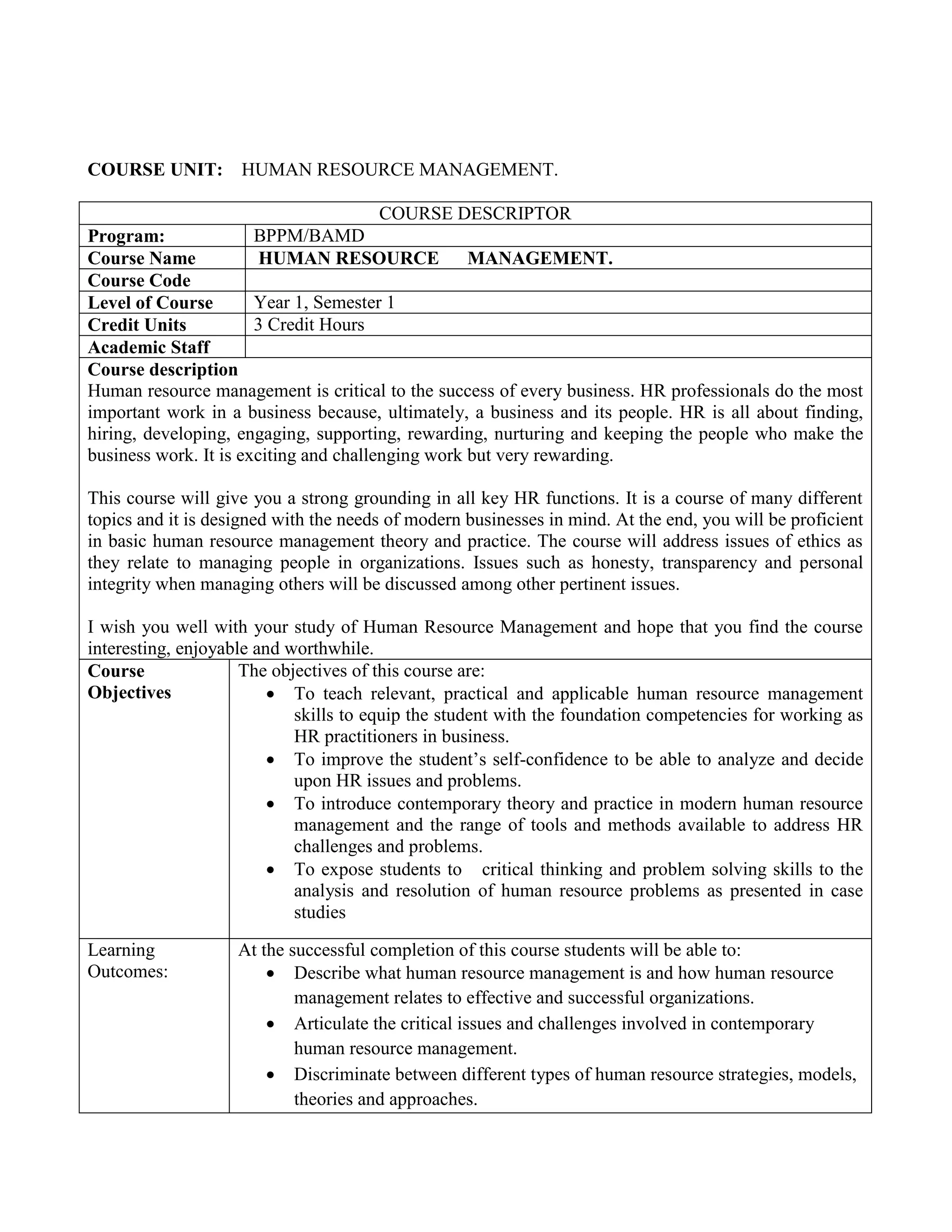
COURSE DESCRIPTOR
Program: BPPM/BAMD
Course Name HUMAN RESOURCE MANAGEMENT.
Course Code
Level of Course Year 1, Semester 1
Credit Units 3 Credit Hours
Academic Staff
Course description
Human resource management is critical to the success of every business. HR professionals do the most
important work in a business because, ultimately, a business and its people. HR is all about finding,
hiring, developing, engaging, supporting, rewarding, nurturing and keeping the people who make the
business work. It is exciting and challenging work but very rewarding.
This course will give you a strong grounding in all key HR functions. It is a course of many different
topics and it is designed with the needs of modern businesses in mind. At the end, you will be proficient
in basic human resource management theory and practice. The course will address issues of ethics as
they relate to managing people in organizations. Issues such as honesty, transparency and personal
integrity when managing others will be discussed among other pertinent issues.
I wish you well with your study of Human Resource Management and hope that you find the course
interesting, enjoyable and worthwhile.
Course
Objectives
The objectives of this course are:
 To teach relevant, practical and applicable human resource management
skills to equip the student with the foundation competencies for working as
HR practitioners in business.
 To improve the student’s self-confidence to be able to analyze and decide
upon HR issues and problems.
 To introduce contemporary theory and practice in modern human resource
management and the range of tools and methods available to address HR
challenges and problems.
 To expose students to critical thinking and problem solving skills to the
analysis and resolution of human resource problems as presented in case
studies
Learning
Outcomes:
At the successful completion of this course students will be able to:
 Describe what human resource management is and how human resource
management relates to effective and successful organizations.
 Articulate the critical issues and challenges involved in contemporary
human resource management.
 Discriminate between different types of human resource strategies, models,
theories and approaches.
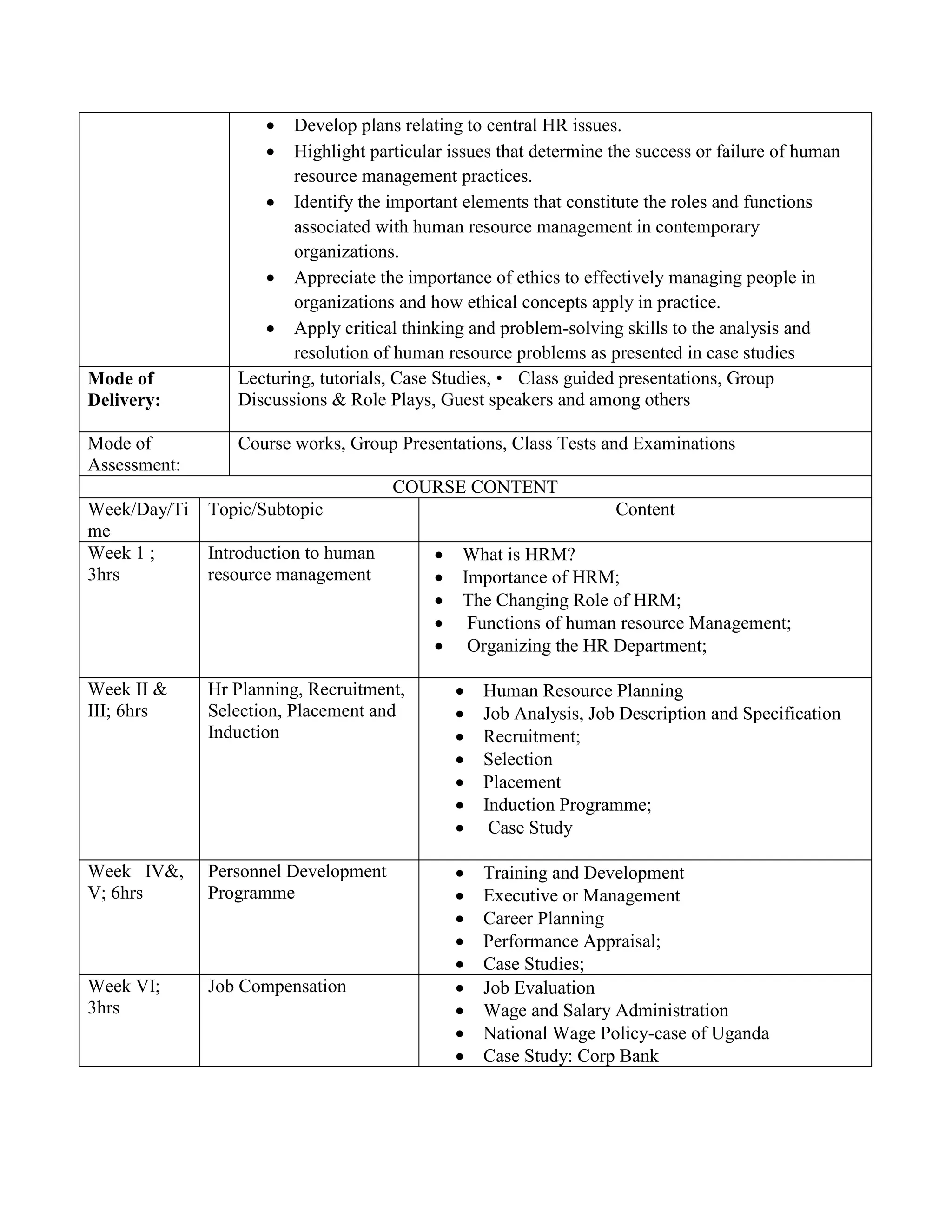
 Develop plans relating to central HR issues.
 Highlight particular issues that determine the success or failure of human
resource management practices.
 Identify the important elements that constitute the roles and functions
associated with human resource management in contemporary
organizations.
 Appreciate the importance of ethics to effectively managing people in
organizations and how ethical concepts apply in practice.
 Apply critical thinking and problem-solving skills to the analysis and
resolution of human resource problems as presented in case studies
Mode of
Delivery:
Lecturing, tutorials, Case Studies, • Class guided presentations, Group
Discussions & Role Plays, Guest speakers and among others
Mode of
Assessment:
Course works, Group Presentations, Class Tests and Examinations
COURSE CONTENT
Week/Day/Ti
me
Topic/Subtopic Content
Week 1 ;
3hrs
Introduction to human
resource management
 What is HRM?
 Importance of HRM;
 The Changing Role of HRM;
 Functions of human resource Management;
 Organizing the HR Department;
Week II &
III; 6hrs
Hr Planning, Recruitment,
Selection, Placement and
Induction
 Human Resource Planning
 Job Analysis, Job Description and Specification
 Recruitment;
 Selection
 Placement
 Induction Programme;
 Case Study
Week IV&,
V; 6hrs
Personnel Development
Programme
 Training and Development
 Executive or Management
 Career Planning
 Performance Appraisal;
 Case Studies;
Week VI;
3hrs
Job Compensation  Job Evaluation
 Wage and Salary Administration
 National Wage Policy-case of Uganda
 Case Study: Corp Bank
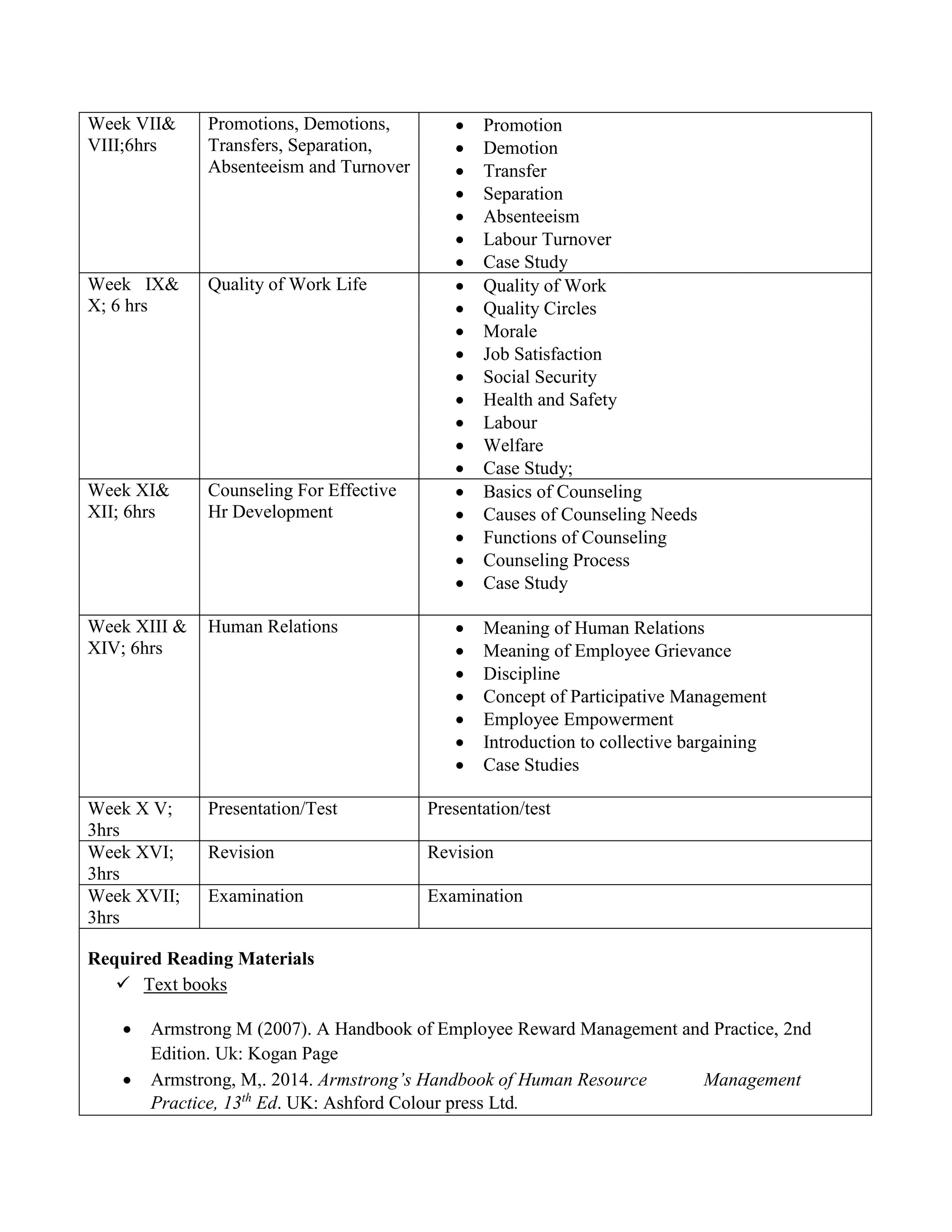
Week VII&
VIII;6hrs
Promotions, Demotions,
Transfers, Separation,
Absenteeism and Turnover
 Promotion
 Demotion
 Transfer
 Separation
 Absenteeism
 Labour Turnover
 Case Study
Week IX&
X; 6 hrs
Quality of Work Life  Quality of Work
 Quality Circles
 Morale
 Job Satisfaction
 Social Security
 Health and Safety
 Labour
 Welfare
 Case Study;
Week XI&
XII; 6hrs
Counseling For Effective
Hr Development
 Basics of Counseling
 Causes of Counseling Needs
 Functions of Counseling
 Counseling Process
 Case Study
Week XIII &
XIV; 6hrs
Human Relations  Meaning of Human Relations
 Meaning of Employee Grievance
 Discipline
 Concept of Participative Management
 Employee Empowerment
 Introduction to collective bargaining
 Case Studies
Week X V;
3hrs
Presentation/Test Presentation/test
Week XVI;
3hrs
Revision Revision
Week XVII;
3hrs
Examination Examination
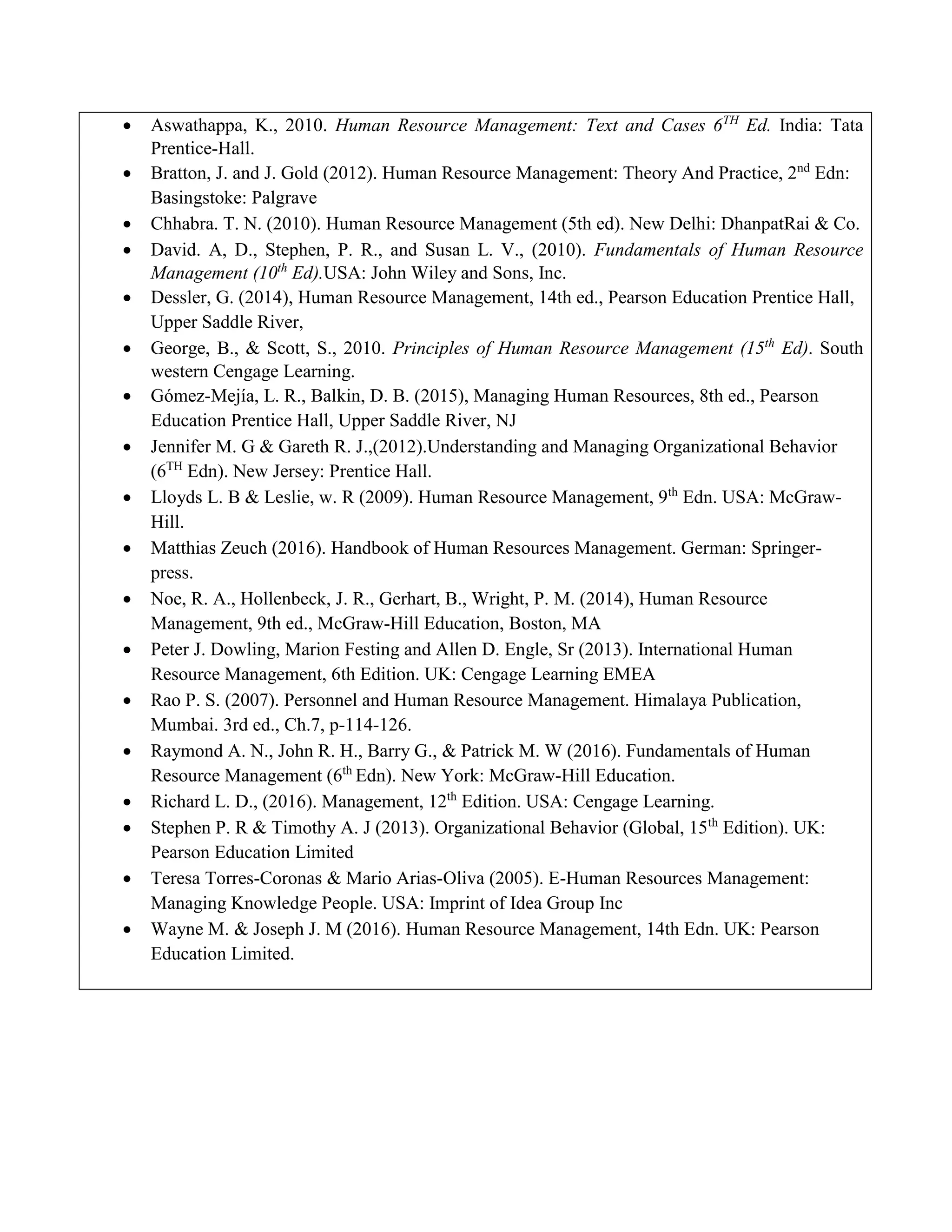
Required Reading Materials
 Text books
 Armstrong M (2007). A Handbook of Employee Reward Management and Practice, 2nd
Edition. Uk: Kogan Page
 Armstrong, M,. 2014. Armstrong’s Handbook of Human Resource Management
Practice, 13th
Ed. UK: Ashford Colour press Ltd.
 Aswathappa, K., 2010. Human Resource Management: Text and Cases 6TH
Ed. India: Tata
Prentice-Hall.
 Bratton, J. and J. Gold (2012). Human Resource Management: Theory And Practice, 2nd
Edn:
Basingstoke: Palgrave
 Chhabra. T. N. (2010). Human Resource Management (5th ed). New Delhi: DhanpatRai & Co.
 David. A, D., Stephen, P. R., and Susan L. V., (2010). Fundamentals of Human Resource
Management (10th
Ed).USA: John Wiley and Sons, Inc.
 Dessler, G. (2014), Human Resource Management, 14th ed., Pearson Education Prentice Hall,
Upper Saddle River,
 George, B., & Scott, S., 2010. Principles of Human Resource Management (15th
Ed). South
western Cengage Learning.
 Gómez-Mejía, L. R., Balkin, D. B. (2015), Managing Human Resources, 8th ed., Pearson
Education Prentice Hall, Upper Saddle River, NJ
 Jennifer M. G & Gareth R. J.,(2012).Understanding and Managing Organizational Behavior
(6TH
Edn). New Jersey: Prentice Hall.
 Lloyds L. B & Leslie, w. R (2009). Human Resource Management, 9th
Edn. USA: McGraw-
Hill.
 Matthias Zeuch (2016). Handbook of Human Resources Management. German: Springer-
press.
 Noe, R. A., Hollenbeck, J. R., Gerhart, B., Wright, P. M. (2014), Human Resource
Management, 9th ed., McGraw-Hill Education, Boston, MA
 Peter J. Dowling, Marion Festing and Allen D. Engle, Sr (2013). International Human
Resource Management, 6th Edition. UK: Cengage Learning EMEA
 Rao P. S. (2007). Personnel and Human Resource Management. Himalaya Publication,
Mumbai. 3rd ed., Ch.7, p-114-126.
 Raymond A. N., John R. H., Barry G., & Patrick M. W (2016). Fundamentals of Human
Resource Management (6th
Edn). New York: McGraw-Hill Education.
 Richard L. D., (2016). Management, 12th
Edition. USA: Cengage Learning.
 Stephen P. R & Timothy A. J (2013). Organizational Behavior (Global, 15th
Edition). UK:
Pearson Education Limited
 Teresa Torres-Coronas & Mario Arias-Oliva (2005). E-Human Resources Management:
Managing Knowledge People. USA: Imprint of Idea Group Inc
 Wayne M. & Joseph J. M (2016). Human Resource Management, 14th Edn. UK: Pearson
Education Limited.

HRM Course OutLine 2024.docx

  • 1.
    COURSE UNIT: HUMANRESOURCE MANAGEMENT. COURSE DESCRIPTOR Program: BPPM/BAMD Course Name HUMAN RESOURCE MANAGEMENT. Course Code Level of Course Year 1, Semester 1 Credit Units 3 Credit Hours Academic Staff Course description Human resource management is critical to the success of every business. HR professionals do the most important work in a business because, ultimately, a business and its people. HR is all about finding, hiring, developing, engaging, supporting, rewarding, nurturing and keeping the people who make the business work. It is exciting and challenging work but very rewarding. This course will give you a strong grounding in all key HR functions. It is a course of many different topics and it is designed with the needs of modern businesses in mind. At the end, you will be proficient in basic human resource management theory and practice. The course will address issues of ethics as they relate to managing people in organizations. Issues such as honesty, transparency and personal integrity when managing others will be discussed among other pertinent issues. I wish you well with your study of Human Resource Management and hope that you find the course interesting, enjoyable and worthwhile. Course Objectives The objectives of this course are:  To teach relevant, practical and applicable human resource management skills to equip the student with the foundation competencies for working as HR practitioners in business.  To improve the student’s self-confidence to be able to analyze and decide upon HR issues and problems.  To introduce contemporary theory and practice in modern human resource management and the range of tools and methods available to address HR challenges and problems.  To expose students to critical thinking and problem solving skills to the analysis and resolution of human resource problems as presented in case studies Learning Outcomes: At the successful completion of this course students will be able to:  Describe what human resource management is and how human resource management relates to effective and successful organizations.  Articulate the critical issues and challenges involved in contemporary human resource management.  Discriminate between different types of human resource strategies, models, theories and approaches.
  • 2.
     Develop plansrelating to central HR issues.  Highlight particular issues that determine the success or failure of human resource management practices.  Identify the important elements that constitute the roles and functions associated with human resource management in contemporary organizations.  Appreciate the importance of ethics to effectively managing people in organizations and how ethical concepts apply in practice.  Apply critical thinking and problem-solving skills to the analysis and resolution of human resource problems as presented in case studies Mode of Delivery: Lecturing, tutorials, Case Studies, • Class guided presentations, Group Discussions & Role Plays, Guest speakers and among others Mode of Assessment: Course works, Group Presentations, Class Tests and Examinations COURSE CONTENT Week/Day/Ti me Topic/Subtopic Content Week 1 ; 3hrs Introduction to human resource management  What is HRM?  Importance of HRM;  The Changing Role of HRM;  Functions of human resource Management;  Organizing the HR Department; Week II & III; 6hrs Hr Planning, Recruitment, Selection, Placement and Induction  Human Resource Planning  Job Analysis, Job Description and Specification  Recruitment;  Selection  Placement  Induction Programme;  Case Study Week IV&, V; 6hrs Personnel Development Programme  Training and Development  Executive or Management  Career Planning  Performance Appraisal;  Case Studies; Week VI; 3hrs Job Compensation  Job Evaluation  Wage and Salary Administration  National Wage Policy-case of Uganda  Case Study: Corp Bank
  • 3.
    Week VII& VIII;6hrs Promotions, Demotions, Transfers,Separation, Absenteeism and Turnover  Promotion  Demotion  Transfer  Separation  Absenteeism  Labour Turnover  Case Study Week IX& X; 6 hrs Quality of Work Life  Quality of Work  Quality Circles  Morale  Job Satisfaction  Social Security  Health and Safety  Labour  Welfare  Case Study; Week XI& XII; 6hrs Counseling For Effective Hr Development  Basics of Counseling  Causes of Counseling Needs  Functions of Counseling  Counseling Process  Case Study Week XIII & XIV; 6hrs Human Relations  Meaning of Human Relations  Meaning of Employee Grievance  Discipline  Concept of Participative Management  Employee Empowerment  Introduction to collective bargaining  Case Studies Week X V; 3hrs Presentation/Test Presentation/test Week XVI; 3hrs Revision Revision Week XVII; 3hrs Examination Examination Required Reading Materials  Text books  Armstrong M (2007). A Handbook of Employee Reward Management and Practice, 2nd Edition. Uk: Kogan Page  Armstrong, M,. 2014. Armstrong’s Handbook of Human Resource Management Practice, 13th Ed. UK: Ashford Colour press Ltd.
  • 4.
     Aswathappa, K.,2010. Human Resource Management: Text and Cases 6TH Ed. India: Tata Prentice-Hall.  Bratton, J. and J. Gold (2012). Human Resource Management: Theory And Practice, 2nd Edn: Basingstoke: Palgrave  Chhabra. T. N. (2010). Human Resource Management (5th ed). New Delhi: DhanpatRai & Co.  David. A, D., Stephen, P. R., and Susan L. V., (2010). Fundamentals of Human Resource Management (10th Ed).USA: John Wiley and Sons, Inc.  Dessler, G. (2014), Human Resource Management, 14th ed., Pearson Education Prentice Hall, Upper Saddle River,  George, B., & Scott, S., 2010. Principles of Human Resource Management (15th Ed). South western Cengage Learning.  Gómez-Mejía, L. R., Balkin, D. B. (2015), Managing Human Resources, 8th ed., Pearson Education Prentice Hall, Upper Saddle River, NJ  Jennifer M. G & Gareth R. J.,(2012).Understanding and Managing Organizational Behavior (6TH Edn). New Jersey: Prentice Hall.  Lloyds L. B & Leslie, w. R (2009). Human Resource Management, 9th Edn. USA: McGraw- Hill.  Matthias Zeuch (2016). Handbook of Human Resources Management. German: Springer- press.  Noe, R. A., Hollenbeck, J. R., Gerhart, B., Wright, P. M. (2014), Human Resource Management, 9th ed., McGraw-Hill Education, Boston, MA  Peter J. Dowling, Marion Festing and Allen D. Engle, Sr (2013). International Human Resource Management, 6th Edition. UK: Cengage Learning EMEA  Rao P. S. (2007). Personnel and Human Resource Management. Himalaya Publication, Mumbai. 3rd ed., Ch.7, p-114-126.  Raymond A. N., John R. H., Barry G., & Patrick M. W (2016). Fundamentals of Human Resource Management (6th Edn). New York: McGraw-Hill Education.  Richard L. D., (2016). Management, 12th Edition. USA: Cengage Learning.  Stephen P. R & Timothy A. J (2013). Organizational Behavior (Global, 15th Edition). UK: Pearson Education Limited  Teresa Torres-Coronas & Mario Arias-Oliva (2005). E-Human Resources Management: Managing Knowledge People. USA: Imprint of Idea Group Inc  Wayne M. & Joseph J. M (2016). Human Resource Management, 14th Edn. UK: Pearson Education Limited.