©SHRM 2014
1
©SHRM 2014
Jambore SDM Indonesia
Sibolangit– April 26-27, 2014
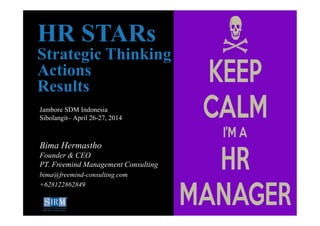
HR STARs
Strategic Thinking
Actions
Results
Bima Hermastho
Founder & CEO
PT. Freemind Management Consulting
bima@freemind-consulting.com
+628122862849
©SHRM 2014
2
©SHRM 2014
Reshaping Your
Key Role
in
HR Functions
©SHRM 2014
3
©SHRM 2014
D
Best Practice Sharing
©SHRM 2014
BIMA HERMASTHO
Manufacturing & Human Performance Improvement Technologist
CEO PT. Freemind Management Consulting – A Business Performance Improvement Consulting.
Professional Experiences:
 Founder Indonesian Balanced Scorecard School (http://www.bsc-indonesia.com) & Indonesian Six Sigma School
(http://www.sixsigma-indonesian.com) - both are free online course in Balanced Scorecard and Six Sigma.
 Founder Indonesian Human Capital Institute, a free online HRM course (http://sdm-indonesia.net)
 Professional experiences: various positions from Management Trainee, HR Manager, TPM Training Manager, OD
Senior Manager, Human Capital & OD Director in local and global companies (PT. Teleperformance Indonesia, PT.
Multi Bintang Indonesia Tbk, PT. Coats Indonesia, PT. Polysindo Eka Perkasa – Asia Pacific Fibre, etc)
 Active & registered member: SHRM (American Society for HRM), ASTD (American Society for Training and
Development), ASQ (American Society for Quality) & ISSP (International Six Sigma Professional Society)
 Bachelor Degree (ITB), Master & Doctorate Degree in “Strategic HRM & Total Quality Management” – UNDIP
 Certified Balanced Scorecard Professional
 Certified Lean Management Professional
 Certified Global Professional in HRM
 Certified Six Sigma Black Belt
 Certified Kaizen Professional
 TPM (Total Productive Management) Trainer
 Certified Mediator on ADR (Alternative Dispute Resolution)
bima@freemind-consulting.com
+62 8122862849
FOUNDER & LEAD CONSULTANT
©SHRM 2014
Vision
• We will be a quality leader in development of business with global reach by
serving ambitious clients, taking global knowledge to local markets.
Mission
• We deliver management consultancy where environmental challenges,
technology, business systems and people are combined in sustainable change
for competitive people and great business.
Challenging culture
• At Freemind Management Consulting, taking the lead without restrictions and
testing one’s capabilities without limitations will always be a legitimate
approach – given the appropriate professional background and goals.
PT. Freemind Management Consulting
©SHRM 2014
6
©SHRM 2014
Our Preferred Clients
©SHRM 2014
7
©SHRM 2014
Our Preferred Clients
©SHRM 2014©SHRM 2014
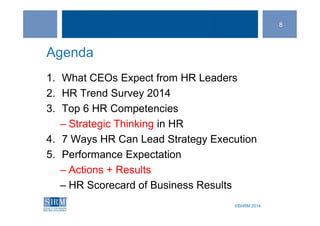
Agenda
1. What CEOs Expect from HR Leaders
2. HR Trend Survey 2014
3. Top 6 HR Competencies
– Strategic Thinking in HR
4. 7 Ways HR Can Lead Strategy Execution
5. Performance Expectation
– Actions + Results
– HR Scorecard of Business Results
8
©SHRM 2014©SHRM 2014
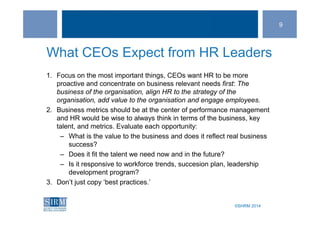
What CEOs Expect from HR Leaders
1. Focus on the most important things, CEOs want HR to be more
proactive and concentrate on business relevant needs first: The
business of the organisation, align HR to the strategy of the
organisation, add value to the organisation and engage employees.
2. Business metrics should be at the center of performance management
and HR would be wise to always think in terms of the business, key
talent, and metrics. Evaluate each opportunity:
– What is the value to the business and does it reflect real business
success?
– Does it fit the talent we need now and in the future?
– Is it responsive to workforce trends, succesion plan, leadership
development program?
3. Don’t just copy ‘best practices.’
9
©SHRM 2014©SHRM 2014
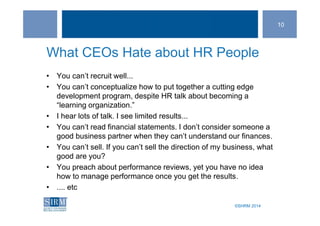
What CEOs Hate about HR People
• You can’t recruit well...
• You can’t conceptualize how to put together a cutting edge
development program, despite HR talk about becoming a
“learning organization.”
• I hear lots of talk. I see limited results...
• You can’t read financial statements. I don’t consider someone a
good business partner when they can’t understand our finances.
• You can’t sell. If you can’t sell the direction of my business, what
good are you?
• You preach about performance reviews, yet you have no idea
how to manage performance once you get the results.
• .... etc
10
©SHRM 2014©SHRM 2014
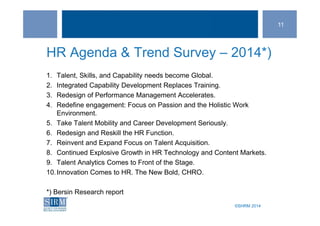
HR Agenda & Trend Survey – 2014*)
1. Talent, Skills, and Capability needs become Global.
2. Integrated Capability Development Replaces Training.
3. Redesign of Performance Management Accelerates.
4. Redefine engagement: Focus on Passion and the Holistic Work
Environment.
5. Take Talent Mobility and Career Development Seriously.
6. Redesign and Reskill the HR Function.
7. Reinvent and Expand Focus on Talent Acquisition.
8. Continued Explosive Growth in HR Technology and Content Markets.
9. Talent Analytics Comes to Front of the Stage.
10.Innovation Comes to HR. The New Bold, CHRO.
*) Bersin Research report
11
©SHRM 2014©SHRM 2014
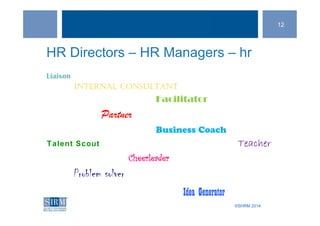
HR Directors – HR Managers – hr
Liaison
Internal Consultant
Facilitator
Partner
Business Coach
Talent Scout Teacher
Cheerleader
Problem solver
Idea Generator
12
©SHRM 2014©SHRM 2014
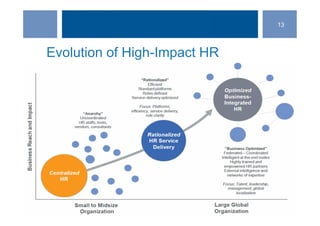
Evolution of High-Impact HR
13
©SHRM 2014©SHRM 2014
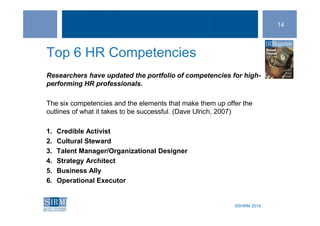
Top 6 HR Competencies
Researchers have updated the portfolio of competencies for high-
performing HR professionals.
The six competencies and the elements that make them up offer the
outlines of what it takes to be successful. (Dave Ulrich, 2007)
1. Credible Activist
2. Cultural Steward
3. Talent Manager/Organizational Designer
4. Strategy Architect
5. Business Ally
6. Operational Executor
14
©SHRM 2014©SHRM 2014
Top HR Competencies - Credible Activist
The Credible Activist is respected, admired, listened to and offers a
point of view, takes a position and challenges assumptions by:
• Delivering results with integrity
• Sharing information
• Building relationships of trust
• Doing HR with an attitude (taking appropriate risks, providing
candid observations, influencing others)
15
©SHRM 2014©SHRM 2014
Top HR Competencies - Cultural Steward
Cultural Steward recognizes, articulates and helps shape a
company’s culture by:
• Facilitating change
• Crafting culture
• Valuing culture
• Personalizing culture (helping employees find meaning in their
work, managing work/life balance, encouraging innovation)
16
©SHRM 2014©SHRM 2014
Top HR Competencies - Talent
Manager/Organizational Designer
The Talent Manager/Organizational Designer masters theory,
research and practice in both talent management and
organizational design by:
• Ensuring today’s and tomorrow’s talent
• Developing talent
• Shaping the organization
• Fostering communication
• Designing reward systems
17
©SHRM 2014©SHRM 2014
Top HR Competencies – Strategy
Architect
The Strategy Architect knows how to make the right change
happen by:
• Sustaining strategic agility
• Engaging customers
18
©SHRM 2014©SHRM 2014
Top HR Competencies – Business Ally
The Business Ally contributes to the success of the business by:
• Serving the value chain
• Interpreting social context
• Articulating the value proposition
• Leveraging business technology
19
©SHRM 2014©SHRM 2014
Top HR Competencies – Operational
Executor
The Operational Executor administers the day-to-day work of
managing people inside an organization by:
• Implementing workplace policies
• Advancing HR technology
20
©SHRM 2014©SHRM 2014
Global Paradox of HRM
Six domains of competencies that HR professionals must demonstrate to be
personally effective and to impact business performance:
1. Outside/in: HR must turn outside business trends and stakeholder expectations
into internal actions;
2. Business/people: HR should focus on both business results and human capital
improvement;
3. Individual/organizational: HR should target both individual ability and
organization capabilities;
4. Event/sustainability: HR is not about an isolated activity (a training,
communication, staffing, or compensation program) but sustainable and
integrated solutions;
5. Past/future: HR should respect its heritage, but shape a future;
6. Administrative/strategic: HR must attend to both day to day administrative
processes and long term strategic practices;
21
©SHRM 2014©SHRM 2014
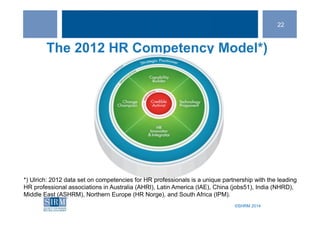
The 2012 HR Competency Model*)
*) Ulrich: 2012 data set on competencies for HR professionals is a unique partnership with the leading
HR professional associations in Australia (AHRI), Latin America (IAE), China (jobs51), India (NHRD),
Middle East (ASHRM), Northern Europe (HR Norge), and South Africa (IPM).
22
©SHRM 2014
23
©SHRM 2014
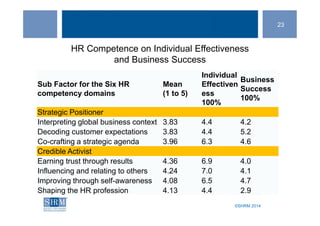
Sub Factor for the Six HR
competency domains
Mean
(1 to 5)
Individual
Effectiven
ess
100%
Business
Success
100%
Strategic Positioner
Interpreting global business context 3.83 4.4 4.2
Decoding customer expectations 3.83 4.4 5.2
Co-crafting a strategic agenda 3.96 6.3 4.6
Credible Activist
Earning trust through results 4.36 6.9 4.0
Influencing and relating to others 4.24 7.0 4.1
Improving through self-awareness 4.08 6.5 4.7
Shaping the HR profession 4.13 4.4 2.9
HR Competence on Individual Effectiveness
and Business Success
©SHRM 2014
24
©SHRM 2014
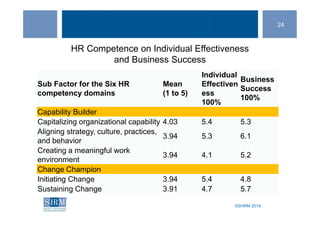
Sub Factor for the Six HR
competency domains
Mean
(1 to 5)
Individual
Effectiven
ess
100%
Business
Success
100%
Capability Builder
Capitalizing organizational capability 4.03 5.4 5.3
Aligning strategy, culture, practices,
and behavior
3.94 5.3 6.1
Creating a meaningful work
environment
3.94 4.1 5.2
Change Champion
Initiating Change 3.94 5.4 4.8
Sustaining Change 3.91 4.7 5.7
HR Competence on Individual Effectiveness
and Business Success
©SHRM 2014
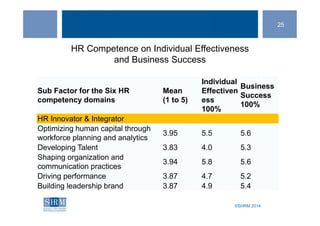
25
©SHRM 2014
Sub Factor for the Six HR
competency domains
Mean
(1 to 5)
Individual
Effectiven
ess
100%
Business
Success
100%
HR Innovator & Integrator
Optimizing human capital through
workforce planning and analytics
3.95 5.5 5.6
Developing Talent 3.83 4.0 5.3
Shaping organization and
communication practices
3.94 5.8 5.6
Driving performance 3.87 4.7 5.2
Building leadership brand 3.87 4.9 5.4
HR Competence on Individual Effectiveness
and Business Success
©SHRM 2014
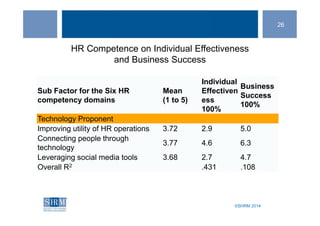
26
©SHRM 2014
Sub Factor for the Six HR
competency domains
Mean
(1 to 5)
Individual
Effectiven
ess
100%
Business
Success
100%
Technology Proponent
Improving utility of HR operations 3.72 2.9 5.0
Connecting people through
technology
3.77 4.6 6.3
Leveraging social media tools 3.68 2.7 4.7
Overall R2 .431 .108
HR Competence on Individual Effectiveness
and Business Success
©SHRM 2014©SHRM 2014
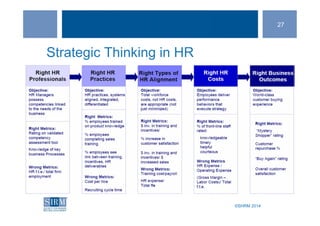
Strategic Thinking in HR
27
©SHRM 2014©SHRM 2014
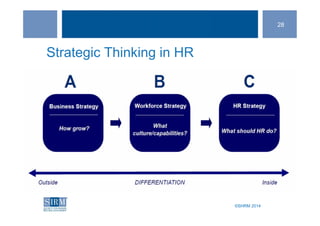
Strategic Thinking in HR
28
©SHRM 2014©SHRM 2014
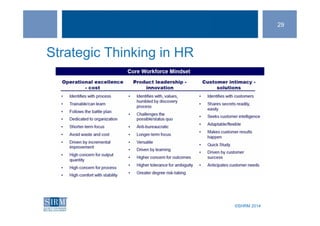
Strategic Thinking in HR
29
©SHRM 2014©SHRM 2014
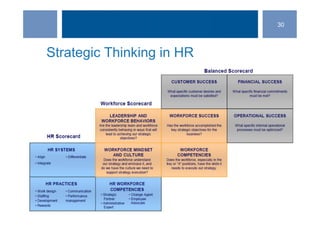
Strategic Thinking in HR
30
©SHRM 2014©SHRM 2014
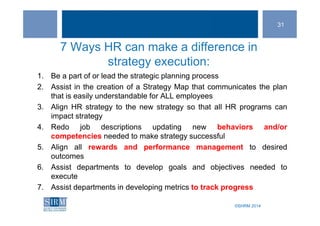
7 Ways HR can make a difference in
strategy execution:
1. Be a part of or lead the strategic planning process
2. Assist in the creation of a Strategy Map that communicates the plan
that is easily understandable for ALL employees
3. Align HR strategy to the new strategy so that all HR programs can
impact strategy
4. Redo job descriptions updating new behaviors and/or
competencies needed to make strategy successful
5. Align all rewards and performance management to desired
outcomes
6. Assist departments to develop goals and objectives needed to
execute
7. Assist departments in developing metrics to track progress
31
©SHRM 2014©SHRM 2014
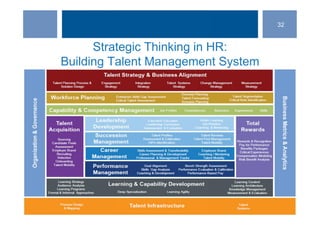
Strategic Thinking in HR:
Building Talent Management System
32
©SHRM 2014©SHRM 2014
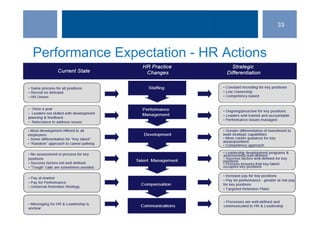
Performance Expectation - HR Actions
33
©SHRM 2014©SHRM 2014
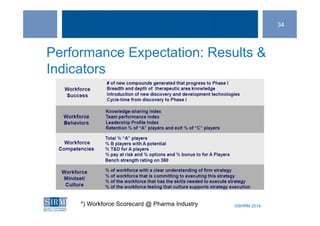
Performance Expectation: Results &
Indicators
*) Workforce Scorecard @ Pharma Industry
34
©SHRM 2014©SHRM 2014
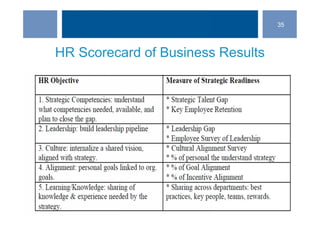
HR Scorecard of Business Results
35
©SHRM 2014
36
©SHRM 2014
Q & A
Thank You

Human Resources STARs ME Now and Next Evolution

  • 1.
    ©SHRM 2014 1 ©SHRM 2014 JamboreSDM Indonesia Sibolangit– April 26-27, 2014 HR STARs Strategic Thinking Actions Results Bima Hermastho Founder & CEO PT. Freemind Management Consulting bima@freemind-consulting.com +628122862849
  • 2.
    ©SHRM 2014 2 ©SHRM 2014 ReshapingYour Key Role in HR Functions
  • 3.
  • 4.
    ©SHRM 2014 BIMA HERMASTHO Manufacturing& Human Performance Improvement Technologist CEO PT. Freemind Management Consulting – A Business Performance Improvement Consulting. Professional Experiences:  Founder Indonesian Balanced Scorecard School (http://www.bsc-indonesia.com) & Indonesian Six Sigma School (http://www.sixsigma-indonesian.com) - both are free online course in Balanced Scorecard and Six Sigma.  Founder Indonesian Human Capital Institute, a free online HRM course (http://sdm-indonesia.net)  Professional experiences: various positions from Management Trainee, HR Manager, TPM Training Manager, OD Senior Manager, Human Capital & OD Director in local and global companies (PT. Teleperformance Indonesia, PT. Multi Bintang Indonesia Tbk, PT. Coats Indonesia, PT. Polysindo Eka Perkasa – Asia Pacific Fibre, etc)  Active & registered member: SHRM (American Society for HRM), ASTD (American Society for Training and Development), ASQ (American Society for Quality) & ISSP (International Six Sigma Professional Society)  Bachelor Degree (ITB), Master & Doctorate Degree in “Strategic HRM & Total Quality Management” – UNDIP  Certified Balanced Scorecard Professional  Certified Lean Management Professional  Certified Global Professional in HRM  Certified Six Sigma Black Belt  Certified Kaizen Professional  TPM (Total Productive Management) Trainer  Certified Mediator on ADR (Alternative Dispute Resolution) bima@freemind-consulting.com +62 8122862849 FOUNDER & LEAD CONSULTANT
  • 5.
    ©SHRM 2014 Vision • Wewill be a quality leader in development of business with global reach by serving ambitious clients, taking global knowledge to local markets. Mission • We deliver management consultancy where environmental challenges, technology, business systems and people are combined in sustainable change for competitive people and great business. Challenging culture • At Freemind Management Consulting, taking the lead without restrictions and testing one’s capabilities without limitations will always be a legitimate approach – given the appropriate professional background and goals. PT. Freemind Management Consulting
  • 6.
  • 7.
  • 8.
    ©SHRM 2014©SHRM 2014 Agenda 1.What CEOs Expect from HR Leaders 2. HR Trend Survey 2014 3. Top 6 HR Competencies – Strategic Thinking in HR 4. 7 Ways HR Can Lead Strategy Execution 5. Performance Expectation – Actions + Results – HR Scorecard of Business Results 8
  • 9.
    ©SHRM 2014©SHRM 2014 WhatCEOs Expect from HR Leaders 1. Focus on the most important things, CEOs want HR to be more proactive and concentrate on business relevant needs first: The business of the organisation, align HR to the strategy of the organisation, add value to the organisation and engage employees. 2. Business metrics should be at the center of performance management and HR would be wise to always think in terms of the business, key talent, and metrics. Evaluate each opportunity: – What is the value to the business and does it reflect real business success? – Does it fit the talent we need now and in the future? – Is it responsive to workforce trends, succesion plan, leadership development program? 3. Don’t just copy ‘best practices.’ 9
  • 10.
    ©SHRM 2014©SHRM 2014 WhatCEOs Hate about HR People • You can’t recruit well... • You can’t conceptualize how to put together a cutting edge development program, despite HR talk about becoming a “learning organization.” • I hear lots of talk. I see limited results... • You can’t read financial statements. I don’t consider someone a good business partner when they can’t understand our finances. • You can’t sell. If you can’t sell the direction of my business, what good are you? • You preach about performance reviews, yet you have no idea how to manage performance once you get the results. • .... etc 10
  • 11.
    ©SHRM 2014©SHRM 2014 HRAgenda & Trend Survey – 2014*) 1. Talent, Skills, and Capability needs become Global. 2. Integrated Capability Development Replaces Training. 3. Redesign of Performance Management Accelerates. 4. Redefine engagement: Focus on Passion and the Holistic Work Environment. 5. Take Talent Mobility and Career Development Seriously. 6. Redesign and Reskill the HR Function. 7. Reinvent and Expand Focus on Talent Acquisition. 8. Continued Explosive Growth in HR Technology and Content Markets. 9. Talent Analytics Comes to Front of the Stage. 10.Innovation Comes to HR. The New Bold, CHRO. *) Bersin Research report 11
  • 12.
    ©SHRM 2014©SHRM 2014 HRDirectors – HR Managers – hr Liaison Internal Consultant Facilitator Partner Business Coach Talent Scout Teacher Cheerleader Problem solver Idea Generator 12
  • 13.
  • 14.
    ©SHRM 2014©SHRM 2014 Top6 HR Competencies Researchers have updated the portfolio of competencies for high- performing HR professionals. The six competencies and the elements that make them up offer the outlines of what it takes to be successful. (Dave Ulrich, 2007) 1. Credible Activist 2. Cultural Steward 3. Talent Manager/Organizational Designer 4. Strategy Architect 5. Business Ally 6. Operational Executor 14
  • 15.
    ©SHRM 2014©SHRM 2014 TopHR Competencies - Credible Activist The Credible Activist is respected, admired, listened to and offers a point of view, takes a position and challenges assumptions by: • Delivering results with integrity • Sharing information • Building relationships of trust • Doing HR with an attitude (taking appropriate risks, providing candid observations, influencing others) 15
  • 16.
    ©SHRM 2014©SHRM 2014 TopHR Competencies - Cultural Steward Cultural Steward recognizes, articulates and helps shape a company’s culture by: • Facilitating change • Crafting culture • Valuing culture • Personalizing culture (helping employees find meaning in their work, managing work/life balance, encouraging innovation) 16
  • 17.
    ©SHRM 2014©SHRM 2014 TopHR Competencies - Talent Manager/Organizational Designer The Talent Manager/Organizational Designer masters theory, research and practice in both talent management and organizational design by: • Ensuring today’s and tomorrow’s talent • Developing talent • Shaping the organization • Fostering communication • Designing reward systems 17
  • 18.
    ©SHRM 2014©SHRM 2014 TopHR Competencies – Strategy Architect The Strategy Architect knows how to make the right change happen by: • Sustaining strategic agility • Engaging customers 18
  • 19.
    ©SHRM 2014©SHRM 2014 TopHR Competencies – Business Ally The Business Ally contributes to the success of the business by: • Serving the value chain • Interpreting social context • Articulating the value proposition • Leveraging business technology 19
  • 20.
    ©SHRM 2014©SHRM 2014 TopHR Competencies – Operational Executor The Operational Executor administers the day-to-day work of managing people inside an organization by: • Implementing workplace policies • Advancing HR technology 20
  • 21.
    ©SHRM 2014©SHRM 2014 GlobalParadox of HRM Six domains of competencies that HR professionals must demonstrate to be personally effective and to impact business performance: 1. Outside/in: HR must turn outside business trends and stakeholder expectations into internal actions; 2. Business/people: HR should focus on both business results and human capital improvement; 3. Individual/organizational: HR should target both individual ability and organization capabilities; 4. Event/sustainability: HR is not about an isolated activity (a training, communication, staffing, or compensation program) but sustainable and integrated solutions; 5. Past/future: HR should respect its heritage, but shape a future; 6. Administrative/strategic: HR must attend to both day to day administrative processes and long term strategic practices; 21
  • 22.
    ©SHRM 2014©SHRM 2014 The2012 HR Competency Model*) *) Ulrich: 2012 data set on competencies for HR professionals is a unique partnership with the leading HR professional associations in Australia (AHRI), Latin America (IAE), China (jobs51), India (NHRD), Middle East (ASHRM), Northern Europe (HR Norge), and South Africa (IPM). 22
  • 23.
    ©SHRM 2014 23 ©SHRM 2014 SubFactor for the Six HR competency domains Mean (1 to 5) Individual Effectiven ess 100% Business Success 100% Strategic Positioner Interpreting global business context 3.83 4.4 4.2 Decoding customer expectations 3.83 4.4 5.2 Co-crafting a strategic agenda 3.96 6.3 4.6 Credible Activist Earning trust through results 4.36 6.9 4.0 Influencing and relating to others 4.24 7.0 4.1 Improving through self-awareness 4.08 6.5 4.7 Shaping the HR profession 4.13 4.4 2.9 HR Competence on Individual Effectiveness and Business Success
  • 24.
    ©SHRM 2014 24 ©SHRM 2014 SubFactor for the Six HR competency domains Mean (1 to 5) Individual Effectiven ess 100% Business Success 100% Capability Builder Capitalizing organizational capability 4.03 5.4 5.3 Aligning strategy, culture, practices, and behavior 3.94 5.3 6.1 Creating a meaningful work environment 3.94 4.1 5.2 Change Champion Initiating Change 3.94 5.4 4.8 Sustaining Change 3.91 4.7 5.7 HR Competence on Individual Effectiveness and Business Success
  • 25.
    ©SHRM 2014 25 ©SHRM 2014 SubFactor for the Six HR competency domains Mean (1 to 5) Individual Effectiven ess 100% Business Success 100% HR Innovator & Integrator Optimizing human capital through workforce planning and analytics 3.95 5.5 5.6 Developing Talent 3.83 4.0 5.3 Shaping organization and communication practices 3.94 5.8 5.6 Driving performance 3.87 4.7 5.2 Building leadership brand 3.87 4.9 5.4 HR Competence on Individual Effectiveness and Business Success
  • 26.
    ©SHRM 2014 26 ©SHRM 2014 SubFactor for the Six HR competency domains Mean (1 to 5) Individual Effectiven ess 100% Business Success 100% Technology Proponent Improving utility of HR operations 3.72 2.9 5.0 Connecting people through technology 3.77 4.6 6.3 Leveraging social media tools 3.68 2.7 4.7 Overall R2 .431 .108 HR Competence on Individual Effectiveness and Business Success
  • 27.
  • 28.
  • 29.
  • 30.
  • 31.
    ©SHRM 2014©SHRM 2014 7Ways HR can make a difference in strategy execution: 1. Be a part of or lead the strategic planning process 2. Assist in the creation of a Strategy Map that communicates the plan that is easily understandable for ALL employees 3. Align HR strategy to the new strategy so that all HR programs can impact strategy 4. Redo job descriptions updating new behaviors and/or competencies needed to make strategy successful 5. Align all rewards and performance management to desired outcomes 6. Assist departments to develop goals and objectives needed to execute 7. Assist departments in developing metrics to track progress 31
  • 32.
    ©SHRM 2014©SHRM 2014 StrategicThinking in HR: Building Talent Management System 32
  • 33.
    ©SHRM 2014©SHRM 2014 PerformanceExpectation - HR Actions 33
  • 34.
    ©SHRM 2014©SHRM 2014 PerformanceExpectation: Results & Indicators *) Workforce Scorecard @ Pharma Industry 34
  • 35.
    ©SHRM 2014©SHRM 2014 HRScorecard of Business Results 35
  • 36.