Environmental
Health
BY
Kyozira Shadiah
Outline
 Explain the elements of environmental health
 Describe methods of waste disposal
 Describe the common ways of protecting water
sources from contamination
 Describe the control of common disease vectors in
Uganda
 Describe an ideal homestead.
 Describe occupational health in healthcare setting
Environmental health
 Environmental health refers to aspects of human health
(including quality of life) that are determined by physical,
chemical, biological, social and psychosocial factors in
the environment.
 Environment broadly includes everything external to
ourselves, including the physical, natural, social and
behavioral environments.
 Health is a state of complete physical, mental and social
wellbeing, and is not merely the absence of disease or
illness.
Total environment
 The total environment includes three conceptually distinct, but
interrelated environments: the natural, human constructed, and
human behavioral.
 Total environment means air, water, soil, flora, and fauna and the
social, economic, and cultural conditions that influence
communities and individual citizens.
Having understood the social
determinants of health, Does
the environment affect Health ?
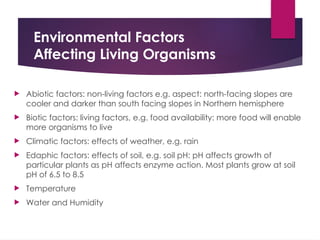
Environmental Factors
Affecting Living Organisms
 Abiotic factors: non-living factors e.g. aspect: north-facing slopes are
cooler and darker than south facing slopes in Northern hemisphere
 Biotic factors: living factors, e.g. food availability: more food will enable
more organisms to live
 Climatic factors: effects of weather, e.g. rain
 Edaphic factors: effects of soil, e.g. soil pH: pH affects growth of
particular plants as pH affects enzyme action. Most plants grow at soil
pH of 6.5 to 8.5
 Temperature
 Water and Humidity
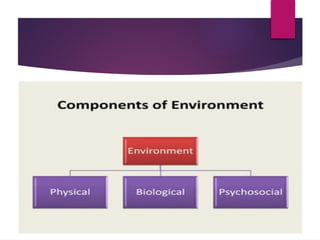
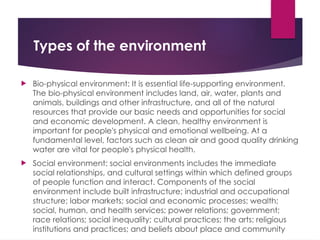
Types of the environment
 Bio-physical environment: It is essential life-supporting environment.
The bio-physical environment includes land, air, water, plants and
animals, buildings and other infrastructure, and all of the natural
resources that provide our basic needs and opportunities for social
and economic development. A clean, healthy environment is
important for people's physical and emotional wellbeing. At a
fundamental level, factors such as clean air and good quality drinking
water are vital for people's physical health.
 Social environment: social environments includes the immediate
social relationships, and cultural settings within which defined groups
of people function and interact. Components of the social
environment include built infrastructure; industrial and occupational
structure; labor markets; social and economic processes; wealth;
social, human, and health services; power relations; government;
race relations; social inequality; cultural practices; the arts; religious
institutions and practices; and beliefs about place and community
Types of environments
 Economic environment: The economic
environment is the sum total of the economic
conditions and the nature of the economy in which
the people has to live and compete. The
economic conditions of people also have a huge
impact on their physical health, mental health and
education. People with low income, don’t have
access to good education and health facilities
 Psychological environment: is the interaction of the
various sources of stress in our lives and how we
respond to them, both individually and as
Waste management
Introduction
 Waste is any material – solid, liquid, or gas – that
is unwanted and/or unvalued, and has been
discarded or discharged by its owner. Waste is
generated in a variety of forms, and can also
change its form over time.
 Healthcare Waste refers to all types of waste
from all health care activities; waste generated
by the health care facilities, research facilities
and laboratories.
 Healthcare waste is also known as biomedical
waste, infectious waste or medical waste.
Classification of wastes
Classification according to matter state (properties)
 1. Solid waste includes common household waste
(including kitchen and garden waste), commercial and
industrial waste, sewage sludge, construction and
demolition waste, waste from agriculture and food
processing, and mine and quarry tailings.
 2. Liquid waste includes domestic waste water (liquid
kitchen, laundry, and bathroom waste), storm water,
used oil, and waste from industrial processes.
 3. Gaseous waste comprises gases and small particles
emitted from open fires, incinerators, and vehicles, or
produced by agricultural and industrial processes.
Classification of wastes-
general according to their
degradability
 Bio-degradable : Whether they can be
degraded by physical or biological
means (paper, wood, fruits and others)
 Non-biodegradable; These cannot be
degraded easily by physical or biological
means (plastics, bottles, old machines,
cans, Styrofoam containers and others)
Types of Waste
• Solid Waste
• Liquid waste
• Industrial solid waste
– Mining
– Agriculture
– Industry
• Municipal solid waste
– Homes
– Businesses
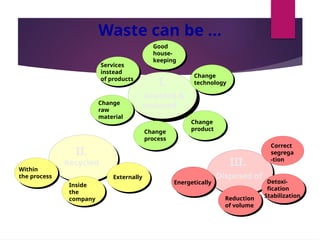
Waste can be ...
Avoided &
reduced
Change
raw
material
Change
process
Change
technology
Good
house-
keeping
Services
instead
of products
Change
product
I.
Recycled
Within
the process
Inside
the
company
Externally
II.
Disposed of
Reduction
of volume
Detoxi-
fication
Stabilization
Energetically
III.
Correct
segrega
-tion
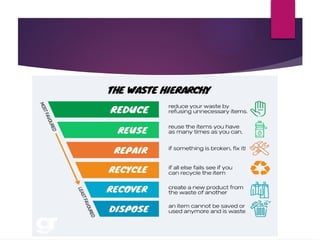
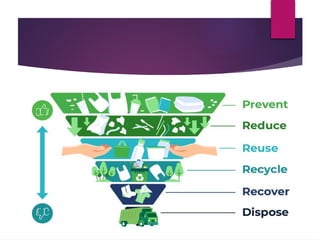
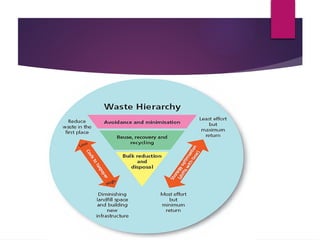
Waste management hierarchy
Introduction
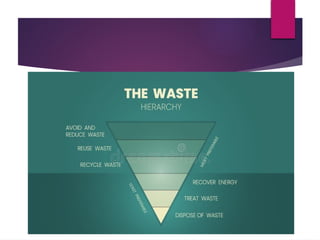
 Definition: It is defined as the order of
preference for action to reduce and
manage waste and is usually presented
diagrammatically in form of pyramid.
 The aim of waste hierarchy is to extract the
maximum practical benefits from products
and to generate minimum amount of
waste.
 This concept focuses on the measures to
be taken so as not to create any type of
wastes in the first place e.g. avoiding to eat
from the ward.
 This is given the top priority in the waste
management program.
1. Prevention/avoidance:
2. Reduction of Wastes/minimization:
 reduce or minimize the amount of waste or the
toxicity of wastes e.g. avoiding to use gloves in
procedures that don’t necessary need one to
use gloves
 companies should take action to make
changes in the type of materials that are being
used for the production of the specific products,
so as to ensure that the by-products are of the
least toxicity.
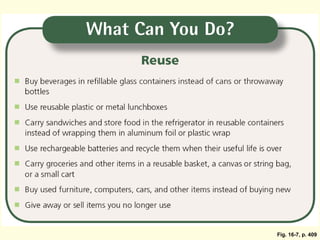
3. Reuse
 waste is not allowed to enter into the disposal
system.
 The wastes are collected in the middle of the
production phase and are again fed along with
the source to aid in the production process e.g.
Autoclaving metal instruments or sterilization of
medical equipment.
Fig. 16-7, p. 409
4. Recycle
 waste materials are implemented in the
production of a new product.
 waste materials of various forms are
collected and then processed.
 Post processing, they enter into the
production lines to give rise to new
products.
 This process prevents pollution and saves
energy.
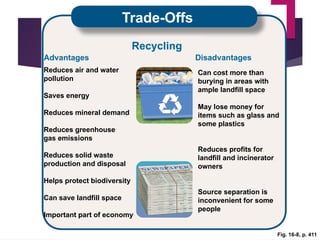
Fig. 16-8, p. 411
Trade-Offs
Recycling
Advantages Disadvantages
Reduces air and water
pollution
Saves energy
Reduces mineral demand
Reduces greenhouse
gas emissions
Reduces solid waste
production and disposal
Helps protect biodiversity
Can save landfill space
Important part of economy
Can cost more than
burying in areas with
ample landfill space
May lose money for
items such as glass and
some plastics
Reduces profits for
landfill and incinerator
owners
Source separation is
inconvenient for some
people
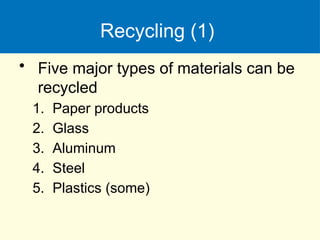
Recycling (1)
• Five major types of materials can be
recycled
1. Paper products
2. Glass
3. Aluminum
4. Steel
5. Plastics (some)
Encouraging Reuse and
Recycling
• Market prices must reflect true costs
• Even economic playing field:
taxes/subsidies
• Stabilize prices for recycled materials
• Fee-per-bag waste collection
• Better-informed public
5. Energy Recovery
 also called as waste to energy conversion.
 In this process; the wastes that cannot be recycled are
being converted into useable forms of energy such as
heat, light and electricity etc.
 This helps in the saving of various natural resources. Various
processes such as combustion, anaerobic digestion, landfill
gas recovery, pyrolization and gasification are being
implemented to carry out the conversion process.
Waste-To-Energy
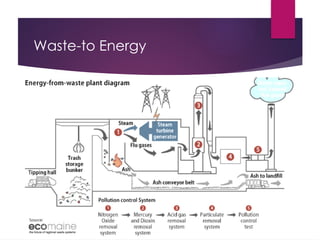
 Waste-to-Energy facilities accept our solid waste
and combust it at very high temperatures,
producing heat that is used to convert water into
steam. The steam is used to run turbines that
generate electricity.
 Scrubbers, filters, and other pollution control
equipment reduce pollutants released during the
incineration process. Ash and other residues from
this process are landfilled.
 Over 27% of Maine's municipal solid waste was
combusted in 2015.
Waste-to Energy
6. Treatment and Disposal
 The disposal process holds the last
position in the waste management
hierarchy.
 Landfills are the common form of waste
disposal.
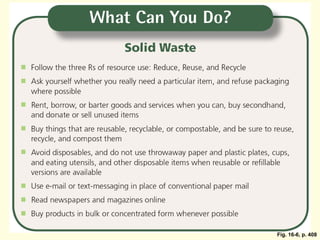
Fig. 16-6, p. 408
Waste disposal
options/methods
These include the following;
1. Incineration
2. Composting
3. Burial
4. Encapsulation
5. Land-fill
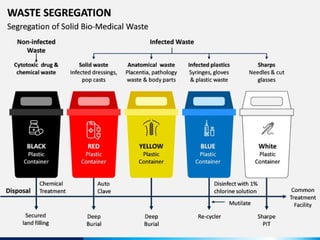
6. Disinfection – Autoclaving/ Microwaving, treatment, Infectious
Waste: Autoclaving, Simple chemical disinfection processes
7. Shredding
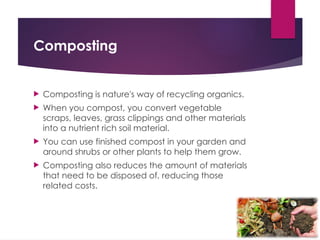
Composting
 Composting is nature's way of recycling organics.
 When you compost, you convert vegetable
scraps, leaves, grass clippings and other materials
into a nutrient rich soil material.
 You can use finished compost in your garden and
around shrubs or other plants to help them grow.
 Composting also reduces the amount of materials
that need to be disposed of, reducing those
related costs.
Composting
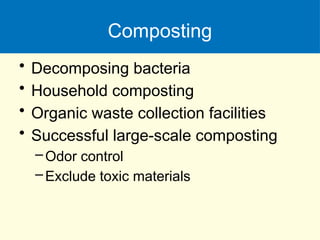
• Decomposing bacteria
• Household composting
• Organic waste collection facilities
• Successful large-scale composting
–Odor control
–Exclude toxic materials
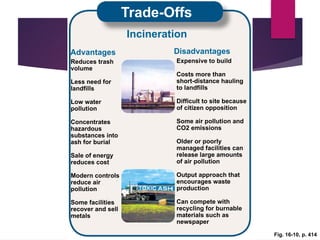
Fig. 16-10, p. 414
Trade-Offs
Incineration
Advantages Disadvantages
Reduces trash
volume
Less need for
landfills
Low water
pollution
Concentrates
hazardous
substances into
ash for burial
Sale of energy
reduces cost
Modern controls
reduce air
pollution
Some facilities
recover and sell
metals
Expensive to build
Costs more than
short-distance hauling
to landfills
Difficult to site because
of citizen opposition
Some air pollution and
CO2 emissions
Older or poorly
managed facilities can
release large amounts
of air pollution
Output approach that
encourages waste
production
Can compete with
recycling for burnable
materials such as
newspaper
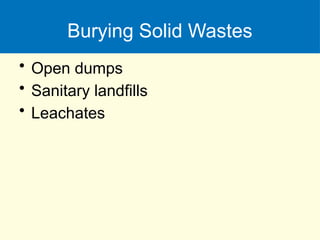
Burying Solid Wastes
• Open dumps
• Sanitary landfills
• Leachates
Landfill
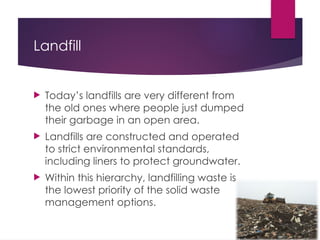
 Today’s landfills are very different from
the old ones where people just dumped
their garbage in an open area.
 Landfills are constructed and operated
to strict environmental standards,
including liners to protect groundwater.
 Within this hierarchy, landfilling waste is
the lowest priority of the solid waste
management options.
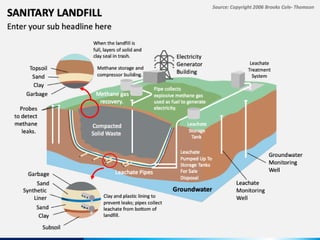
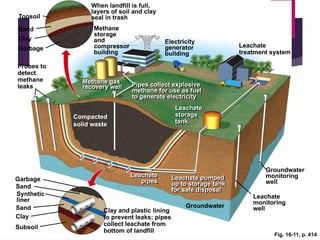
Clay and plastic lining
to prevent leaks; pipes
collect leachate from
bottom of landfill
Groundwater
Leachate
monitoring
well
Groundwater
monitoring
well
Leachate pumped
up to storage tank
for safe disposal
Leachate
storage
tank
Leachate
treatment system
Pipes collect explosive
methane for use as fuel
to generate electricity
Electricity
generator
building
When landfill is full,
layers of soil and clay
seal in trash
Methane
storage
and
compressor
building
Methane gas
recovery well
Compacted
solid waste
Leachate
pipes
Probes to
detect
methane
leaks
Topsoil
Garbage
Clay
Sand
Garbage
Subsoil
Synthetic
liner
Sand
Clay
Sand
Fig. 16-11, p. 414
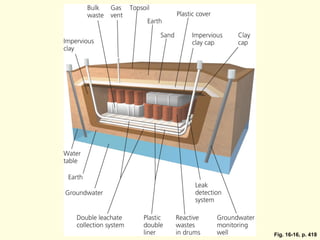
Fig. 16-16, p. 418
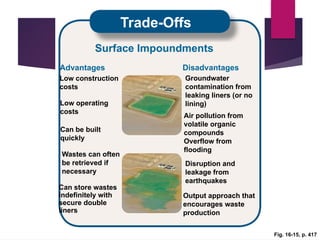
Fig. 16-15, p. 417
Trade-Offs
Surface Impoundments
Advantages Disadvantages
Wastes can often
be retrieved if
necessary
Groundwater
contamination from
leaking liners (or no
lining)
Low construction
costs
Low operating
costs
Can be built
quickly
Can store wastes
indefinitely with
secure double
liners
Output approach that
encourages waste
production
Disruption and
leakage from
earthquakes
Air pollution from
volatile organic
compounds
Overflow from
flooding
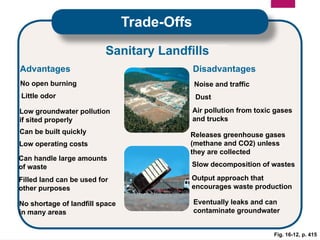
Fig. 16-12, p. 415
Trade-Offs
Sanitary Landfills
Advantages Disadvantages
No open burning Noise and traffic
No shortage of landfill space
in many areas
Filled land can be used for
other purposes
Eventually leaks and can
contaminate groundwater
Output approach that
encourages waste production
Slow decomposition of wastes
Releases greenhouse gases
(methane and CO2) unless
they are collected
Air pollution from toxic gases
and trucks
Dust
Can handle large amounts
of waste
Low operating costs
Can be built quickly
Low groundwater pollution
if sited properly
Little odor
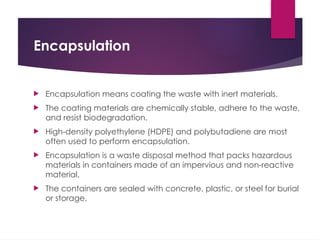
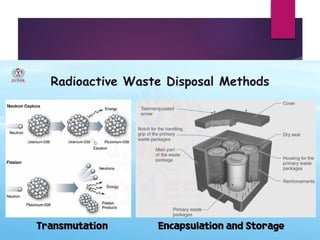
Encapsulation
 Encapsulation means coating the waste with inert materials.
 The coating materials are chemically stable, adhere to the waste,
and resist biodegradation.
 High-density polyethylene (HDPE) and polybutadiene are most
often used to perform encapsulation.
 Encapsulation is a waste disposal method that packs hazardous
materials in containers made of an impervious and non-reactive
material.
 The containers are sealed with concrete, plastic, or steel for burial
or storage.
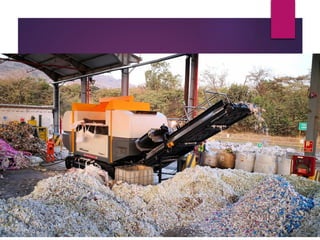
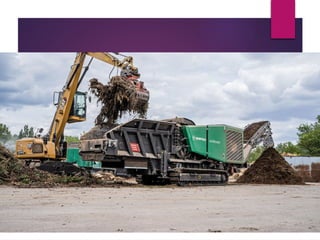
Shredding
 garbage shredders take your miscellaneous trash and reduce
them to scraps for simple disposal and recycling.
 Waste shredding is an effective way to reduce the need for
landfills.
 Shredding makes it possible to mechanically separate various
materials, allowing more homogeneous material to be fed into
the sorting plant.
 This ensures more efficient sorting, better-functioning equipment
and a higher share of recycled material.
 By breaking down waste into smaller, more manageable pieces,
shredders ensure that materials are more homogenous and burn
more evenly.
Disinfection and sterilization
 Disinfection and sterilization are both decontamination processes.
 While disinfection is the process of eliminating or reducing harmful
microorganisms from inanimate objects and surfaces,
 sterilization is the process of killing all microorganisms.
 Disinfectants and antiseptics are many active chemical
compounds called biocides, which can fight microorganisms on
nonliving surfaces and human skin.
 These biocides, such as alcohol, iodine, and chlorine
The six stages of cleaning
 1. Pre-clean
This is the first stage of cleaning where you would remove substances and loose debris from the
surface you are cleaning. (wiping, sweeping or rinsing. Removing as much loose debris as possible).
 2. Main clean
The second stage of cleaning is to loosen any substances, debris, dirt or grease that you were
unable to remove during the pre-clean stage. This would involve using hot water and a detergent.
 3. Rinse
The third stage of cleaning is to remove all of the loosened dirt, debris and substances as well as
the detergent. You can do this by using clean hot water and a cloth or mop.
 4. Disinfection
The fourth stage of cleaning is to disinfect the surface, which will destroy bacteria and other
microorganisms. This could be done by using heat or a chemical disinfectant for a prolonged
contact time. Follow the specific instructions for any products or equipment you use.
 5. Final Rinse
The fifth stage of cleaning is to remove any disinfectants from the previous stage using clean, hot
water. Always follow the manufacturer’s guidance and seek further advice if you need to do so.
 6. Drying
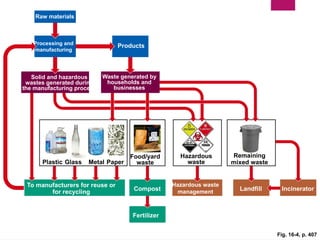
Fertilizer
Compost
Hazardous waste
management Landfill
Hazardous
waste
Remaining
mixed waste
To manufacturers for reuse or
for recycling
Processing and
manufacturing
Plastic Glass Paper
Food/yard
waste
Solid and hazardous
wastes generated during
the manufacturing process
Waste generated by
households and
businesses
Products
Raw materials
Metal
Incinerator
Fig. 16-4, p. 407
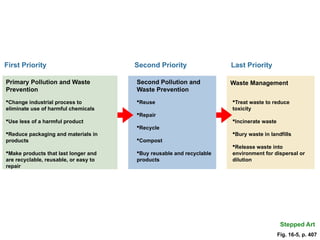
Last Priority
Waste Management
Treat waste to reduce
toxicity
Incinerate waste
Bury waste in landfills
Release waste into
environment for dispersal or
dilution
Stepped Art
Second Priority
Second Pollution and
Waste Prevention
Reuse
Repair
Recycle
Compost
Buy reusable and recyclable
products
First Priority
Primary Pollution and Waste
Prevention
Change industrial process to
eliminate use of harmful chemicals
Use less of a harmful product
Reduce packaging and materials in
products
Make products that last longer and
are recyclable, reusable, or easy to
repair
Fig. 16-5, p. 407
Producing Less Waste
• Refuse
• Reduce
• Reuse
• Recycle
Science Focus: Bioplastics
• Most plastics are organic polymers
produced from petrochemicals
• Bioplastics are made from plant
materials
• Biodegradable
–Composting
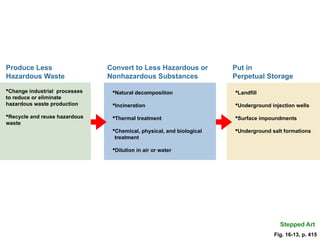
Hazardous waste
How Should We Deal with
Hazardous Waste?
• A more sustainable approach to
hazardous waste is first to produce
less of it, then to reuse or recycle it,
then to convert it to less hazardous
materials, and finally to safely store
what is left.
Put in
Perpetual Storage
Landfill
Underground injection wells
Surface impoundments
Underground salt formations
Stepped Art
Convert to Less Hazardous or
Nonhazardous Substances
Natural decomposition
Incineration
Thermal treatment
Chemical, physical, and biological
treatment
Dilution in air or water
Produce Less
Hazardous Waste
Change industrial processes
to reduce or eliminate
hazardous waste production
Recycle and reuse hazardous
waste
Fig. 16-13, p. 415
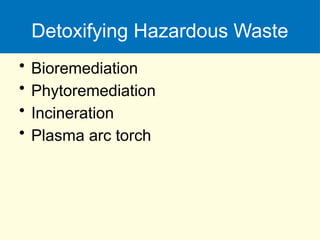
Detoxifying Hazardous Waste
• Bioremediation
• Phytoremediation
• Incineration
• Plasma arc torch
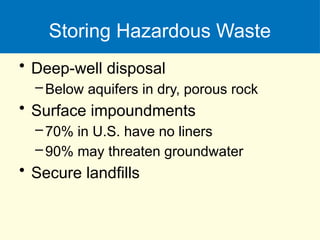
Storing Hazardous Waste
• Deep-well disposal
–Below aquifers in dry, porous rock
• Surface impoundments
–70% in U.S. have no liners
–90% may threaten groundwater
• Secure landfills
Fig. 16-17, p. 418
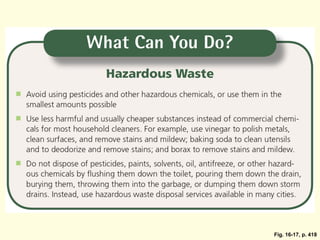
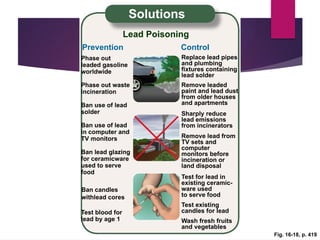
Fig. 16-18, p. 419
Solutions
Lead Poisoning
Prevention Control
Phase out
leaded gasoline
worldwide
Phase out waste
incineration
Ban use of lead
solder
Ban use of lead
in computer and
TV monitors
Ban lead glazing
for ceramicware
used to serve
food
Test blood for
lead by age 1
Replace lead pipes
and plumbing
fixtures containing
lead solder
Wash fresh fruits
and vegetables
Test existing
candles for lead
Test for lead in
existing ceramic-
ware used
to serve food
Remove lead from
TV sets and
computer
monitors before
incineration or
land disposal
Sharply reduce
lead emissions
from incinerators
Remove leaded
paint and lead dust
from older houses
and apartments
Ban candles
withlead cores
How Can We Make the Transition to a
More Sustainable Low-Waste Society?
• Shifting to a low-waste society
requires individuals and organizations
to reduce resource use and to reuse
and recycle wastes at local, national,
and global levels.
Five Principles for Achieving a
Low-Waste Society
1. Everything is connected
2. There is no “away” for wastes
3. Polluters and producers must pay for
wastes
4. Different categories of hazardous waste
and recyclable waste should not be
mixed
5. Reuse, recycle, and compost solid
wastes
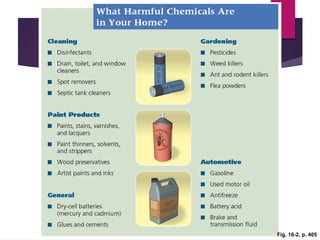
Fig. 16-2, p. 405
THE EXISTING
LEGISLATION
ON
ENVIRONMENT
The 1995 Constitution of the Republic of Uganda (as
variously amended)
 In Objective XIII, the Constitution requires the state to protect
important natural resources including land, water, wetlands,
minerals, oil, fauna and flora on behalf of the people of
Uganda.
 Objective XXI requires the state to take all practical measures
to promote a good water management system at all levels.
 Under Objective XXVII, the state shall promote sustainable
development and public awareness of the need to manage
land, air, water resources in a balanced and sustainable
manner for the present and future generations.
 Under Article 39 the Constitution of the Republic of Uganda
entitles every citizen to a clean and healthy environment.
The Public Health Act, 2000
 The Act provides for prevention of diseases to the public
arising from sewerage, poor sanitation and pollution of the
environment.
 It regulates the use of chemicals for public health and sets
up the Health Inspectorate to ensure compliance. It also
sets up the drainage and sanitation rules which specifically
mention technical aspects of waste disposal. It gives
guidance on waste management in general.
 Section 105 of the Public Health Act imposes a duty on the
local authority to take measures to prevent any pollution
dangerous to health of any water supply which the public
has a right to use for drinking or domestic purposes.
The National Environment Act,
2019
 The Act prohibits the discharge of hazardous substances into any part
of the environment except with the guidance of the National
Environment Management Authority.
 It also prohibits pollution contrary to established standards; prohibits the
illegal traffic of hazardous wastes and gives any person generating
hazardous wastes the duty of the management of his wastes.
 The National Environment Act, CAP 153 requires NEMA in consultation
with lead agencies to establish environment standards. Currently, many
environmental standards have been prescribed and some of the
relevant ones include; (Next slide)
 The National Environment Waste Management Regulations - 1999
which require a person who owns or controls a facility or premises
which generate waste to minimize the waste generated by
adopting cleaner production methods.
They also offer guidance on application for a license to transport or
store waste, license to operate a waste treatment plant and other
requirements for waste in general.
The regulations, however, do not explicitly address the area of
healthcare waste management, but the all encompassing provisions
remain applicable
The Occupational Safety and
Health Act, 2006
 Article 13 (1) of this Act states that it is the duty of employers to take as
far as possible all measures to protect their workers and the general
public from dangerous aspects of the employer’s undertaking at their
own cost.
 The employer should ensure that the working environments are clean
and kept free from hazards due to pollution.
 Article 19 (1) states that the employer should provide protective gear
where the level of air pollution and chemical substances in a working
environment exceed the exposure limits specified by an occupational
health specialist, an employer shall provide adequate and suitable
protective clothing and protective equipment to the workers of his or
her undertaking.
 It shall be the duty of an employer to ensure that personal protective
equipment provided under subsection (1) is used whenever it is
required.
The Amended Water Act, 1997
CAP 152
 Among the objectives of the Act are:
• To promote the provision of a clean, safe
and sufficient supply of water for domestic
purposes to all persons; and
• To control pollution and to promote the safe
storage, treatment, discharge and disposal of
waste which may pollute water or otherwise
harm the environment and human health.
The Local Government Act,
1997
 The Local Governmental Act, 1997
allocates responsibility for service delivery
of a number of functions to Local
Government Councils
(Districts/Cities/Municipalities/Towns) and
to lower Local Government Councils
(Sub-Counties/Divisions). These functions
include water services and sanitation.
The Land Act
 This act provides that all rights in the water of any
natural spring, river, stream, watercourse, pond, or
lake on or under land, whether alienated or
unalienated, shall be reserved to the
Government;
and no such water shall be obstructed, dammed,
diverted, polluted or otherwise interfered with
directly or indirectly, except in pursuance of
permission in writing granted by the minister
responsible for water or natural resources in
accordance with the Water Act.
Related National Policies
(environment)
 The National Environmental Health Policy, 2005
The objective of this policy is to create an enabling environment
for the achievement and maintenance of healthy living
conditions in rural and urban areas.
The policy establishes the environmental health priorities of the
government of Uganda and provides a framework for
development of services and programmes at national and local
government levels.
Injection Safety and
Healthcare Waste
Management Policy, 2018
 The policy sets out strategies for ensuring that patients, health workers, communities are
protected from risks associated with unnecessary and unsafe injections. The policy also
provides guiding principles for safe injection practice and proper management of all
health care waste.
 Under Policy 4.0 - Health Care Waste Management, the policy states that:
a) Every health facility shall have someone in-charge of health care waste management;
b) Waste management guidelines shall be made available to health workers;
c) All health workers will follow waste guidelines as elaborated in the national infection
prevention and control guidelines;
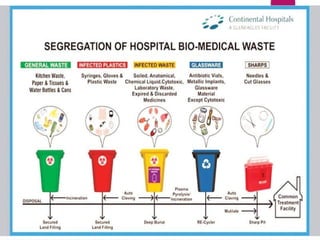
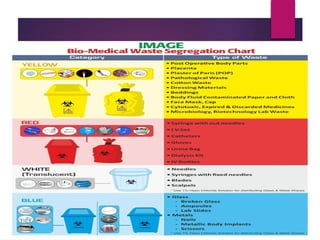
d) Health care waste shall be segregated at the source into pre-colour coded containers;
e) Sharps shall be collected into secure sharps containers or safety boxes immediately
after use;
f) Sharps boxes will be disposed of when three quarters full;
g) The recommended final disposal method is incineration, where incinerators are not
available; the sharps containers shall be burnt followed by burying.
The National Environmental
Management Policy, 2014
 The overall policy goal is sustainable development which
maintains and promotes environmental quality and
resource productivity for socio-economic transformation.
 One of the key policy objectives is to promote long-term,
socio-economic development for improved health and
quality of life through sound environmental and natural
resource management.
 Under this section, one of the key principles is that every
person has a constitutional right to live in a clean and
healthy environment and the obligation to keep the
environment clean, safe and productive.
National Hospital policy, 2006
The national hospital policy is soft law which
was established to guide the operations of
the hospital sub-sector that includes public,
NGOs, PNFPs and private hospitals by setting
terms of reference for accreditation, which is
a voluntary quality assurance mechanism.
This can be used as an incentive in the
acceptance, compliance and
implementation of WASH in HCFs.
Hand Hygiene
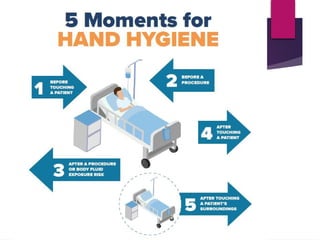
The World Health Organisation has defined the
5 Moments for Hand Hygiene, as the critical
times at which Hand Hygiene should occur. The
5 Moments can be applied to all care settings.
It is also essential to decontaminate hands before and/or after a
range of activities e.g.:
 When preparing, handling or consuming food and drinks
 After visiting the toilet
 After handling contaminated waste
 Before entering and leaving isolation rooms
 Before commencing and leaving work
 Before applying and immediately after removing Personal
Protective Equipment(PPE) such as aprons & gloves
 Whenever hands are visibly soiled
Bare Below the Elbows (BBE)
 The ‘bare below the elbows’ initiative/Strategy to reduce infection risks by
improving the ability to clean the hands effectively. (People in clinical area must
adopt the ‘bare below the elbows” dress code)
 Short sleeves (or long sleeves rolled up)
 Ties and Lanyards if worn, must be tucked into the shirt.
 No wrist watch or jewellery to be worn in the patient zone.
 Only one plain ring can be worn
 Fingernails should be kept clean and short (not visible when viewed with palms
facing upwards.
 Do not wear artificial nails or nail varnish.
 Any staff who wear their own clothes in the clinical area, must adhere to BBE.
 Staff who wear adornments for cultural/religious reasons should consider if they
can be placed on other areas of the body, rather than the hands or wrists.
Discuss with IPC if this is problematic.
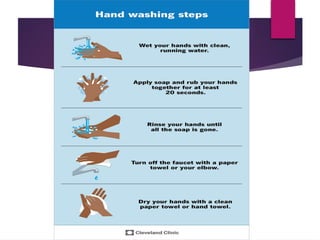
5 steps of hand washing
 Wet
 lather
 scrub for 20 seconds
 rinse, and
 dry
Human
waste
disposal
Pit latrines
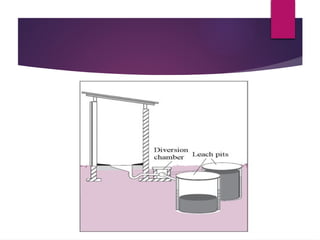
 Pit latrines are the simplest form of dry latrine that
can be adapted easily into different types of
latrines such as VIP latrines and ecological
sanitation systems.
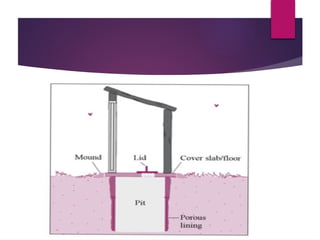
 They consist of a pit dug in the ground and a cover
slab or floor above the hole.
 Pit latrines must have a cleanable cover slab in
order to be considered as improved sanitation
systems.
 The excreta (both faeces and urine) drop through
 Pit latrines should be constructed on a slight mound so they are
higher than the surrounding ground and water at the surface
will flow away from the hole.
 They should also have a lid that can be placed over the hole to
reduce problems with flies and odours.
 They may have a squat pan or a raised footrest to make using
the latrine more convenient.
 The pit is often lined but the bottom remains open, allowing the
liquid to drain into the soil and leaving the solids behind.
 Pit latrines should also have an upper part, called the
superstructure, to provide protection from the rain and sun, and
privacy and comfort for the user
Advantages of pit latrines
 They do not require water so are appropriate in areas where
there is no adequate water supply.
 Squatting is normal to many people and thus is acceptable to
users.
 Alternating double pits will allow the excreta to drain, degrade
and transform into a nutrient-rich, safe humic material that can
be used to improve soils.
 They avoid contamination of surface water and top soil if
properly installed and maintained.
 They can be constructed with minimum cost using local
material and local skills.
 The presence of properly constructed slabs will allow easy
cleaning and avoid unsightliness.
Disadvantages of pit latrines
 There may be a foul odour from the pit
 favourable breeding sites of flies and mosquitoes.
 With single pits, a new pit needs to be dug every time one gets full.
 They can be susceptible to failure/overflowing during floods.
 if the superstructure is not properly constructed, it may discourage
use of the latrine by family members.
 Children may be discouraged from using the latrine if the slab is
not designed with them in mind and is too big for them.
 Use of excess water or less compostable materials for anal
cleansing should be avoided because it may affect the
decomposition rate of human excreta.
Ventilated improved pit (VIP)
latrine
 The VIP latrine is an improvement over the simple dry pit latrine.
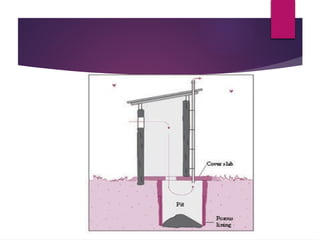
 The distinctive feature that gives the VIP latrine its name is the vent pipe
installed into the pit, which is used to exhaust the foul odour from the pit and
control flies
 The principle is that a continuous flow of air comes in through the
superstructure and enters the pit through the hole.
 This cold air will go down into the pit displacing (pushing up) the hot smelly
air upward through the vent pipe.
 The other advantage of the vent is controlling flies. As we discussed earlier,
dry pit latrines potentially serve as breeding places for flies. Newly-emerging
adult flies will try to escape through the vent pipe because the pipe allows
sunlight to enter into the pit and flies are photopositive (meaning they move
towards light) by nature.
 A mesh screen tied at the top of the vent pipe will prevent flies from
escaping to the outside of the latrine.
Water carriage systems of
human waste disposal
 The flush toilet consists of two parts: a tank (cistern)
that supplies flushwater for carrying away the
excreta and a bowl into which the excreta are
deposited.
 It also needs connection to constant running water
and a discharge pipe to take the wastewater away
to a sewer or septic tank.
 WCs are rarely found in rural households but are
quite common in urban offices, government offices,
some schools and health facilities.
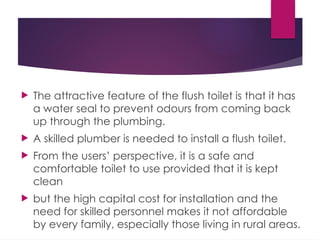
 The attractive feature of the flush toilet is that it has
a water seal to prevent odours from coming back
up through the plumbing.
 A skilled plumber is needed to install a flush toilet.
 From the users’ perspective, it is a safe and
comfortable toilet to use provided that it is kept
clean
 but the high capital cost for installation and the
need for skilled personnel makes it not affordable
by every family, especially those living in rural areas.
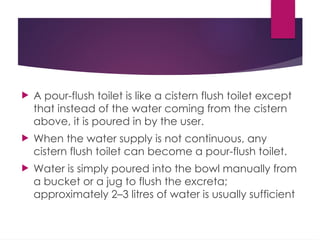
 A pour-flush toilet is like a cistern flush toilet except
that instead of the water coming from the cistern
above, it is poured in by the user.
 When the water supply is not continuous, any
cistern flush toilet can become a pour-flush toilet.
 Water is simply poured into the bowl manually from
a bucket or a jug to flush the excreta;
approximately 2–3 litres of water is usually sufficient
Thank You

HPE environmental health LECTURE notes.pptx

  • 1.
  • 2.
    Outline  Explain theelements of environmental health  Describe methods of waste disposal  Describe the common ways of protecting water sources from contamination  Describe the control of common disease vectors in Uganda  Describe an ideal homestead.  Describe occupational health in healthcare setting
  • 3.
    Environmental health  Environmentalhealth refers to aspects of human health (including quality of life) that are determined by physical, chemical, biological, social and psychosocial factors in the environment.  Environment broadly includes everything external to ourselves, including the physical, natural, social and behavioral environments.  Health is a state of complete physical, mental and social wellbeing, and is not merely the absence of disease or illness.
  • 4.
    Total environment  Thetotal environment includes three conceptually distinct, but interrelated environments: the natural, human constructed, and human behavioral.  Total environment means air, water, soil, flora, and fauna and the social, economic, and cultural conditions that influence communities and individual citizens.
  • 5.
    Having understood thesocial determinants of health, Does the environment affect Health ?
  • 6.
    Environmental Factors Affecting LivingOrganisms  Abiotic factors: non-living factors e.g. aspect: north-facing slopes are cooler and darker than south facing slopes in Northern hemisphere  Biotic factors: living factors, e.g. food availability: more food will enable more organisms to live  Climatic factors: effects of weather, e.g. rain  Edaphic factors: effects of soil, e.g. soil pH: pH affects growth of particular plants as pH affects enzyme action. Most plants grow at soil pH of 6.5 to 8.5  Temperature  Water and Humidity
  • 8.
    Types of theenvironment  Bio-physical environment: It is essential life-supporting environment. The bio-physical environment includes land, air, water, plants and animals, buildings and other infrastructure, and all of the natural resources that provide our basic needs and opportunities for social and economic development. A clean, healthy environment is important for people's physical and emotional wellbeing. At a fundamental level, factors such as clean air and good quality drinking water are vital for people's physical health.  Social environment: social environments includes the immediate social relationships, and cultural settings within which defined groups of people function and interact. Components of the social environment include built infrastructure; industrial and occupational structure; labor markets; social and economic processes; wealth; social, human, and health services; power relations; government; race relations; social inequality; cultural practices; the arts; religious institutions and practices; and beliefs about place and community
  • 9.
    Types of environments Economic environment: The economic environment is the sum total of the economic conditions and the nature of the economy in which the people has to live and compete. The economic conditions of people also have a huge impact on their physical health, mental health and education. People with low income, don’t have access to good education and health facilities  Psychological environment: is the interaction of the various sources of stress in our lives and how we respond to them, both individually and as
  • 10.
  • 11.
    Introduction  Waste isany material – solid, liquid, or gas – that is unwanted and/or unvalued, and has been discarded or discharged by its owner. Waste is generated in a variety of forms, and can also change its form over time.  Healthcare Waste refers to all types of waste from all health care activities; waste generated by the health care facilities, research facilities and laboratories.  Healthcare waste is also known as biomedical waste, infectious waste or medical waste.
  • 12.
    Classification of wastes Classificationaccording to matter state (properties)  1. Solid waste includes common household waste (including kitchen and garden waste), commercial and industrial waste, sewage sludge, construction and demolition waste, waste from agriculture and food processing, and mine and quarry tailings.  2. Liquid waste includes domestic waste water (liquid kitchen, laundry, and bathroom waste), storm water, used oil, and waste from industrial processes.  3. Gaseous waste comprises gases and small particles emitted from open fires, incinerators, and vehicles, or produced by agricultural and industrial processes.
  • 13.
    Classification of wastes- generalaccording to their degradability  Bio-degradable : Whether they can be degraded by physical or biological means (paper, wood, fruits and others)  Non-biodegradable; These cannot be degraded easily by physical or biological means (plastics, bottles, old machines, cans, Styrofoam containers and others)
  • 14.
    Types of Waste •Solid Waste • Liquid waste • Industrial solid waste – Mining – Agriculture – Industry • Municipal solid waste – Homes – Businesses
  • 15.
    Waste can be... Avoided & reduced Change raw material Change process Change technology Good house- keeping Services instead of products Change product I. Recycled Within the process Inside the company Externally II. Disposed of Reduction of volume Detoxi- fication Stabilization Energetically III. Correct segrega -tion
  • 16.
    Waste management hierarchy Introduction Definition: It is defined as the order of preference for action to reduce and manage waste and is usually presented diagrammatically in form of pyramid.  The aim of waste hierarchy is to extract the maximum practical benefits from products and to generate minimum amount of waste.
  • 18.
     This conceptfocuses on the measures to be taken so as not to create any type of wastes in the first place e.g. avoiding to eat from the ward.  This is given the top priority in the waste management program. 1. Prevention/avoidance:
  • 19.
    2. Reduction ofWastes/minimization:  reduce or minimize the amount of waste or the toxicity of wastes e.g. avoiding to use gloves in procedures that don’t necessary need one to use gloves  companies should take action to make changes in the type of materials that are being used for the production of the specific products, so as to ensure that the by-products are of the least toxicity.
  • 20.
    3. Reuse  wasteis not allowed to enter into the disposal system.  The wastes are collected in the middle of the production phase and are again fed along with the source to aid in the production process e.g. Autoclaving metal instruments or sterilization of medical equipment.
  • 21.
  • 22.
    4. Recycle  wastematerials are implemented in the production of a new product.  waste materials of various forms are collected and then processed.  Post processing, they enter into the production lines to give rise to new products.  This process prevents pollution and saves energy.
  • 23.
    Fig. 16-8, p.411 Trade-Offs Recycling Advantages Disadvantages Reduces air and water pollution Saves energy Reduces mineral demand Reduces greenhouse gas emissions Reduces solid waste production and disposal Helps protect biodiversity Can save landfill space Important part of economy Can cost more than burying in areas with ample landfill space May lose money for items such as glass and some plastics Reduces profits for landfill and incinerator owners Source separation is inconvenient for some people
  • 24.
    Recycling (1) • Fivemajor types of materials can be recycled 1. Paper products 2. Glass 3. Aluminum 4. Steel 5. Plastics (some)
  • 25.
    Encouraging Reuse and Recycling •Market prices must reflect true costs • Even economic playing field: taxes/subsidies • Stabilize prices for recycled materials • Fee-per-bag waste collection • Better-informed public
  • 26.
    5. Energy Recovery also called as waste to energy conversion.  In this process; the wastes that cannot be recycled are being converted into useable forms of energy such as heat, light and electricity etc.  This helps in the saving of various natural resources. Various processes such as combustion, anaerobic digestion, landfill gas recovery, pyrolization and gasification are being implemented to carry out the conversion process.
  • 27.
    Waste-To-Energy  Waste-to-Energy facilitiesaccept our solid waste and combust it at very high temperatures, producing heat that is used to convert water into steam. The steam is used to run turbines that generate electricity.  Scrubbers, filters, and other pollution control equipment reduce pollutants released during the incineration process. Ash and other residues from this process are landfilled.  Over 27% of Maine's municipal solid waste was combusted in 2015.
  • 28.
  • 29.
    6. Treatment andDisposal  The disposal process holds the last position in the waste management hierarchy.  Landfills are the common form of waste disposal.
  • 33.
  • 34.
    Waste disposal options/methods These includethe following; 1. Incineration 2. Composting 3. Burial 4. Encapsulation 5. Land-fill 6. Disinfection – Autoclaving/ Microwaving, treatment, Infectious Waste: Autoclaving, Simple chemical disinfection processes 7. Shredding
  • 35.
    Composting  Composting isnature's way of recycling organics.  When you compost, you convert vegetable scraps, leaves, grass clippings and other materials into a nutrient rich soil material.  You can use finished compost in your garden and around shrubs or other plants to help them grow.  Composting also reduces the amount of materials that need to be disposed of, reducing those related costs.
  • 36.
    Composting • Decomposing bacteria •Household composting • Organic waste collection facilities • Successful large-scale composting –Odor control –Exclude toxic materials
  • 37.
    Fig. 16-10, p.414 Trade-Offs Incineration Advantages Disadvantages Reduces trash volume Less need for landfills Low water pollution Concentrates hazardous substances into ash for burial Sale of energy reduces cost Modern controls reduce air pollution Some facilities recover and sell metals Expensive to build Costs more than short-distance hauling to landfills Difficult to site because of citizen opposition Some air pollution and CO2 emissions Older or poorly managed facilities can release large amounts of air pollution Output approach that encourages waste production Can compete with recycling for burnable materials such as newspaper
  • 38.
    Burying Solid Wastes •Open dumps • Sanitary landfills • Leachates
  • 39.
    Landfill  Today’s landfillsare very different from the old ones where people just dumped their garbage in an open area.  Landfills are constructed and operated to strict environmental standards, including liners to protect groundwater.  Within this hierarchy, landfilling waste is the lowest priority of the solid waste management options.
  • 41.
    Clay and plasticlining to prevent leaks; pipes collect leachate from bottom of landfill Groundwater Leachate monitoring well Groundwater monitoring well Leachate pumped up to storage tank for safe disposal Leachate storage tank Leachate treatment system Pipes collect explosive methane for use as fuel to generate electricity Electricity generator building When landfill is full, layers of soil and clay seal in trash Methane storage and compressor building Methane gas recovery well Compacted solid waste Leachate pipes Probes to detect methane leaks Topsoil Garbage Clay Sand Garbage Subsoil Synthetic liner Sand Clay Sand Fig. 16-11, p. 414
  • 42.
  • 43.
    Fig. 16-15, p.417 Trade-Offs Surface Impoundments Advantages Disadvantages Wastes can often be retrieved if necessary Groundwater contamination from leaking liners (or no lining) Low construction costs Low operating costs Can be built quickly Can store wastes indefinitely with secure double liners Output approach that encourages waste production Disruption and leakage from earthquakes Air pollution from volatile organic compounds Overflow from flooding
  • 44.
    Fig. 16-12, p.415 Trade-Offs Sanitary Landfills Advantages Disadvantages No open burning Noise and traffic No shortage of landfill space in many areas Filled land can be used for other purposes Eventually leaks and can contaminate groundwater Output approach that encourages waste production Slow decomposition of wastes Releases greenhouse gases (methane and CO2) unless they are collected Air pollution from toxic gases and trucks Dust Can handle large amounts of waste Low operating costs Can be built quickly Low groundwater pollution if sited properly Little odor
  • 45.
    Encapsulation  Encapsulation meanscoating the waste with inert materials.  The coating materials are chemically stable, adhere to the waste, and resist biodegradation.  High-density polyethylene (HDPE) and polybutadiene are most often used to perform encapsulation.  Encapsulation is a waste disposal method that packs hazardous materials in containers made of an impervious and non-reactive material.  The containers are sealed with concrete, plastic, or steel for burial or storage.
  • 47.
    Shredding  garbage shredderstake your miscellaneous trash and reduce them to scraps for simple disposal and recycling.  Waste shredding is an effective way to reduce the need for landfills.  Shredding makes it possible to mechanically separate various materials, allowing more homogeneous material to be fed into the sorting plant.  This ensures more efficient sorting, better-functioning equipment and a higher share of recycled material.  By breaking down waste into smaller, more manageable pieces, shredders ensure that materials are more homogenous and burn more evenly.
  • 50.
    Disinfection and sterilization Disinfection and sterilization are both decontamination processes.  While disinfection is the process of eliminating or reducing harmful microorganisms from inanimate objects and surfaces,  sterilization is the process of killing all microorganisms.  Disinfectants and antiseptics are many active chemical compounds called biocides, which can fight microorganisms on nonliving surfaces and human skin.  These biocides, such as alcohol, iodine, and chlorine
  • 51.
    The six stagesof cleaning  1. Pre-clean This is the first stage of cleaning where you would remove substances and loose debris from the surface you are cleaning. (wiping, sweeping or rinsing. Removing as much loose debris as possible).  2. Main clean The second stage of cleaning is to loosen any substances, debris, dirt or grease that you were unable to remove during the pre-clean stage. This would involve using hot water and a detergent.  3. Rinse The third stage of cleaning is to remove all of the loosened dirt, debris and substances as well as the detergent. You can do this by using clean hot water and a cloth or mop.  4. Disinfection The fourth stage of cleaning is to disinfect the surface, which will destroy bacteria and other microorganisms. This could be done by using heat or a chemical disinfectant for a prolonged contact time. Follow the specific instructions for any products or equipment you use.  5. Final Rinse The fifth stage of cleaning is to remove any disinfectants from the previous stage using clean, hot water. Always follow the manufacturer’s guidance and seek further advice if you need to do so.  6. Drying
  • 52.
    Fertilizer Compost Hazardous waste management Landfill Hazardous waste Remaining mixedwaste To manufacturers for reuse or for recycling Processing and manufacturing Plastic Glass Paper Food/yard waste Solid and hazardous wastes generated during the manufacturing process Waste generated by households and businesses Products Raw materials Metal Incinerator Fig. 16-4, p. 407
  • 53.
    Last Priority Waste Management Treatwaste to reduce toxicity Incinerate waste Bury waste in landfills Release waste into environment for dispersal or dilution Stepped Art Second Priority Second Pollution and Waste Prevention Reuse Repair Recycle Compost Buy reusable and recyclable products First Priority Primary Pollution and Waste Prevention Change industrial process to eliminate use of harmful chemicals Use less of a harmful product Reduce packaging and materials in products Make products that last longer and are recyclable, reusable, or easy to repair Fig. 16-5, p. 407
  • 54.
    Producing Less Waste •Refuse • Reduce • Reuse • Recycle
  • 55.
    Science Focus: Bioplastics •Most plastics are organic polymers produced from petrochemicals • Bioplastics are made from plant materials • Biodegradable –Composting
  • 56.
  • 57.
    How Should WeDeal with Hazardous Waste? • A more sustainable approach to hazardous waste is first to produce less of it, then to reuse or recycle it, then to convert it to less hazardous materials, and finally to safely store what is left.
  • 58.
    Put in Perpetual Storage Landfill Undergroundinjection wells Surface impoundments Underground salt formations Stepped Art Convert to Less Hazardous or Nonhazardous Substances Natural decomposition Incineration Thermal treatment Chemical, physical, and biological treatment Dilution in air or water Produce Less Hazardous Waste Change industrial processes to reduce or eliminate hazardous waste production Recycle and reuse hazardous waste Fig. 16-13, p. 415
  • 59.
    Detoxifying Hazardous Waste •Bioremediation • Phytoremediation • Incineration • Plasma arc torch
  • 60.
    Storing Hazardous Waste •Deep-well disposal –Below aquifers in dry, porous rock • Surface impoundments –70% in U.S. have no liners –90% may threaten groundwater • Secure landfills
  • 61.
  • 62.
    Fig. 16-18, p.419 Solutions Lead Poisoning Prevention Control Phase out leaded gasoline worldwide Phase out waste incineration Ban use of lead solder Ban use of lead in computer and TV monitors Ban lead glazing for ceramicware used to serve food Test blood for lead by age 1 Replace lead pipes and plumbing fixtures containing lead solder Wash fresh fruits and vegetables Test existing candles for lead Test for lead in existing ceramic- ware used to serve food Remove lead from TV sets and computer monitors before incineration or land disposal Sharply reduce lead emissions from incinerators Remove leaded paint and lead dust from older houses and apartments Ban candles withlead cores
  • 63.
    How Can WeMake the Transition to a More Sustainable Low-Waste Society? • Shifting to a low-waste society requires individuals and organizations to reduce resource use and to reuse and recycle wastes at local, national, and global levels.
  • 64.
    Five Principles forAchieving a Low-Waste Society 1. Everything is connected 2. There is no “away” for wastes 3. Polluters and producers must pay for wastes 4. Different categories of hazardous waste and recyclable waste should not be mixed 5. Reuse, recycle, and compost solid wastes
  • 69.
  • 70.
  • 71.
    The 1995 Constitutionof the Republic of Uganda (as variously amended)  In Objective XIII, the Constitution requires the state to protect important natural resources including land, water, wetlands, minerals, oil, fauna and flora on behalf of the people of Uganda.  Objective XXI requires the state to take all practical measures to promote a good water management system at all levels.  Under Objective XXVII, the state shall promote sustainable development and public awareness of the need to manage land, air, water resources in a balanced and sustainable manner for the present and future generations.  Under Article 39 the Constitution of the Republic of Uganda entitles every citizen to a clean and healthy environment.
  • 72.
    The Public HealthAct, 2000  The Act provides for prevention of diseases to the public arising from sewerage, poor sanitation and pollution of the environment.  It regulates the use of chemicals for public health and sets up the Health Inspectorate to ensure compliance. It also sets up the drainage and sanitation rules which specifically mention technical aspects of waste disposal. It gives guidance on waste management in general.  Section 105 of the Public Health Act imposes a duty on the local authority to take measures to prevent any pollution dangerous to health of any water supply which the public has a right to use for drinking or domestic purposes.
  • 73.
    The National EnvironmentAct, 2019  The Act prohibits the discharge of hazardous substances into any part of the environment except with the guidance of the National Environment Management Authority.  It also prohibits pollution contrary to established standards; prohibits the illegal traffic of hazardous wastes and gives any person generating hazardous wastes the duty of the management of his wastes.  The National Environment Act, CAP 153 requires NEMA in consultation with lead agencies to establish environment standards. Currently, many environmental standards have been prescribed and some of the relevant ones include; (Next slide)
  • 74.
     The NationalEnvironment Waste Management Regulations - 1999 which require a person who owns or controls a facility or premises which generate waste to minimize the waste generated by adopting cleaner production methods. They also offer guidance on application for a license to transport or store waste, license to operate a waste treatment plant and other requirements for waste in general. The regulations, however, do not explicitly address the area of healthcare waste management, but the all encompassing provisions remain applicable
  • 75.
    The Occupational Safetyand Health Act, 2006  Article 13 (1) of this Act states that it is the duty of employers to take as far as possible all measures to protect their workers and the general public from dangerous aspects of the employer’s undertaking at their own cost.  The employer should ensure that the working environments are clean and kept free from hazards due to pollution.  Article 19 (1) states that the employer should provide protective gear where the level of air pollution and chemical substances in a working environment exceed the exposure limits specified by an occupational health specialist, an employer shall provide adequate and suitable protective clothing and protective equipment to the workers of his or her undertaking.  It shall be the duty of an employer to ensure that personal protective equipment provided under subsection (1) is used whenever it is required.
  • 76.
    The Amended WaterAct, 1997 CAP 152  Among the objectives of the Act are: • To promote the provision of a clean, safe and sufficient supply of water for domestic purposes to all persons; and • To control pollution and to promote the safe storage, treatment, discharge and disposal of waste which may pollute water or otherwise harm the environment and human health.
  • 77.
    The Local GovernmentAct, 1997  The Local Governmental Act, 1997 allocates responsibility for service delivery of a number of functions to Local Government Councils (Districts/Cities/Municipalities/Towns) and to lower Local Government Councils (Sub-Counties/Divisions). These functions include water services and sanitation.
  • 78.
    The Land Act This act provides that all rights in the water of any natural spring, river, stream, watercourse, pond, or lake on or under land, whether alienated or unalienated, shall be reserved to the Government; and no such water shall be obstructed, dammed, diverted, polluted or otherwise interfered with directly or indirectly, except in pursuance of permission in writing granted by the minister responsible for water or natural resources in accordance with the Water Act.
  • 79.
    Related National Policies (environment) The National Environmental Health Policy, 2005 The objective of this policy is to create an enabling environment for the achievement and maintenance of healthy living conditions in rural and urban areas. The policy establishes the environmental health priorities of the government of Uganda and provides a framework for development of services and programmes at national and local government levels.
  • 80.
    Injection Safety and HealthcareWaste Management Policy, 2018  The policy sets out strategies for ensuring that patients, health workers, communities are protected from risks associated with unnecessary and unsafe injections. The policy also provides guiding principles for safe injection practice and proper management of all health care waste.  Under Policy 4.0 - Health Care Waste Management, the policy states that: a) Every health facility shall have someone in-charge of health care waste management; b) Waste management guidelines shall be made available to health workers; c) All health workers will follow waste guidelines as elaborated in the national infection prevention and control guidelines; d) Health care waste shall be segregated at the source into pre-colour coded containers; e) Sharps shall be collected into secure sharps containers or safety boxes immediately after use; f) Sharps boxes will be disposed of when three quarters full; g) The recommended final disposal method is incineration, where incinerators are not available; the sharps containers shall be burnt followed by burying.
  • 81.
    The National Environmental ManagementPolicy, 2014  The overall policy goal is sustainable development which maintains and promotes environmental quality and resource productivity for socio-economic transformation.  One of the key policy objectives is to promote long-term, socio-economic development for improved health and quality of life through sound environmental and natural resource management.  Under this section, one of the key principles is that every person has a constitutional right to live in a clean and healthy environment and the obligation to keep the environment clean, safe and productive.
  • 82.
    National Hospital policy,2006 The national hospital policy is soft law which was established to guide the operations of the hospital sub-sector that includes public, NGOs, PNFPs and private hospitals by setting terms of reference for accreditation, which is a voluntary quality assurance mechanism. This can be used as an incentive in the acceptance, compliance and implementation of WASH in HCFs.
  • 83.
    Hand Hygiene The WorldHealth Organisation has defined the 5 Moments for Hand Hygiene, as the critical times at which Hand Hygiene should occur. The 5 Moments can be applied to all care settings.
  • 85.
    It is alsoessential to decontaminate hands before and/or after a range of activities e.g.:  When preparing, handling or consuming food and drinks  After visiting the toilet  After handling contaminated waste  Before entering and leaving isolation rooms  Before commencing and leaving work  Before applying and immediately after removing Personal Protective Equipment(PPE) such as aprons & gloves  Whenever hands are visibly soiled
  • 86.
    Bare Below theElbows (BBE)  The ‘bare below the elbows’ initiative/Strategy to reduce infection risks by improving the ability to clean the hands effectively. (People in clinical area must adopt the ‘bare below the elbows” dress code)  Short sleeves (or long sleeves rolled up)  Ties and Lanyards if worn, must be tucked into the shirt.  No wrist watch or jewellery to be worn in the patient zone.  Only one plain ring can be worn  Fingernails should be kept clean and short (not visible when viewed with palms facing upwards.  Do not wear artificial nails or nail varnish.  Any staff who wear their own clothes in the clinical area, must adhere to BBE.  Staff who wear adornments for cultural/religious reasons should consider if they can be placed on other areas of the body, rather than the hands or wrists. Discuss with IPC if this is problematic.
  • 87.
    5 steps ofhand washing  Wet  lather  scrub for 20 seconds  rinse, and  dry
  • 89.
  • 90.
    Pit latrines  Pitlatrines are the simplest form of dry latrine that can be adapted easily into different types of latrines such as VIP latrines and ecological sanitation systems.  They consist of a pit dug in the ground and a cover slab or floor above the hole.  Pit latrines must have a cleanable cover slab in order to be considered as improved sanitation systems.  The excreta (both faeces and urine) drop through
  • 92.
     Pit latrinesshould be constructed on a slight mound so they are higher than the surrounding ground and water at the surface will flow away from the hole.  They should also have a lid that can be placed over the hole to reduce problems with flies and odours.  They may have a squat pan or a raised footrest to make using the latrine more convenient.  The pit is often lined but the bottom remains open, allowing the liquid to drain into the soil and leaving the solids behind.  Pit latrines should also have an upper part, called the superstructure, to provide protection from the rain and sun, and privacy and comfort for the user
  • 93.
    Advantages of pitlatrines  They do not require water so are appropriate in areas where there is no adequate water supply.  Squatting is normal to many people and thus is acceptable to users.  Alternating double pits will allow the excreta to drain, degrade and transform into a nutrient-rich, safe humic material that can be used to improve soils.  They avoid contamination of surface water and top soil if properly installed and maintained.  They can be constructed with minimum cost using local material and local skills.  The presence of properly constructed slabs will allow easy cleaning and avoid unsightliness.
  • 94.
    Disadvantages of pitlatrines  There may be a foul odour from the pit  favourable breeding sites of flies and mosquitoes.  With single pits, a new pit needs to be dug every time one gets full.  They can be susceptible to failure/overflowing during floods.  if the superstructure is not properly constructed, it may discourage use of the latrine by family members.  Children may be discouraged from using the latrine if the slab is not designed with them in mind and is too big for them.  Use of excess water or less compostable materials for anal cleansing should be avoided because it may affect the decomposition rate of human excreta.
  • 95.
    Ventilated improved pit(VIP) latrine  The VIP latrine is an improvement over the simple dry pit latrine.  The distinctive feature that gives the VIP latrine its name is the vent pipe installed into the pit, which is used to exhaust the foul odour from the pit and control flies  The principle is that a continuous flow of air comes in through the superstructure and enters the pit through the hole.  This cold air will go down into the pit displacing (pushing up) the hot smelly air upward through the vent pipe.  The other advantage of the vent is controlling flies. As we discussed earlier, dry pit latrines potentially serve as breeding places for flies. Newly-emerging adult flies will try to escape through the vent pipe because the pipe allows sunlight to enter into the pit and flies are photopositive (meaning they move towards light) by nature.  A mesh screen tied at the top of the vent pipe will prevent flies from escaping to the outside of the latrine.
  • 97.
    Water carriage systemsof human waste disposal  The flush toilet consists of two parts: a tank (cistern) that supplies flushwater for carrying away the excreta and a bowl into which the excreta are deposited.  It also needs connection to constant running water and a discharge pipe to take the wastewater away to a sewer or septic tank.  WCs are rarely found in rural households but are quite common in urban offices, government offices, some schools and health facilities.
  • 98.
     The attractivefeature of the flush toilet is that it has a water seal to prevent odours from coming back up through the plumbing.  A skilled plumber is needed to install a flush toilet.  From the users’ perspective, it is a safe and comfortable toilet to use provided that it is kept clean  but the high capital cost for installation and the need for skilled personnel makes it not affordable by every family, especially those living in rural areas.
  • 99.
     A pour-flushtoilet is like a cistern flush toilet except that instead of the water coming from the cistern above, it is poured in by the user.  When the water supply is not continuous, any cistern flush toilet can become a pour-flush toilet.  Water is simply poured into the bowl manually from a bucket or a jug to flush the excreta; approximately 2–3 litres of water is usually sufficient
  • 101.

Editor's Notes

  • #23 Figure 16.8: Advantages and disadvantages of recycling solid waste (Concept 16-3). Questions: Which single advantage and which single disadvantage do you think are the most important? Why?
  • #37 Figure 16.10: Advantages and disadvantages of incinerating solid waste (Concept 16-4). These trade-offs also apply to the incineration of hazardous waste. Since 1985, more than 280 new incinerator projects have been delayed or canceled in the United States because of high costs, concern over air pollution, and intense citizen opposition. Questions: Which single advantage and which single disadvantage do you think are the most important? Why?
  • #41 Figure 16.11: Solutions: state-of-the-art sanitary landfill, which is designed to eliminate or minimize environmental problems that plague older landfills. Since 1997, only modern sanitary landfills are allowed in the United States. As a result, many small, older landfills have been closed and replaced by larger and more regional landfills. Question: Some experts say that these landfills will eventually develop leaks, which could emit toxic liquids. How do you think this could happen?
  • #43 Figure 16.15: Advantages and disadvantages of storing liquid hazardous wastes in surface impoundments. Questions: Which single advantage and which single disadvantage do you think are the most important? Why?
  • #44 Figure 16.12: Advantages and disadvantages of using sanitary landfills to dispose of solid waste (Concept 16-4). Questions: Which single advantage and which single disadvantage do you think are the most important? Why?
  • #52 Figure 16.4: Integrated waste management: Wastes are reduced through reuse, recycling, and composting or managed by burying them in landfills or incinerating them. Most countries rely primarily on burial and incineration. Question: What happens to the solid waste you produce?
  • #53 Figure 16.5: Integrated waste management: priorities suggested by the U.S. National Academy of Scientists for dealing with solid waste. To date, these waste reduction priorities have not been followed in the United States or in most other countries. Instead, most efforts are devoted to waste management (bury it or burn it). Question: Why do you think most countries do not follow these priorities, which are based on consensus science? (Data from U.S. Environmental Protection Agency and U.S. National Academy of Sciences)
  • #62 Figure 16.18: Individuals matter: There are several ways to help protect children from lead poisoning. Questions: Which two of these solutions do you think are the most important? Why?