How You Can Use Math & Split
Testing To Go Viral
What Does Going Viral Really
Mean?

A piece of content (whether that is a video, an
image, an article, a petition, or an app) goes
viral if it is circulated rapidly on the internet.

Going viral includes the use of “pre-existing
social networking services and other
technologies to try to produce increases in
brand awareness or to achieve other marketing
objectives (such as product sales) through self-
replicating viral processes, analogous to the
spread of viruses or computer viruses.”
Measuring Virality through K-Factor

K-Factor: a measurement of the growth rate of
websites, apps, or a customer base

“If “i” is the number of invitations (or messages,
in the case of viral content) sent out by each
customer or user, and “C” the percent
conversion rate of each invitation, then “K” is
the product of the two.” (Richard Fong)

K is equal to “i” multiplied by “C”
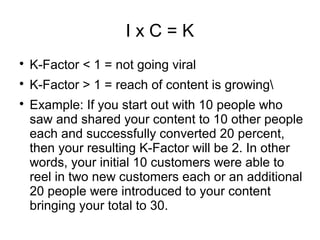
I x C = K

K-Factor < 1 = not going viral

K-Factor > 1 = reach of content is growing

Example: If you start out with 10 people who
saw and shared your content to 10 other people
each and successfully converted 20 percent,
then your resulting K-Factor will be 2. In other
words, your initial 10 customers were able to
reel in two new customers each or an additional
20 people were introduced to your content
bringing your total to 30.
Engineering Your App/SaaS To Go
Viral

Increase in invitations + increase in conversion rate =
Growth

Four key metrics when it comes to viral content:
1. Number of monthly unique users (MUU)
2. Monthly authenticated users (MAU)
3. Daily authenticated users (DAU)
4. Daily authenticated users who publish shareable events
(pDAU).
Engineering Your App/SaaS To Go
Viral

Boost ratio between MUU and MAU:
− Offer one-click social sign-in instead of username/password sign-
in

Grow ratio between MAU and DAU:
− Promote automatic log-in
− Provide useful notifications
− Send out regular e-mails

Foster growth between your daily DAU and PDAU:
− Employ a system for lightweight event sharing (Spotify, Flickr, etc)
− Leverage passive sharing (share activities automatically with
user's permission)
− Make your content shareable across devices
Six STEPPS to Encouraging The
Share
1. Social Currency
− Content that makes a person sharing it look
knowledgeable
2. Triggers
− Content pertaining to topics that are current are more
shareable
3. Emotion
− Negative and positive emotion; as long as it triggers
high forms of psychological arousal (joy, anger,
outrage, etc.)
Six STEPPS to Encouraging The
Share
4. Public
− People naturally join bandwagons whenever they can;
people want to the same things as successful
individuals
5. Practical Value
− Content that proves to be useful gets shared
6. Stories
− People love sharing stories; viral content usually flows
as a story and sometimes begins as an anecdote
Making a Piece of Content Go Viral
1. Incentive
− Content that promises a premium has a high change of
going viral
− Example: Dropbox grew in popularity because of its referral
program.
2. One-Step Sharing
− Employ a sharing scheme with one step; make it easy and
simple for your users to share your content
3. Ego
− Content that makes users proud of their accomplishments
gets shared
− Examples: IQ tests and surveys
Making a Piece of Content Go Viral
4. Trigger an Emotional Response
− Awe: Your content should display something remarkable
− Anger: When people are angry, they want to talk, especially on
social media.
− Anxiety: If you make a person uneasy, he or she is likely to talk
about it and share the content.
− Joy: Positive, inspiring and uplifting content garners a lot of
shares.
− Lust: Lust doesn't always mean physical pleasures. People can
lust for money, results, etc. Content that tantalizes readers with
potential results gets shared.
− Surprise: Content that goes against expectation is highly
shareable. These pieces challenge assumptions and prove
readers wrong.
TL;DR

Going viral isn't a game of chance.

Virality is based on the science of Psychology
and Mathematics.

Improve the virality of you content involves
hitting the right buttons with your audience's
psyche and convincing them to share.

By improving the conversion rate between
impressions and shares you can engineer viral
growth.

How You Can Use Math & Split Testing To Go Viral

  • 1.
    How You CanUse Math & Split Testing To Go Viral
  • 2.
    What Does GoingViral Really Mean?  A piece of content (whether that is a video, an image, an article, a petition, or an app) goes viral if it is circulated rapidly on the internet.  Going viral includes the use of “pre-existing social networking services and other technologies to try to produce increases in brand awareness or to achieve other marketing objectives (such as product sales) through self- replicating viral processes, analogous to the spread of viruses or computer viruses.”
  • 3.
    Measuring Virality throughK-Factor  K-Factor: a measurement of the growth rate of websites, apps, or a customer base  “If “i” is the number of invitations (or messages, in the case of viral content) sent out by each customer or user, and “C” the percent conversion rate of each invitation, then “K” is the product of the two.” (Richard Fong)  K is equal to “i” multiplied by “C”
  • 4.
    I x C= K  K-Factor < 1 = not going viral  K-Factor > 1 = reach of content is growing  Example: If you start out with 10 people who saw and shared your content to 10 other people each and successfully converted 20 percent, then your resulting K-Factor will be 2. In other words, your initial 10 customers were able to reel in two new customers each or an additional 20 people were introduced to your content bringing your total to 30.
  • 5.
    Engineering Your App/SaaSTo Go Viral  Increase in invitations + increase in conversion rate = Growth  Four key metrics when it comes to viral content: 1. Number of monthly unique users (MUU) 2. Monthly authenticated users (MAU) 3. Daily authenticated users (DAU) 4. Daily authenticated users who publish shareable events (pDAU).
  • 6.
    Engineering Your App/SaaSTo Go Viral  Boost ratio between MUU and MAU: − Offer one-click social sign-in instead of username/password sign- in  Grow ratio between MAU and DAU: − Promote automatic log-in − Provide useful notifications − Send out regular e-mails  Foster growth between your daily DAU and PDAU: − Employ a system for lightweight event sharing (Spotify, Flickr, etc) − Leverage passive sharing (share activities automatically with user's permission) − Make your content shareable across devices
  • 7.
    Six STEPPS toEncouraging The Share 1. Social Currency − Content that makes a person sharing it look knowledgeable 2. Triggers − Content pertaining to topics that are current are more shareable 3. Emotion − Negative and positive emotion; as long as it triggers high forms of psychological arousal (joy, anger, outrage, etc.)
  • 8.
    Six STEPPS toEncouraging The Share 4. Public − People naturally join bandwagons whenever they can; people want to the same things as successful individuals 5. Practical Value − Content that proves to be useful gets shared 6. Stories − People love sharing stories; viral content usually flows as a story and sometimes begins as an anecdote
  • 9.
    Making a Pieceof Content Go Viral 1. Incentive − Content that promises a premium has a high change of going viral − Example: Dropbox grew in popularity because of its referral program. 2. One-Step Sharing − Employ a sharing scheme with one step; make it easy and simple for your users to share your content 3. Ego − Content that makes users proud of their accomplishments gets shared − Examples: IQ tests and surveys
  • 10.
    Making a Pieceof Content Go Viral 4. Trigger an Emotional Response − Awe: Your content should display something remarkable − Anger: When people are angry, they want to talk, especially on social media. − Anxiety: If you make a person uneasy, he or she is likely to talk about it and share the content. − Joy: Positive, inspiring and uplifting content garners a lot of shares. − Lust: Lust doesn't always mean physical pleasures. People can lust for money, results, etc. Content that tantalizes readers with potential results gets shared. − Surprise: Content that goes against expectation is highly shareable. These pieces challenge assumptions and prove readers wrong.
  • 11.
    TL;DR  Going viral isn'ta game of chance.  Virality is based on the science of Psychology and Mathematics.  Improve the virality of you content involves hitting the right buttons with your audience's psyche and convincing them to share.  By improving the conversion rate between impressions and shares you can engineer viral growth.