How To
Write Safety
Observation
@meraj ahamad
Table of Contents
• Introduction
• Understanding Safety Observation
• Benefits of Conducting Safety Observation
• Preparation for Safety Observation
• Conducting Safety Observation
• Key Elements of Safety observation
• Writing the Safety Observation Report
• Describing observed hazards
• Evaluating Risks
• Recommending Corrective Action
• Documenting Safety Observation
• Safety Observation Samples.
Introduction
In busy work environment any workplace, ensuring the safety of
employee’s is top priority. Safety observation are a critical
component of maintaining a secure and productive work
environment.
As a Safety officer, our role involves not only identifying potential
hazards but also documenting these observations
comprehensively to implement effective safety measures.
@meraj ahamad
Understanding Safety Observations
Safety observations are systematic
inspections conducted to identify and
mitigate risks in the workplace.
The primary purpose is to
prevent accidents and promote
a safety culture among
employees.
Definition Purpose
@meraj ahamad
Benefits of Conducting
Safety Observations
Regular safety observations can lead to a significant
reduction in workplace accidents, enhance employee
awareness about safety practices, and help in create a
proactive safety culture. They also provide data to
improve existing safety protocols.
@meraj ahamad
Preparation for Safety observation
Identifying Key Areas for Observations
Gathering Necessary Tools and Documentation
Before you begin, it’s crucial to identify the areas
that require inspection / observation. This include
high risk zone, areas with heavy machinery, and
places where previous incidents have occurred,
HAZMAT/ material storage area etc.
Ensure you have all the necessary tools, such as Safety
checklist, inspection forms and required Personnel
Protective Equipment’s (PPE’S). Documentation helps in
maintaining a consistent and thorough observation
process.
@meraj ahamad
Conducting Safety Observations
Best Practices for Observing
➢ When conducting observations, be methodical
and systematic. Start from one end of the area
and move to the other, ensuring no spot is
overlooked.
Engaging with Employees
➢ Interacting with employees during
observations can provide valuable insights.
They can highlight potential hazards as you
might miss and offer suggestion for safety
improvements.
@meraj ahamad
Key Elements of Safety Observations
Identifying Hazards Assessing Risks Nothing Safe Practices
➢ The core of any safety
observation is identifying
potential hazards. This includes
anything that can cause harm,
such as slippery floors, exposed
wires, or unguarded machinery.
➢ Once hazards are identified,
assess the risks associated with
them. Determining the likelihood
and potential severity of an
incident occurring.
➢ It’s equally important to note and
commend safe practices. This
reinforces positive behavior and
encourages a culture of safety.
@meraj ahamad
Structure of the Report
Tips for clear and Concise Writing
➢ A well-structure report should be including an
introduction, a detailed account of
observations, risk assessments, and
recommended actions. Being with a summary
of the purpose and scope of the observation.
➢ Use clear, concise language. Avoid jargon and
be direct in your descriptions. Bullet points can
be effective for listing hazards and
recommendations.
Writing the Safety Observation Report
@meraj ahamad
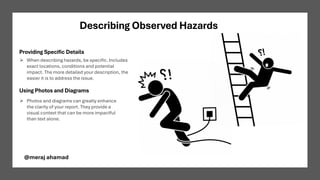
Describing Observed Hazards
Providing Specific Details
Using Photos and Diagrams
➢ When describing hazards, be specific. Includes
exact locations, conditions and potential
impact. The more detailed your description, the
easier it is to address the issue.
➢ Photos and diagrams can greatly enhance
the clarity of your report. They provide a
visual context that can be more impactful
than text alone.
@meraj ahamad
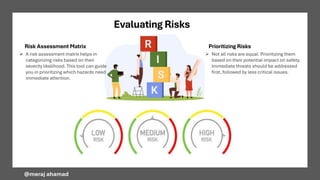
Evaluating Risks
Risk Assessment Matrix Prioritizing Risks
➢ Not all risks are equal. Prioritizing them
based on their potential impact on safety.
Immediate threats should be addressed
first, followed by less critical issues.
@meraj ahamad
➢ A risk assessment matrix helps in
categorizing risks based on their
severity likelihood. This tool can guide
you in prioritizing which hazards need
immediate attention.
Developing Actionable Solutions
Recommending Corrective Action
Engaging Management for Implementation
➢ Recommend specific actions to mitigate identified
risks. These should be practical, achievable, and
clearly communicated.
➢ Involve management in the process. Their support is
crucial for implementing corrective action
effectively.
@meraj ahamad
Documenting Safety Observations
Importance of Detailed Notes Using Standardized Forms
❖ Detailed notes are essential for
accurate reporting. Include
descriptions of hazards, their
locations, any immediate actions
taken.
❖ Using standardized forms ensure
consistency and completeness in
your observations. These forms can
be tailored to specific industries or
type of observations.
@meraj ahamad
Safety Observation Samples
Date: 12-06-2024
Location: Construction Site - Area B
Observer: XYZ
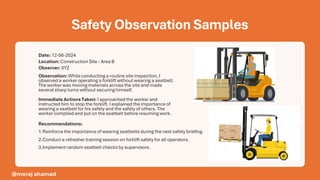
Observation: While conducting a routine site inspection, I
observed a worker operating a forklift without wearing a seatbelt.
The worker was moving materials across the site and made
several sharp turns without securing himself.
Immediate Actions Taken: I approached the worker and
instructed him to stop the forklift. I explained the importance of
wearing a seatbelt for his safety and the safety of others. The
worker compliedand put on the seatbelt before resuming work.
Recommendations:
1.Reinforce the importance of wearing seatbelts during the next safety briefing.
2.Conduct a refresher training session on forklift safety for all operators.
3.Implement random seatbelt checks by supervisors.
@meraj ahamad
Safety Observation Samples
Date: 12-06-2024
Location: ManufacturingPlant - ChemicalStorageArea
Observer: XYZ
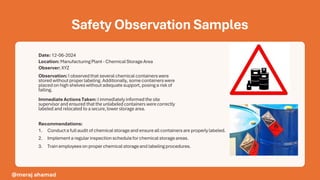
Observation: I observedthat severalchemicalcontainerswere
storedwithoutproperlabeling.Additionally,somecontainerswere
placedon highshelveswithoutadequatesupport,posinga riskof
falling.
Immediate Actions Taken: I immediatelyinformedthe site
supervisorand ensured thatthe unlabeledcontainers were correctly
labeledand relocated to a secure, lowerstorage area.
Recommendations:
1. Conducta fullaudit of chemicalstorageand ensureall containersare properlylabeled.
2. Implementa regularinspectionschedulefor chemicalstorageareas.
3. Trainemployeeson properchemicalstorageand labelingprocedures.
@meraj ahamad
Safety Observation Samples
Date: 12-06-2024
Location: ConstructionSite ScaffoldingArea
Observer: XYZ
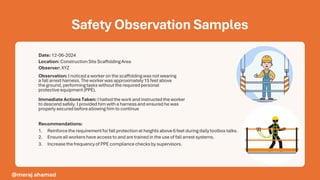
Observation: I noticeda workeron the scaffoldingwas notwearing
a fallarrestharness.Theworkerwas approximately15 feetabove
the ground,performingtaskswithoutthe requiredpersonal
protectiveequipment(PPE).
Immediate Actions Taken: I haltedthe workand instructedthe worker
to descendsafely.I providedhimwith a harnessand ensuredhe was
properlysecuredbeforeallowinghimto continue
Recommendations:
1. Reinforcethe requirementforfallprotectionat heightsabove6 feetduringdailytoolboxtalks.
2. Ensureall workershave accessto and are trainedin the useof fallarrestsystems.
3. Increasethe frequencyof PPE compliancechecksby supervisors.
@meraj ahamad

How to write Safety Observation Report.pdf

  • 1.
  • 2.
    Table of Contents •Introduction • Understanding Safety Observation • Benefits of Conducting Safety Observation • Preparation for Safety Observation • Conducting Safety Observation • Key Elements of Safety observation • Writing the Safety Observation Report • Describing observed hazards • Evaluating Risks • Recommending Corrective Action • Documenting Safety Observation • Safety Observation Samples.
  • 3.
    Introduction In busy workenvironment any workplace, ensuring the safety of employee’s is top priority. Safety observation are a critical component of maintaining a secure and productive work environment. As a Safety officer, our role involves not only identifying potential hazards but also documenting these observations comprehensively to implement effective safety measures. @meraj ahamad
  • 4.
    Understanding Safety Observations Safetyobservations are systematic inspections conducted to identify and mitigate risks in the workplace. The primary purpose is to prevent accidents and promote a safety culture among employees. Definition Purpose @meraj ahamad
  • 5.
    Benefits of Conducting SafetyObservations Regular safety observations can lead to a significant reduction in workplace accidents, enhance employee awareness about safety practices, and help in create a proactive safety culture. They also provide data to improve existing safety protocols. @meraj ahamad
  • 6.
    Preparation for Safetyobservation Identifying Key Areas for Observations Gathering Necessary Tools and Documentation Before you begin, it’s crucial to identify the areas that require inspection / observation. This include high risk zone, areas with heavy machinery, and places where previous incidents have occurred, HAZMAT/ material storage area etc. Ensure you have all the necessary tools, such as Safety checklist, inspection forms and required Personnel Protective Equipment’s (PPE’S). Documentation helps in maintaining a consistent and thorough observation process. @meraj ahamad
  • 7.
    Conducting Safety Observations BestPractices for Observing ➢ When conducting observations, be methodical and systematic. Start from one end of the area and move to the other, ensuring no spot is overlooked. Engaging with Employees ➢ Interacting with employees during observations can provide valuable insights. They can highlight potential hazards as you might miss and offer suggestion for safety improvements. @meraj ahamad
  • 8.
    Key Elements ofSafety Observations Identifying Hazards Assessing Risks Nothing Safe Practices ➢ The core of any safety observation is identifying potential hazards. This includes anything that can cause harm, such as slippery floors, exposed wires, or unguarded machinery. ➢ Once hazards are identified, assess the risks associated with them. Determining the likelihood and potential severity of an incident occurring. ➢ It’s equally important to note and commend safe practices. This reinforces positive behavior and encourages a culture of safety. @meraj ahamad
  • 9.
    Structure of theReport Tips for clear and Concise Writing ➢ A well-structure report should be including an introduction, a detailed account of observations, risk assessments, and recommended actions. Being with a summary of the purpose and scope of the observation. ➢ Use clear, concise language. Avoid jargon and be direct in your descriptions. Bullet points can be effective for listing hazards and recommendations. Writing the Safety Observation Report @meraj ahamad
  • 10.
    Describing Observed Hazards ProvidingSpecific Details Using Photos and Diagrams ➢ When describing hazards, be specific. Includes exact locations, conditions and potential impact. The more detailed your description, the easier it is to address the issue. ➢ Photos and diagrams can greatly enhance the clarity of your report. They provide a visual context that can be more impactful than text alone. @meraj ahamad
  • 11.
    Evaluating Risks Risk AssessmentMatrix Prioritizing Risks ➢ Not all risks are equal. Prioritizing them based on their potential impact on safety. Immediate threats should be addressed first, followed by less critical issues. @meraj ahamad ➢ A risk assessment matrix helps in categorizing risks based on their severity likelihood. This tool can guide you in prioritizing which hazards need immediate attention.
  • 12.
    Developing Actionable Solutions RecommendingCorrective Action Engaging Management for Implementation ➢ Recommend specific actions to mitigate identified risks. These should be practical, achievable, and clearly communicated. ➢ Involve management in the process. Their support is crucial for implementing corrective action effectively. @meraj ahamad
  • 13.
    Documenting Safety Observations Importanceof Detailed Notes Using Standardized Forms ❖ Detailed notes are essential for accurate reporting. Include descriptions of hazards, their locations, any immediate actions taken. ❖ Using standardized forms ensure consistency and completeness in your observations. These forms can be tailored to specific industries or type of observations. @meraj ahamad
  • 14.
    Safety Observation Samples Date:12-06-2024 Location: Construction Site - Area B Observer: XYZ Observation: While conducting a routine site inspection, I observed a worker operating a forklift without wearing a seatbelt. The worker was moving materials across the site and made several sharp turns without securing himself. Immediate Actions Taken: I approached the worker and instructed him to stop the forklift. I explained the importance of wearing a seatbelt for his safety and the safety of others. The worker compliedand put on the seatbelt before resuming work. Recommendations: 1.Reinforce the importance of wearing seatbelts during the next safety briefing. 2.Conduct a refresher training session on forklift safety for all operators. 3.Implement random seatbelt checks by supervisors. @meraj ahamad
  • 15.
    Safety Observation Samples Date:12-06-2024 Location: ManufacturingPlant - ChemicalStorageArea Observer: XYZ Observation: I observedthat severalchemicalcontainerswere storedwithoutproperlabeling.Additionally,somecontainerswere placedon highshelveswithoutadequatesupport,posinga riskof falling. Immediate Actions Taken: I immediatelyinformedthe site supervisorand ensured thatthe unlabeledcontainers were correctly labeledand relocated to a secure, lowerstorage area. Recommendations: 1. Conducta fullaudit of chemicalstorageand ensureall containersare properlylabeled. 2. Implementa regularinspectionschedulefor chemicalstorageareas. 3. Trainemployeeson properchemicalstorageand labelingprocedures. @meraj ahamad
  • 16.
    Safety Observation Samples Date:12-06-2024 Location: ConstructionSite ScaffoldingArea Observer: XYZ Observation: I noticeda workeron the scaffoldingwas notwearing a fallarrestharness.Theworkerwas approximately15 feetabove the ground,performingtaskswithoutthe requiredpersonal protectiveequipment(PPE). Immediate Actions Taken: I haltedthe workand instructedthe worker to descendsafely.I providedhimwith a harnessand ensuredhe was properlysecuredbeforeallowinghimto continue Recommendations: 1. Reinforcethe requirementforfallprotectionat heightsabove6 feetduringdailytoolboxtalks. 2. Ensureall workershave accessto and are trainedin the useof fallarrestsystems. 3. Increasethe frequencyof PPE compliancechecksby supervisors. @meraj ahamad