The Language Your Restaurant Menu Should
Be Using
Introduction
➢The Menu card is the most important internal advertisement tool of your restaurant.
➢The Menu showcases the restaurant’s signature dishes.
➢ Menu reflects the style, ambiance, and theme of the restaurant.
â–  For Example, They can either be formal i.e. all your dishes listed on heavy paper
with fancy fonts, or they can be ultra-casual, i.e. daily special dishes written on a
chalkboard.
Rhyming and Reasoning
➢While writing a restaurant menu you should have a rhyme and reason to it.
➢Understand the following pieces of your puzzle that make a restaurant menu successful.
â–  Theme and colors
â–  Lay your layout well
■ It’s all in the description
â–  Pricing the right way
â–  A picture is worth a thousand words
Theme and Colors
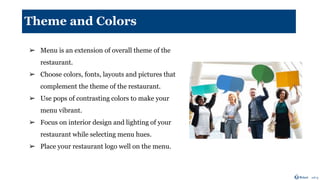
➢ Menu is an extension of overall theme of the
restaurant.
➢ Choose colors, fonts, layouts and pictures that
complement the theme of the restaurant.
➢ Use pops of contrasting colors to make your
menu vibrant.
➢ Focus on interior design and lighting of your
restaurant while selecting menu hues.
➢ Place your restaurant logo well on the menu.
Did you ever wonder why so many restaurant menus
utilize yellow and red? Well, yellow draws our attention
and red stimulates appetite whereas blue images and icons
can be helpful in selling seafood.
*Source-https://upserve.com/restaurant-insider/science-perfect-menu-design-important-food/
Lay your layout well
➢Breakdown your menu into categories that
flow in the same pattern that a customer would
take while eating a meal.
➢Use one or two column format for a clean look.
➢Designate house specialty and signature dishes
with an outline, bold or star print that will
draw the reader’s attention.
It’s all in the description
➢ The way you choose to describe your dishes is your chance to sell them.
➢ Engage your guests with clear and straightforward descriptions.
➢ Avoid overly descriptive language and hard to read fonts.
➢ Describe your item in a way that lets your customers know it’s different and more
appetizing.
➢ Use expressive language to appeal to your customers’ senses and excite their
appetites.
■ For example, Instead of using “Bread pudding with oranges and
butterscotch,” consider a description like, “Warm orange bread pudding
with butterscotch glaze.”
Pricing the right way
➢Understanding your food costs is one of the most crucial parts for pricing a restaurant
menu because that determines the profit or loss and should be carefully calculated.
➢Using long tail words to describe a dish and price is a sign of an expensive restaurant.
➢Your food should cost roughly 30% to 35% of the selling price of the menu.
➢Make sure you survey competitor restaurants to determine the average pricing for the
area.
➢Seasonal food items will require you to use the market price on your restaurant’s menu.
A Picture is worth a thousand words
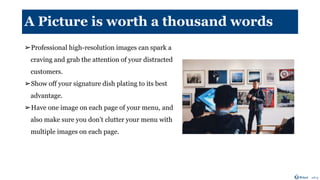
➢Professional high-resolution images can spark a
craving and grab the attention of your distracted
customers.
➢Show off your signature dish plating to its best
advantage.
➢Have one image on each page of your menu, and
also make sure you don’t clutter your menu with
multiple images on each page.
Menus
➢ A physical menu is standard for almost every restaurant. But one menu is never going
to be sufficient.
➢ According to a study, 80% of customers want to see a menu online before going down
to the restaurant.
➢ Work on the online menu for your restaurant.
➢ Don’t shy away from changing your restaurant’s offerings from time to time.
Conclusion
➢ On a final note, designing and printing restaurant menus may be expensive, and you
might have a cash crunch due to other factors like revamping or renovating your
restaurant.
➢ You can apply for small business restaurant alternative financing for easy cash flow as
you surely don’t want to compromise on the quality of the menu!
Thank You!!
For more info visit our website
https://www.reliantfunding.com/blog/language-your-restaurant-menu-should-be-
using/

The language your restaurant menu should be using

  • 1.
    The Language YourRestaurant Menu Should Be Using
  • 2.
    Introduction ➢The Menu cardis the most important internal advertisement tool of your restaurant. ➢The Menu showcases the restaurant’s signature dishes. ➢ Menu reflects the style, ambiance, and theme of the restaurant. ■ For Example, They can either be formal i.e. all your dishes listed on heavy paper with fancy fonts, or they can be ultra-casual, i.e. daily special dishes written on a chalkboard.
  • 3.
    Rhyming and Reasoning ➢Whilewriting a restaurant menu you should have a rhyme and reason to it. ➢Understand the following pieces of your puzzle that make a restaurant menu successful. ■ Theme and colors ■ Lay your layout well ■ It’s all in the description ■ Pricing the right way ■ A picture is worth a thousand words
  • 4.
    Theme and Colors ➢Menu is an extension of overall theme of the restaurant. ➢ Choose colors, fonts, layouts and pictures that complement the theme of the restaurant. ➢ Use pops of contrasting colors to make your menu vibrant. ➢ Focus on interior design and lighting of your restaurant while selecting menu hues. ➢ Place your restaurant logo well on the menu.
  • 5.
    Did you everwonder why so many restaurant menus utilize yellow and red? Well, yellow draws our attention and red stimulates appetite whereas blue images and icons can be helpful in selling seafood. *Source-https://upserve.com/restaurant-insider/science-perfect-menu-design-important-food/
  • 6.
    Lay your layoutwell ➢Breakdown your menu into categories that flow in the same pattern that a customer would take while eating a meal. ➢Use one or two column format for a clean look. ➢Designate house specialty and signature dishes with an outline, bold or star print that will draw the reader’s attention.
  • 7.
    It’s all inthe description ➢ The way you choose to describe your dishes is your chance to sell them. ➢ Engage your guests with clear and straightforward descriptions. ➢ Avoid overly descriptive language and hard to read fonts. ➢ Describe your item in a way that lets your customers know it’s different and more appetizing. ➢ Use expressive language to appeal to your customers’ senses and excite their appetites. ■ For example, Instead of using “Bread pudding with oranges and butterscotch,” consider a description like, “Warm orange bread pudding with butterscotch glaze.”
  • 8.
    Pricing the rightway ➢Understanding your food costs is one of the most crucial parts for pricing a restaurant menu because that determines the profit or loss and should be carefully calculated. ➢Using long tail words to describe a dish and price is a sign of an expensive restaurant. ➢Your food should cost roughly 30% to 35% of the selling price of the menu. ➢Make sure you survey competitor restaurants to determine the average pricing for the area. ➢Seasonal food items will require you to use the market price on your restaurant’s menu.
  • 9.
    A Picture isworth a thousand words ➢Professional high-resolution images can spark a craving and grab the attention of your distracted customers. ➢Show off your signature dish plating to its best advantage. ➢Have one image on each page of your menu, and also make sure you don’t clutter your menu with multiple images on each page.
  • 10.
    Menus ➢ A physicalmenu is standard for almost every restaurant. But one menu is never going to be sufficient. ➢ According to a study, 80% of customers want to see a menu online before going down to the restaurant. ➢ Work on the online menu for your restaurant. ➢ Don’t shy away from changing your restaurant’s offerings from time to time.
  • 11.
    Conclusion ➢ On afinal note, designing and printing restaurant menus may be expensive, and you might have a cash crunch due to other factors like revamping or renovating your restaurant. ➢ You can apply for small business restaurant alternative financing for easy cash flow as you surely don’t want to compromise on the quality of the menu!
  • 12.
    Thank You!! For moreinfo visit our website https://www.reliantfunding.com/blog/language-your-restaurant-menu-should-be- using/