How to stay sane during your
Vagrant journey
Jakub Wądołowski
• Focus goes primarily towards staging and production
• Local environments are often underrated and left behind
• Engineers need their own playgrounds
Environment hierarchy
https://flic.kr/p/daxeMY
Why should I care about local
environments?
Everyone runs the same
https://flic.kr/p/aiBHiz
Fast onboarding
https://flic.kr/p/dMP2zA
Break things!
https://flic.kr/p/c7a8iE
Experiment!
https://flic.kr/p/pZg3vQ
Start over any time you need it
https://flic.kr/p/8Mw9gq
Before Vagrant
• ZIP files everywhere
• Build it once and ZIP it!
• …
• xyz-aem-author.zip
• xyz-aem-author (copy).zip
• xyz-aem-author_20140112.zip
• xyz-aem-publish_backup.zip
• xyz-aem-publish_recovery_061213.zip
• john’s-aem-author (backup).zip
• 1307120312-aem (copy).zip
Back in the days…
https://flic.kr/p/nD6HMe
• The overall complexity increased
• Much more moving parts
• Whatever Works™ doesn’t scale anymore
• New technologies emerged
Things have changed
https://flic.kr/p/EQbNYd
• Isolation
• Reliability
• Completeness
• Ability to upgrade
• Decent UX
The right balance
https://flic.kr/p/6cKwNy
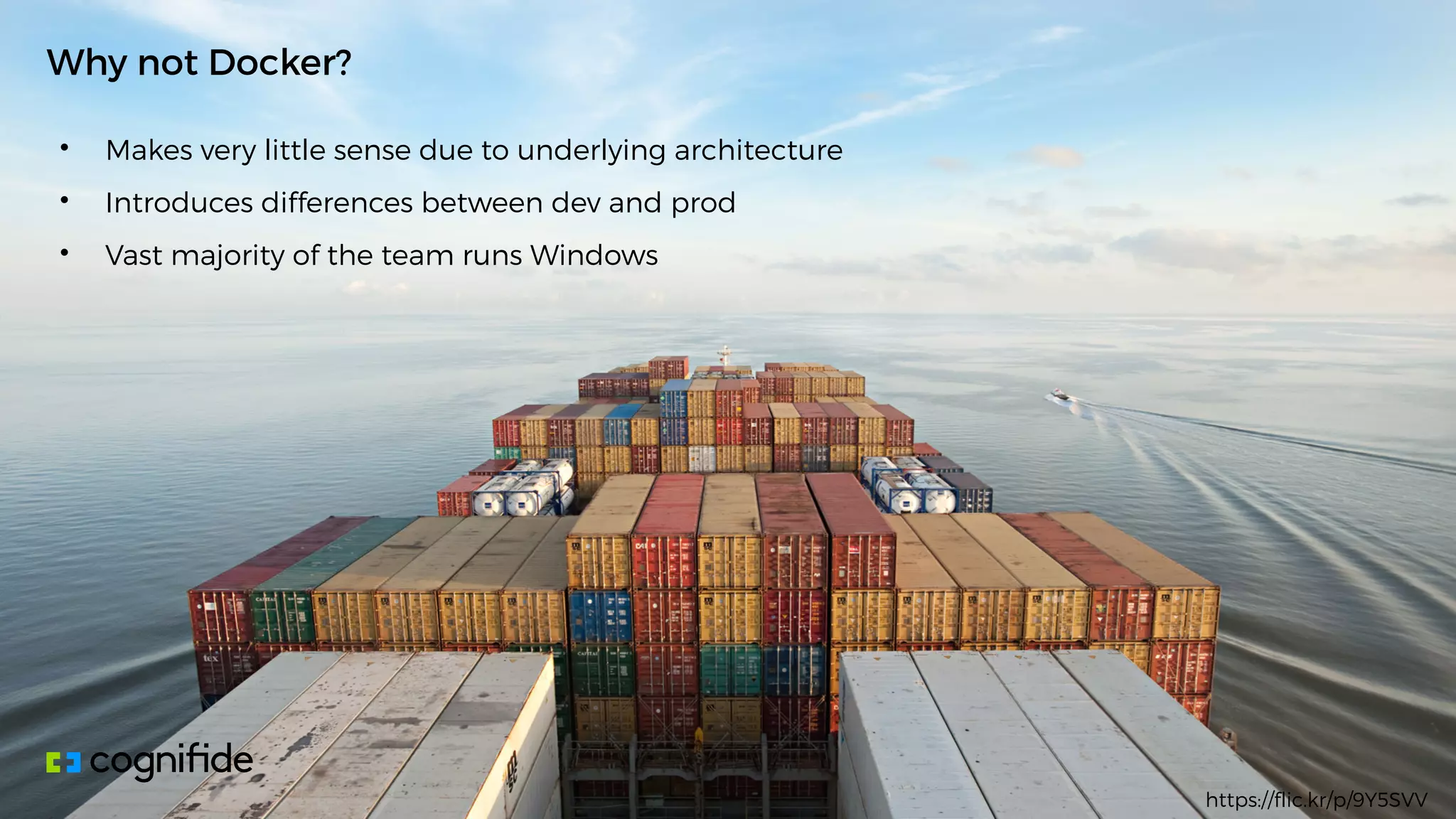
• Makes very little sense due to underlying architecture
• Introduces differences between dev and prod
• Vast majority of the team runs Windows
Why not Docker?
https://flic.kr/p/9Y5SVV
Vagrant beginnings
VAGRANTFILE_API_VERSION = '2'
Vagrant.require_version '>= 1.5.0'
Vagrant.configure(VAGRANTFILE_API_VERSION) do |config|
config.vm.hostname = 'project-vagrant'
config.vm.box = 'opscode-centos-6.6'
config.vm.box_url = 'http://whatever.s3.amazonaws.com/opscode-centos-6.6.box'
config.vm.network :private_network, ip: '192.168.123.123'
config.vm.network 'forwarded_port', guest: 6002, host: 4502
config.vm.network 'forwarded_port', guest: 26002, host: 24502
config.vm.provider 'virtualbox' do |v|
v.memory = 3072
v.cpus = 2
end
config.omnibus.chef_version = '11.16.4'
config.berkshelf.enabled = true
config.vm.provision :chef_solo do |chef|
chef.json = {}
chef.run_list = [
'recipe[cognifide-base::default]',
'recipe[project-webapp::author_base]',
'recipe[project-webapp::author_app]',
'recipe[project-httpd::default]'
]
end
end
• Pros
• full application stack
• provisioned the same way as all other
environments (Chef)
• all in one box
• managed as Chef cookbook
Nothing extraordinary, huh?
https://flic.kr/p/dwvcSo
• Cons
• based on completely clean box
• first vagrant up takes over 2 hours
• everyone waits for the same process
to complete
• poor user experience
Custom boxes
• Veewee was first (released in 2011)
• Packer came into play in 2013
• Both tools require something that underpins the build process
Build your own box
https://flic.kr/p/cMBbTu
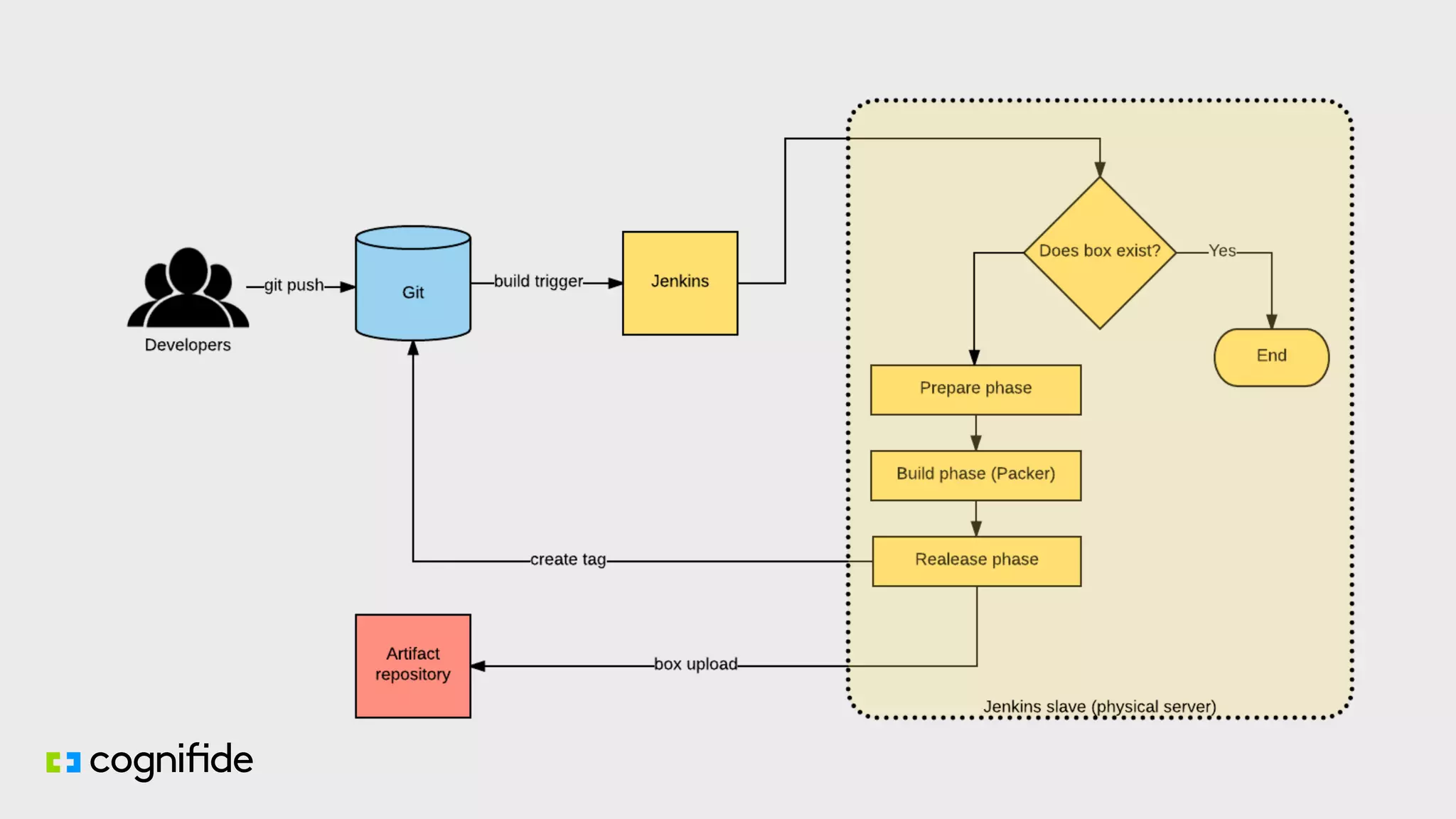
• In-house tool that goes through 3 phases
• prepare
• build (Packer)
• release
• Requires physical machine
Build process
https://flic.kr/p/GQopsq
{
"builders": [
{
"type": "virtualbox-ovf",
"vm_name": "{{user `image_name`}}"
}
],
"post-processors": [
{
"output": "{{user `packer_build_dir`}}/{{.Provider}}/{{user `image_name`}}-{{user `image_version`}}.box",
"type": "vagrant"
}
],
"provisioners": [
{
"chef_environment": "app-packer",
"run_list": [
"recipe[xyz-base::hostname]",
"recipe[xyz-base::lvm]"
],
"validation_key_path": "{{user `chef_validation_key_path`}}"
},
{
"scripts": [
"scripts/aem/remove_tmp.sh",
"scripts/generic/minimize.sh"
],
"type": "shell"
}
],
"variables": {
"chef_validation_key_path": "{{env `CHEF_VALIDATION_KEY_PATH`}}",
"description": "xyz full-stack box",
"image_name": "xyz-full-stack",
"image_version": "0.9.1",
"packer_build_dir": "{{env `PACKER_BUILD_DIR`}}",
}
}
• Build takes 1-3 hours (varies by project)
• Packer destroys everything on error
• Say hello to github.com/mitchellh/packer/issues/409
• Extremely frustrating at the very beginning
• Even more frustrating when it happens during box export
Take your time…
https://flic.kr/p/e88Ce2
• Set TMP variable to custom location
• Use environment variables for configuration
• Save Chef environment to file upon successful build
• Create tags in your repository
• Reduce box size, but…
• Great examples: github.com/chef/bento
Build tuning
https://flic.kr/p/9hTC27
• Why one VM is better than many?
• Consider incremental boxes
• Don’t repeat yourself (start from scratch)
Even more tuning
https://flic.kr/p/kmYSYT
• HashiCorp Atlas
• Build your internal Vagrant Cloud Atlas
• 3rd party services, i.e. Artifactory
Box distribution
https://flic.kr/p/5EBCiH
VAGRANTFILE_API_VERSION = '2'
Vagrant.require_version '>= 1.5.0'
Vagrant.configure(VAGRANTFILE_API_VERSION) do |config|
config.vm.hostname = 'project-vagrant'
config.vm.box = 'project-full-stack'
config.vm.box_url = 'https://boxes.example.com/project-full-stack/'
config.vm.box_version = '0.6.2'
config.vm.box_check_update = true
config.vm.network :private_network, ip: '192.168.123.123'
config.vm.network 'forwarded_port', guest: 6002, host: 4502
config.vm.network 'forwarded_port', guest: 26002, host: 24502
config.vm.provider 'virtualbox' do |v|
v.memory = 3072
v.cpus = 2
end
config.omnibus.chef_version = '11.16.4'
config.berkshelf.enabled = true
config.vm.provision :chef_zero do |chef|
chef.json = {}
chef.run_list = [
'recipe[cognifide-base::default]',
'recipe[project-webapp::author_base]',
'recipe[project-webapp::author_app]',
'recipe[project-httpd::default]'
]
end
end
• vagrant up provides complete environment
• Don’t force vagrant provision on first run
• All services are in place
Final product
https://flic.kr/p/gs9NMG
On-going work with Vagrant
• Preserve habits and routines
• Compile/build/install flow stays the same
• No config changes is required
• Feels like a first-class environment
• Easy to upgrade
Provisioning rules
https://flic.kr/p/csrifU
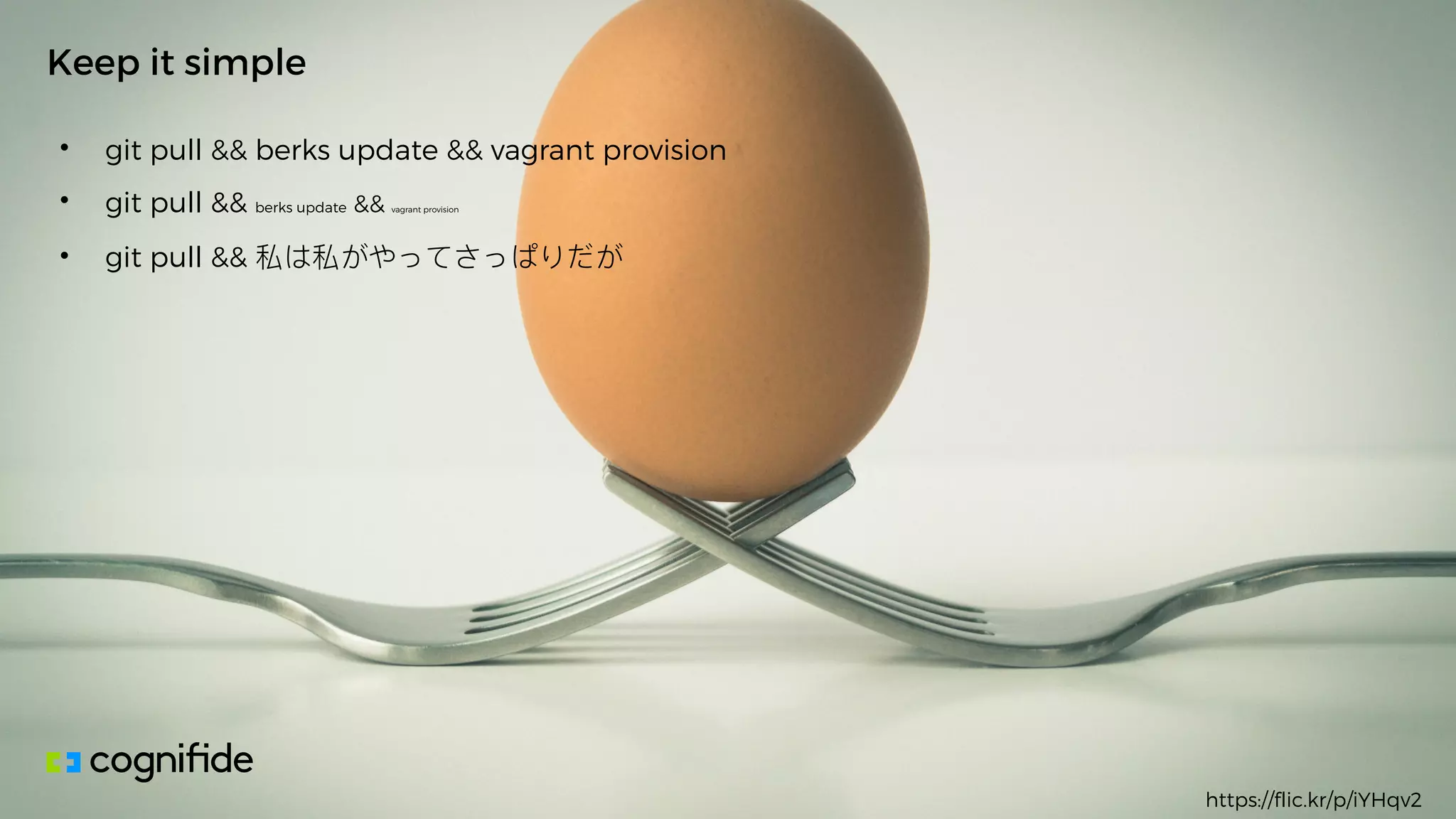
• git pull && berks update && vagrant provision
• git pull &&
Keep it simple
https://flic.kr/p/iYHqv2
Featureful, but slow and heavy
https://flic.kr/p/9nHAfM
Better UX , much faster
https://flic.kr/p/nA2Tf1
• Automate repetitive tasks
• Reduce CLI complexity
• Eliminate confusion related to Berkshelf
• 15 minutes to deploy a single config change?!
• 8/789 resources updated in 04 minutes 41 seconds?!
Time to rake
https://flic.kr/p/aEaKWh
Vagrant.require_version '~> 1.8.1'
Vagrant.configure(VAGRANTFILE_API_VERSION) do |config|
config.vm.hostname = 'project-vagrant'
config.vm.box = 'project-full-stack'
config.vm.box_url = 'https://boxes.example.com/project-full-stack/'
config.vm.box_version = '1.2.1'
config.vm.box_check_update = true
config.vm.provider 'virtualbox' do |v|
v.memory = ENV['VAGRANT_MEM'] || 6144
v.cpus = ENV['VAGRANT_CPU'] || 2
v.linked_clone = true
end
config.berkshelf.enabled = false if Vagrant.has_plugin?('vagrant-berkshelf')
config.vm.provision :chef_solo do |chef|
chef.node_name = 'project-vagrant'
chef.cookbooks_path = 'cookbooks'
run_lists = {}
run_lists['empty'] = []
run_lists['httpd'] = [ 'recipe[project-httpd::default]' ]
run_lists['tomcat_baseline'] = [ 'recipe[project-tomcat::default]' ]
run_lists['tomcat_full'] = [
'recipe[project-tomcat::default]',
'recipe[project-tomcat::app]'
]
# Fallback to empty run list if there's no .run_list file
rl = File.read('.run_list') rescue 'empty'
chef.run_list = run_lists[rl]
File.delete('.run_list') rescue nil # Once read this file is redundant
end
end
services = [
{ 'httpd' => 'Provision Apache configuration' },
{ 'tomcat_baseline' => 'Provision Tomcat' },
{ 'tomcat_full' => 'Provision Tomcat and install apps' },
]
namespace 'berkshelf' do
file 'Berksfile.lock' => 'Berksfile' do
sh 'berks update || berks install'
Rake::Task['berkshelf:vendor'].execute
end
task :vendor do
sh 'berks vendor cookbooks'
end
end
namespace 'vagrant' do
task :up do
sh 'vagrant up --no-provision --no-color'
end
task :provision => 'Berksfile.lock' do
sh 'vagrant provision --no-color'
end
end
namespace 'provision' do
services.each do |s|
desc "#{s.values.first}"
task :"#{s.keys.first}" do
File.open('.run_list', 'w') { |f| f.write(s.keys.first) }
Rake::Task['vagrant:provision'].invoke
end
end
end
desc 'Install all required Vagrant plugins'
task :init do
sh 'vagrant plugin install vagrant-hostmanager'
end
desc 'Remove old Vagrant boxes to reclaim disk space'
task :clean do
vf = File.read('Vagrantfile')
box_name = vf[/config.vm.box = '([^']+)'/,1]
box_version = vf[/config.vm.box_version = '([^']+)'/,1]
old_versions = []
%x(vagrant box list).lines.grep(/#{box_name}/).each do |l|
# Line format: BOX_NAME (PROVIDER, VERSION)
m = l.match(/(?:[^ ]+) +((?:[^,]+), (?<version>.+))/)
old_versions.push(m['version']) if m['version'] != box_version
end
old_versions.each do |v|
sh "vagrant box remove #{box_name} --box-version #{v}"
end
end
desc 'Start Vagrant and skip provisioning part'
task :up => 'vagrant:up'
task :provision => 'vagrant:provision'
desc 'Refresh all cookbook dependecies'
task :refresh do
sh 'berks update'
Rake::Task['berkshelf:vendor'].invoke
end
The reward
https://flic.kr/p/do51TU
$ rake -T
rake clean # Remove old Vagrant boxes to reclaim disk space
rake refresh # Refresh all cookbook dependecies
rake init # Install all required Vagrant plugins
rake provision:httpd # Provision Apache configuration
rake provision:tomcat_baseline # Provision Tomcat
rake provision:tomcat_full # Provision Tomcat and install all apps
rake up # Start Vagrant and skip provisioning part
$ rake provision:httpd
vagrant provision --no-color
==> default: Running provisioner: chef_solo...
==> default: Detected Chef (latest) is already installed
==> default: Generating chef JSON and uploading...
==> default: Running chef-solo...
==> default: Compiling Cookbooks…
...
==> default: [2016-06-10T08:35:02+02:00] INFO: Chef Run complete in 9.854542964 seconds
==> default: [2016-06-10T08:35:02+02:00] INFO: Skipping removal of unused files from the cache
==> default:
==> default: Running handlers:
==> default: [2016-06-10T08:35:02+02:00] INFO: Running report handlers
==> default: Running handlers complete
==> default: [2016-06-10T08:35:02+02:00] INFO: Report handlers complete
==> default: Chef Client finished, 0/34 resources updated in 11 seconds
• Does it make any sense?
• Consul + dnsmasq
• Update nameservers in /etc/resolv.conf
• Prevent DNS changes via /etc/dhcp/dhclient-enter-hooks
• Works most of the time
Service discovery and Vagrant
https://flic.kr/p/83mv7r
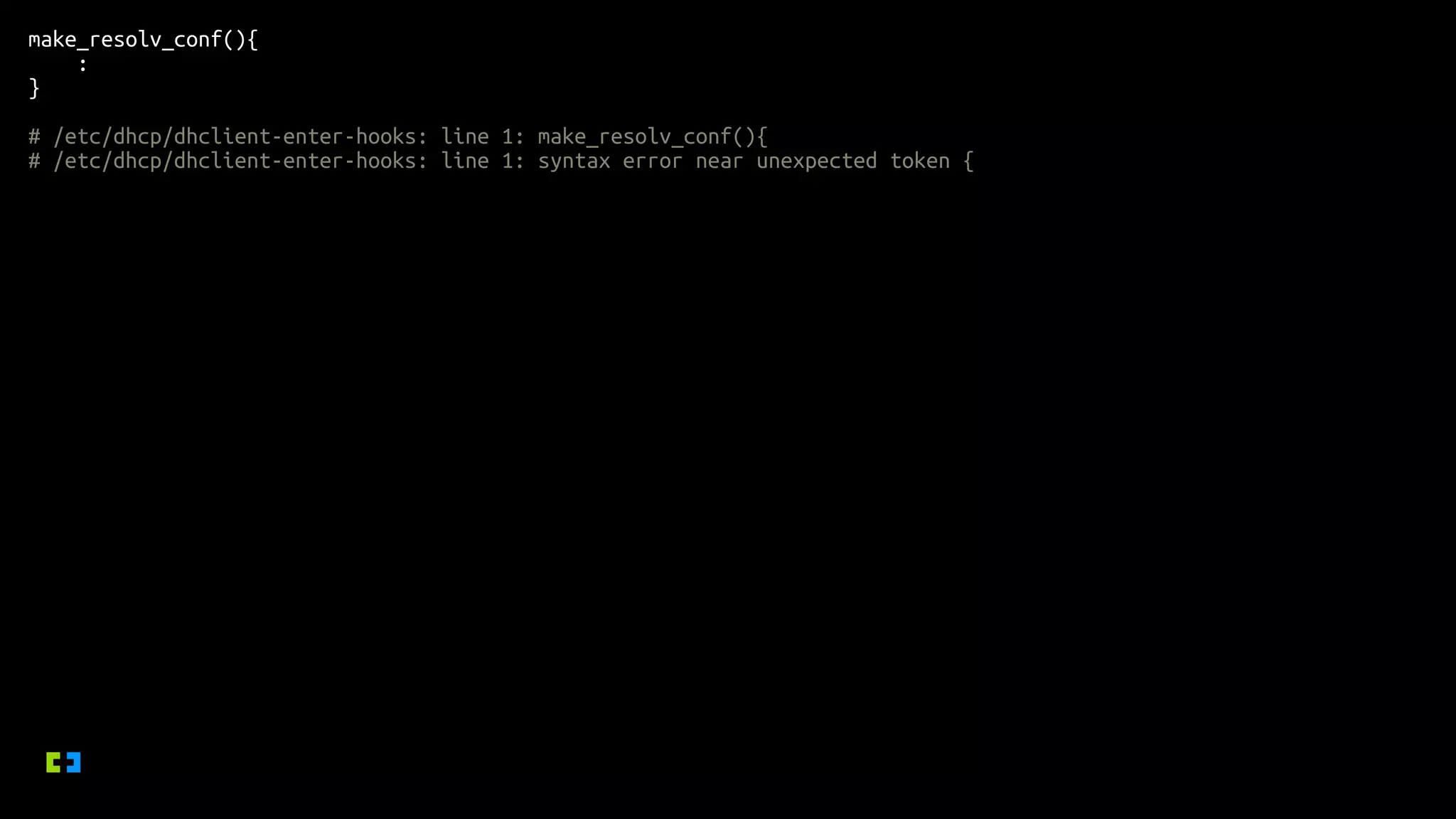
make_resolv_conf(){
:
}
# /etc/dhcp/dhclient-enter-hooks: line 1: make_resolv_conf(){
# /etc/dhcp/dhclient-enter-hooks: line 1: syntax error near unexpected token {
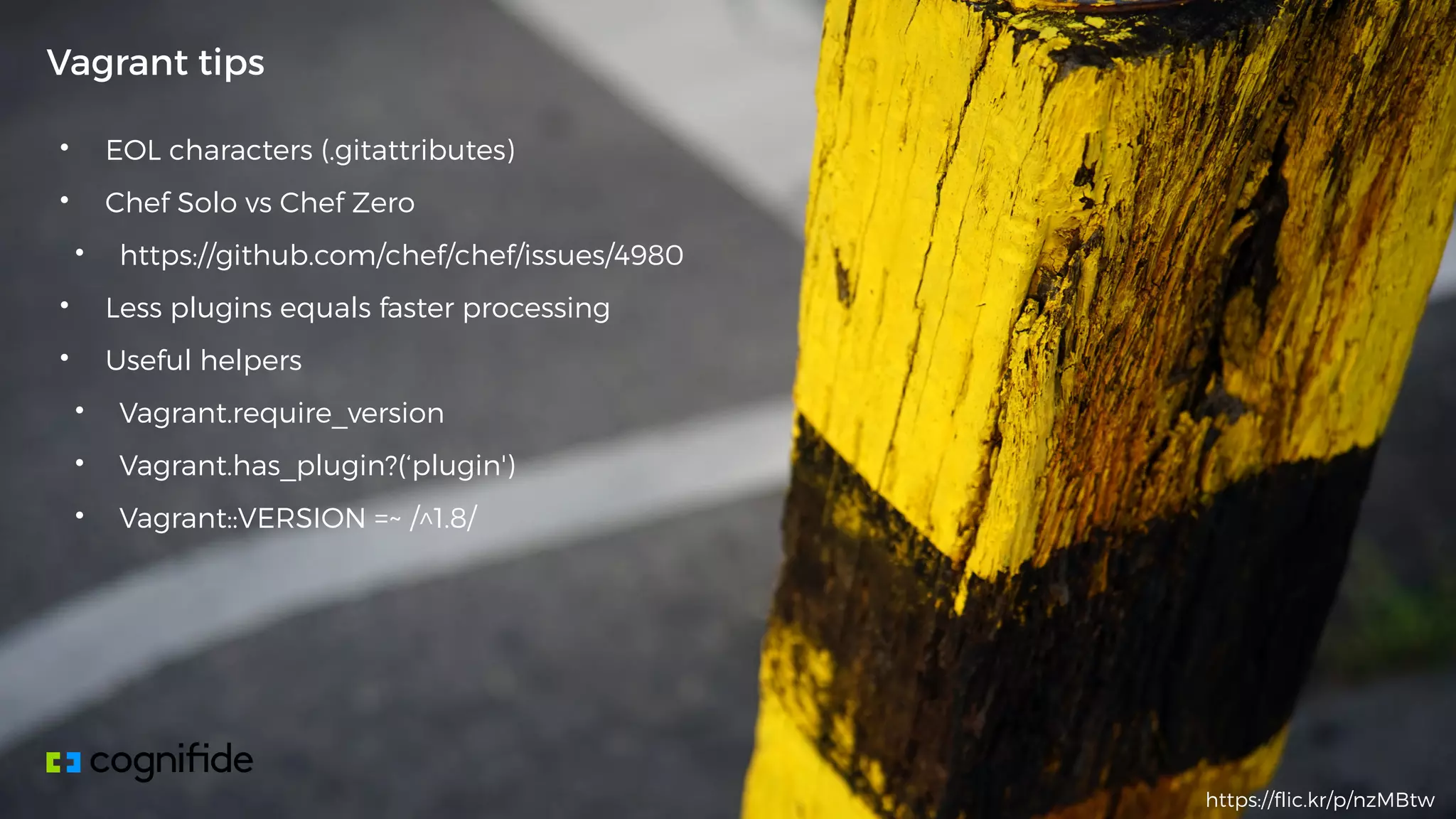
• EOL characters (.gitattributes)
• Chef Solo vs Chef Zero
• https://github.com/chef/chef/issues/4980
• Less plugins equals faster processing
• Useful helpers
• Vagrant.require_version
• Vagrant.has_plugin?(‘plugin')
• Vagrant::VERSION =~ /^1.8/
Vagrant tips
https://flic.kr/p/nzMBtw
https://flic.kr/p/tt2yB7

How to stay sane during your Vagrant journey

  • 1.
    How to staysane during your Vagrant journey Jakub Wądołowski
  • 2.
    • Focus goesprimarily towards staging and production • Local environments are often underrated and left behind • Engineers need their own playgrounds Environment hierarchy https://flic.kr/p/daxeMY
  • 3.
    Why should Icare about local environments?
  • 4.
    Everyone runs thesame https://flic.kr/p/aiBHiz
  • 5.
  • 6.
  • 7.
  • 8.
    Start over anytime you need it https://flic.kr/p/8Mw9gq
  • 9.
  • 10.
    • ZIP fileseverywhere • Build it once and ZIP it! • … • xyz-aem-author.zip • xyz-aem-author (copy).zip • xyz-aem-author_20140112.zip • xyz-aem-publish_backup.zip • xyz-aem-publish_recovery_061213.zip • john’s-aem-author (backup).zip • 1307120312-aem (copy).zip Back in the days… https://flic.kr/p/nD6HMe
  • 11.
    • The overallcomplexity increased • Much more moving parts • Whatever Works™ doesn’t scale anymore • New technologies emerged Things have changed https://flic.kr/p/EQbNYd
  • 12.
    • Isolation • Reliability •Completeness • Ability to upgrade • Decent UX The right balance https://flic.kr/p/6cKwNy
  • 13.
    • Makes verylittle sense due to underlying architecture • Introduces differences between dev and prod • Vast majority of the team runs Windows Why not Docker? https://flic.kr/p/9Y5SVV
  • 14.
  • 15.
    VAGRANTFILE_API_VERSION = '2' Vagrant.require_version'>= 1.5.0' Vagrant.configure(VAGRANTFILE_API_VERSION) do |config| config.vm.hostname = 'project-vagrant' config.vm.box = 'opscode-centos-6.6' config.vm.box_url = 'http://whatever.s3.amazonaws.com/opscode-centos-6.6.box' config.vm.network :private_network, ip: '192.168.123.123' config.vm.network 'forwarded_port', guest: 6002, host: 4502 config.vm.network 'forwarded_port', guest: 26002, host: 24502 config.vm.provider 'virtualbox' do |v| v.memory = 3072 v.cpus = 2 end config.omnibus.chef_version = '11.16.4' config.berkshelf.enabled = true config.vm.provision :chef_solo do |chef| chef.json = {} chef.run_list = [ 'recipe[cognifide-base::default]', 'recipe[project-webapp::author_base]', 'recipe[project-webapp::author_app]', 'recipe[project-httpd::default]' ] end end
  • 16.
    • Pros • fullapplication stack • provisioned the same way as all other environments (Chef) • all in one box • managed as Chef cookbook Nothing extraordinary, huh? https://flic.kr/p/dwvcSo • Cons • based on completely clean box • first vagrant up takes over 2 hours • everyone waits for the same process to complete • poor user experience
  • 17.
  • 18.
    • Veewee wasfirst (released in 2011) • Packer came into play in 2013 • Both tools require something that underpins the build process Build your own box https://flic.kr/p/cMBbTu
  • 19.
    • In-house toolthat goes through 3 phases • prepare • build (Packer) • release • Requires physical machine Build process https://flic.kr/p/GQopsq
  • 21.
    { "builders": [ { "type": "virtualbox-ovf", "vm_name":"{{user `image_name`}}" } ], "post-processors": [ { "output": "{{user `packer_build_dir`}}/{{.Provider}}/{{user `image_name`}}-{{user `image_version`}}.box", "type": "vagrant" } ], "provisioners": [ { "chef_environment": "app-packer", "run_list": [ "recipe[xyz-base::hostname]", "recipe[xyz-base::lvm]" ], "validation_key_path": "{{user `chef_validation_key_path`}}" }, { "scripts": [ "scripts/aem/remove_tmp.sh", "scripts/generic/minimize.sh" ], "type": "shell" } ], "variables": { "chef_validation_key_path": "{{env `CHEF_VALIDATION_KEY_PATH`}}", "description": "xyz full-stack box", "image_name": "xyz-full-stack", "image_version": "0.9.1", "packer_build_dir": "{{env `PACKER_BUILD_DIR`}}", } }
  • 22.
    • Build takes1-3 hours (varies by project) • Packer destroys everything on error • Say hello to github.com/mitchellh/packer/issues/409 • Extremely frustrating at the very beginning • Even more frustrating when it happens during box export Take your time… https://flic.kr/p/e88Ce2
  • 23.
    • Set TMPvariable to custom location • Use environment variables for configuration • Save Chef environment to file upon successful build • Create tags in your repository • Reduce box size, but… • Great examples: github.com/chef/bento Build tuning https://flic.kr/p/9hTC27
  • 24.
    • Why oneVM is better than many? • Consider incremental boxes • Don’t repeat yourself (start from scratch) Even more tuning https://flic.kr/p/kmYSYT
  • 25.
    • HashiCorp Atlas •Build your internal Vagrant Cloud Atlas • 3rd party services, i.e. Artifactory Box distribution https://flic.kr/p/5EBCiH
  • 26.
    VAGRANTFILE_API_VERSION = '2' Vagrant.require_version'>= 1.5.0' Vagrant.configure(VAGRANTFILE_API_VERSION) do |config| config.vm.hostname = 'project-vagrant' config.vm.box = 'project-full-stack' config.vm.box_url = 'https://boxes.example.com/project-full-stack/' config.vm.box_version = '0.6.2' config.vm.box_check_update = true config.vm.network :private_network, ip: '192.168.123.123' config.vm.network 'forwarded_port', guest: 6002, host: 4502 config.vm.network 'forwarded_port', guest: 26002, host: 24502 config.vm.provider 'virtualbox' do |v| v.memory = 3072 v.cpus = 2 end config.omnibus.chef_version = '11.16.4' config.berkshelf.enabled = true config.vm.provision :chef_zero do |chef| chef.json = {} chef.run_list = [ 'recipe[cognifide-base::default]', 'recipe[project-webapp::author_base]', 'recipe[project-webapp::author_app]', 'recipe[project-httpd::default]' ] end end
  • 27.
    • vagrant upprovides complete environment • Don’t force vagrant provision on first run • All services are in place Final product https://flic.kr/p/gs9NMG
  • 28.
  • 29.
    • Preserve habitsand routines • Compile/build/install flow stays the same • No config changes is required • Feels like a first-class environment • Easy to upgrade Provisioning rules https://flic.kr/p/csrifU
  • 30.
    • git pull&& berks update && vagrant provision • git pull && berks update && vagrant provision • git pull && Keep it simple https://flic.kr/p/iYHqv2
  • 31.
    Featureful, but slowand heavy https://flic.kr/p/9nHAfM
  • 32.
    Better UX ,much faster https://flic.kr/p/nA2Tf1
  • 33.
    • Automate repetitivetasks • Reduce CLI complexity • Eliminate confusion related to Berkshelf • 15 minutes to deploy a single config change?! • 8/789 resources updated in 04 minutes 41 seconds?! Time to rake https://flic.kr/p/aEaKWh
  • 34.
    Vagrant.require_version '~> 1.8.1' Vagrant.configure(VAGRANTFILE_API_VERSION)do |config| config.vm.hostname = 'project-vagrant' config.vm.box = 'project-full-stack' config.vm.box_url = 'https://boxes.example.com/project-full-stack/' config.vm.box_version = '1.2.1' config.vm.box_check_update = true config.vm.provider 'virtualbox' do |v| v.memory = ENV['VAGRANT_MEM'] || 6144 v.cpus = ENV['VAGRANT_CPU'] || 2 v.linked_clone = true end config.berkshelf.enabled = false if Vagrant.has_plugin?('vagrant-berkshelf') config.vm.provision :chef_solo do |chef| chef.node_name = 'project-vagrant' chef.cookbooks_path = 'cookbooks' run_lists = {} run_lists['empty'] = [] run_lists['httpd'] = [ 'recipe[project-httpd::default]' ] run_lists['tomcat_baseline'] = [ 'recipe[project-tomcat::default]' ] run_lists['tomcat_full'] = [ 'recipe[project-tomcat::default]', 'recipe[project-tomcat::app]' ] # Fallback to empty run list if there's no .run_list file rl = File.read('.run_list') rescue 'empty' chef.run_list = run_lists[rl] File.delete('.run_list') rescue nil # Once read this file is redundant end end
  • 35.
    services = [ {'httpd' => 'Provision Apache configuration' }, { 'tomcat_baseline' => 'Provision Tomcat' }, { 'tomcat_full' => 'Provision Tomcat and install apps' }, ] namespace 'berkshelf' do file 'Berksfile.lock' => 'Berksfile' do sh 'berks update || berks install' Rake::Task['berkshelf:vendor'].execute end task :vendor do sh 'berks vendor cookbooks' end end namespace 'vagrant' do task :up do sh 'vagrant up --no-provision --no-color' end task :provision => 'Berksfile.lock' do sh 'vagrant provision --no-color' end end namespace 'provision' do services.each do |s| desc "#{s.values.first}" task :"#{s.keys.first}" do File.open('.run_list', 'w') { |f| f.write(s.keys.first) } Rake::Task['vagrant:provision'].invoke end end end
  • 36.
    desc 'Install allrequired Vagrant plugins' task :init do sh 'vagrant plugin install vagrant-hostmanager' end desc 'Remove old Vagrant boxes to reclaim disk space' task :clean do vf = File.read('Vagrantfile') box_name = vf[/config.vm.box = '([^']+)'/,1] box_version = vf[/config.vm.box_version = '([^']+)'/,1] old_versions = [] %x(vagrant box list).lines.grep(/#{box_name}/).each do |l| # Line format: BOX_NAME (PROVIDER, VERSION) m = l.match(/(?:[^ ]+) +((?:[^,]+), (?<version>.+))/) old_versions.push(m['version']) if m['version'] != box_version end old_versions.each do |v| sh "vagrant box remove #{box_name} --box-version #{v}" end end desc 'Start Vagrant and skip provisioning part' task :up => 'vagrant:up' task :provision => 'vagrant:provision' desc 'Refresh all cookbook dependecies' task :refresh do sh 'berks update' Rake::Task['berkshelf:vendor'].invoke end
  • 37.
  • 38.
    $ rake -T rakeclean # Remove old Vagrant boxes to reclaim disk space rake refresh # Refresh all cookbook dependecies rake init # Install all required Vagrant plugins rake provision:httpd # Provision Apache configuration rake provision:tomcat_baseline # Provision Tomcat rake provision:tomcat_full # Provision Tomcat and install all apps rake up # Start Vagrant and skip provisioning part $ rake provision:httpd vagrant provision --no-color ==> default: Running provisioner: chef_solo... ==> default: Detected Chef (latest) is already installed ==> default: Generating chef JSON and uploading... ==> default: Running chef-solo... ==> default: Compiling Cookbooks… ... ==> default: [2016-06-10T08:35:02+02:00] INFO: Chef Run complete in 9.854542964 seconds ==> default: [2016-06-10T08:35:02+02:00] INFO: Skipping removal of unused files from the cache ==> default: ==> default: Running handlers: ==> default: [2016-06-10T08:35:02+02:00] INFO: Running report handlers ==> default: Running handlers complete ==> default: [2016-06-10T08:35:02+02:00] INFO: Report handlers complete ==> default: Chef Client finished, 0/34 resources updated in 11 seconds
  • 39.
    • Does itmake any sense? • Consul + dnsmasq • Update nameservers in /etc/resolv.conf • Prevent DNS changes via /etc/dhcp/dhclient-enter-hooks • Works most of the time Service discovery and Vagrant https://flic.kr/p/83mv7r
  • 40.
    make_resolv_conf(){ : } # /etc/dhcp/dhclient-enter-hooks: line1: make_resolv_conf(){ # /etc/dhcp/dhclient-enter-hooks: line 1: syntax error near unexpected token {
  • 41.
    • EOL characters(.gitattributes) • Chef Solo vs Chef Zero • https://github.com/chef/chef/issues/4980 • Less plugins equals faster processing • Useful helpers • Vagrant.require_version • Vagrant.has_plugin?(‘plugin') • Vagrant::VERSION =~ /^1.8/ Vagrant tips https://flic.kr/p/nzMBtw
  • 42.