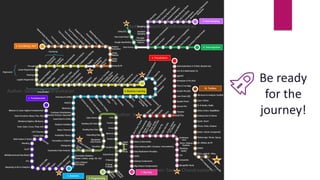
How to start your journey as a
Data Scientist?
PARVANEH SHAFIEI
WOMAN IN DATA SCIENCE – TURIN 26TH FEBRUARY
Who I am
 Past Web & Software developer
 Master: computer science in Polimi
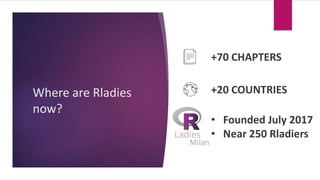
• Founded July 2017
• Near 250 Rladiers
Where are Rladies
now?
+20 COUNTRIES
+70 CHAPTERS
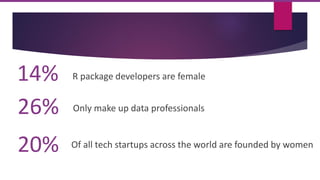
14% R package developers are female
20% Of all tech startups across the world are founded by women
26% Only make up data professionals
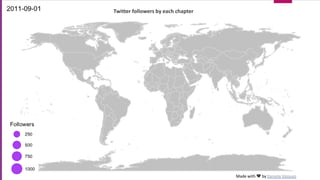
Twitter followers by each chapter
Made with 💜 by Daniela Vázquez
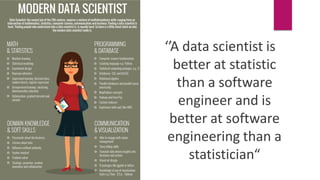
‘’A data scientist is
better at statistic
than a software
engineer and is
better at software
engineering than a
statistician“
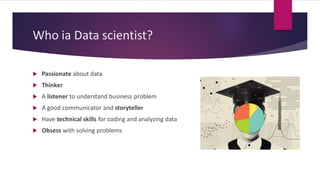
Who ia Data scientist?
 Passionate about data
 Thinker
 A listener to understand business problem
 A good communicator and storyteller
 Have technical skills for coding and analyzing data
 Obsess with solving problems
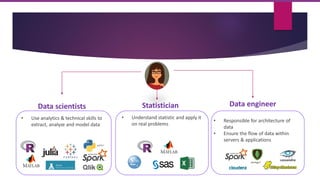
Data scientists Statistician Data engineer
• Use analytics & technical skills to
extract, analyze and model data
• Understand statistic and apply it
on real problems
• Responsible for architecture of
data
• Ensure the flow of data within
servers & applications
Be ready
for the
journey!
Learning in data science is not a linear
path!
 Data science is not about just one specific skills
 You must know all things and be expert in one of them
 It is a fast evolving field
 It does not need to be expert in the domain
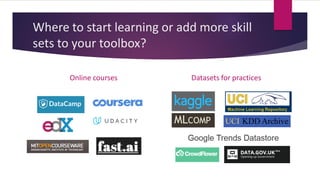
Where to start learning or add more skill
sets to your toolbox?
Online courses Datasets for practices
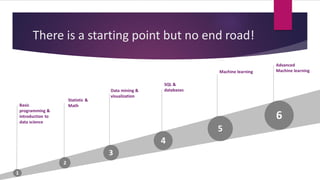
There is a starting point but no end road!
6
5
3
2
4
1
Basic
programming &
introduction to
data science
Statistic &
Math
Data mining &
visualization
SQL &
databases
Machine learning
Advanced
Machine learning
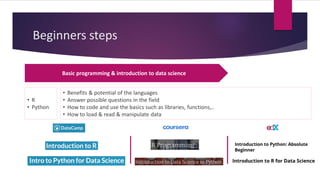
Beginners steps
Basic programming & introduction to data science
• Benefits & potential of the languages
• Answer possible questions in the field
• How to code and use the basics such as libraries, functions,..
• How to load & read & manipulate data
• R
• Python
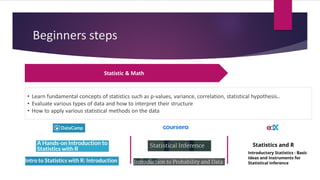
Beginners steps
Statistic & Math
• Learn fundamental concepts of statistics such as p-values, variance, correlation, statistical hypothesis..
• Evaluate various types of data and how to interpret their structure
• How to apply various statistical methods on the data
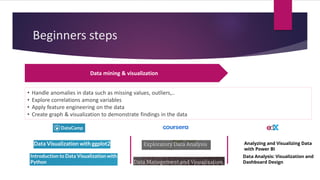
Beginners steps
Data mining & visualization
• Handle anomalies in data such as missing values, outliers,..
• Explore correlations among variables
• Apply feature engineering on the data
• Create graph & visualization to demonstrate findings in the data
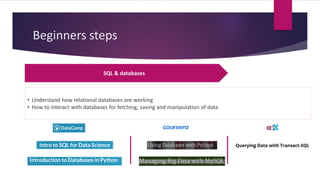
Beginners steps
SQL & databases
• Understand how relational databases are working
• How to interact with databases for fetching, saving and manipulation of data
Beginners steps
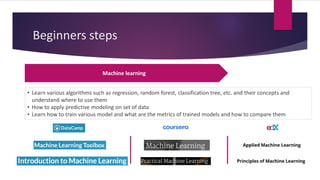
Machine learning
• Learn various algorithms such as regression, random forest, classification tree, etc. and their concepts and
understand where to use them
• How to apply predictive modeling on set of data
• Learn how to train various model and what are the metrics of trained models and how to compare them
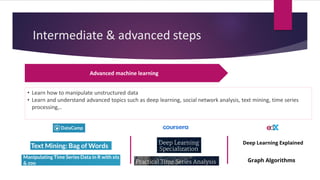
Intermediate & advanced steps
Advanced machine learning
• Learn how to manipulate unstructured data
• Learn and understand advanced topics such as deep learning, social network analysis, text mining, time series
processing,..
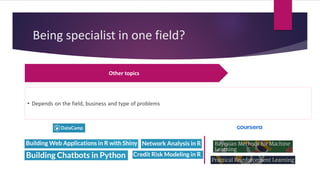
Being specialist in one field?
Other topics
• Depends on the field, business and type of problems
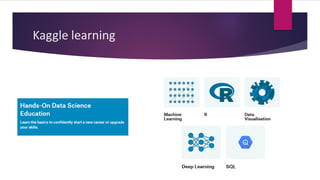
Kaggle learning
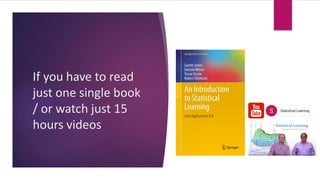
If you have to read
just one single book
/ or watch just 15
hours videos
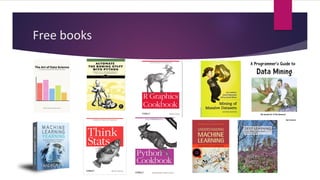
Free books
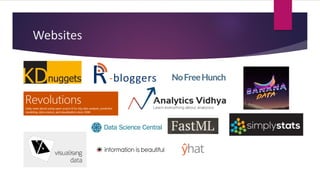
Websites
You don’t have any experience?
 Do the action!
 Apply what you learn on some use cases from Kaggle or any other data set that
you can
 Do the competitions in Kaggle, share the code in blogs, GitHub account,
LinkedIn,...
 You can find internship, asking companies directly
 Ask mentors to follow you in the way
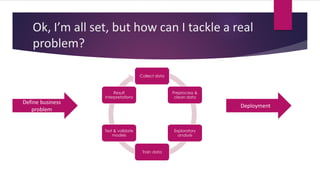
Ok, I’m all set, but how can I tackle a real
problem?
Collect data
Preprocess &
clean data
Exploratory
analysis
Train data
Test & validate
models
Result
interpretations
Define business
problem
Deployment
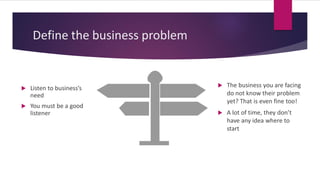
Define the business problem
 Listen to business’s
need
 You must be a good
listener
 The business you are facing
do not know their problem
yet? That is even fine too!
 A lot of time, they don’t
have any idea where to
start
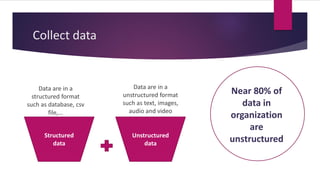
Collect data
Structured
data
Unstructured
data
Data are in a
unstructured format
such as text, images,
audio and video
Data are in a
structured format
such as database, csv
file,...
Near 80% of
data in
organization
are
unstructured
Preprocessing & cleaning data
 Never trust your data
 Check consistency & structure of the data to be sure about its quality
 Fill missing values
 Be aware of noisy data and treat them well!
 Check outliers & remove them
 Apply data transformation such as normalization or aggregation
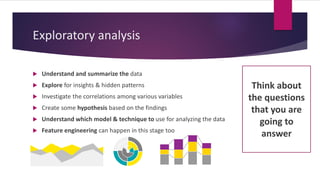
Exploratory analysis
 Understand and summarize the data
 Explore for insights & hidden patterns
 Investigate the correlations among various variables
 Create some hypothesis based on the findings
 Understand which model & technique to use for analyzing the data
 Feature engineering can happen in this stage too
Think about
the questions
that you are
going to
answer
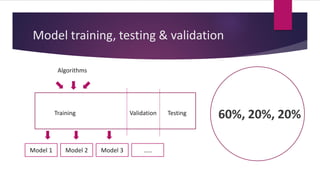
Model training, testing & validation
Training Validation
Algorithms
Model 1
Testing
Model 2 Model 3 .....
60%, 20%, 20%
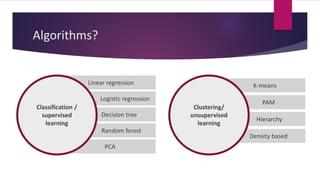
Decision tree
Density based
Hierarchy
PAM
K-means
PCA
Random forest
Logistic regression
Linear regression
Algorithms?
Classification /
supervised
learning
Clustering/
unsupervised
learning
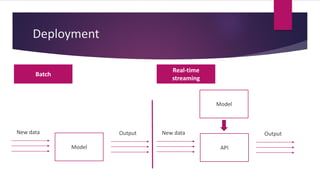
Deployment
API
New data Output
Model
New data Output
Batch
Model
Real-time
streaming
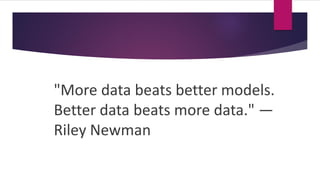
"More data beats better models.
Better data beats more data." —
Riley Newman
“
”
Enjoy your
journey!

How to start your journey as a data scientist

  • 1.
    How to startyour journey as a Data Scientist? PARVANEH SHAFIEI WOMAN IN DATA SCIENCE – TURIN 26TH FEBRUARY
  • 2.
    Who I am Past Web & Software developer  Master: computer science in Polimi
  • 3.
    • Founded July2017 • Near 250 Rladiers Where are Rladies now? +20 COUNTRIES +70 CHAPTERS
  • 4.
    14% R packagedevelopers are female 20% Of all tech startups across the world are founded by women 26% Only make up data professionals
  • 5.
    Twitter followers byeach chapter Made with 💜 by Daniela Vázquez
  • 6.
    ‘’A data scientistis better at statistic than a software engineer and is better at software engineering than a statistician“
  • 7.
    Who ia Datascientist?  Passionate about data  Thinker  A listener to understand business problem  A good communicator and storyteller  Have technical skills for coding and analyzing data  Obsess with solving problems
  • 8.
    Data scientists StatisticianData engineer • Use analytics & technical skills to extract, analyze and model data • Understand statistic and apply it on real problems • Responsible for architecture of data • Ensure the flow of data within servers & applications
  • 9.
  • 10.
    Learning in datascience is not a linear path!  Data science is not about just one specific skills  You must know all things and be expert in one of them  It is a fast evolving field  It does not need to be expert in the domain
  • 11.
    Where to startlearning or add more skill sets to your toolbox? Online courses Datasets for practices
  • 12.
    There is astarting point but no end road! 6 5 3 2 4 1 Basic programming & introduction to data science Statistic & Math Data mining & visualization SQL & databases Machine learning Advanced Machine learning
  • 13.
    Beginners steps Basic programming& introduction to data science • Benefits & potential of the languages • Answer possible questions in the field • How to code and use the basics such as libraries, functions,.. • How to load & read & manipulate data • R • Python
  • 14.
    Beginners steps Statistic &Math • Learn fundamental concepts of statistics such as p-values, variance, correlation, statistical hypothesis.. • Evaluate various types of data and how to interpret their structure • How to apply various statistical methods on the data
  • 15.
    Beginners steps Data mining& visualization • Handle anomalies in data such as missing values, outliers,.. • Explore correlations among variables • Apply feature engineering on the data • Create graph & visualization to demonstrate findings in the data
  • 16.
    Beginners steps SQL &databases • Understand how relational databases are working • How to interact with databases for fetching, saving and manipulation of data
  • 17.
    Beginners steps Machine learning •Learn various algorithms such as regression, random forest, classification tree, etc. and their concepts and understand where to use them • How to apply predictive modeling on set of data • Learn how to train various model and what are the metrics of trained models and how to compare them
  • 18.
    Intermediate & advancedsteps Advanced machine learning • Learn how to manipulate unstructured data • Learn and understand advanced topics such as deep learning, social network analysis, text mining, time series processing,..
  • 19.
    Being specialist inone field? Other topics • Depends on the field, business and type of problems
  • 20.
  • 21.
    If you haveto read just one single book / or watch just 15 hours videos
  • 22.
  • 23.
  • 24.
    You don’t haveany experience?  Do the action!  Apply what you learn on some use cases from Kaggle or any other data set that you can  Do the competitions in Kaggle, share the code in blogs, GitHub account, LinkedIn,...  You can find internship, asking companies directly  Ask mentors to follow you in the way
  • 26.
    Ok, I’m allset, but how can I tackle a real problem? Collect data Preprocess & clean data Exploratory analysis Train data Test & validate models Result interpretations Define business problem Deployment
  • 27.
    Define the businessproblem  Listen to business’s need  You must be a good listener  The business you are facing do not know their problem yet? That is even fine too!  A lot of time, they don’t have any idea where to start
  • 28.
    Collect data Structured data Unstructured data Data arein a unstructured format such as text, images, audio and video Data are in a structured format such as database, csv file,... Near 80% of data in organization are unstructured
  • 29.
    Preprocessing & cleaningdata  Never trust your data  Check consistency & structure of the data to be sure about its quality  Fill missing values  Be aware of noisy data and treat them well!  Check outliers & remove them  Apply data transformation such as normalization or aggregation
  • 30.
    Exploratory analysis  Understandand summarize the data  Explore for insights & hidden patterns  Investigate the correlations among various variables  Create some hypothesis based on the findings  Understand which model & technique to use for analyzing the data  Feature engineering can happen in this stage too Think about the questions that you are going to answer
  • 31.
    Model training, testing& validation Training Validation Algorithms Model 1 Testing Model 2 Model 3 ..... 60%, 20%, 20%
  • 32.
    Decision tree Density based Hierarchy PAM K-means PCA Randomforest Logistic regression Linear regression Algorithms? Classification / supervised learning Clustering/ unsupervised learning
  • 34.
    Deployment API New data Output Model Newdata Output Batch Model Real-time streaming
  • 35.
    "More data beatsbetter models. Better data beats more data." — Riley Newman
  • 36.