Dr. Manjunath Kotari
Professor & Head - CSE
Alva’s Institute of Engineering & Technology, Moodbidri
Review Paper Template
& Literature Survey
Courtesy: https://writing.colostate.edu
Contents
• 1. Information About Review
• 2. Sources for Review Paper
• 3. How to start Review Paper
• 4. Format of Review Paper
• 5. Case Study of Literature Survey
Courtesy: https://writing.colostate.edu
What is a review paper ???
Courtesy: https://writing.colostate.edu
“succinct review of a specific topic
that provide sufficient and in-depth
interpretation and synthesis of
published work.”
A review paper is a..
Courtesy: https://writing.colostate.edu
Resolve definitional ambiguities and outline the
scope of the topic.
Provide an integrated, synthesized overview of
the current state of knowledge.
Identify inconsistencies in prior results and
potential explanations (e.g., measures and
approaches).
of writing
Review paper
Courtesy: https://writing.colostate.edu
Evaluate existing methodological approaches and
unique insights.
Develop conceptual frameworks to reconcile and
extend past research.
Describe research insights, existing gaps, and
future research directions.
of writing
Review paper
Courtesy: https://writing.colostate.edu
Importance of Review Papers
• Teaching institute to Research institute
• Career advancement / Promotion
• Assessing quality of person
• Recognition
• Competition
• Publish or Perish
Courtesy: https://writing.colostate.edu
Answer:
Conference and Journals.
Springer Journals
ELSIEVIER Journals
Books, White / Review Papers
 Patents
Web materials etc.,
Courtesy: https://writing.colostate.edu
1. Domain selection
2. Selection of topic
3. Download papers and materials
4. Literature survey
5. Write in your own words about
10 to 15 lines for each paper
Answer:
Courtesy: https://writing.colostate.edu
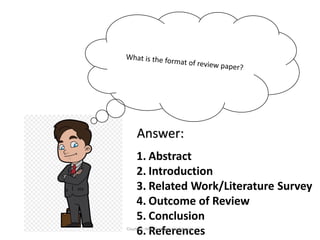
Answer:
1. Abstract
2. Introduction
3. Related Work/Literature Survey
4. Outcome of Review
5. Conclusion
6. References
Courtesy: https://writing.colostate.edu
How to write ABSTRACT
Covers the following academic elements
Background
Purpose and Focus
Methods
Results
Conclusions
The essence of the whole paper
Courtesy: https://writing.colostate.edu
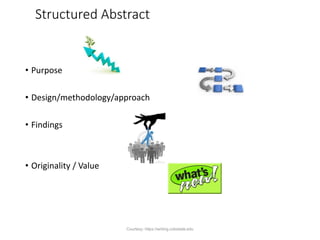
Structured Abstract
• Purpose
• Design/methodology/approach
• Findings
• Originality / Value
Courtesy: https://writing.colostate.edu
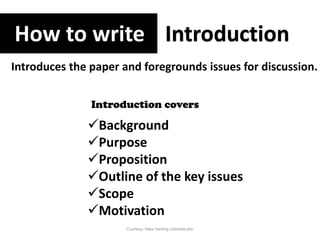
How to write Introduction
Introduces the paper and foregrounds issues for discussion.
Background
Purpose
Proposition
Outline of the key issues
Scope
Motivation
Introduction covers
Courtesy: https://writing.colostate.edu
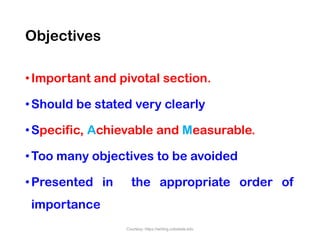
Objectives
•Important and pivotal section.
•Should be stated very clearly
•Specific, Achievable and Measurable.
•Too many objectives to be avoided
•Presented in the appropriate order of
importance
Courtesy: https://writing.colostate.edu
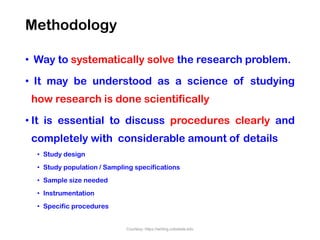
Methodology
• Way to systematically solve the research problem.
• It may be understood as a science of studying
how research is done scientifically
• It is essential to discuss procedures clearly and
completely with considerable amount of details
• Study design
• Study population / Sampling specifications
• Sample size needed
• Instrumentation
• Specific procedures
Courtesy: https://writing.colostate.edu
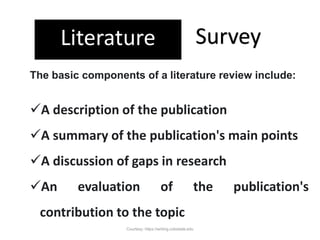
Literature Survey
A description of the publication
A summary of the publication's main points
A discussion of gaps in research
An evaluation of the publication's
contribution to the topic
The basic components of a literature review include:
Courtesy: https://writing.colostate.edu
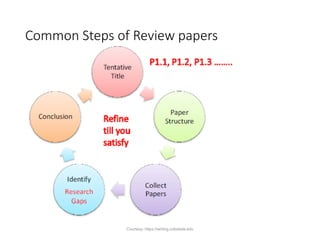
Common Steps of Review papers
Courtesy: https://writing.colostate.edu
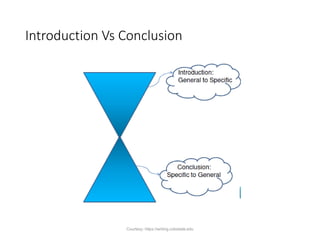
Introduction Vs Conclusion
Courtesy: https://writing.colostate.edu
Conclusion
• Provides closure for the reader while reminding the
reader of the contents and importance of the paper.
• Accomplishes this by stepping back from the specifics
in order to view the bigger picture of the document.
• A conclusion does not introduce new ideas; instead, it
should clarify the intent and importance of the paper.
• Suggest a possible future research on the topic.
Courtesy: https://writing.colostate.edu
References
• Grosan, C., Abraham, A. (2007). Hybrid evolutionary algorithms:
Methodologies, architectures, and reviews. Studies in Computational
Intelligence, 75: 1-17. https://doi.org/10.1007/978-3-540-73297-6_1
• Neal Bastek.. (1994 - 2012). Review Essays for the Biological sciences.
• Writing@CSU. Colorado State University. Available at
https://writing.colostate.edu/guides/guide.cfm?guideid=79.
Courtesy: https://writing.colostate.edu

How to prepare Review Paper- Template.pdf

  • 1.
    Dr. Manjunath Kotari Professor& Head - CSE Alva’s Institute of Engineering & Technology, Moodbidri Review Paper Template & Literature Survey Courtesy: https://writing.colostate.edu
  • 2.
    Contents • 1. InformationAbout Review • 2. Sources for Review Paper • 3. How to start Review Paper • 4. Format of Review Paper • 5. Case Study of Literature Survey Courtesy: https://writing.colostate.edu
  • 3.
    What is areview paper ??? Courtesy: https://writing.colostate.edu
  • 4.
    “succinct review ofa specific topic that provide sufficient and in-depth interpretation and synthesis of published work.” A review paper is a.. Courtesy: https://writing.colostate.edu
  • 5.
    Resolve definitional ambiguitiesand outline the scope of the topic. Provide an integrated, synthesized overview of the current state of knowledge. Identify inconsistencies in prior results and potential explanations (e.g., measures and approaches). of writing Review paper Courtesy: https://writing.colostate.edu
  • 6.
    Evaluate existing methodologicalapproaches and unique insights. Develop conceptual frameworks to reconcile and extend past research. Describe research insights, existing gaps, and future research directions. of writing Review paper Courtesy: https://writing.colostate.edu
  • 7.
  • 8.
    Importance of ReviewPapers • Teaching institute to Research institute • Career advancement / Promotion • Assessing quality of person • Recognition • Competition • Publish or Perish Courtesy: https://writing.colostate.edu
  • 9.
  • 10.
    Answer: Conference and Journals. SpringerJournals ELSIEVIER Journals Books, White / Review Papers  Patents Web materials etc., Courtesy: https://writing.colostate.edu
  • 11.
  • 12.
    1. Domain selection 2.Selection of topic 3. Download papers and materials 4. Literature survey 5. Write in your own words about 10 to 15 lines for each paper Answer: Courtesy: https://writing.colostate.edu
  • 13.
  • 14.
    Answer: 1. Abstract 2. Introduction 3.Related Work/Literature Survey 4. Outcome of Review 5. Conclusion 6. References Courtesy: https://writing.colostate.edu
  • 15.
    How to writeABSTRACT Covers the following academic elements Background Purpose and Focus Methods Results Conclusions The essence of the whole paper Courtesy: https://writing.colostate.edu
  • 16.
    Structured Abstract • Purpose •Design/methodology/approach • Findings • Originality / Value Courtesy: https://writing.colostate.edu
  • 17.
    How to writeIntroduction Introduces the paper and foregrounds issues for discussion. Background Purpose Proposition Outline of the key issues Scope Motivation Introduction covers Courtesy: https://writing.colostate.edu
  • 18.
    Objectives •Important and pivotalsection. •Should be stated very clearly •Specific, Achievable and Measurable. •Too many objectives to be avoided •Presented in the appropriate order of importance Courtesy: https://writing.colostate.edu
  • 19.
    Methodology • Way tosystematically solve the research problem. • It may be understood as a science of studying how research is done scientifically • It is essential to discuss procedures clearly and completely with considerable amount of details • Study design • Study population / Sampling specifications • Sample size needed • Instrumentation • Specific procedures Courtesy: https://writing.colostate.edu
  • 20.
    Literature Survey A descriptionof the publication A summary of the publication's main points A discussion of gaps in research An evaluation of the publication's contribution to the topic The basic components of a literature review include: Courtesy: https://writing.colostate.edu
  • 21.
    Common Steps ofReview papers Courtesy: https://writing.colostate.edu
  • 22.
    Introduction Vs Conclusion Courtesy:https://writing.colostate.edu
  • 23.
    Conclusion • Provides closurefor the reader while reminding the reader of the contents and importance of the paper. • Accomplishes this by stepping back from the specifics in order to view the bigger picture of the document. • A conclusion does not introduce new ideas; instead, it should clarify the intent and importance of the paper. • Suggest a possible future research on the topic. Courtesy: https://writing.colostate.edu
  • 24.
    References • Grosan, C.,Abraham, A. (2007). Hybrid evolutionary algorithms: Methodologies, architectures, and reviews. Studies in Computational Intelligence, 75: 1-17. https://doi.org/10.1007/978-3-540-73297-6_1 • Neal Bastek.. (1994 - 2012). Review Essays for the Biological sciences. • Writing@CSU. Colorado State University. Available at https://writing.colostate.edu/guides/guide.cfm?guideid=79. Courtesy: https://writing.colostate.edu