Beyond Blueprints:
3D Laser Scanning in
Construction
Tejjy Inc. BIM Service Providers in USA
Introduction
• Move over, blueprints!
• 3D laser scanning is rewriting the
construction playbook, offering an
unrivaled level of accuracy and
efficiency that's transforming the
industry.
• This cutting-edge technology promises
to revolutionize every step of the
construction process, from initial
planning to final handover.
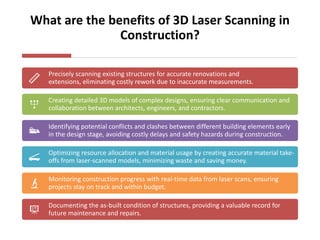
What are the benefits of 3D Laser Scanning in
Construction?
Precisely scanning existing structures for accurate renovations and
extensions, eliminating costly rework due to inaccurate measurements.
Creating detailed 3D models of complex designs, ensuring clear communication and
collaboration between architects, engineers, and contractors.
Identifying potential conflicts and clashes between different building elements early
in the design stage, avoiding costly delays and safety hazards during construction.
Optimizing resource allocation and material usage by creating accurate material take-
offs from laser-scanned models, minimizing waste and saving money.
Monitoring construction progress with real-time data from laser scans, ensuring
projects stay on track and within budget.
Documenting the as-built condition of structures, providing a valuable record for
future maintenance and repairs.
3D Laser Scanning
Shaping Construction
Landscape Today
• 3D laser scanning isn't just a
futuristic concept; it's a reality
shaping the construction
landscape today.
• Companies like Google and
Amazon are already utilizing this
technology to improve efficiency
and accuracy in their building
projects.
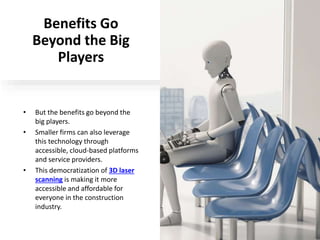
Benefits Go
Beyond the Big
Players
• But the benefits go beyond the
big players.
• Smaller firms can also leverage
this technology through
accessible, cloud-based platforms
and service providers.
• This democratization of 3D laser
scanning is making it more
accessible and affordable for
everyone in the construction
industry.
Need for Skilled
3D Scanning
Professionals
• However, with this revolution
comes the need for skilled
professionals.
• Mastering the technology,
interpreting data, and integrating
it into existing workflows requires
training and expertise.
• Educational institutions and
industry leaders need to
collaborate to equip the next
generation of construction
professionals with the skills
necessary to harness the power
of 3D laser scanning.
Software for Point
Cloud Processing
and Registration:
• Autodesk ReCap Pro: This comprehensive software
allows you to import, register, clean, and analyze
point cloud data from a variety of sources. It also
integrates seamlessly with Autodesk Revit and
other BIM software.
• Bentley ContextCapture: This software is known for
its powerful point cloud processing capabilities and
ability to handle large datasets. It also offers a wide
range of features for creating 3D models and
visualizations.
• Trimble RealWorks: This popular software is widely
used in the construction industry for processing
point cloud data. It offers a user-friendly interface
and a wide range of features for point cloud
registration, cleaning, and analysis.
• Creaform VXelements: This software is specifically
designed for processing point cloud data from
Creaform 3D scanners. It offers a streamlined
workflow for registration, cleaning, and meshing of
point clouds.
Software for BIM
Modeling:
• Autodesk Revit: This industry-standard software is a
comprehensive BIM modeling solution that allows you to
import and integrate point cloud data into your BIM
models. It offers a wide range of tools for creating and
managing building elements, as well as advanced
features for collaboration and coordination.
• Bentley MicroStation: This powerful software is another
popular choice for BIM modeling. It offers a wide range
of features for creating 3D models and documentation,
including support for point cloud data.
• ArchiCAD: This software is specifically designed for
architects and offers a user-friendly interface for BIM
modeling. It also includes features for point cloud
integration and analysis.
• Tekla Structures: This software is a popular choice for
structural engineers and offers a comprehensive range of
features for modeling and detailing steel and concrete
structures. It also includes support for point cloud data.
Additional
Software:
• FARO Scene: This software is
designed for viewing and analyzing
point cloud data. It offers a wide
range of tools for visualizing point
clouds and extracting features.
• Navisworks: This software is used
for clash detection and
coordination. It allows you to
import point cloud data and
identify potential conflicts between
different building elements.
• Insight: This software is used for
energy modeling and analysis. It
allows you to import point cloud
data and analyze the energy
performance of your BIM model.
Choosing the Right
Software:
• The best software for you will depend
on your specific needs and budget.
Some factors to consider include:
• The size and complexity of your
project: If you are working on a large
or complex project, you will need
software that can handle large
datasets and offer advanced features.
• Your budget: Software for BIM 3D
laser scanning can range in price from
free to several thousand dollars. It is
important to choose a software that
fits your budget.
• Your experience level: If you are new
to BIM 3D laser scanning, you may
want to choose a software with a
user-friendly interface and plenty of
online resources.
Final Thought
• The future of construction is
digital.
• With 3D laser scanning, the
construction industry can
build smarter, faster, and
more efficiently.
• This technology has the
potential to transform how
we design, build, and
manage structures, shaping
a more productive and
sustainable future for
construction.
Contact
Tejjy Inc.
BIM
Consultants
in USA for
3D Laser
Scanning
• To get 3D Laser Scanning in
Construction for your
construction projects, get in
touch with Tejjy BIM
Engineers in USA at 202-
465-4830 or info@tejjy.com

Beyond Blueprints 3D Laser Scanning in Construction

  • 1.
    Beyond Blueprints: 3D LaserScanning in Construction Tejjy Inc. BIM Service Providers in USA
  • 2.
    Introduction • Move over,blueprints! • 3D laser scanning is rewriting the construction playbook, offering an unrivaled level of accuracy and efficiency that's transforming the industry. • This cutting-edge technology promises to revolutionize every step of the construction process, from initial planning to final handover.
  • 3.
    What are thebenefits of 3D Laser Scanning in Construction? Precisely scanning existing structures for accurate renovations and extensions, eliminating costly rework due to inaccurate measurements. Creating detailed 3D models of complex designs, ensuring clear communication and collaboration between architects, engineers, and contractors. Identifying potential conflicts and clashes between different building elements early in the design stage, avoiding costly delays and safety hazards during construction. Optimizing resource allocation and material usage by creating accurate material take- offs from laser-scanned models, minimizing waste and saving money. Monitoring construction progress with real-time data from laser scans, ensuring projects stay on track and within budget. Documenting the as-built condition of structures, providing a valuable record for future maintenance and repairs.
  • 4.
    3D Laser Scanning ShapingConstruction Landscape Today • 3D laser scanning isn't just a futuristic concept; it's a reality shaping the construction landscape today. • Companies like Google and Amazon are already utilizing this technology to improve efficiency and accuracy in their building projects.
  • 5.
    Benefits Go Beyond theBig Players • But the benefits go beyond the big players. • Smaller firms can also leverage this technology through accessible, cloud-based platforms and service providers. • This democratization of 3D laser scanning is making it more accessible and affordable for everyone in the construction industry.
  • 6.
    Need for Skilled 3DScanning Professionals • However, with this revolution comes the need for skilled professionals. • Mastering the technology, interpreting data, and integrating it into existing workflows requires training and expertise. • Educational institutions and industry leaders need to collaborate to equip the next generation of construction professionals with the skills necessary to harness the power of 3D laser scanning.
  • 7.
    Software for Point CloudProcessing and Registration: • Autodesk ReCap Pro: This comprehensive software allows you to import, register, clean, and analyze point cloud data from a variety of sources. It also integrates seamlessly with Autodesk Revit and other BIM software. • Bentley ContextCapture: This software is known for its powerful point cloud processing capabilities and ability to handle large datasets. It also offers a wide range of features for creating 3D models and visualizations. • Trimble RealWorks: This popular software is widely used in the construction industry for processing point cloud data. It offers a user-friendly interface and a wide range of features for point cloud registration, cleaning, and analysis. • Creaform VXelements: This software is specifically designed for processing point cloud data from Creaform 3D scanners. It offers a streamlined workflow for registration, cleaning, and meshing of point clouds.
  • 8.
    Software for BIM Modeling: •Autodesk Revit: This industry-standard software is a comprehensive BIM modeling solution that allows you to import and integrate point cloud data into your BIM models. It offers a wide range of tools for creating and managing building elements, as well as advanced features for collaboration and coordination. • Bentley MicroStation: This powerful software is another popular choice for BIM modeling. It offers a wide range of features for creating 3D models and documentation, including support for point cloud data. • ArchiCAD: This software is specifically designed for architects and offers a user-friendly interface for BIM modeling. It also includes features for point cloud integration and analysis. • Tekla Structures: This software is a popular choice for structural engineers and offers a comprehensive range of features for modeling and detailing steel and concrete structures. It also includes support for point cloud data.
  • 9.
    Additional Software: • FARO Scene:This software is designed for viewing and analyzing point cloud data. It offers a wide range of tools for visualizing point clouds and extracting features. • Navisworks: This software is used for clash detection and coordination. It allows you to import point cloud data and identify potential conflicts between different building elements. • Insight: This software is used for energy modeling and analysis. It allows you to import point cloud data and analyze the energy performance of your BIM model.
  • 10.
    Choosing the Right Software: •The best software for you will depend on your specific needs and budget. Some factors to consider include: • The size and complexity of your project: If you are working on a large or complex project, you will need software that can handle large datasets and offer advanced features. • Your budget: Software for BIM 3D laser scanning can range in price from free to several thousand dollars. It is important to choose a software that fits your budget. • Your experience level: If you are new to BIM 3D laser scanning, you may want to choose a software with a user-friendly interface and plenty of online resources.
  • 11.
    Final Thought • Thefuture of construction is digital. • With 3D laser scanning, the construction industry can build smarter, faster, and more efficiently. • This technology has the potential to transform how we design, build, and manage structures, shaping a more productive and sustainable future for construction.
  • 12.
    Contact Tejjy Inc. BIM Consultants in USAfor 3D Laser Scanning • To get 3D Laser Scanning in Construction for your construction projects, get in touch with Tejjy BIM Engineers in USA at 202- 465-4830 or info@tejjy.com