Vulnerability
Management for
JD Edwards
EnterpriseOne
Challenges
How to Implement a Robust
Vulnerability Management
Program
Proactive Protection
for Your Critical
ERP System
JD Edwards EnterpriseOne is a powerful ERP solution crucial to business operations.
However, like any complex software, it’s susceptible to vulnerabilities. Key challenges include:
COMPLEX AND
EVOLVING LANDSCAPE
Vulnerabilities in JDE itself,
as well as in the underlying
operating systems,
databases, and supporting
components create a
complex landscape for
security teams to navigate.
OUTDATED AND
CUSTOM CODE
Older JDE versions and
heavily customized
environments may be
harder to patch and
introduce unique security
risks.
TIME-CONSUMING
PATCHING
Keeping JDE up-to-date
demands significant testing
and deployment, straining
IT resources.
COMPLIANCE NEEDS
Many industries mandate
strict security and reporting.
Noncompliance can lead to
fines and reputational damage.
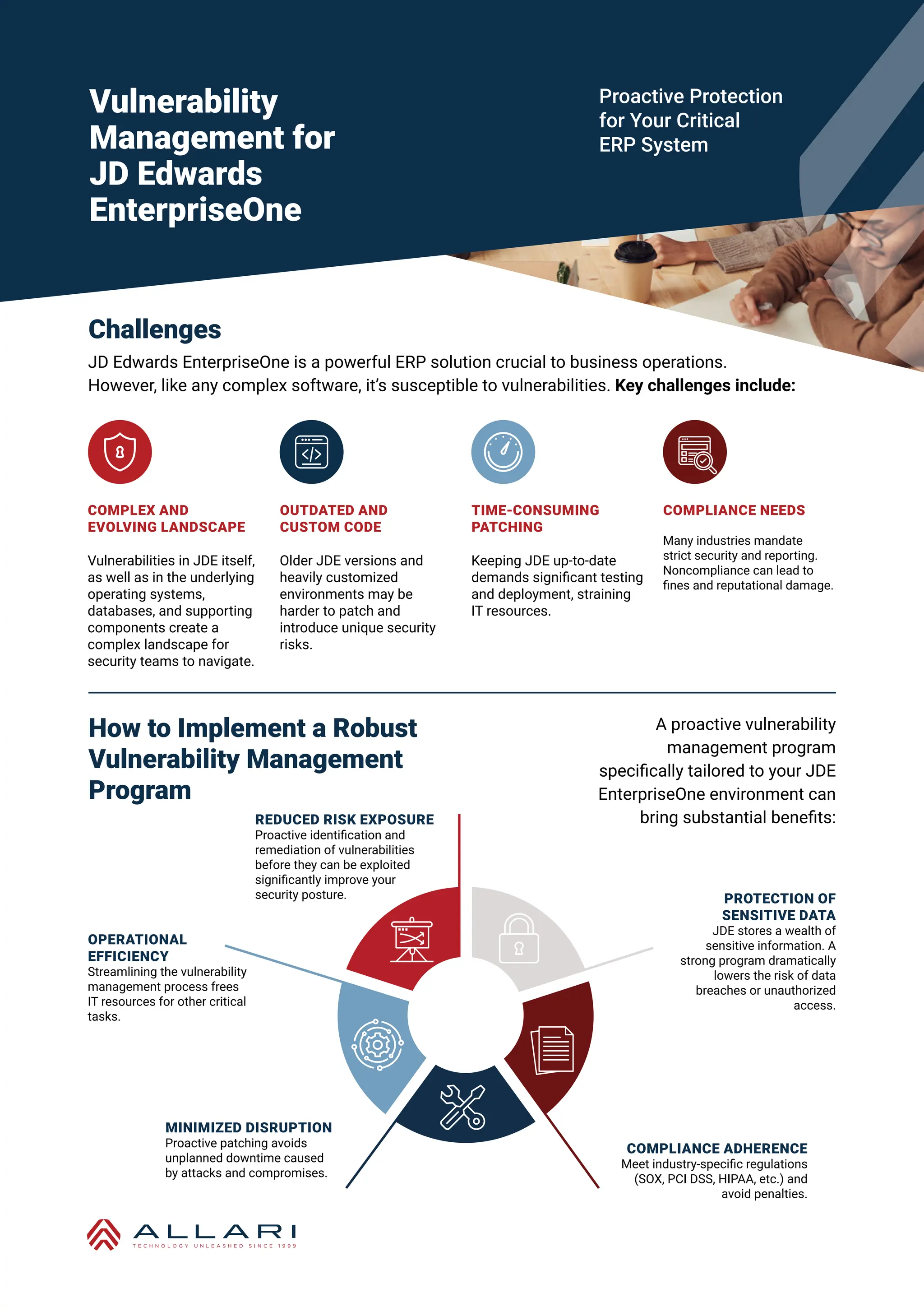
A proactive vulnerability
management program
specifically tailored to your JDE
EnterpriseOne environment can
bring substantial benefits:
REDUCED RISK EXPOSURE
Proactive identification and
remediation of vulnerabilities
before they can be exploited
significantly improve your
security posture. PROTECTION OF
SENSITIVE DATA
JDE stores a wealth of
sensitive information. A
strong program dramatically
lowers the risk of data
breaches or unauthorized
access.
COMPLIANCE ADHERENCE
Meet industry-specific regulations
(SOX, PCI DSS, HIPAA, etc.) and
avoid penalties.
MINIMIZED DISRUPTION
Proactive patching avoids
unplanned downtime caused
by attacks and compromises.
OPERATIONAL
EFFICIENCY
Streamlining the vulnerability
management process frees
IT resources for other critical
tasks.
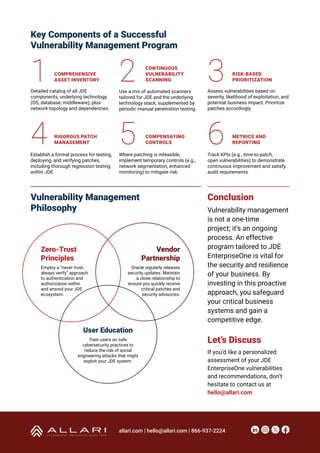
Key Components of a Successful
Vulnerability Management Program
Vulnerability Management
Philosophy
COMPREHENSIVE
ASSET INVENTORY
Detailed catalog of all JDE
components, underlying technology
(OS, database, middleware), plus
network topology and dependencies.
Assess vulnerabilities based on
severity, likelihood of exploitation, and
potential business impact. Prioritize
patches accordingly.
Conclusion
Vulnerability management
is not a one-time
project; it’s an ongoing
process. An effective
program tailored to JDE
EnterpriseOne is vital for
the security and resilience
of your business. By
investing in this proactive
approach, you safeguard
your critical business
systems and gain a
competitive edge.
Let’s Discuss
If you’d like a personalized
assessment of your JDE
EnterpriseOne vulnerabilities
and recommendations, don’t
hesitate to contact us at
hello@allari.com
Zero-Trust
Principles
Employ a “never trust,
always verify” approach
to authentication and
authorization within
and around your JDE
ecosystem.
Vendor
Partnership
Oracle regularly releases
security updates. Maintain
a close relationship to
ensure you quickly receive
critical patches and
security advisories.
User Education
Train users on safe
cybersecurity practices to
reduce the risk of social
engineering attacks that might
exploit your JDE system.
1
4
2
5
3
6
CONTINUOUS
VULNERABILITY
SCANNING
Use a mix of automated scanners
tailored for JDE and the underlying
technology stack, supplemented by
periodic manual penetration testing.
RISK-BASED
PRIORITIZATION
RIGOROUS PATCH
MANAGEMENT
Establish a formal process for testing,
deploying, and verifying patches,
including thorough regression testing
within JDE.
COMPENSATING
CONTROLS
Where patching is infeasible,
implement temporary controls (e.g.,
network segmentation, enhanced
monitoring) to mitigate risk.
METRICS AND
REPORTING
Track KPIs (e.g., time-to-patch,
open vulnerabilities) to demonstrate
continuous improvement and satisfy
audit requirements.
allari.com | hello@allari.com | 866-937-2224

How to Implement a Robust JDE Vulnerability Management Program

  • 1.
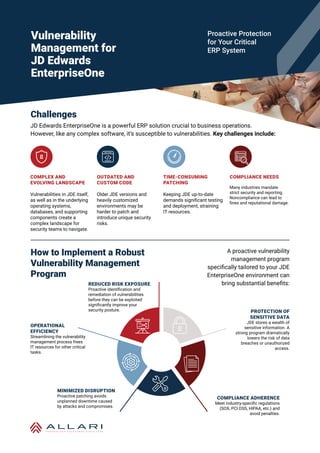
    Vulnerability Management for JD Edwards EnterpriseOne Challenges Howto Implement a Robust Vulnerability Management Program Proactive Protection for Your Critical ERP System JD Edwards EnterpriseOne is a powerful ERP solution crucial to business operations. However, like any complex software, it’s susceptible to vulnerabilities. Key challenges include: COMPLEX AND EVOLVING LANDSCAPE Vulnerabilities in JDE itself, as well as in the underlying operating systems, databases, and supporting components create a complex landscape for security teams to navigate. OUTDATED AND CUSTOM CODE Older JDE versions and heavily customized environments may be harder to patch and introduce unique security risks. TIME-CONSUMING PATCHING Keeping JDE up-to-date demands significant testing and deployment, straining IT resources. COMPLIANCE NEEDS Many industries mandate strict security and reporting. Noncompliance can lead to fines and reputational damage. A proactive vulnerability management program specifically tailored to your JDE EnterpriseOne environment can bring substantial benefits: REDUCED RISK EXPOSURE Proactive identification and remediation of vulnerabilities before they can be exploited significantly improve your security posture. PROTECTION OF SENSITIVE DATA JDE stores a wealth of sensitive information. A strong program dramatically lowers the risk of data breaches or unauthorized access. COMPLIANCE ADHERENCE Meet industry-specific regulations (SOX, PCI DSS, HIPAA, etc.) and avoid penalties. MINIMIZED DISRUPTION Proactive patching avoids unplanned downtime caused by attacks and compromises. OPERATIONAL EFFICIENCY Streamlining the vulnerability management process frees IT resources for other critical tasks.
  • 2.
    Key Components ofa Successful Vulnerability Management Program Vulnerability Management Philosophy COMPREHENSIVE ASSET INVENTORY Detailed catalog of all JDE components, underlying technology (OS, database, middleware), plus network topology and dependencies. Assess vulnerabilities based on severity, likelihood of exploitation, and potential business impact. Prioritize patches accordingly. Conclusion Vulnerability management is not a one-time project; it’s an ongoing process. An effective program tailored to JDE EnterpriseOne is vital for the security and resilience of your business. By investing in this proactive approach, you safeguard your critical business systems and gain a competitive edge. Let’s Discuss If you’d like a personalized assessment of your JDE EnterpriseOne vulnerabilities and recommendations, don’t hesitate to contact us at hello@allari.com Zero-Trust Principles Employ a “never trust, always verify” approach to authentication and authorization within and around your JDE ecosystem. Vendor Partnership Oracle regularly releases security updates. Maintain a close relationship to ensure you quickly receive critical patches and security advisories. User Education Train users on safe cybersecurity practices to reduce the risk of social engineering attacks that might exploit your JDE system. 1 4 2 5 3 6 CONTINUOUS VULNERABILITY SCANNING Use a mix of automated scanners tailored for JDE and the underlying technology stack, supplemented by periodic manual penetration testing. RISK-BASED PRIORITIZATION RIGOROUS PATCH MANAGEMENT Establish a formal process for testing, deploying, and verifying patches, including thorough regression testing within JDE. COMPENSATING CONTROLS Where patching is infeasible, implement temporary controls (e.g., network segmentation, enhanced monitoring) to mitigate risk. METRICS AND REPORTING Track KPIs (e.g., time-to-patch, open vulnerabilities) to demonstrate continuous improvement and satisfy audit requirements. allari.com | hello@allari.com | 866-937-2224