How to Handle OWASP
Top Vulnerabilities
INTRODUCTION
 The Open Web Application Security Project (OWASP) is
renowned for its efforts to improve software security. One of its
key contributions is the OWASP Top Ten list, which highlights the
most critical security risks to web applications. Handling these
vulnerabilities effectively requires a combination of best practices,
awareness, and ongoing vigilance. Here is a guide to addressing
the OWASP's top vulnerabilities.
1. Injection
 Injection flaws, such as SQL, NoSQL, and LDAP injection, occur
when untrusted data is sent to an interpreter. The best way to prevent
these is to use parameterized queries or prepared statements.
Additionally, employing input validation and escaping special
characters can mitigate risks.
2. Broken Authentication
 To address broken authentication related to OWASP top
vulnerabilities, use multi-factor authentication (MFA) to add an
extra layer of security. Ensure strong password policies and avoid
default credentials. Implement mechanisms to detect and respond
to brute force attacks and enforce session management best
practices, such as secure session cookies.
3. Sensitive Data Exposure
 Encrypt sensitive data both in transit and at rest using
strong encryption standards like TLS and AES. Implement
proper key management practices and avoid exposing
sensitive data in URLs. Regularly review and update your
encryption methods with the help of White Coast
Security to align with current best practices.
4. XML External Entities (XXE)
 To prevent XXE attacks, White Coast Security experts recommend
you disable the usage of external entities and DTDs in XML parsers.
Use relatively less complex data formats, like JSON, where possible.
Apply input validation and output encoding to mitigate the risks
associated with XML processing.
5. Broken Access Control
 Ensure robust access control by adopting the principle of least
privilege. Use role-based access controls and implement proper
permission checks at both the object and function levels. Regularly
audit and review access controls to identify and rectify improper
configurations.
6. Security Misconfiguration
 Regularly update and patch systems and applications. Employ
automated configuration management tools to ensure consistency
and compliance with security standards. Disable unused features
and services, and implement security hardening guides specific to
the technologies in use.
7. Cross-Site Scripting (XSS)
 To mitigate XSS vulnerabilities, use frameworks that automatically
escape user inputs. Sanitize and validate all input to ensure it does not
include malicious scripts. Implement Content Security Policy (CSP)
headers to restrict the sources from which scripts can be executed.
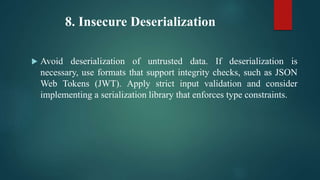
8. Insecure Deserialization
 Avoid deserialization of untrusted data. If deserialization is
necessary, use formats that support integrity checks, such as JSON
Web Tokens (JWT). Apply strict input validation and consider
implementing a serialization library that enforces type constraints.
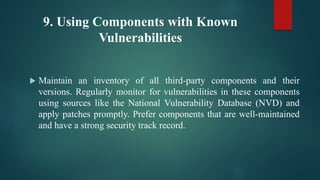
9. Using Components with Known
Vulnerabilities
 Maintain an inventory of all third-party components and their
versions. Regularly monitor for vulnerabilities in these components
using sources like the National Vulnerability Database (NVD) and
apply patches promptly. Prefer components that are well-maintained
and have a strong security track record.
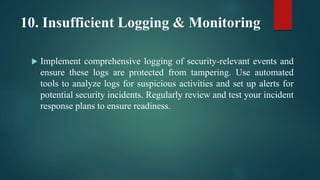
10. Insufficient Logging & Monitoring
 Implement comprehensive logging of security-relevant events and
ensure these logs are protected from tampering. Use automated
tools to analyze logs for suspicious activities and set up alerts for
potential security incidents. Regularly review and test your incident
response plans to ensure readiness.
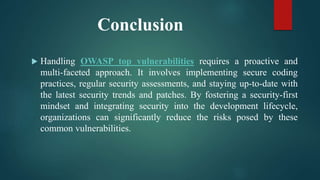
Conclusion
 Handling OWASP top vulnerabilities requires a proactive and
multi-faceted approach. It involves implementing secure coding
practices, regular security assessments, and staying up-to-date with
the latest security trends and patches. By fostering a security-first
mindset and integrating security into the development lifecycle,
organizations can significantly reduce the risks posed by these
common vulnerabilities.
To get more information, check
https://whitecoastsecurity.com/safeguarding-web-
applications-a-white-coast-security-perspective-on-
the-owasp-top-10-vulnerabilities/

How to Handle Open Web Application Security Project(OWASP) Top Vulnerabilities

  • 1.
    How to HandleOWASP Top Vulnerabilities
  • 2.
    INTRODUCTION  The OpenWeb Application Security Project (OWASP) is renowned for its efforts to improve software security. One of its key contributions is the OWASP Top Ten list, which highlights the most critical security risks to web applications. Handling these vulnerabilities effectively requires a combination of best practices, awareness, and ongoing vigilance. Here is a guide to addressing the OWASP's top vulnerabilities.
  • 3.
    1. Injection  Injectionflaws, such as SQL, NoSQL, and LDAP injection, occur when untrusted data is sent to an interpreter. The best way to prevent these is to use parameterized queries or prepared statements. Additionally, employing input validation and escaping special characters can mitigate risks.
  • 4.
    2. Broken Authentication To address broken authentication related to OWASP top vulnerabilities, use multi-factor authentication (MFA) to add an extra layer of security. Ensure strong password policies and avoid default credentials. Implement mechanisms to detect and respond to brute force attacks and enforce session management best practices, such as secure session cookies.
  • 5.
    3. Sensitive DataExposure  Encrypt sensitive data both in transit and at rest using strong encryption standards like TLS and AES. Implement proper key management practices and avoid exposing sensitive data in URLs. Regularly review and update your encryption methods with the help of White Coast Security to align with current best practices.
  • 6.
    4. XML ExternalEntities (XXE)  To prevent XXE attacks, White Coast Security experts recommend you disable the usage of external entities and DTDs in XML parsers. Use relatively less complex data formats, like JSON, where possible. Apply input validation and output encoding to mitigate the risks associated with XML processing.
  • 7.
    5. Broken AccessControl  Ensure robust access control by adopting the principle of least privilege. Use role-based access controls and implement proper permission checks at both the object and function levels. Regularly audit and review access controls to identify and rectify improper configurations.
  • 8.
    6. Security Misconfiguration Regularly update and patch systems and applications. Employ automated configuration management tools to ensure consistency and compliance with security standards. Disable unused features and services, and implement security hardening guides specific to the technologies in use.
  • 9.
    7. Cross-Site Scripting(XSS)  To mitigate XSS vulnerabilities, use frameworks that automatically escape user inputs. Sanitize and validate all input to ensure it does not include malicious scripts. Implement Content Security Policy (CSP) headers to restrict the sources from which scripts can be executed.
  • 10.
    8. Insecure Deserialization Avoid deserialization of untrusted data. If deserialization is necessary, use formats that support integrity checks, such as JSON Web Tokens (JWT). Apply strict input validation and consider implementing a serialization library that enforces type constraints.
  • 11.
    9. Using Componentswith Known Vulnerabilities  Maintain an inventory of all third-party components and their versions. Regularly monitor for vulnerabilities in these components using sources like the National Vulnerability Database (NVD) and apply patches promptly. Prefer components that are well-maintained and have a strong security track record.
  • 12.
    10. Insufficient Logging& Monitoring  Implement comprehensive logging of security-relevant events and ensure these logs are protected from tampering. Use automated tools to analyze logs for suspicious activities and set up alerts for potential security incidents. Regularly review and test your incident response plans to ensure readiness.
  • 13.
    Conclusion  Handling OWASPtop vulnerabilities requires a proactive and multi-faceted approach. It involves implementing secure coding practices, regular security assessments, and staying up-to-date with the latest security trends and patches. By fostering a security-first mindset and integrating security into the development lifecycle, organizations can significantly reduce the risks posed by these common vulnerabilities.
  • 14.
    To get moreinformation, check https://whitecoastsecurity.com/safeguarding-web- applications-a-white-coast-security-perspective-on- the-owasp-top-10-vulnerabilities/