

No conflicts of interest in relation with this presentation
How to evaluate shock by echo?
Critical care echocardiography
Rafael Vidal-Perez
Hospital Universitario Lucus Augusti (Lugo)
SPAIN
@rafavidalperez
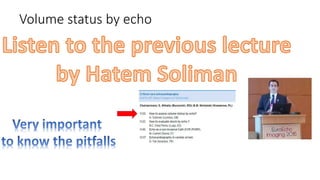
https://www.slideshare.net/HatemSoliman2/echocardiographic-evaluation-of-shock-states-81347188
How to evaluate shock by echo?
• Definition of shock
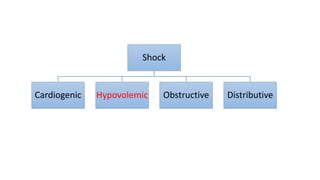
• Types of Shock
• Epidemiology of Shock
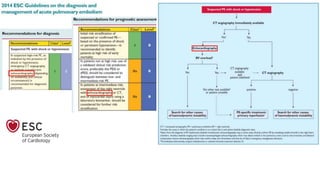
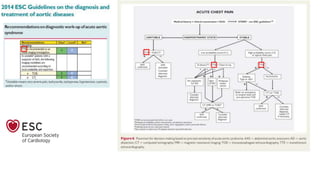
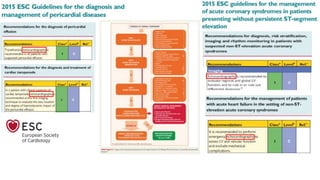
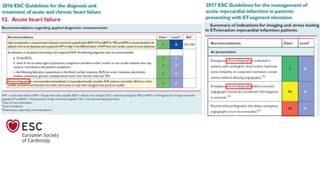
• What do the guidelines say about echo in shock?
• The neverending name game
• How to evaluate in daily practice
• The future challenge of handheld echo
Definition of shock
Life-threatening, generalized form of acute circulatory failure
associated with inadequate oxygen utilization by the cells
As a result, there is cellular dysoxia, associated
with increased blood lactate levels.
Cecconi M et al. Intensive Care Med (2014) 40:1795–1815
Definition of shock
Diagnosis based on a combination of clinical, hemodynamic and biochemical signs
• Clinical signs of shock typically include.-
• Arterial Hypotension (although this is not always present),
• Signs of altered tissue perfusion, visualized through the 3 ‘windows’ of the body
• Peripheral window (skin that is cold, clammy & blue, pale or discolored)
• Renal window (decreased urine output: <0.5 mL/kg/h)
• Neurologic window (altered mental characterized by obtundation,
disorientation & confusion)
• Presence of Arterial Hypotension [defined as systolic blood pressure of <90 mmHg, or
mean arterial pressure (MAP) of <65 mmHg, or a decrease of ≥40 mmHg from baseline],
while commonly present, should not be required to define shock
• Lactate levels are typically >2 mEq/L (or mmol/L) in shock states
Cecconi M et al. Intensive Care Med (2014) 40:1795–1815
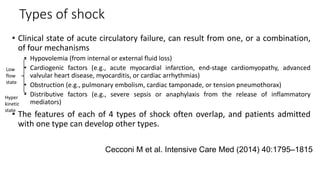
Types of shock
• Clinical state of acute circulatory failure, can result from one, or a combination,
of four mechanisms
• Hypovolemia (from internal or external fluid loss)
• Cardiogenic factors (e.g., acute myocardial infarction, end-stage cardiomyopathy, advanced
valvular heart disease, myocarditis, or cardiac arrhythmias)
• Obstruction (e.g., pulmonary embolism, cardiac tamponade, or tension pneumothorax)
• Distributive factors (e.g., severe sepsis or anaphylaxis from the release of inflammatory
mediators)
• The features of each of 4 types of shock often overlap, and patients admitted
with one type can develop other types.
Low
flow
state
Hyper
kinetic
state
Cecconi M et al. Intensive Care Med (2014) 40:1795–1815
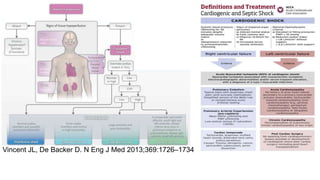
Vincent JL, De Backer D. N Eng J Med 2013;369:1726–1734
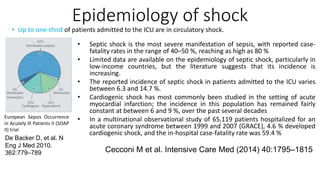
• Up to one-third of patients admitted to the ICU are in circulatory shock.
Epidemiology of shock
European Sepsis Occurrence
in Acutely Ill Patients II (SOAP
II) trial
De Backer D, et al. N
Eng J Med 2010.
362:779–789
• Septic shock is the most severe manifestation of sepsis, with reported case-
fatality rates in the range of 40–50 %, reaching as high as 80 %
• Limited data are available on the epidemiology of septic shock, particularly in
low-income countries, but the literature suggests that its incidence is
increasing.
• The reported incidence of septic shock in patients admitted to the ICU varies
between 6.3 and 14.7 %.
• Cardiogenic shock has most commonly been studied in the setting of acute
myocardial infarction; the incidence in this population has remained fairly
constant at between 6 and 9 %, over the past several decades
• In a multinational observational study of 65,119 patients hospitalized for an
acute coronary syndrome between 1999 and 2007 (GRACE), 4.6 % developed
cardiogenic shock, and the in-hospital case-fatality rate was 59.4 %
Cecconi M et al. Intensive Care Med (2014) 40:1795–1815
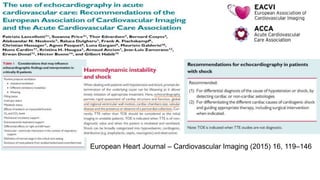
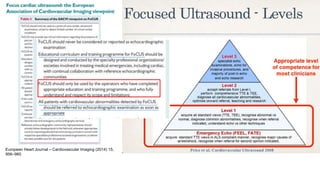
European Heart Journal – Cardiovascular Imaging (2015) 16, 119–146
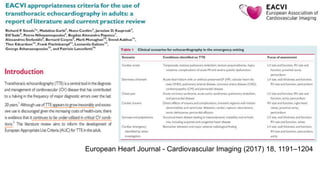
European Heart Journal - Cardiovascular Imaging (2017) 18, 1191–1204
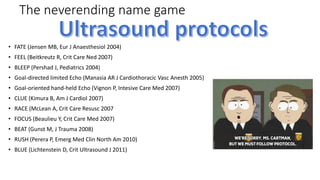
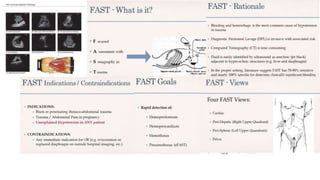
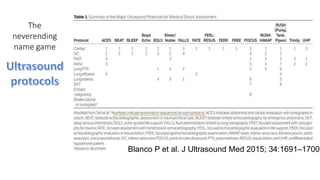
The neverending name game
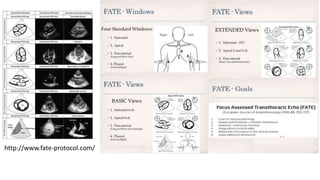
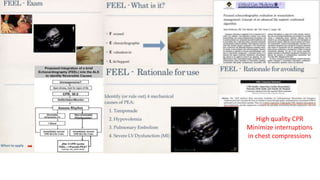
• FATE (Jensen MB, Eur J Anaesthesiol 2004)
• FEEL (Beitkreutz R, Crit Care Ned 2007)
• BLEEP (Pershad J, Pediatrics 2004)
• Goal-directed limited Echo (Manasia AR J Cardiothoracic Vasc Anesth 2005)
• Goal-oriented hand-held Echo (Vignon P, Intesive Care Med 2007)
• CLUE (Kimura B, Am J Cardiol 2007)
• RACE (McLean A, Crit Care Resusc 2007
• FOCUS (Beaulieu Y, Crit Care Med 2007)
• BEAT (Gunst M, J Trauma 2008)
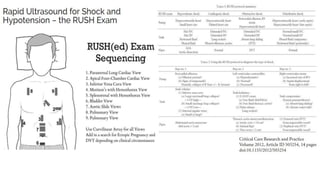
• RUSH (Perera P, Emerg Med Clin North Am 2010)
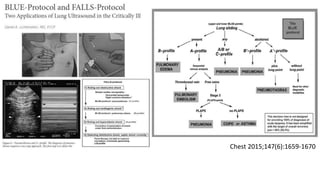
• BLUE (Lichtenstein D, Crit Ultrasound J 2011)
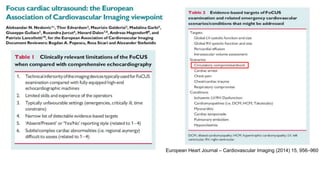
European Heart Journal – Cardiovascular Imaging (2014) 15, 956–960
European Heart Journal – Cardiovascular Imaging (2014) 15,
956–960
http://www.fate-protocol.com/
High quality CPR
Minimize interruptions
in chest compressions
Chest 2015;147(6):1659-1670
The
neverending
name game
Blanco P et al. J Ultrasound Med 2015; 34:1691–1700
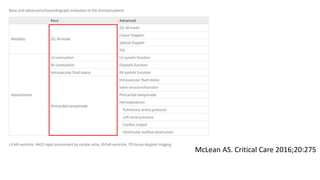
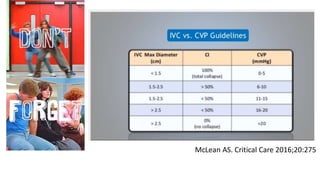
McLean AS. Critical Care 2016;20:275
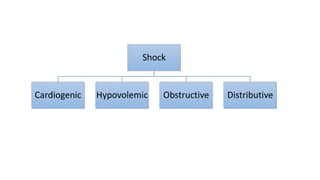
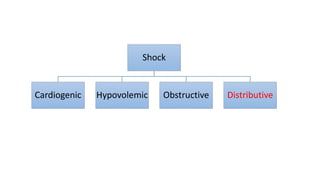
Shock
Cardiogenic Hypovolemic Obstructive Distributive
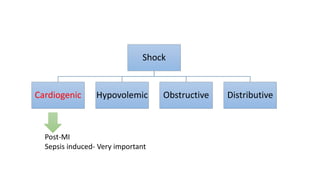
Shock
Cardiogenic Hypovolemic Obstructive Distributive
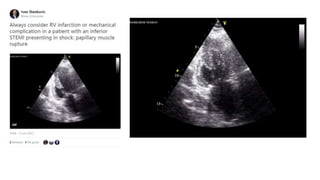
Post-MI
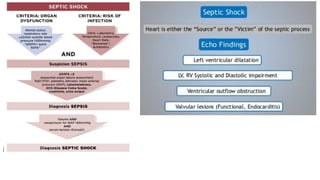
Sepsis induced- Very important
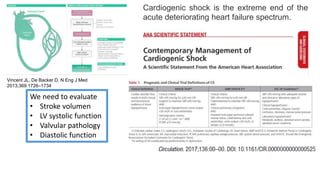
Vincent JL, De Backer D. N Eng J Med
2013;369:1726–1734
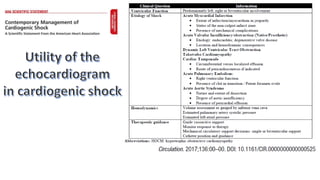
We need to evaluate
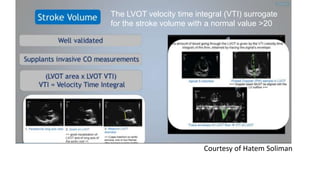
• Stroke volumen
• LV systolic function
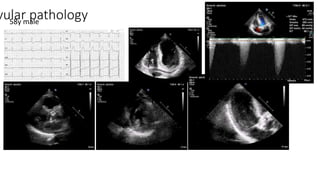
• Valvular pathology
• Diastolic function
Cardiogenic shock is the extreme end of the
acute deteriorating heart failure spectrum.
Courtesy of Hatem Soliman
The LVOT velocity time integral (VTI) surrogate
for the stroke volume with a normal value >20
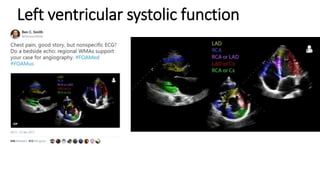
Left ventricular systolic function
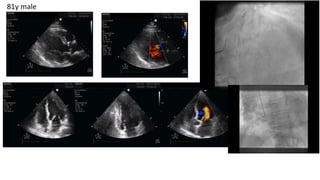
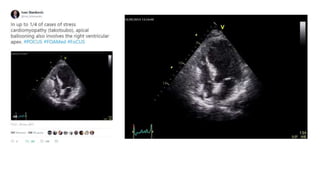
• The most common cause of cardiogenic shock results from marked reduction
in left ventricular contraction.
• The size of both the left atrium and ventricle may provide clues to the
duration of the contractile impairment, with dilatation indicating a degree of
chronicity
• Left ventricular ejection fraction (LVEF) is a traditional parameter which,
though far from ideal, can be a helpful guide.
• The Simpson’s multidisc method can be applied
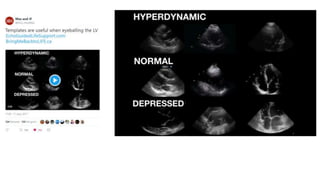
• Subjective evaluation or “eyeballing” the LVEF is reasonably accurate with experience
but objective measurement should always be considered in the advanced study
McLean AS. Critical Care 2016;20:275
Left ventricular systolic function
81y male
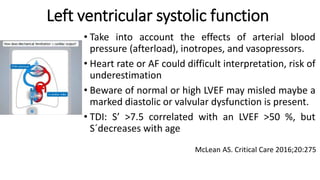
• Take into account the effects of arterial blood
pressure (afterload), inotropes, and vasopressors.
• Heart rate or AF could difficult interpretation, risk of
underestimation
• Beware of normal or high LVEF may misled maybe a
marked diastolic or valvular dysfunction is present.
• TDI: S’ >7.5 correlated with an LVEF >50 %, but
S´decreases with age
Left ventricular systolic function
McLean AS. Critical Care 2016;20:275
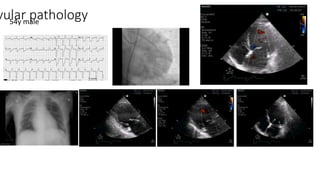
vular pathology54y male
vular pathology58y male
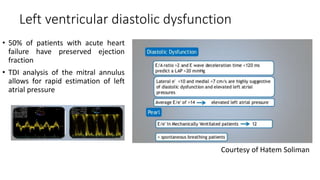
Left ventricular diastolic dysfunction
• 50% of patients with acute heart
failure have preserved ejection
fraction
• TDI analysis of the mitral annulus
allows for rapid estimation of left
atrial pressure
Courtesy of Hatem Soliman
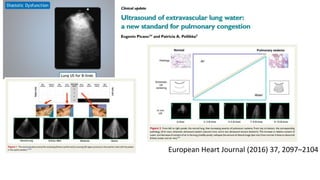
European Heart Journal (2016) 37, 2097–2104
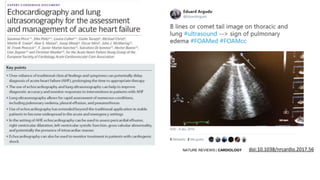
NATURE REVIEWS | CARDIOLOGY doi:10.1038/nrcardio.2017.56
Left ventricular diastolic dysfunction
Shock
Cardiogenic Hypovolemic Obstructive Distributive
Vincent JL, De Backer D. N Eng J Med 2013;369:1726–1734
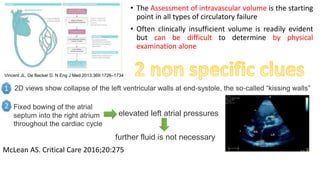
• The Assessment of intravascular volume is the starting
point in all types of circulatory failure
• Often clinically insufficient volume is readily evident
but can be difficult to determine by physical
examination alone
2D views show collapse of the left ventricular walls at end‐systole, the so‐called “kissing walls”
further fluid is not necessary
Fixed bowing of the atrial
septum into the right atrium
throughout the cardiac cycle
elevated left atrial pressures
1
2
McLean AS. Critical Care 2016;20:275
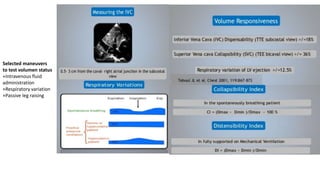
Selected maneuvers
to test volumen status
+Intravenous fluid
administration
+Respiratory variation
+Passive leg raising
McLean AS. Critical Care 2016;20:275
Volume status by echo
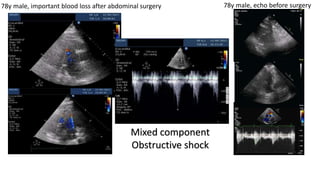
78y male, important blood loss after abdominal surgery 78y male, echo before surgery
Mixed component
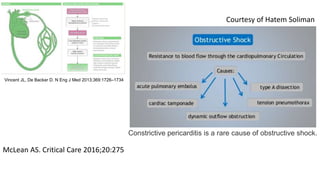
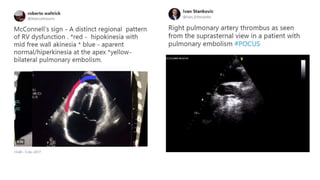
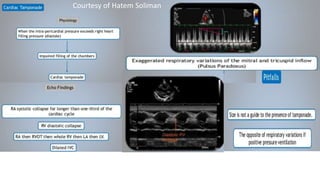
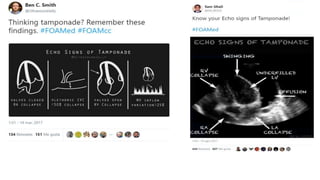
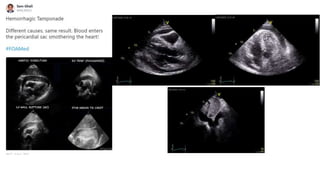
Obstructive shock
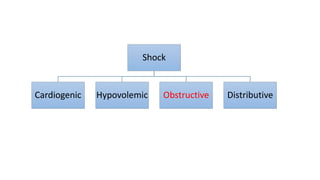
Shock
Cardiogenic Hypovolemic Obstructive Distributive
Vincent JL, De Backer D. N Eng J Med 2013;369:1726–1734
McLean AS. Critical Care 2016;20:275
Constrictive pericarditis is a rare cause of obstructive shock.
Courtesy of Hatem Soliman
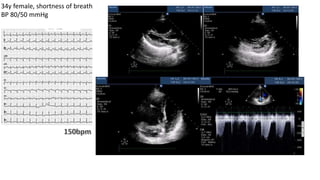
34y female, shortness of breath
BP 80/50 mmHg
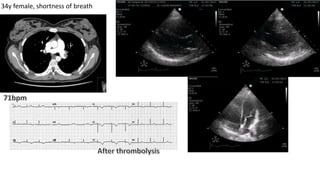
34y female, shortness of breath
Courtesy of Hatem Soliman
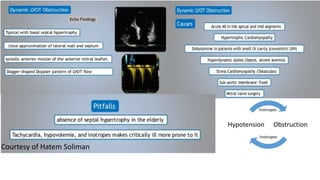
ObstructionHypotension
Inotropes
Inotropes
Courtesy of Hatem Soliman
Shock
Cardiogenic Hypovolemic Obstructive Distributive
Vincent JL, De Backer D. N Eng J Med 2013;369:1726–1734
McLean AS. Critical Care 2016;20:275
Courtesy of Hatem Soliman
January 9th, 2015
August 6th,
2016
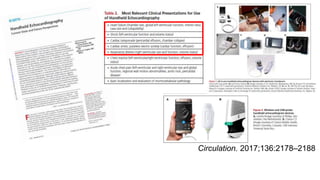
Circulation. 2017;136:2178–2188
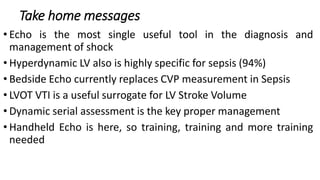
Take home messages
• Echo is the most single useful tool in the diagnosis and
management of shock
• Hyperdynamic LV also is highly specific for sepsis (94%)
• Bedside Echo currently replaces CVP measurement in Sepsis
• LVOT VTI is a useful surrogate for LV Stroke Volume
• Dynamic serial assessment is the key proper management
• Handheld Echo is here, so training, training and more training
needed
@rafavidalperez

How to evaluate shock by echo

  • 1.
    No conflicts ofinterest in relation with this presentation How to evaluate shock by echo? Critical care echocardiography Rafael Vidal-Perez Hospital Universitario Lucus Augusti (Lugo) SPAIN @rafavidalperez
  • 2.
  • 4.
    How to evaluateshock by echo? • Definition of shock • Types of Shock • Epidemiology of Shock • What do the guidelines say about echo in shock? • The neverending name game • How to evaluate in daily practice • The future challenge of handheld echo
  • 5.
    Definition of shock Life-threatening,generalized form of acute circulatory failure associated with inadequate oxygen utilization by the cells As a result, there is cellular dysoxia, associated with increased blood lactate levels. Cecconi M et al. Intensive Care Med (2014) 40:1795–1815
  • 6.
    Definition of shock Diagnosisbased on a combination of clinical, hemodynamic and biochemical signs • Clinical signs of shock typically include.- • Arterial Hypotension (although this is not always present), • Signs of altered tissue perfusion, visualized through the 3 ‘windows’ of the body • Peripheral window (skin that is cold, clammy & blue, pale or discolored) • Renal window (decreased urine output: <0.5 mL/kg/h) • Neurologic window (altered mental characterized by obtundation, disorientation & confusion) • Presence of Arterial Hypotension [defined as systolic blood pressure of <90 mmHg, or mean arterial pressure (MAP) of <65 mmHg, or a decrease of ≥40 mmHg from baseline], while commonly present, should not be required to define shock • Lactate levels are typically >2 mEq/L (or mmol/L) in shock states Cecconi M et al. Intensive Care Med (2014) 40:1795–1815
  • 7.
    Types of shock •Clinical state of acute circulatory failure, can result from one, or a combination, of four mechanisms • Hypovolemia (from internal or external fluid loss) • Cardiogenic factors (e.g., acute myocardial infarction, end-stage cardiomyopathy, advanced valvular heart disease, myocarditis, or cardiac arrhythmias) • Obstruction (e.g., pulmonary embolism, cardiac tamponade, or tension pneumothorax) • Distributive factors (e.g., severe sepsis or anaphylaxis from the release of inflammatory mediators) • The features of each of 4 types of shock often overlap, and patients admitted with one type can develop other types. Low flow state Hyper kinetic state Cecconi M et al. Intensive Care Med (2014) 40:1795–1815
  • 8.
    Vincent JL, DeBacker D. N Eng J Med 2013;369:1726–1734
  • 9.
    • Up toone-third of patients admitted to the ICU are in circulatory shock. Epidemiology of shock European Sepsis Occurrence in Acutely Ill Patients II (SOAP II) trial De Backer D, et al. N Eng J Med 2010. 362:779–789 • Septic shock is the most severe manifestation of sepsis, with reported case- fatality rates in the range of 40–50 %, reaching as high as 80 % • Limited data are available on the epidemiology of septic shock, particularly in low-income countries, but the literature suggests that its incidence is increasing. • The reported incidence of septic shock in patients admitted to the ICU varies between 6.3 and 14.7 %. • Cardiogenic shock has most commonly been studied in the setting of acute myocardial infarction; the incidence in this population has remained fairly constant at between 6 and 9 %, over the past several decades • In a multinational observational study of 65,119 patients hospitalized for an acute coronary syndrome between 1999 and 2007 (GRACE), 4.6 % developed cardiogenic shock, and the in-hospital case-fatality rate was 59.4 % Cecconi M et al. Intensive Care Med (2014) 40:1795–1815
  • 11.
    Cecconi M etal. Intensive Care Med (2014) 40:1795–1815
  • 16.
    European Heart Journal– Cardiovascular Imaging (2015) 16, 119–146
  • 17.
    European Heart Journal- Cardiovascular Imaging (2017) 18, 1191–1204
  • 19.
    The neverending namegame • FATE (Jensen MB, Eur J Anaesthesiol 2004) • FEEL (Beitkreutz R, Crit Care Ned 2007) • BLEEP (Pershad J, Pediatrics 2004) • Goal-directed limited Echo (Manasia AR J Cardiothoracic Vasc Anesth 2005) • Goal-oriented hand-held Echo (Vignon P, Intesive Care Med 2007) • CLUE (Kimura B, Am J Cardiol 2007) • RACE (McLean A, Crit Care Resusc 2007 • FOCUS (Beaulieu Y, Crit Care Med 2007) • BEAT (Gunst M, J Trauma 2008) • RUSH (Perera P, Emerg Med Clin North Am 2010) • BLUE (Lichtenstein D, Crit Ultrasound J 2011)
  • 20.
    European Heart Journal– Cardiovascular Imaging (2014) 15, 956–960
  • 21.
    European Heart Journal– Cardiovascular Imaging (2014) 15, 956–960
  • 22.
  • 25.
    High quality CPR Minimizeinterruptions in chest compressions
  • 26.
  • 27.
    The neverending name game Blanco Pet al. J Ultrasound Med 2015; 34:1691–1700
  • 29.
    McLean AS. CriticalCare 2016;20:275
  • 30.
  • 31.
    Shock Cardiogenic Hypovolemic ObstructiveDistributive Post-MI Sepsis induced- Very important
  • 32.
    Vincent JL, DeBacker D. N Eng J Med 2013;369:1726–1734 We need to evaluate • Stroke volumen • LV systolic function • Valvular pathology • Diastolic function Cardiogenic shock is the extreme end of the acute deteriorating heart failure spectrum.
  • 34.
    Courtesy of HatemSoliman The LVOT velocity time integral (VTI) surrogate for the stroke volume with a normal value >20
  • 35.
    Left ventricular systolicfunction • The most common cause of cardiogenic shock results from marked reduction in left ventricular contraction. • The size of both the left atrium and ventricle may provide clues to the duration of the contractile impairment, with dilatation indicating a degree of chronicity • Left ventricular ejection fraction (LVEF) is a traditional parameter which, though far from ideal, can be a helpful guide. • The Simpson’s multidisc method can be applied • Subjective evaluation or “eyeballing” the LVEF is reasonably accurate with experience but objective measurement should always be considered in the advanced study McLean AS. Critical Care 2016;20:275
  • 37.
  • 38.
  • 40.
    • Take intoaccount the effects of arterial blood pressure (afterload), inotropes, and vasopressors. • Heart rate or AF could difficult interpretation, risk of underestimation • Beware of normal or high LVEF may misled maybe a marked diastolic or valvular dysfunction is present. • TDI: S’ >7.5 correlated with an LVEF >50 %, but S´decreases with age Left ventricular systolic function McLean AS. Critical Care 2016;20:275
  • 41.
  • 43.
  • 44.
    Left ventricular diastolicdysfunction • 50% of patients with acute heart failure have preserved ejection fraction • TDI analysis of the mitral annulus allows for rapid estimation of left atrial pressure Courtesy of Hatem Soliman
  • 45.
    European Heart Journal(2016) 37, 2097–2104
  • 46.
    NATURE REVIEWS |CARDIOLOGY doi:10.1038/nrcardio.2017.56
  • 47.
  • 48.
  • 49.
    Vincent JL, DeBacker D. N Eng J Med 2013;369:1726–1734 • The Assessment of intravascular volume is the starting point in all types of circulatory failure • Often clinically insufficient volume is readily evident but can be difficult to determine by physical examination alone 2D views show collapse of the left ventricular walls at end‐systole, the so‐called “kissing walls” further fluid is not necessary Fixed bowing of the atrial septum into the right atrium throughout the cardiac cycle elevated left atrial pressures 1 2 McLean AS. Critical Care 2016;20:275
  • 50.
    Selected maneuvers to testvolumen status +Intravenous fluid administration +Respiratory variation +Passive leg raising
  • 51.
    McLean AS. CriticalCare 2016;20:275
  • 52.
  • 53.
    78y male, importantblood loss after abdominal surgery 78y male, echo before surgery Mixed component Obstructive shock
  • 54.
  • 55.
    Vincent JL, DeBacker D. N Eng J Med 2013;369:1726–1734 McLean AS. Critical Care 2016;20:275 Constrictive pericarditis is a rare cause of obstructive shock. Courtesy of Hatem Soliman
  • 56.
    34y female, shortnessof breath BP 80/50 mmHg
  • 57.
  • 58.
  • 60.
  • 63.
  • 65.
  • 66.
    Vincent JL, DeBacker D. N Eng J Med 2013;369:1726–1734 McLean AS. Critical Care 2016;20:275
  • 67.
  • 71.
  • 73.
  • 75.
    Take home messages •Echo is the most single useful tool in the diagnosis and management of shock • Hyperdynamic LV also is highly specific for sepsis (94%) • Bedside Echo currently replaces CVP measurement in Sepsis • LVOT VTI is a useful surrogate for LV Stroke Volume • Dynamic serial assessment is the key proper management • Handheld Echo is here, so training, training and more training needed
  • 77.

Editor's Notes

  • #8 For example, patients hospitalized with hemorrhagic shock due to trauma or with cardiogenic shock occasionally develop septic shock