How to Estimate Costs Like a Pro
(Even When You Don't Feel Like One)
$
$
$$
$
$
$
$
$$$
$
One of the inevitable moments of «freelance real life»
is when your potential client asks for an estimate.
Let’s walk through the process of an estimate, shall we?
The key is to obtain as many project details as you can
from the potential client, so that you can provide an
estimate that is as accurate as possible.
✦ What will you be delivering to the client as a final product or service?
✦ What is the timeline that is expected of you?
✦ How much will this cost you in supplies?
✦ Does the job involve travel and consequential mileage costs?
✦ How many revisions are you willing to do?
When creating an estimate,
remember:
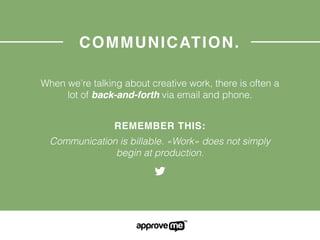
COMMUNICATION.
When we’re talking about creative work, there is often a
lot of back-and-forth via email and phone.
REMEMBER THIS:
Communication is billable. «Work» does not simply
begin at production.
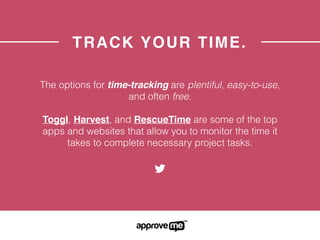
TRACK YOUR TIME.
The options for time-tracking are plentiful, easy-to-use,
and often free.
Toggl, Harvest, and RescueTime are some of the top
apps and websites that allow you to monitor the time it
takes to complete necessary project tasks.
What if
you’re
new ?
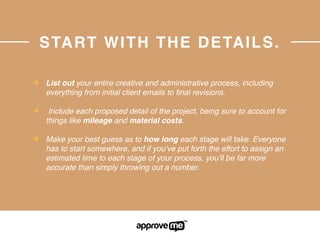
START WITH THE DETAILS.
✦ List out your entire creative and administrative process, including
everything from initial client emails to final revisions.
✦ Include each proposed detail of the project, being sure to account for
things like mileage and material costs.
✦ Make your best guess as to how long each stage will take. Everyone
has to start somewhere, and if you’ve put forth the effort to assign an
estimated time to each stage of your process, you’ll be far more
accurate than simply throwing out a number.
✦ Determine your rates. Whether you want to
charge by project or by the hour, it’s a good idea
to figure up your ideal hourly rates and give
yourself a basic framework. We’ve got a handy
hourly rate calculator that can help you with
that.
✦ Put it all together. Include a project description
in which you can write a paragraph or two about
the scope (and value) of the project, then create
an itemized list detailing each stage of the
process and its associated cost, ending with an
estimated total.
Want to know more about this tools?
READ THE ARTICLE
Don’t get caught in a courtroom... with a contract
that’s not legally binding.
www.approveme.me

how to estimate

  • 1.
    How to EstimateCosts Like a Pro (Even When You Don't Feel Like One)
  • 2.
    $ $ $$ $ $ $ $ $$$ $ One of theinevitable moments of «freelance real life» is when your potential client asks for an estimate. Let’s walk through the process of an estimate, shall we?
  • 3.
    The key isto obtain as many project details as you can from the potential client, so that you can provide an estimate that is as accurate as possible. ✦ What will you be delivering to the client as a final product or service? ✦ What is the timeline that is expected of you? ✦ How much will this cost you in supplies? ✦ Does the job involve travel and consequential mileage costs? ✦ How many revisions are you willing to do?
  • 4.
    When creating anestimate, remember:
  • 5.
    COMMUNICATION. When we’re talkingabout creative work, there is often a lot of back-and-forth via email and phone. REMEMBER THIS: Communication is billable. «Work» does not simply begin at production.
  • 6.
    TRACK YOUR TIME. Theoptions for time-tracking are plentiful, easy-to-use, and often free. Toggl, Harvest, and RescueTime are some of the top apps and websites that allow you to monitor the time it takes to complete necessary project tasks.
  • 7.
  • 8.
    START WITH THEDETAILS. ✦ List out your entire creative and administrative process, including everything from initial client emails to final revisions. ✦ Include each proposed detail of the project, being sure to account for things like mileage and material costs. ✦ Make your best guess as to how long each stage will take. Everyone has to start somewhere, and if you’ve put forth the effort to assign an estimated time to each stage of your process, you’ll be far more accurate than simply throwing out a number.
  • 9.
    ✦ Determine yourrates. Whether you want to charge by project or by the hour, it’s a good idea to figure up your ideal hourly rates and give yourself a basic framework. We’ve got a handy hourly rate calculator that can help you with that. ✦ Put it all together. Include a project description in which you can write a paragraph or two about the scope (and value) of the project, then create an itemized list detailing each stage of the process and its associated cost, ending with an estimated total.
  • 10.
    Want to knowmore about this tools? READ THE ARTICLE
  • 11.
    Don’t get caughtin a courtroom... with a contract that’s not legally binding. www.approveme.me