10 Tips
How To Create A
Profitable
Brand Experience
&
Grow Financial ValueAintro ducto ry g uide
Joy Abdullah
Marketing Director– Benefit Point
A Publication of
Tableof Contents
Creating a Profitable Brand Experience
Tip #1:How to Seize Attention
Tip #2: Describing the Brand Experience
Tip #3: Brand Differentiation & Brand Culture
Tip #4: Conversations of a Brand
Tip #5: Deepen the Reach of the Brand
Experience
Tip #6: Building Financial Value Through The
Employee Conversation
Tip #7: Building Financial Value Through The
Customer Conversation
Tip #8: Impact of Leadership on Brand
Experience
Tip #9:Evaluate Brand Risk
Tip #10:Brand Experience is Dependent on
Conversations
Come #HaveAConversation
Creating a Profitable
Brand Experience
Creating a engaging, endearing and relevant brand
experience is a bit like cooking your favourite culinary dish.
There is a list of ingredients which need to be measured
carefully and prepared so that the result is a mind-blowing
dish.
It’s exactly the same in creating a brand experience that
creates financial value. The various elements need to be
measured and prepared carefully so that the required
perception is created in the target person’s mind.
There are 10 critical elements that go into developing such
an effective brand experience. This e-book provides an
overview of these 10 elements as tips.
Intro ductio n
TIP #1
HOWTO
SEIZEATTENTION
1
“The trick is to remember that your
customers and employees are HUMAN
like you! Overloaded with information
Joy Abdullah
“
How To Seize Attention
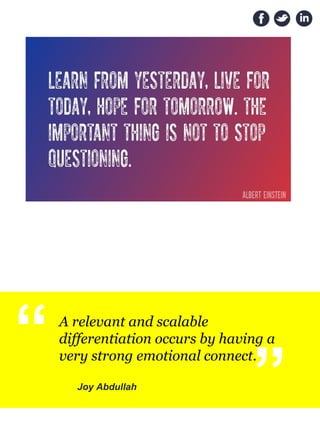
 A Microsoft Canada study in 2015 established that
humans have an attention span of only 8 seconds!
 And we all have information overload!
 So we are very selective of the message and content
we spend time on.
The trick is to remember that your customers and
employees are HUMAN like you! They’re overloaded
with information.
In creating brand content bring out clarity and crispness
of the benefit the brand offers.
Answer the ‘WIIFM’—What’s In It For Me—in crafting the
brand promise.
And please customise the message content to suit each
communication channel! Do not put a newspaper ad
with fine print, in 8pt font size, out on a Out-Of-Home-
digital board on the sidewalk!
TIP #2
DESCRIBINGTHE
BRANDEXPERIENCE
2
“
In creating an engaging and endearing
brand experience various elements need
to be measured and prepared carefully
so that a desired perception is created.
Joy Abdullah
“
Describing the
Brand Experience
In creating the brand experience a significant amount of
discussion, on the perceived emotions the brand is to
deliver or is attempting to deliver, is required in order to
clearly identify what exactly is the brand promise.
The outcome of the brand promise is the experience
created.
This experience is then mapped, across various
touchpoints that the customer uses, for the delivery or
execution of the experience.
In describing the brand experience it helps to:
1.Write it out to have clarity!
2.Put specific measurement metrics to it! After all what gets
measured gets done.
TIP #3
BRAND
DIFFERENTIATION &
BRANDCULTURE
3
“ A relevant and scalable 
differentiation occurs by having a 
very strong emotional connect. 
Joy Abdullah
“
Creating Brand Differentiation &
Seeding the Brand Culture
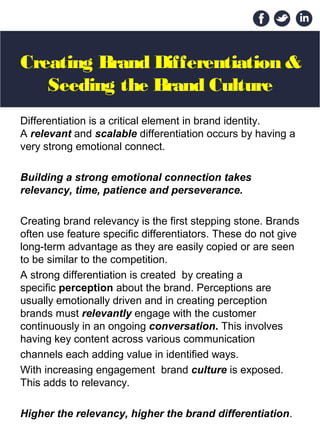
Differentiation is a critical element in brand identity.
A relevant and scalable differentiation occurs by having a
very strong emotional connect.
Building a strong emotional connection takes
relevancy, time, patience and perseverance.
Creating brand relevancy is the first stepping stone. Brands
often use feature specific differentiators. These do not give
long-term advantage as they are easily copied or are seen
to be similar to the competition.
A strong differentiation is created by creating a
specific perception about the brand. Perceptions are
usually emotionally driven and in creating perception
brands must relevantly engage with the customer
continuously in an ongoing conversation. This involves
having key content across various communication
channels each adding value in identified ways.
With increasing engagement brand culture is exposed.
This adds to relevancy.
Higher the relevancy, higher the brand differentiation.
TIP #4
CONVERSATIONSOF
ABRAND
4
“Conversations are always
happening-- in person, online &
offline. Each of these conversations
can provide sustainable value.
Joy Abdullah
“
The Conversations 
A Brand Has
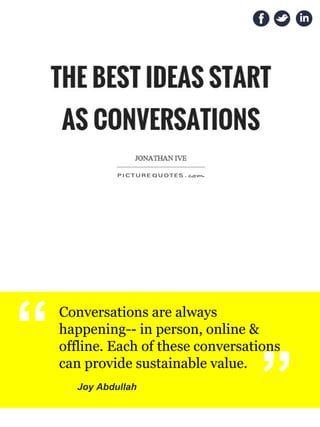
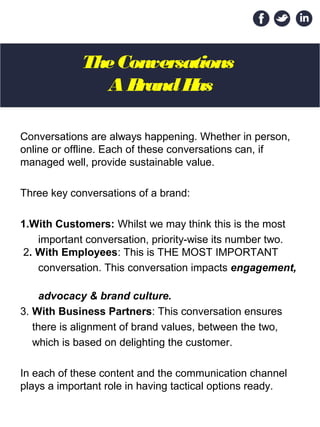
Conversations are always happening. Whether in person,
online or offline. Each of these conversations can, if
managed well, provide sustainable value.
Three key conversations of a brand:
1.With Customers: Whilst we may think this is the most
important conversation, priority-wise its number two.
2. With Employees: This is THE MOST IMPORTANT
conversation. This conversation impacts engagement,
advocacy & brand culture.
3. With Business Partners: This conversation ensures
there is alignment of brand values, between the two,
which is based on delighting the customer.
In each of these content and the communication channel
plays a important role in having tactical options ready.
TIP #5
DEEPEN THEREACH
OFTHE
BRANDEXPERIENCE
5
“
Availability, Affordability, 
Credibility & Explorations are 4 
ways to deepen the reach
Joy Abdullah
“
Deepen the Reach
of the Brand Experience
There are four areas to look at when exploring how to
deepen the reach of the brand experience:
1.Easy availability: This covers distribution both online
and offline.
2. Affordability: This is the pricing of the brand.
3. Ensuring credibility of the experience created:
Through the employee advocacy conversations and
communications.
4. Exploring opportunities to create brand extensions:
This is planning for strategic financial growth.
If you have followed the tips thus far you would have
enabled the communication support your brand needs to
be ready for marketing.
TIP #6
BUILDINGFINANCIAL
VALUETHROUGHTHE
EMPLOYEE
CONVERSATION
6
“A transparent and safe
conversation with employees
creates accountability &
responsibility.
Joy Abdullah
“
Building Financial Value
Through The
EmployeeConversation
The conversation with the employees is the most
important one.
This conversation needs to be on:
1.The organizational purpose and mission
2. The alignment of the purpose and mission into the
brand promise.
3. How individual roles and job functions impact on the
delivery of the brand promise.
Such a conversation creates accountability and
responsibility, on employees, to take ownership in
advocating for the brand.
Note: This is not a one-off annual conversation. It’s an on-
going one through-out the year that impacts the brand
experience at all points in time in the year.
TIP #7
7
BUILDINGFINANCIAL
VALUETHROUGHTHE
CUSTOMER
CONVERSATION
“
Social listening and data
analysis are key in having great
customer conversations.
Joy Abdullah
“
Building Financial Value
Through The
CustomerConversation
This is the second most important conversation in
creating financial value through brand experience.
In this conversation the key is listening in order to
understand the competitive choices a customer has.
How do we learn about the choices a customer has?
Social listening & data analysis
Social listening comes from investing in a good social team
that helps listen, understand and create key interactions
with the customers online.
From those interactions looking through the data and
finding the right insights to aid in strengthening the
brand engagement.
Note: The customer conversation is an on-going one
through the year and is not a on-off activity. It requires
strategic overview and management to identify key insights
and points-of-entry for the brand.
TIP #8
IMPACTOFLEADERSHIP
ON BRANDEXPERIENCE
8
“
The leader’s vision,
communication and behavior
sets the culture.
Joy Abdullah
“
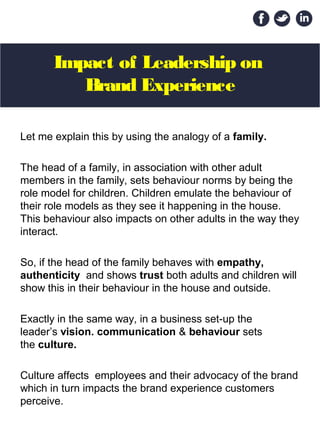
Impact of Leadership on
Brand Experience
Let me explain this by using the analogy of a family.
The head of a family, in association with other adult
members in the family, sets behaviour norms by being the
role model for children. Children emulate the behaviour of
their role models as they see it happening in the house.
This behaviour also impacts on other adults in the way they
interact.
So, if the head of the family behaves with empathy,
authenticity and shows trust both adults and children will
show this in their behaviour in the house and outside.
Exactly in the same way, in a business set-up the
leader’s vision. communication & behaviour sets
the culture.
Culture affects employees and their advocacy of the brand
which in turn impacts the brand experience customers
perceive.
TIP #9
EVALUATEBRANDRISK
9
“
Anything that threatens the
sustainability of the company’s
current and future brand
demand.
Joy Abdullah
“
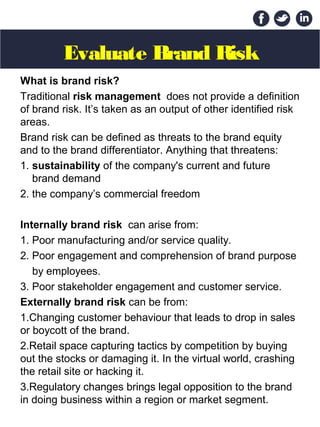
Evaluate Brand Risk
What is brand risk?
Traditional risk management  does not provide a definition 
of brand risk. It’s taken as an output of other identified risk 
areas. 
Brand risk can be defined as threats to the brand equity 
and to the brand differentiator. Anything that threatens:
1. sustainability of the company's current and future
    brand demand
2. the company’s commercial freedom 
Internally brand risk  can arise from:
1. Poor manufacturing and/or service quality.
2. Poor engagement and comprehension of brand purpose
    by employees.
3. Poor stakeholder engagement and customer service. 
Externally brand risk can be from:
1.Changing customer behaviour that leads to drop in sales 
or boycott of the brand.
2.Retail space capturing tactics by competition by buying 
out the stocks or damaging it. In the virtual world, crashing 
the retail site or hacking it.
3.Regulatory changes brings legal opposition to the brand 
in doing business within a region or market segment.
TIP #10
BRANDEXPERIENCE
ISDEPENDENTON
CONVERSATIONS
10
“
The entire brand experience is
contingent on conversations—
internally and externally.
Joy Abdullah
“
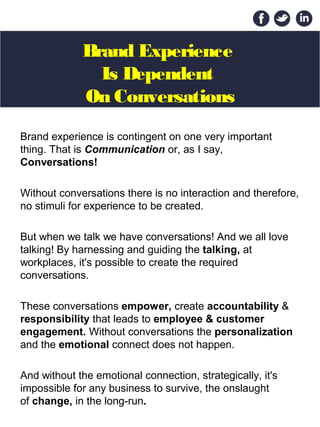
Brand Experience
Is Dependent
On Conversations
Brand experience is contingent on one very important 
thing. That is Communication or, as I say,
Conversations! 
Without conversations there is no interaction and therefore, 
no stimuli for experience to be created.
But when we talk we have conversations! And we all love 
talking! By harnessing and guiding the talking, at 
workplaces, it's possible to create the required 
conversations. 
These conversations empower, create accountability & 
responsibility that leads to employee & customer
engagement. Without conversations the personalization 
and the emotional connect does not happen. 
And without the emotional connection, strategically, it's 
impossible for any business to survive, the onslaught 
of change, in the long-run.
To get your brand experience
create profits for you.
Let’s
#HaveAConversation
Book me at :
 www. calendly.com/joyabdullah 

How To Create A Profitable Brand Experience

  • 1.
    10 Tips How To CreateA Profitable Brand Experience & Grow Financial ValueAintro ducto ry g uide Joy Abdullah Marketing Director– Benefit Point A Publication of
  • 2.
    Tableof Contents Creating aProfitable Brand Experience Tip #1:How to Seize Attention Tip #2: Describing the Brand Experience Tip #3: Brand Differentiation & Brand Culture Tip #4: Conversations of a Brand Tip #5: Deepen the Reach of the Brand Experience Tip #6: Building Financial Value Through The Employee Conversation Tip #7: Building Financial Value Through The Customer Conversation Tip #8: Impact of Leadership on Brand Experience Tip #9:Evaluate Brand Risk Tip #10:Brand Experience is Dependent on Conversations Come #HaveAConversation
  • 3.
    Creating a Profitable BrandExperience Creating a engaging, endearing and relevant brand experience is a bit like cooking your favourite culinary dish. There is a list of ingredients which need to be measured carefully and prepared so that the result is a mind-blowing dish. It’s exactly the same in creating a brand experience that creates financial value. The various elements need to be measured and prepared carefully so that the required perception is created in the target person’s mind. There are 10 critical elements that go into developing such an effective brand experience. This e-book provides an overview of these 10 elements as tips. Intro ductio n
  • 4.
  • 5.
    “The trick isto remember that your customers and employees are HUMAN like you! Overloaded with information Joy Abdullah “
  • 6.
    How To SeizeAttention  A Microsoft Canada study in 2015 established that humans have an attention span of only 8 seconds!  And we all have information overload!  So we are very selective of the message and content we spend time on. The trick is to remember that your customers and employees are HUMAN like you! They’re overloaded with information. In creating brand content bring out clarity and crispness of the benefit the brand offers. Answer the ‘WIIFM’—What’s In It For Me—in crafting the brand promise. And please customise the message content to suit each communication channel! Do not put a newspaper ad with fine print, in 8pt font size, out on a Out-Of-Home- digital board on the sidewalk!
  • 7.
  • 8.
    “ In creating anengaging and endearing brand experience various elements need to be measured and prepared carefully so that a desired perception is created. Joy Abdullah “
  • 9.
    Describing the Brand Experience Increating the brand experience a significant amount of discussion, on the perceived emotions the brand is to deliver or is attempting to deliver, is required in order to clearly identify what exactly is the brand promise. The outcome of the brand promise is the experience created. This experience is then mapped, across various touchpoints that the customer uses, for the delivery or execution of the experience. In describing the brand experience it helps to: 1.Write it out to have clarity! 2.Put specific measurement metrics to it! After all what gets measured gets done.
  • 10.
  • 11.
  • 12.
    Creating Brand Differentiation& Seeding the Brand Culture Differentiation is a critical element in brand identity. A relevant and scalable differentiation occurs by having a very strong emotional connect. Building a strong emotional connection takes relevancy, time, patience and perseverance. Creating brand relevancy is the first stepping stone. Brands often use feature specific differentiators. These do not give long-term advantage as they are easily copied or are seen to be similar to the competition. A strong differentiation is created by creating a specific perception about the brand. Perceptions are usually emotionally driven and in creating perception brands must relevantly engage with the customer continuously in an ongoing conversation. This involves having key content across various communication channels each adding value in identified ways. With increasing engagement brand culture is exposed. This adds to relevancy. Higher the relevancy, higher the brand differentiation.
  • 13.
  • 14.
    “Conversations are always happening--in person, online & offline. Each of these conversations can provide sustainable value. Joy Abdullah “
  • 15.
    The Conversations  A Brand Has Conversations arealways happening. Whether in person, online or offline. Each of these conversations can, if managed well, provide sustainable value. Three key conversations of a brand: 1.With Customers: Whilst we may think this is the most important conversation, priority-wise its number two. 2. With Employees: This is THE MOST IMPORTANT conversation. This conversation impacts engagement, advocacy & brand culture. 3. With Business Partners: This conversation ensures there is alignment of brand values, between the two, which is based on delighting the customer. In each of these content and the communication channel plays a important role in having tactical options ready.
  • 16.
  • 17.
  • 18.
    Deepen the Reach ofthe Brand Experience There are four areas to look at when exploring how to deepen the reach of the brand experience: 1.Easy availability: This covers distribution both online and offline. 2. Affordability: This is the pricing of the brand. 3. Ensuring credibility of the experience created: Through the employee advocacy conversations and communications. 4. Exploring opportunities to create brand extensions: This is planning for strategic financial growth. If you have followed the tips thus far you would have enabled the communication support your brand needs to be ready for marketing.
  • 19.
  • 20.
    “A transparent andsafe conversation with employees creates accountability & responsibility. Joy Abdullah “
  • 21.
    Building Financial Value ThroughThe EmployeeConversation The conversation with the employees is the most important one. This conversation needs to be on: 1.The organizational purpose and mission 2. The alignment of the purpose and mission into the brand promise. 3. How individual roles and job functions impact on the delivery of the brand promise. Such a conversation creates accountability and responsibility, on employees, to take ownership in advocating for the brand. Note: This is not a one-off annual conversation. It’s an on- going one through-out the year that impacts the brand experience at all points in time in the year.
  • 22.
  • 23.
    “ Social listening anddata analysis are key in having great customer conversations. Joy Abdullah “
  • 24.
    Building Financial Value ThroughThe CustomerConversation This is the second most important conversation in creating financial value through brand experience. In this conversation the key is listening in order to understand the competitive choices a customer has. How do we learn about the choices a customer has? Social listening & data analysis Social listening comes from investing in a good social team that helps listen, understand and create key interactions with the customers online. From those interactions looking through the data and finding the right insights to aid in strengthening the brand engagement. Note: The customer conversation is an on-going one through the year and is not a on-off activity. It requires strategic overview and management to identify key insights and points-of-entry for the brand.
  • 25.
  • 26.
    “ The leader’s vision, communicationand behavior sets the culture. Joy Abdullah “
  • 27.
    Impact of Leadershipon Brand Experience Let me explain this by using the analogy of a family. The head of a family, in association with other adult members in the family, sets behaviour norms by being the role model for children. Children emulate the behaviour of their role models as they see it happening in the house. This behaviour also impacts on other adults in the way they interact. So, if the head of the family behaves with empathy, authenticity and shows trust both adults and children will show this in their behaviour in the house and outside. Exactly in the same way, in a business set-up the leader’s vision. communication & behaviour sets the culture. Culture affects employees and their advocacy of the brand which in turn impacts the brand experience customers perceive.
  • 28.
  • 29.
    “ Anything that threatensthe sustainability of the company’s current and future brand demand. Joy Abdullah “
  • 30.
    Evaluate Brand Risk Whatis brand risk? Traditional risk management  does not provide a definition  of brand risk. It’s taken as an output of other identified risk  areas.  Brand risk can be defined as threats to the brand equity  and to the brand differentiator. Anything that threatens: 1. sustainability of the company's current and future     brand demand 2. the company’s commercial freedom  Internally brand risk  can arise from: 1. Poor manufacturing and/or service quality. 2. Poor engagement and comprehension of brand purpose     by employees. 3. Poor stakeholder engagement and customer service.  Externally brand risk can be from: 1.Changing customer behaviour that leads to drop in sales  or boycott of the brand. 2.Retail space capturing tactics by competition by buying  out the stocks or damaging it. In the virtual world, crashing  the retail site or hacking it. 3.Regulatory changes brings legal opposition to the brand  in doing business within a region or market segment.
  • 31.
  • 32.
    “ The entire brandexperience is contingent on conversations— internally and externally. Joy Abdullah “
  • 33.
    Brand Experience Is Dependent OnConversations Brand experience is contingent on one very important  thing. That is Communication or, as I say, Conversations!  Without conversations there is no interaction and therefore,  no stimuli for experience to be created. But when we talk we have conversations! And we all love  talking! By harnessing and guiding the talking, at  workplaces, it's possible to create the required  conversations.  These conversations empower, create accountability &  responsibility that leads to employee & customer engagement. Without conversations the personalization  and the emotional connect does not happen.  And without the emotional connection, strategically, it's  impossible for any business to survive, the onslaught  of change, in the long-run.
  • 34.
    To get yourbrand experience create profits for you. Let’s #HaveAConversation Book me at :  www. calendly.com/joyabdullah