How to choose the right
machine learning algorithm
for your project?
Machine learning is a field of artificial intelligence that allows
computers to learn from data and improve their performance on
a specific task over time without being explicitly programmed.
The success of a machine learning project depends heavily on
choosing the right algorithm. Selecting the wrong algorithm can
lead to poor performance, inaccurate results, and wasted
resources.
Types of Machine Learning Algorithms
• Supervised Learning
• Unsupervised Learning
• Semi-supervised Learning
• Reinforcement Learning
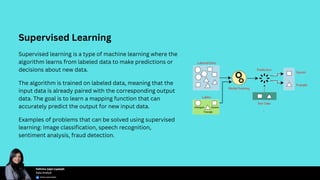
Supervised Learning
Supervised learning is a type of machine learning where the
algorithm learns from labeled data to make predictions or
decisions about new data.
The algorithm is trained on labeled data, meaning that the
input data is already paired with the corresponding output
data. The goal is to learn a mapping function that can
accurately predict the output for new input data.
Examples of problems that can be solved using supervised
learning: Image classification, speech recognition,
sentiment analysis, fraud detection.
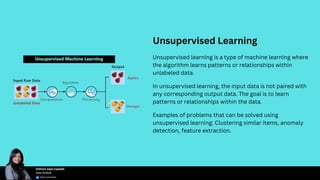
Unsupervised Learning
Unsupervised learning is a type of machine learning where
the algorithm learns patterns or relationships within
unlabeled data.
In unsupervised learning, the input data is not paired with
any corresponding output data. The goal is to learn
patterns or relationships within the data.
Examples of problems that can be solved using
unsupervised learning: Clustering similar items, anomaly
detection, feature extraction.
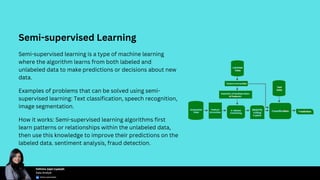
Semi-supervised Learning
Semi-supervised learning is a type of machine learning
where the algorithm learns from both labeled and
unlabeled data to make predictions or decisions about new
data.
Examples of problems that can be solved using semi-
supervised learning: Text classification, speech recognition,
image segmentation.
How it works: Semi-supervised learning algorithms first
learn patterns or relationships within the unlabeled data,
then use this knowledge to improve their predictions on the
labeled data. sentiment analysis, fraud detection.
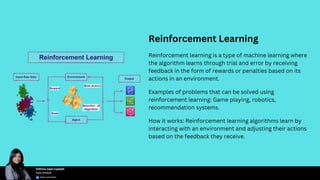
Reinforcement Learning
Reinforcement learning is a type of machine learning where
the algorithm learns through trial and error by receiving
feedback in the form of rewards or penalties based on its
actions in an environment.
Examples of problems that can be solved using
reinforcement learning: Game playing, robotics,
recommendation systems.
How it works: Reinforcement learning algorithms learn by
interacting with an environment and adjusting their actions
based on the feedback they receive.
Factors to Consider When Choosing an Algorithm
• Type of problem you are trying to solve: Different types of problems require
different types of algorithms.
• Size and nature of the dataset: Some algorithms perform better on large datasets,
while others work better on smaller datasets.
• Accuracy vs Interpretability: Some algorithms may be highly accurate but difficult
to interpret, while others may be less accurate but easier to understand.
• Computational resources: Some algorithms may require more computational
resources than others.
Popular Machine Learning Algorithms
Decision trees are used for classification and regression problems. They create a tree-like
model of decisions and their possible consequences.
Random forest is an ensemble learning method that constructs multiple decision trees
and combines their predictions to improve accuracy and avoid overfitting.
Support Vector Machines (SVM) is a type of supervised learning algorithm used for
classification and regression analysis. It finds the optimal boundary between classes to
make accurate predictions.
K-Nearest Neighbors (KNN) is a simple and easy-to-understand classification algorithm
that determines the class of a new observation by looking at the k-nearest neighbors in the
training set.
Naive Bayes is a classification algorithm based on Bayes' theorem, which assumes that the
presence of a particular feature is unrelated to the presence of any other feature. It is
commonly used for text classification and sentiment analysis.
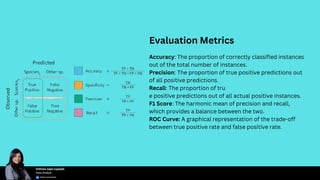
Evaluation Metrics
Accuracy: The proportion of correctly classified instances
out of the total number of instances.
Precision: The proportion of true positive predictions out
of all positive predictions.
Recall: The proportion of tru
e positive predictions out of all actual positive instances.
F1 Score: The harmonic mean of precision and recall,
which provides a balance between the two.
ROC Curve: A graphical representation of the trade-off
between true positive rate and false positive rate.
Conclusion
• Choosing the right machine learning algorithm for your project is crucial for its
success.
• Consider the type of problem you are trying to solve, the size and nature of the
dataset, accuracy vs interpretability, and computational resources when choosing an
algorithm.
• Evaluate the performance of the algorithm using appropriate metrics and fine-tune it
as necessary.
• There are various popular machine learning algorithms to choose from, including
decision trees, random forest, SVM, KNN, and Naive Bayes.

How to choose the right machine learning algorithm for your project

  • 1.
    How to choosethe right machine learning algorithm for your project?
  • 2.
    Machine learning isa field of artificial intelligence that allows computers to learn from data and improve their performance on a specific task over time without being explicitly programmed. The success of a machine learning project depends heavily on choosing the right algorithm. Selecting the wrong algorithm can lead to poor performance, inaccurate results, and wasted resources.
  • 3.
    Types of MachineLearning Algorithms • Supervised Learning • Unsupervised Learning • Semi-supervised Learning • Reinforcement Learning
  • 4.
    Supervised Learning Supervised learningis a type of machine learning where the algorithm learns from labeled data to make predictions or decisions about new data. The algorithm is trained on labeled data, meaning that the input data is already paired with the corresponding output data. The goal is to learn a mapping function that can accurately predict the output for new input data. Examples of problems that can be solved using supervised learning: Image classification, speech recognition, sentiment analysis, fraud detection.
  • 5.
    Unsupervised Learning Unsupervised learningis a type of machine learning where the algorithm learns patterns or relationships within unlabeled data. In unsupervised learning, the input data is not paired with any corresponding output data. The goal is to learn patterns or relationships within the data. Examples of problems that can be solved using unsupervised learning: Clustering similar items, anomaly detection, feature extraction.
  • 6.
    Semi-supervised Learning Semi-supervised learningis a type of machine learning where the algorithm learns from both labeled and unlabeled data to make predictions or decisions about new data. Examples of problems that can be solved using semi- supervised learning: Text classification, speech recognition, image segmentation. How it works: Semi-supervised learning algorithms first learn patterns or relationships within the unlabeled data, then use this knowledge to improve their predictions on the labeled data. sentiment analysis, fraud detection.
  • 7.
    Reinforcement Learning Reinforcement learningis a type of machine learning where the algorithm learns through trial and error by receiving feedback in the form of rewards or penalties based on its actions in an environment. Examples of problems that can be solved using reinforcement learning: Game playing, robotics, recommendation systems. How it works: Reinforcement learning algorithms learn by interacting with an environment and adjusting their actions based on the feedback they receive.
  • 8.
    Factors to ConsiderWhen Choosing an Algorithm • Type of problem you are trying to solve: Different types of problems require different types of algorithms. • Size and nature of the dataset: Some algorithms perform better on large datasets, while others work better on smaller datasets. • Accuracy vs Interpretability: Some algorithms may be highly accurate but difficult to interpret, while others may be less accurate but easier to understand. • Computational resources: Some algorithms may require more computational resources than others.
  • 9.
    Popular Machine LearningAlgorithms Decision trees are used for classification and regression problems. They create a tree-like model of decisions and their possible consequences. Random forest is an ensemble learning method that constructs multiple decision trees and combines their predictions to improve accuracy and avoid overfitting. Support Vector Machines (SVM) is a type of supervised learning algorithm used for classification and regression analysis. It finds the optimal boundary between classes to make accurate predictions. K-Nearest Neighbors (KNN) is a simple and easy-to-understand classification algorithm that determines the class of a new observation by looking at the k-nearest neighbors in the training set. Naive Bayes is a classification algorithm based on Bayes' theorem, which assumes that the presence of a particular feature is unrelated to the presence of any other feature. It is commonly used for text classification and sentiment analysis.
  • 10.
    Evaluation Metrics Accuracy: Theproportion of correctly classified instances out of the total number of instances. Precision: The proportion of true positive predictions out of all positive predictions. Recall: The proportion of tru e positive predictions out of all actual positive instances. F1 Score: The harmonic mean of precision and recall, which provides a balance between the two. ROC Curve: A graphical representation of the trade-off between true positive rate and false positive rate.
  • 11.
    Conclusion • Choosing theright machine learning algorithm for your project is crucial for its success. • Consider the type of problem you are trying to solve, the size and nature of the dataset, accuracy vs interpretability, and computational resources when choosing an algorithm. • Evaluate the performance of the algorithm using appropriate metrics and fine-tune it as necessary. • There are various popular machine learning algorithms to choose from, including decision trees, random forest, SVM, KNN, and Naive Bayes.