D.2
D.3
D.4
by Victorino Cunha
For 20 years, he was head coach of the
Angolan national team and won three African
Championships, one Pan African Games, and
one Military Championship. Cunha, the for-
mer President of African Coaches Committee,
participated with Angola in three World
Championships and one Olympic Games
(Barcelona, 1992). Cunha is presently the
FIBA instructor for Africa and the National
Technical Director of the Angolan Federation.
1. PHILOSOPHY
Zone defense challenges the offense to
shoot well from the outside. The main goals
of the zone defenses are:
■ Put pressure on the ball in all areas of the
half court, with the primary purpose being to
prevent high-percentage shots, and offer
help when one offensive player penetrates
with or without the ball (dribbling penetra-
tion, cuts from the weakside of the ball, pass
to the centers).
■ Prevent the penetration of the ball (by
pass, dribble, or cut), forcing the offense to
move the ball around the perimeter, farther
away from the basket.
■ The defenders never move before the pass
is made and the defender nearest to the ball
should “defend” on the next pass.
2. WHEN WE SHOULD PLAY ZONE DEFENSE
When we want:
■ To catch the offense unprepared
because we switch the defense.
■ To protect the area near the basket.
■ To hide one (or more) weak defensive
player.
■ To protect one or more players, who are
in foul trouble.
■ To force the offense in the last two
minutes of the game, when we are
ahead by 8 to 10 points, to make extra
passes before shooting.
■ To organize our fastbreak in a very
efficient way.
3. DISADVANTAGES
■ Does not encourage the improvement of
individual defensive skills.
■ Leaves the team vulnerable against
good outside shooters.
■ It is problematic against quick ball rota
tion, combined with splits and cuts in
the gaps of the zone.
4. MAIN PRINCIPLES
It is easy to teach zone defense, but it is very
difficult to do so efficiently.
The zone defense has many weak points.
■ The defensive players must
recover quickly.
■ All defensive players must know exactly
their position on the court and what are
theirresponsibilities.
■ Each defender must know the position
of the ball.
■ The defenders must go to certain
rebound areas.
5. STUDIES ON REBOUND AREAS
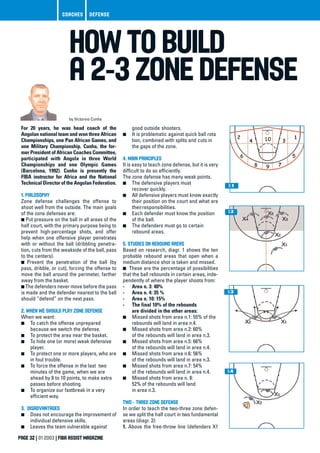
Based on research, diagr. 1 shows the ten
probable rebound areas that open when a
medium distance shot is taken and missed.
■ These are the percentage of possibilities
that the ball rebounds in certain areas, inde-
pendently of where the player shoots from:
- Area n. 3: 40%
- Area n. 4: 35 %
- Area n. 10: 15%
- The final 10% of the rebounds
are divided in the other areas:
■ Missed shots from area n.1: 55% of the
rebounds will land in area n.4.
■ Missed shots from area n.2: 60%
of the rebounds will land in area n.3.
■ Missed shots from area n.5: 66%
of the rebounds will land in area n.4.
■ Missed shots from area n.6: 56%
of the rebounds will land in area n.3.
■ Missed shots from area n.7: 54%
of the rebounds will land in area n.4.
■ Missed shots from area n. 8:
52% of the rebounds will land
in area n.3.
TWO - THREE ZONE DEFENSE
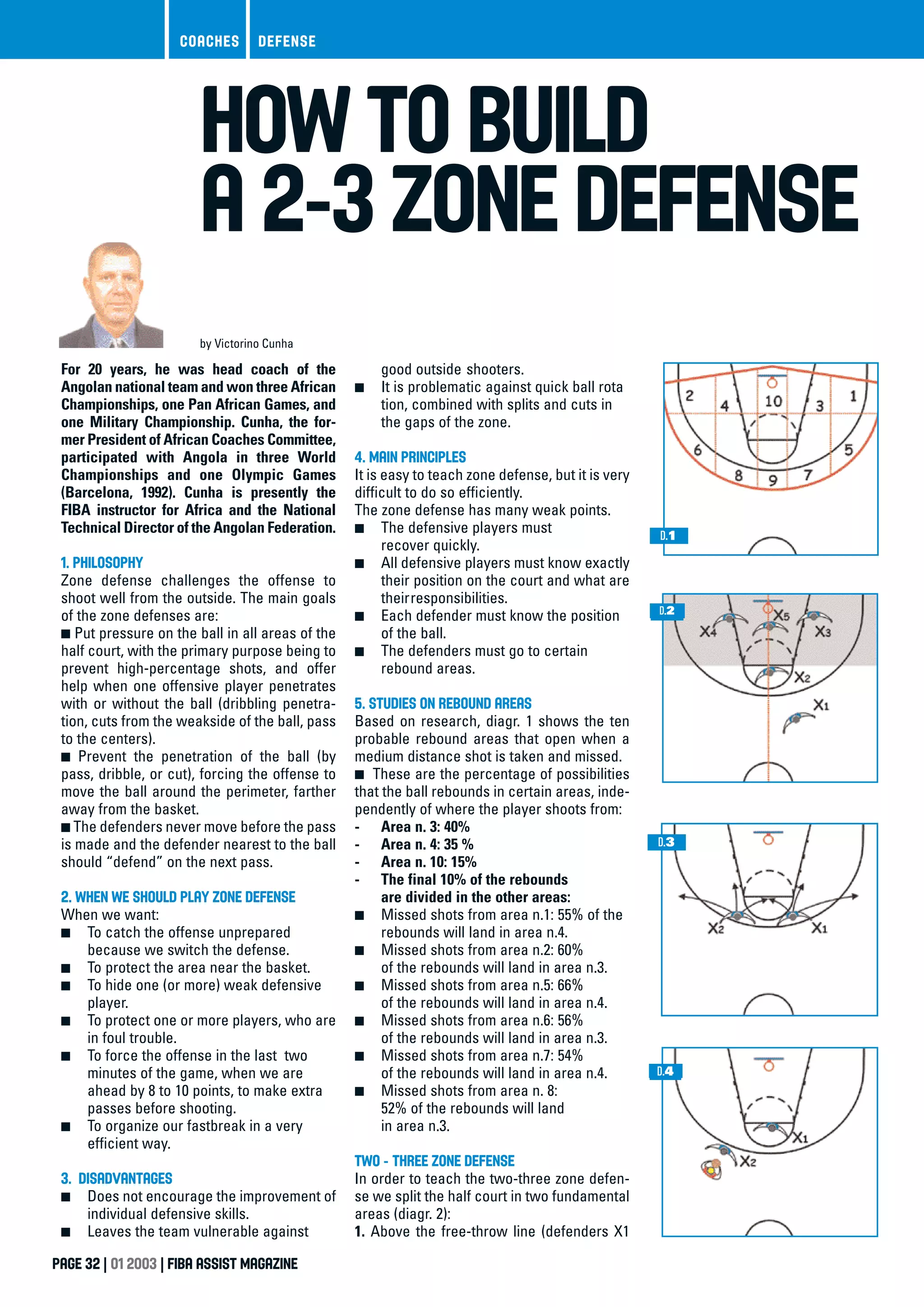
In order to teach the two-three zone defen-
se we split the half court in two fundamental
areas (diagr. 2):
1. Above the free-throw line (defenders X1
HOW TO BUILD
A 2-3 ZONE DEFENSE
PAGE 32 | 01 2003 | FIBA ASSIST MAGAZINE
FIBA EUROPE
D.1
COACHES DEFENSE
FIBAMAGAZINE_32-35 4-04-2003 11:47 Pagina 32
FIBA ASSIST MAGAZINE | 01 2003 | PAGE 33
D.5
and X2).
2. Below the free-throw line (defenders X3,
X4 and X5).
BALL ABOVE THE FREE THROW LINE
Defensive slides of X1 and X2
In diagr. 3, the slides of the first line defen-
ders are shown.
In diagr. 4, you can see the position of defen-
der X1 on the ball and the other one, X2, who
helps out.
In diagr. 5, X1 goes towards the dribbler,
puts pressure, and then slides when the ball
is passed to the other guard. X2 helps and
waits for the pass to the helpside.
Another option: X1 and X2 can also wait for
the lateral pass and then slide (diagr. 6).
X1 and X2 are in a tandem position, with X1
pressuring 1 with the ball and X2 is behind
X1, ready to go out to guard the ball after it
is passed by 1 (diagr.7).
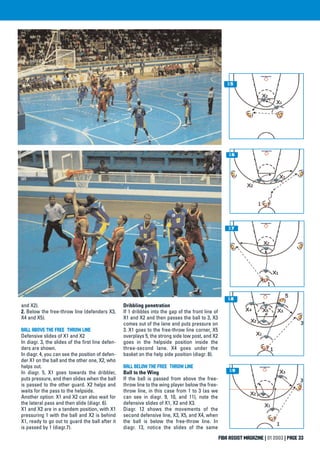
Dribbling penetration
If 1 dribbles into the gap of the front line of
X1 and X2 and then passes the ball to 3, X3
comes out of the lane and puts pressure on
3. X1 goes to the free-throw line corner, X5
overplays 5, the strong side low post, and X2
goes in the helpside position inside the
three-second lane. X4 goes under the
basket on the help side position (diagr. 8).
BALL BELOW THE FREE THROW LINE
Ball to the Wing
If the ball is passed from above the free-
throw line to the wing player below the free-
throw line, in this case from 1 to 3 (as we
can see in diagr. 9, 10, and 11), note the
defensive slides of X1, X2 and X3.
Diagr. 12 shows the movements of the
second defensive line, X3, X5, and X4, when
the ball is below the free-throw line. In
diagr. 13, notice the slides of the same
D.8
D.9
D.7
D.6
FIBAMAGAZINE_32-35 4-04-2003 11:47 Pagina 33
D.10
PAGE 34 | 01 2003 | FIBA ASSIST MAGAZINE
defenders when the ball is instead passed
to the wing on the weak side.
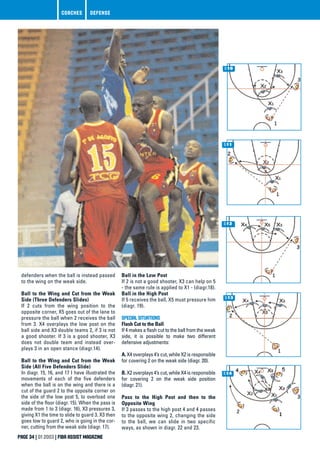
Ball to the Wing and Cut from the Weak
Side (Three Defenders Slides)
If 2 cuts from the wing position to the
opposite corner, X5 goes out of the lane to
pressure the ball when 2 receives the ball
from 3. X4 overplays the low post on the
ball side and X3 double teams 2, if 3 is not
a good shooter. If 3 is a good shooter, X3
does not double team and instead over-
plays 3 in an open stance (diagr.14).
Ball to the Wing and Cut from the Weak
Side (All Five Defenders Slide)
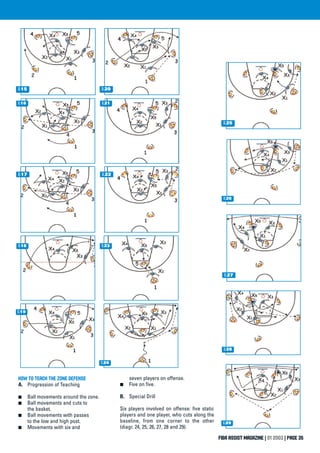
In diagr. 15, 16, and 17 I have illustrated the
movements of each of the five defenders
when the ball is on the wing and there is a
cut of the guard 2 to the opposite corner on
the side of the low post 5, to overload one
side of the floor (diagr. 15). When the pass is
made from 1 to 3 (diagr. 16), X3 pressures 3,
giving X1 the time to slide to guard 3. X3 then
goes low to guard 2, who is going in the cor-
ner, cutting from the weak side (diagr. 17).
Ball in the Low Post
If 2 is not a good shooter, X3 can help on 5
- the same rule is applied to X1 - (diagr.18).
Ball in the High Post
If 5 receives the ball, X5 must pressure him
(diagr. 19).
SPECIAL SITUATIONS
Flash Cut to the Ball
If 4 makes a flash cut to the ball from the weak
side, it is possible to make two different
defensive adjustments:
A. X4 overplays 4’s cut, while X2 is responsible
for covering 2 on the weak side (diagr. 20).
B. X2 overplays 4’s cut, while X4 is responsible
for covering 2 on the weak side position
(diagr. 21).
Pass to the High Post and then to the
Opposite Wing
If 3 passes to the high post 4 and 4 passes
to the opposite wing 2, changing the side
to the ball, we can slide in two specific
ways, as shown in diagr. 22 and 23.
D.11
D.12D.12
D.14
D.13
FIBA EUROPE
COACHES DEFENSE
FIBAMAGAZINE_32-35 4-04-2003 11:47 Pagina 34
FIBA ASSIST MAGAZINE | 01 2003 | PAGE 35
D.15 D.20
D.16
D.17
D.18
D.19
D.25
D.21
D.22
D.23
D.24
D.26
D.27
D.28
D.29
HOW TO TEACH THE ZONE DEFENSE
A. Progression of Teaching
■ Ball movements around the zone.
■ Ball movements and cuts to
the basket.
■ Ball movements with passes
to the low and high post.
■ Movements with six and
seven players on offense.
■ Five on five.
B. Special Drill
Six players involved on offense: five static
players and one player, who cuts along the
baseline, from one corner to the other
(diagr. 24, 25, 26, 27, 28 and 29).
FIBAMAGAZINE_32-35 4-04-2003 11:47 Pagina 35

Basketball ANGOLA_Victorino Cunha

  • 1.
    D.2 D.3 D.4 by Victorino Cunha For20 years, he was head coach of the Angolan national team and won three African Championships, one Pan African Games, and one Military Championship. Cunha, the for- mer President of African Coaches Committee, participated with Angola in three World Championships and one Olympic Games (Barcelona, 1992). Cunha is presently the FIBA instructor for Africa and the National Technical Director of the Angolan Federation. 1. PHILOSOPHY Zone defense challenges the offense to shoot well from the outside. The main goals of the zone defenses are: ■ Put pressure on the ball in all areas of the half court, with the primary purpose being to prevent high-percentage shots, and offer help when one offensive player penetrates with or without the ball (dribbling penetra- tion, cuts from the weakside of the ball, pass to the centers). ■ Prevent the penetration of the ball (by pass, dribble, or cut), forcing the offense to move the ball around the perimeter, farther away from the basket. ■ The defenders never move before the pass is made and the defender nearest to the ball should “defend” on the next pass. 2. WHEN WE SHOULD PLAY ZONE DEFENSE When we want: ■ To catch the offense unprepared because we switch the defense. ■ To protect the area near the basket. ■ To hide one (or more) weak defensive player. ■ To protect one or more players, who are in foul trouble. ■ To force the offense in the last two minutes of the game, when we are ahead by 8 to 10 points, to make extra passes before shooting. ■ To organize our fastbreak in a very efficient way. 3. DISADVANTAGES ■ Does not encourage the improvement of individual defensive skills. ■ Leaves the team vulnerable against good outside shooters. ■ It is problematic against quick ball rota tion, combined with splits and cuts in the gaps of the zone. 4. MAIN PRINCIPLES It is easy to teach zone defense, but it is very difficult to do so efficiently. The zone defense has many weak points. ■ The defensive players must recover quickly. ■ All defensive players must know exactly their position on the court and what are theirresponsibilities. ■ Each defender must know the position of the ball. ■ The defenders must go to certain rebound areas. 5. STUDIES ON REBOUND AREAS Based on research, diagr. 1 shows the ten probable rebound areas that open when a medium distance shot is taken and missed. ■ These are the percentage of possibilities that the ball rebounds in certain areas, inde- pendently of where the player shoots from: - Area n. 3: 40% - Area n. 4: 35 % - Area n. 10: 15% - The final 10% of the rebounds are divided in the other areas: ■ Missed shots from area n.1: 55% of the rebounds will land in area n.4. ■ Missed shots from area n.2: 60% of the rebounds will land in area n.3. ■ Missed shots from area n.5: 66% of the rebounds will land in area n.4. ■ Missed shots from area n.6: 56% of the rebounds will land in area n.3. ■ Missed shots from area n.7: 54% of the rebounds will land in area n.4. ■ Missed shots from area n. 8: 52% of the rebounds will land in area n.3. TWO - THREE ZONE DEFENSE In order to teach the two-three zone defen- se we split the half court in two fundamental areas (diagr. 2): 1. Above the free-throw line (defenders X1 HOW TO BUILD A 2-3 ZONE DEFENSE PAGE 32 | 01 2003 | FIBA ASSIST MAGAZINE FIBA EUROPE D.1 COACHES DEFENSE FIBAMAGAZINE_32-35 4-04-2003 11:47 Pagina 32
  • 2.
    FIBA ASSIST MAGAZINE| 01 2003 | PAGE 33 D.5 and X2). 2. Below the free-throw line (defenders X3, X4 and X5). BALL ABOVE THE FREE THROW LINE Defensive slides of X1 and X2 In diagr. 3, the slides of the first line defen- ders are shown. In diagr. 4, you can see the position of defen- der X1 on the ball and the other one, X2, who helps out. In diagr. 5, X1 goes towards the dribbler, puts pressure, and then slides when the ball is passed to the other guard. X2 helps and waits for the pass to the helpside. Another option: X1 and X2 can also wait for the lateral pass and then slide (diagr. 6). X1 and X2 are in a tandem position, with X1 pressuring 1 with the ball and X2 is behind X1, ready to go out to guard the ball after it is passed by 1 (diagr.7). Dribbling penetration If 1 dribbles into the gap of the front line of X1 and X2 and then passes the ball to 3, X3 comes out of the lane and puts pressure on 3. X1 goes to the free-throw line corner, X5 overplays 5, the strong side low post, and X2 goes in the helpside position inside the three-second lane. X4 goes under the basket on the help side position (diagr. 8). BALL BELOW THE FREE THROW LINE Ball to the Wing If the ball is passed from above the free- throw line to the wing player below the free- throw line, in this case from 1 to 3 (as we can see in diagr. 9, 10, and 11), note the defensive slides of X1, X2 and X3. Diagr. 12 shows the movements of the second defensive line, X3, X5, and X4, when the ball is below the free-throw line. In diagr. 13, notice the slides of the same D.8 D.9 D.7 D.6 FIBAMAGAZINE_32-35 4-04-2003 11:47 Pagina 33
  • 3.
    D.10 PAGE 34 |01 2003 | FIBA ASSIST MAGAZINE defenders when the ball is instead passed to the wing on the weak side. Ball to the Wing and Cut from the Weak Side (Three Defenders Slides) If 2 cuts from the wing position to the opposite corner, X5 goes out of the lane to pressure the ball when 2 receives the ball from 3. X4 overplays the low post on the ball side and X3 double teams 2, if 3 is not a good shooter. If 3 is a good shooter, X3 does not double team and instead over- plays 3 in an open stance (diagr.14). Ball to the Wing and Cut from the Weak Side (All Five Defenders Slide) In diagr. 15, 16, and 17 I have illustrated the movements of each of the five defenders when the ball is on the wing and there is a cut of the guard 2 to the opposite corner on the side of the low post 5, to overload one side of the floor (diagr. 15). When the pass is made from 1 to 3 (diagr. 16), X3 pressures 3, giving X1 the time to slide to guard 3. X3 then goes low to guard 2, who is going in the cor- ner, cutting from the weak side (diagr. 17). Ball in the Low Post If 2 is not a good shooter, X3 can help on 5 - the same rule is applied to X1 - (diagr.18). Ball in the High Post If 5 receives the ball, X5 must pressure him (diagr. 19). SPECIAL SITUATIONS Flash Cut to the Ball If 4 makes a flash cut to the ball from the weak side, it is possible to make two different defensive adjustments: A. X4 overplays 4’s cut, while X2 is responsible for covering 2 on the weak side (diagr. 20). B. X2 overplays 4’s cut, while X4 is responsible for covering 2 on the weak side position (diagr. 21). Pass to the High Post and then to the Opposite Wing If 3 passes to the high post 4 and 4 passes to the opposite wing 2, changing the side to the ball, we can slide in two specific ways, as shown in diagr. 22 and 23. D.11 D.12D.12 D.14 D.13 FIBA EUROPE COACHES DEFENSE FIBAMAGAZINE_32-35 4-04-2003 11:47 Pagina 34
  • 4.
    FIBA ASSIST MAGAZINE| 01 2003 | PAGE 35 D.15 D.20 D.16 D.17 D.18 D.19 D.25 D.21 D.22 D.23 D.24 D.26 D.27 D.28 D.29 HOW TO TEACH THE ZONE DEFENSE A. Progression of Teaching ■ Ball movements around the zone. ■ Ball movements and cuts to the basket. ■ Ball movements with passes to the low and high post. ■ Movements with six and seven players on offense. ■ Five on five. B. Special Drill Six players involved on offense: five static players and one player, who cuts along the baseline, from one corner to the other (diagr. 24, 25, 26, 27, 28 and 29). FIBAMAGAZINE_32-35 4-04-2003 11:47 Pagina 35