© Prof. J-B.E.M. Steenkamp
Not to be used or reproduced without permission
Jan-Benedict E.M. Steenkamp
Massey Distinguished Professor of Marketing,
Marketing Area Chairman & Fellow iSIG, Fudan University
www.brandbreakout.com
Key-Note at the Annual Conference of
Foro de Marcas Renombradas Espanolas
Madrid (Spain)
How Spanish Brands Can Succeed
Internationally
© Prof. J-B.E.M. Steenkamp
Not to be reproduced without permission
Agenda
• Why care about taking your brand to
the global marketplace?
• The key role of a compelling customer
proposition for your brand
• Routes to brand internationalization
• Takeaways
© Prof. J-B.E.M. Steenkamp
Not to be reproduced without permission
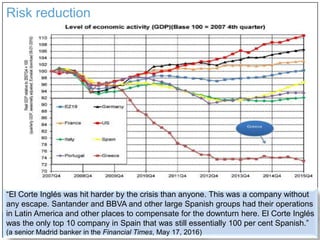
Risk reduction
“El Corte Inglés was hit harder by the crisis than anyone. This was a company without
any escape. Santander and BBVA and other large Spanish groups had their operations

in Latin America and other places to compensate for the downturn here. El Corte Inglés
was the only top 10 company in Spain that was still essentially 100 per cent Spanish.”
(a senior Madrid banker in the Financial Times, May 17, 2016)
© Prof. J-B.E.M. Steenkamp
Not to be reproduced without permission
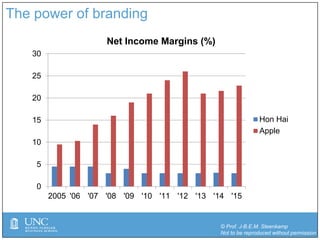
0
5
10
15
20
25
30
2005 '06 '07 '08 '09 '10 '11 '12 '13 '14 '15
Net Income Margins (%)
Hon Hai
Apple
The power of branding
© Prof. J-B.E.M. Steenkamp
Not to be reproduced without permission
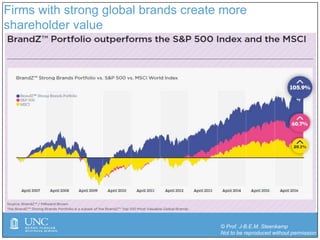
Firms with strong global brands create more
shareholder value
© Prof. J-B.E.M. Steenkamp
Not to be reproduced without permission
Agenda
• Why care about taking your brand to
the global marketplace?
• The key role of a compelling customer
proposition for your brand
• Routes to brand internationalization
• Takeaways
© Prof. J-B.E.M. Steenkamp
Not to be reproduced without permission
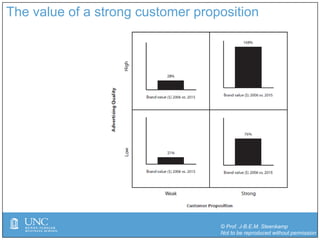
The value of a strong customer proposition
© Prof. J-B.E.M. Steenkamp
Not to be reproduced without permission
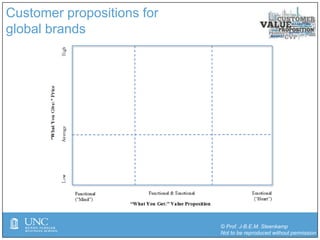
Customer propositions for
global brands
© Prof. J-B.E.M. Steenkamp
Not to be reproduced without permission
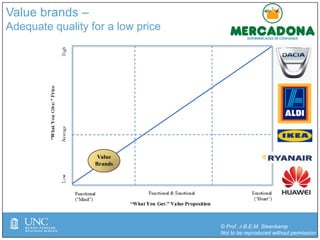
Value brands –
Adequate quality for a low price
Value
Brands
© Prof. J-B.E.M. Steenkamp
Not to be reproduced without permission
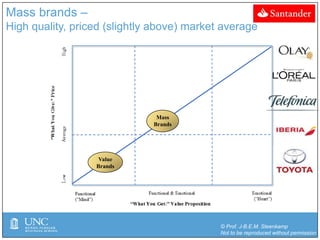
Mass brands –
High quality, priced (slightly above) market average
Value
Brands
Mass
Brands
© Prof. J-B.E.M. Steenkamp
Not to be reproduced without permission
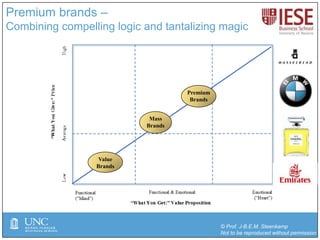
Premium brands –
Combining compelling logic and tantalizing magic
Value
Brands
Mass
Brands
Premium
Brands
© Prof. J-B.E.M. Steenkamp
Not to be reproduced without permission
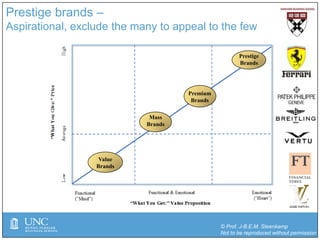
Prestige brands –
Aspirational, exclude the many to appeal to the few
Value
Brands
Mass
Brands
Premium
Brands
Prestige
Brands
© Prof. J-B.E.M. Steenkamp
Not to be reproduced without permission
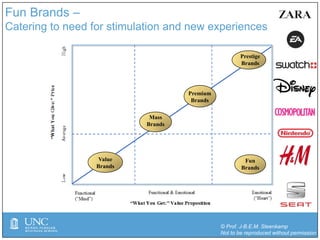
Fun Brands –
Catering to need for stimulation and new experiences
Value
Brands
Mass
Brands
Premium
Brands
Prestige
Brands
Fun
Brands
© Prof. J-B.E.M. Steenkamp
Not to be reproduced without permission
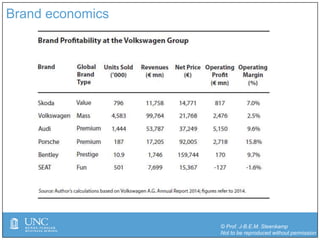
Brand economics
© Prof. J-B.E.M. Steenkamp
Not to be reproduced without permission
Agenda
• Why care about taking your brand to
the global marketplace?
• The key role of a compelling customer
proposition for your brand
• Routes to brand internationalization
• Takeaways
© Prof. J-B.E.M. Steenkamp
Not to be reproduced without permission
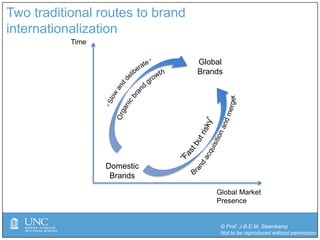
Two traditional routes to brand
internationalization
Global Market
Presence
Time
Domestic
Brands
Global
Brands
© Prof. J-B.E.M. Steenkamp
Not to be reproduced without permission
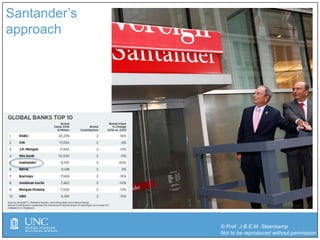
Santander’s
approach
© Prof. J-B.E.M. Steenkamp
Not to be reproduced without permission
Brand merger
Especially useful if:
• the acquiring firm has considerable control
because customers face substantial exit
barriers;
• the acquirer believes that its own brand is
stronger than the acquired brand;
• large economies of scale and scope are
associated with global brand name;
• global brand name inspires consumer trust.
© Prof. J-B.E.M. Steenkamp
Not to be reproduced without permission
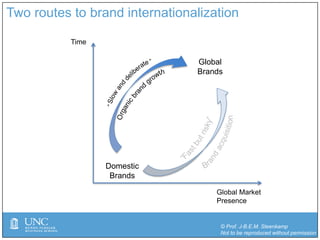
Two routes to brand internationalization
Global Market
Presence
Time
Domestic
Brands
Global
Brands
© Prof. J-B.E.M. Steenkamp
Not to be reproduced without permission
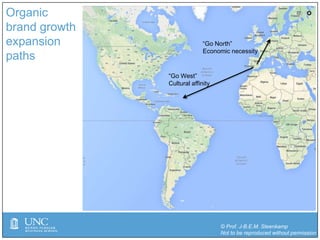
Organic
brand growth
expansion
paths
“Go West”
Cultural affinity
“Go North”
Economic necessity
© Prof. J-B.E.M. Steenkamp
Not to be reproduced without permission
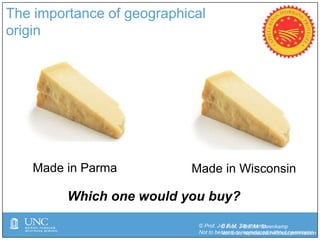
The importance of geographical
origin
Made in Parma Made in Wisconsin
Which one would you buy?
© Prof. J-B.E.M. Steenkamp
Not to be used or reproduced without permission
© Prof. J-B.E.M. Steenkamp
Not to be reproduced without permission
Geographical origin image –
Country, region, city
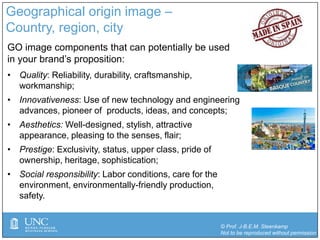
GO image components that can potentially be used
in your brand’s proposition:
• Quality: Reliability, durability, craftsmanship,
workmanship;
• Innovativeness: Use of new technology and engineering
advances, pioneer of products, ideas, and concepts;
• Aesthetics: Well-designed, stylish, attractive
appearance, pleasing to the senses, flair;
• Prestige: Exclusivity, status, upper class, pride of
ownership, heritage, sophistication;
• Social responsibility: Labor conditions, care for the
environment, environmentally-friendly production,
safety.
© Prof. J-B.E.M. Steenkamp
Not to be reproduced without permission
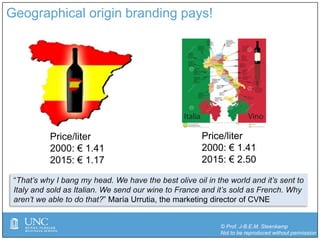
Geographical origin branding pays!
Price/liter
2000: € 1.41
2015: € 1.17
Price/liter
2000: € 1.41
2015: € 2.50
“That’s why I bang my head. We have the best olive oil in the world and it’s sent to
Italy and sold as Italian. We send our wine to France and it’s sold as French. Why
aren’t we able to do that?” María Urrutia, the marketing director of CVNE
© Prof. J-B.E.M. Steenkamp
Not to be reproduced without permission
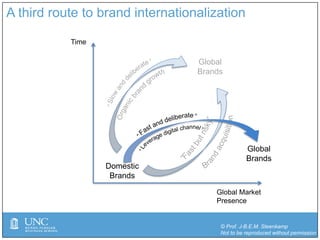
A third route to brand internationalization
Global Market
Presence
Time
Global
Brands
Domestic
Brands
Global
Brands
© Prof. J-B.E.M. Steenkamp
Not to be reproduced without permission
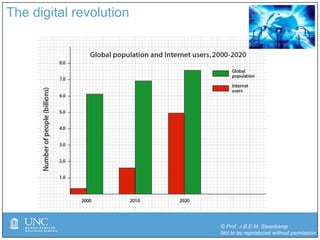
The digital revolution
© Prof. J-B.E.M. Steenkamp
Not to be reproduced without permission
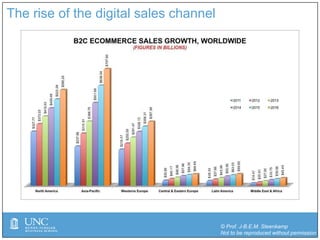
The rise of the digital sales channel
© Prof. J-B.E.M. Steenkamp
Not to be reproduced without permission
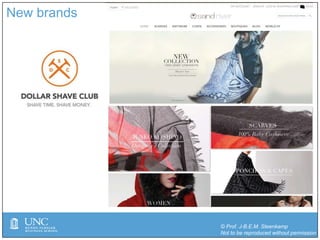
New brands
© Prof. J-B.E.M. Steenkamp
Not to be reproduced without permission
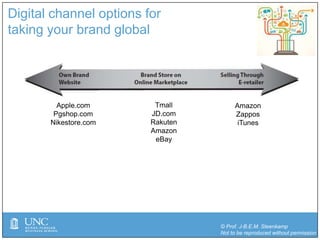
Digital channel options for
taking your brand global
Apple.com
Pgshop.com
Nikestore.com
Tmall
JD.com
Rakuten
Amazon
eBay
Amazon
Zappos
iTunes
© Prof. J-B.E.M. Steenkamp
Not to be reproduced without permission
SMEs: Global selling collaboration
© Prof. J-B.E.M. Steenkamp
Not to be reproduced without permission
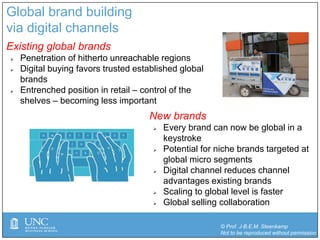
Global brand building
via digital channels
Existing global brands
 Penetration of hitherto unreachable regions
 Digital buying favors trusted established global
brands
 Entrenched position in retail – control of the
shelves – becoming less important
New brands
 Every brand can now be global in a
keystroke
 Potential for niche brands targeted at
global micro segments
 Digital channel reduces channel
advantages existing brands
 Scaling to global level is faster
 Global selling collaboration
© Prof. J-B.E.M. Steenkamp
Not to be reproduced without permission
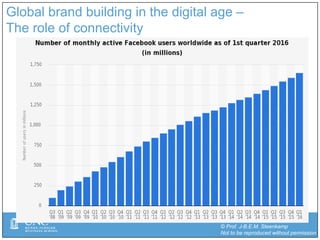
Global brand building in the digital age –
The role of connectivity
© Prof. J-B.E.M. Steenkamp
Not to be reproduced without permission
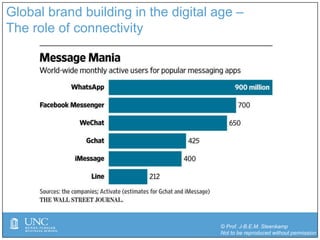
Global brand building in the digital age –
The role of connectivity
© Prof. J-B.E.M. Steenkamp
Not to be reproduced without permission
Global brand building in the digital age – The
role of connectivity
• Multi-flow of communication
• The critical role of eWOM
• New global brands based on
connectivity and sharing economy
© Prof. J-B.E.M. Steenkamp
Not to be reproduced without permission
New brands based on the sharing
economy
© Prof. J-B.E.M. Steenkamp
Not to be reproduced without permission
Global brand building in the age of connectivity
Existing global brands
 Need for globally consistent customer
proposition
 Balance of power has shifted to customer
 Corporate scandals impossible to hide; you
need to come clean fully and fast
 Sharing economy can completely disrupt
your business model
New brands
 New brands can gain rapid
acceptance through eWOM
 Opportunities for new global
brands based on “sharing”
economy
© Prof. J-B.E.M. Steenkamp
Not to be used or reproduced without permission
Managerial takeaways
• Global brands build firm value
• A strong brand starts with a compelling value proposition
• If you expand through acquisition, merge the acquired brand with the
existing brands if:
‒ You have considerable control because customers face substantial exit barriers;
‒ You believe that your own brand is stronger than the acquired brand;
‒ There are large economies of scale and scope are associated with global brand
name;
‒ Having a global brand name inspires consumer trust.
• If you grow organically, consider “Going North” or “Going West” before
“Going Global.”
• Consider geographical origin in your customer proposition as part of
taking your brand international. This can be country, region, or city. This
strategy is also very useful for small/medium-sized enterprises!
© Prof. J-B.E.M. Steenkamp
Not to be used or reproduced without permission
Managerial takeaways (cont’d)
• Established global brands can reach hitherto unserved
parts of countries like China through the digital channel.
Niche brands can garner sufficient scale by aggregating
demand across countries.
• The boundary between local and global brands becomes
permeable. In fact, any local brand can become global at
the touch of a keystroke.
• Rapid information flows, connectivity, and market
transparency render brand consistency across countries
ever more important.
• Accept that in the digital age, you no longer control the
brand narrative
© Prof. J-B.E.M. Steenkamp
Not to be used or reproduced without permission
Further reading
Published by Palgrave
MacMillan, 2017

How Spanish Brands Can Succeed Internationally

  • 1.
    © Prof. J-B.E.M.Steenkamp Not to be used or reproduced without permission Jan-Benedict E.M. Steenkamp Massey Distinguished Professor of Marketing, Marketing Area Chairman & Fellow iSIG, Fudan University www.brandbreakout.com Key-Note at the Annual Conference of Foro de Marcas Renombradas Espanolas Madrid (Spain) How Spanish Brands Can Succeed Internationally
  • 2.
    © Prof. J-B.E.M.Steenkamp Not to be reproduced without permission Agenda • Why care about taking your brand to the global marketplace? • The key role of a compelling customer proposition for your brand • Routes to brand internationalization • Takeaways
  • 3.
    © Prof. J-B.E.M.Steenkamp Not to be reproduced without permission Risk reduction “El Corte Inglés was hit harder by the crisis than anyone. This was a company without any escape. Santander and BBVA and other large Spanish groups had their operations in Latin America and other places to compensate for the downturn here. El Corte Inglés was the only top 10 company in Spain that was still essentially 100 per cent Spanish.” (a senior Madrid banker in the Financial Times, May 17, 2016)
  • 4.
    © Prof. J-B.E.M.Steenkamp Not to be reproduced without permission 0 5 10 15 20 25 30 2005 '06 '07 '08 '09 '10 '11 '12 '13 '14 '15 Net Income Margins (%) Hon Hai Apple The power of branding
  • 5.
    © Prof. J-B.E.M.Steenkamp Not to be reproduced without permission Firms with strong global brands create more shareholder value
  • 6.
    © Prof. J-B.E.M.Steenkamp Not to be reproduced without permission Agenda • Why care about taking your brand to the global marketplace? • The key role of a compelling customer proposition for your brand • Routes to brand internationalization • Takeaways
  • 7.
    © Prof. J-B.E.M.Steenkamp Not to be reproduced without permission The value of a strong customer proposition
  • 8.
    © Prof. J-B.E.M.Steenkamp Not to be reproduced without permission Customer propositions for global brands
  • 9.
    © Prof. J-B.E.M.Steenkamp Not to be reproduced without permission Value brands – Adequate quality for a low price Value Brands
  • 10.
    © Prof. J-B.E.M.Steenkamp Not to be reproduced without permission Mass brands – High quality, priced (slightly above) market average Value Brands Mass Brands
  • 11.
    © Prof. J-B.E.M.Steenkamp Not to be reproduced without permission Premium brands – Combining compelling logic and tantalizing magic Value Brands Mass Brands Premium Brands
  • 12.
    © Prof. J-B.E.M.Steenkamp Not to be reproduced without permission Prestige brands – Aspirational, exclude the many to appeal to the few Value Brands Mass Brands Premium Brands Prestige Brands
  • 13.
    © Prof. J-B.E.M.Steenkamp Not to be reproduced without permission Fun Brands – Catering to need for stimulation and new experiences Value Brands Mass Brands Premium Brands Prestige Brands Fun Brands
  • 14.
    © Prof. J-B.E.M.Steenkamp Not to be reproduced without permission Brand economics
  • 15.
    © Prof. J-B.E.M.Steenkamp Not to be reproduced without permission Agenda • Why care about taking your brand to the global marketplace? • The key role of a compelling customer proposition for your brand • Routes to brand internationalization • Takeaways
  • 16.
    © Prof. J-B.E.M.Steenkamp Not to be reproduced without permission Two traditional routes to brand internationalization Global Market Presence Time Domestic Brands Global Brands
  • 17.
    © Prof. J-B.E.M.Steenkamp Not to be reproduced without permission Santander’s approach
  • 18.
    © Prof. J-B.E.M.Steenkamp Not to be reproduced without permission Brand merger Especially useful if: • the acquiring firm has considerable control because customers face substantial exit barriers; • the acquirer believes that its own brand is stronger than the acquired brand; • large economies of scale and scope are associated with global brand name; • global brand name inspires consumer trust.
  • 19.
    © Prof. J-B.E.M.Steenkamp Not to be reproduced without permission Two routes to brand internationalization Global Market Presence Time Domestic Brands Global Brands
  • 20.
    © Prof. J-B.E.M.Steenkamp Not to be reproduced without permission Organic brand growth expansion paths “Go West” Cultural affinity “Go North” Economic necessity
  • 21.
    © Prof. J-B.E.M.Steenkamp Not to be reproduced without permission The importance of geographical origin Made in Parma Made in Wisconsin Which one would you buy? © Prof. J-B.E.M. Steenkamp Not to be used or reproduced without permission
  • 22.
    © Prof. J-B.E.M.Steenkamp Not to be reproduced without permission Geographical origin image – Country, region, city GO image components that can potentially be used in your brand’s proposition: • Quality: Reliability, durability, craftsmanship, workmanship; • Innovativeness: Use of new technology and engineering advances, pioneer of products, ideas, and concepts; • Aesthetics: Well-designed, stylish, attractive appearance, pleasing to the senses, flair; • Prestige: Exclusivity, status, upper class, pride of ownership, heritage, sophistication; • Social responsibility: Labor conditions, care for the environment, environmentally-friendly production, safety.
  • 23.
    © Prof. J-B.E.M.Steenkamp Not to be reproduced without permission Geographical origin branding pays! Price/liter 2000: € 1.41 2015: € 1.17 Price/liter 2000: € 1.41 2015: € 2.50 “That’s why I bang my head. We have the best olive oil in the world and it’s sent to Italy and sold as Italian. We send our wine to France and it’s sold as French. Why aren’t we able to do that?” María Urrutia, the marketing director of CVNE
  • 24.
    © Prof. J-B.E.M.Steenkamp Not to be reproduced without permission A third route to brand internationalization Global Market Presence Time Global Brands Domestic Brands Global Brands
  • 25.
    © Prof. J-B.E.M.Steenkamp Not to be reproduced without permission The digital revolution
  • 26.
    © Prof. J-B.E.M.Steenkamp Not to be reproduced without permission The rise of the digital sales channel
  • 27.
    © Prof. J-B.E.M.Steenkamp Not to be reproduced without permission New brands
  • 28.
    © Prof. J-B.E.M.Steenkamp Not to be reproduced without permission Digital channel options for taking your brand global Apple.com Pgshop.com Nikestore.com Tmall JD.com Rakuten Amazon eBay Amazon Zappos iTunes
  • 29.
    © Prof. J-B.E.M.Steenkamp Not to be reproduced without permission SMEs: Global selling collaboration
  • 30.
    © Prof. J-B.E.M.Steenkamp Not to be reproduced without permission Global brand building via digital channels Existing global brands  Penetration of hitherto unreachable regions  Digital buying favors trusted established global brands  Entrenched position in retail – control of the shelves – becoming less important New brands  Every brand can now be global in a keystroke  Potential for niche brands targeted at global micro segments  Digital channel reduces channel advantages existing brands  Scaling to global level is faster  Global selling collaboration
  • 31.
    © Prof. J-B.E.M.Steenkamp Not to be reproduced without permission Global brand building in the digital age – The role of connectivity
  • 32.
    © Prof. J-B.E.M.Steenkamp Not to be reproduced without permission Global brand building in the digital age – The role of connectivity
  • 33.
    © Prof. J-B.E.M.Steenkamp Not to be reproduced without permission Global brand building in the digital age – The role of connectivity • Multi-flow of communication • The critical role of eWOM • New global brands based on connectivity and sharing economy
  • 34.
    © Prof. J-B.E.M.Steenkamp Not to be reproduced without permission New brands based on the sharing economy
  • 35.
    © Prof. J-B.E.M.Steenkamp Not to be reproduced without permission Global brand building in the age of connectivity Existing global brands  Need for globally consistent customer proposition  Balance of power has shifted to customer  Corporate scandals impossible to hide; you need to come clean fully and fast  Sharing economy can completely disrupt your business model New brands  New brands can gain rapid acceptance through eWOM  Opportunities for new global brands based on “sharing” economy
  • 36.
    © Prof. J-B.E.M.Steenkamp Not to be used or reproduced without permission Managerial takeaways • Global brands build firm value • A strong brand starts with a compelling value proposition • If you expand through acquisition, merge the acquired brand with the existing brands if: ‒ You have considerable control because customers face substantial exit barriers; ‒ You believe that your own brand is stronger than the acquired brand; ‒ There are large economies of scale and scope are associated with global brand name; ‒ Having a global brand name inspires consumer trust. • If you grow organically, consider “Going North” or “Going West” before “Going Global.” • Consider geographical origin in your customer proposition as part of taking your brand international. This can be country, region, or city. This strategy is also very useful for small/medium-sized enterprises!
  • 37.
    © Prof. J-B.E.M.Steenkamp Not to be used or reproduced without permission Managerial takeaways (cont’d) • Established global brands can reach hitherto unserved parts of countries like China through the digital channel. Niche brands can garner sufficient scale by aggregating demand across countries. • The boundary between local and global brands becomes permeable. In fact, any local brand can become global at the touch of a keystroke. • Rapid information flows, connectivity, and market transparency render brand consistency across countries ever more important. • Accept that in the digital age, you no longer control the brand narrative
  • 38.
    © Prof. J-B.E.M.Steenkamp Not to be used or reproduced without permission Further reading Published by Palgrave MacMillan, 2017