Josh Santos
Jenell Pizarro
Lindsay Mahalak
Michael Isam
The week of July 12, 2006, MySpace became the most
visited website in the United States, overtaking Yahoo and
Google.
MySpace had 61+ million registered users and was
growing at a pace of about 220,000 per day (Kurkell).
It was 50.2% male, 49.8% female, the second largest
destination on the entire Web and earned about $750,000
per day in ad revenue.
Today, with about 130 million users, Myspace has lost the
social networking race to Facebook, which counts nearly
half a billion members.
One year ago (2009), Myspace had 76 million visitors in
the month of October, according to Comscore, a company
that tracks online traffic.
In October 2010, that number was down nearly 20 million,
and the amount of time people spent on the site had
dropped by more than half.
So What happened?
MySpace has failed to keep up with the innovation.
Sites like Bandcamp, Topspin, Sonicbids and Reverb
Nation now exist and have, in most cases, improved upon
MySpace's once catch-all utility for bands, the site may not
even be able to rely upon the musicians who once gave
Myspace its best publicity.
Though it is still seen largely as a social network, Facebook
had companies building apps to make it a better site for
entertainment.
Too Little TOO Late?.
In a
November 16, 2010 interview with Laura Sydell of NPR
MySpace CEO Mike Jones announced a category he terms
'social entertainment,' to basically give everyone a very
personalized entertainment experience around celebrities,
TV, music, and movies that they love.
Does it stand a chance?
If you want to connect around film and television, there's
two billion sites to go do it on and so they (MySpace) have
to offer something really compelling that makes people
want to do it there rather than elsewhere. Nancy Baym, a
communications professor, University of Kansas
For MySpace the music sounds more like a funeral dirge.
Is bird really the word?
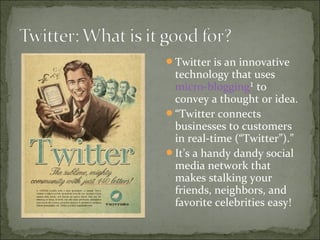
Twitter is an innovative
technology that uses
micro-blogging¹ to
convey a thought or idea.
“Twitter connects
businesses to customers
in real-time (“Twitter”).”
It’s a handy dandy social
media network that
makes stalking your
friends, neighbors, and
favorite celebrities easy!
Twitter has been known
to convey quick bursts of
news quite efficiently.
Used in last year’s MTV
Video Music Awards to
talk about what
celebrities were doing or
wearing.
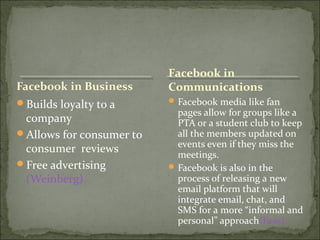
Facebook in
Communications
Builds loyalty to a
company
Allows for consumer to
consumer reviews
Free advertising
(Weinberg).
Facebook media like fan
pages allow for groups like a
PTA or a student club to keep
all the members updated on
events even if they miss the
meetings.
Facebook is also in the
process of releasing a new
email platform that will
integrate email, chat, and
SMS for a more “informal and
personal” approach(Faas).
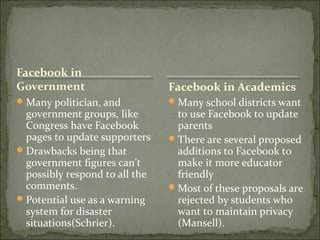
Facebook in Academics
Many politician, and
government groups, like
Congress have Facebook
pages to update supporters
Drawbacks being that
government figures can’t
possibly respond to all the
comments.
Potential use as a warning
system for disaster
situations(Schrier).
Many school districts want
to use Facebook to update
parents
There are several proposed
additions to Facebook to
make it more educator
friendly
Most of these proposals are
rejected by students who
want to maintain privacy
(Mansell).
"About Twitter." Twitter. Twitter, Inc., 16 Nov 2010. Web. 17
Nov 2010. <http://twitter.com/about>.
Kukral , Jim. "MySpace: Destroying Our Children’s Future,
One Profile at a Time." MarketingProfs Daily Fix Blog.
MarketingProfs, 27 Apr 2006. Web. 19 Nov 2010.
<http://www.mpdailyfix.com/myspace-destroying-our-
childrens-future-one-profile-at-a-time/>.
Lardinois, Frederic. "The Youtube Government: Why Is Youtube
Getting Preferential Treatment?." Read Write Web. Read Write
Web, 12 Jan 2009. Web. 22 Nov 2010.
<http://www.readwriteweb.com/archives/the_youtube_gov
"microblogging." Dictionary.com's 21st Century Lexicon.
Dictionary.com, LLC. 19 Nov. 2010. <Dictionary.com
http://dictionary.reference.com/browse/microblogging>.
 Mansell, Colin. "Buisness: Educationa Uses of Facebook." E-
learning, Course Development, Learning Management.
Ecademy, 15 Feb 2008. Web. 22 Nov 2010.
<http://www.ecademy.com/node.php?id=98854>.
 Schrier, Bill. "Twitter, Facebook Not Ready For Government 2.0?."
Notes From a City CIO. Digital Communities Blog, 22 Mar 2009.
Web. 22 Nov 2010.
<http://www.digitalcommunitiesblogs.com/CCIO
/2009/03/twitter-facebook-not-ready-for.php>.
 Sydell, Laura. "MySpace Update Focuses On Music." The
Record. National Public Radio, 16 Nov 2010. Web. 19 Nov 2010.
<http://www.npr.org/blogs/therecord/2010/11/ 16/131362400/myspace-
update-focuses-on-music>.
 Weinberg, Tamar. "How to Use Fecebook for Buisness and Marketing." Social
Media Consultant and Tech Geek at Heart. Techipedia, 05 May 2010. Web. 22 Nov
2010. <http://www.techipedia.com/2010/how-to-use-facebook-for-business-
and-marketing/>.

How social networking can be effective final draft[1]

  • 1.
  • 3.
    The week ofJuly 12, 2006, MySpace became the most visited website in the United States, overtaking Yahoo and Google. MySpace had 61+ million registered users and was growing at a pace of about 220,000 per day (Kurkell). It was 50.2% male, 49.8% female, the second largest destination on the entire Web and earned about $750,000 per day in ad revenue.
  • 4.
    Today, with about130 million users, Myspace has lost the social networking race to Facebook, which counts nearly half a billion members. One year ago (2009), Myspace had 76 million visitors in the month of October, according to Comscore, a company that tracks online traffic. In October 2010, that number was down nearly 20 million, and the amount of time people spent on the site had dropped by more than half. So What happened?
  • 5.
    MySpace has failedto keep up with the innovation. Sites like Bandcamp, Topspin, Sonicbids and Reverb Nation now exist and have, in most cases, improved upon MySpace's once catch-all utility for bands, the site may not even be able to rely upon the musicians who once gave Myspace its best publicity. Though it is still seen largely as a social network, Facebook had companies building apps to make it a better site for entertainment.
  • 6.
    Too Little TOOLate?. In a November 16, 2010 interview with Laura Sydell of NPR MySpace CEO Mike Jones announced a category he terms 'social entertainment,' to basically give everyone a very personalized entertainment experience around celebrities, TV, music, and movies that they love. Does it stand a chance?
  • 7.
    If you wantto connect around film and television, there's two billion sites to go do it on and so they (MySpace) have to offer something really compelling that makes people want to do it there rather than elsewhere. Nancy Baym, a communications professor, University of Kansas For MySpace the music sounds more like a funeral dirge.
  • 8.
    Is bird reallythe word?
  • 9.
    Twitter is aninnovative technology that uses micro-blogging¹ to convey a thought or idea. “Twitter connects businesses to customers in real-time (“Twitter”).” It’s a handy dandy social media network that makes stalking your friends, neighbors, and favorite celebrities easy!
  • 10.
    Twitter has beenknown to convey quick bursts of news quite efficiently. Used in last year’s MTV Video Music Awards to talk about what celebrities were doing or wearing.
  • 13.
    Facebook in Communications Builds loyaltyto a company Allows for consumer to consumer reviews Free advertising (Weinberg). Facebook media like fan pages allow for groups like a PTA or a student club to keep all the members updated on events even if they miss the meetings. Facebook is also in the process of releasing a new email platform that will integrate email, chat, and SMS for a more “informal and personal” approach(Faas).
  • 14.
    Facebook in Academics Manypolitician, and government groups, like Congress have Facebook pages to update supporters Drawbacks being that government figures can’t possibly respond to all the comments. Potential use as a warning system for disaster situations(Schrier). Many school districts want to use Facebook to update parents There are several proposed additions to Facebook to make it more educator friendly Most of these proposals are rejected by students who want to maintain privacy (Mansell).
  • 17.
    "About Twitter." Twitter.Twitter, Inc., 16 Nov 2010. Web. 17 Nov 2010. <http://twitter.com/about>. Kukral , Jim. "MySpace: Destroying Our Children’s Future, One Profile at a Time." MarketingProfs Daily Fix Blog. MarketingProfs, 27 Apr 2006. Web. 19 Nov 2010. <http://www.mpdailyfix.com/myspace-destroying-our- childrens-future-one-profile-at-a-time/>. Lardinois, Frederic. "The Youtube Government: Why Is Youtube Getting Preferential Treatment?." Read Write Web. Read Write Web, 12 Jan 2009. Web. 22 Nov 2010. <http://www.readwriteweb.com/archives/the_youtube_gov "microblogging." Dictionary.com's 21st Century Lexicon. Dictionary.com, LLC. 19 Nov. 2010. <Dictionary.com http://dictionary.reference.com/browse/microblogging>.
  • 18.
     Mansell, Colin."Buisness: Educationa Uses of Facebook." E- learning, Course Development, Learning Management. Ecademy, 15 Feb 2008. Web. 22 Nov 2010. <http://www.ecademy.com/node.php?id=98854>.  Schrier, Bill. "Twitter, Facebook Not Ready For Government 2.0?." Notes From a City CIO. Digital Communities Blog, 22 Mar 2009. Web. 22 Nov 2010. <http://www.digitalcommunitiesblogs.com/CCIO /2009/03/twitter-facebook-not-ready-for.php>.  Sydell, Laura. "MySpace Update Focuses On Music." The Record. National Public Radio, 16 Nov 2010. Web. 19 Nov 2010. <http://www.npr.org/blogs/therecord/2010/11/ 16/131362400/myspace- update-focuses-on-music>.  Weinberg, Tamar. "How to Use Fecebook for Buisness and Marketing." Social Media Consultant and Tech Geek at Heart. Techipedia, 05 May 2010. Web. 22 Nov 2010. <http://www.techipedia.com/2010/how-to-use-facebook-for-business- and-marketing/>.

Editor's Notes

  • #10 1. www.dictionary.com 2. http://twitter.com/about