How Much Do You Know About The Winter Olympics?
How did the Olympics Start?The first written records for the Olympic Games  show that they were held in 776 BCE although historians believe they had been held for many years before that.  The first winner of the Olympics was a naked runner, Coroebus (a cook from Elis) who won a run of about 210 yards.  He was the first Olympic champion.The ancient games grew and continued to be played every four  years for nearly 1200 years.In 393 CE the Roman emperor Theodosius 1 Abolished the Games because of their pagan influences.
How did the Winter Olympics Start?About 1500 years later a young Frenchman named Pierre de Coubertin began to revive the games.  He believed that France was overrun by the Germans during the War of 1870 in part because the soldiers lacked  “vigor.”  He examined the education of the German, British, and American Children and decided that it was exercise and sports that made a well-rounded and vigorous person. He spent several years working to convince people that the Olympics should begin again. He helped to form the IOC (International Olympic Committee) and the planning began.  The first “modern” Summer Olympics were held in April 1896 in Athens Greece.People started thinking about winter games in 1908 when there was a figure skating even at theSummer Olympic Games in London.  Ulrich Salchow of Sweden (one revolution backwardsjump) won for the men.The 1916 Olympics were supposed to be in Berlin and organizers were planning on having a “Skiing Olympia” up in the Black Forest in the mountains, but the Olympics were cancelled because WW1 broke out in 1914The Summer Olympics were back in 1920 in Belgium, and figure skating and Ice Hockey were included (Canada won gold, USA silver, Czechoslovakia Bronze)The first Olympic Committee sanctioned an “International Winter Sports Week” at Chamonix France was in 1924. Events included nordic skiing, speed skating, figure skating, ice hockey and bobsledding.  This week later was called the first Winter Olympic Games.
1924 Chamonix France1928 St. Moritz Switzerland1932 Lake Placid USA1936 Garmisch Germany19401944 1948 St. Moritz Switzerland1952 Oslo Norway1956 Cortina d’Ampezzo Italy1960 Squaw Valley USA1964 Innsbruck Austria1968 Grenoble France1972 Sapporo Japan1976 Innsbruck Austria1980 Lake Placid USA1984 Sarajevo Yugoslavia1988 Calgary Canada1992 Albertville France1994 Lillehammer Norway1998 Nagano Japan2002 Sault Lake City US2006 Turin Italy2010 Vancouver Canada2012 Sochi RussiaHow Often?The Olympics were held every 4 years until 1992, except for the cancellation in 1940 and 1944 during World War II.In 1994 the Olympics began a new     schedule where the summer and    winter games would not take place    in the same year, but would instead    alternate every two years.  This     made only a two year gap between     Winter Olympic games.
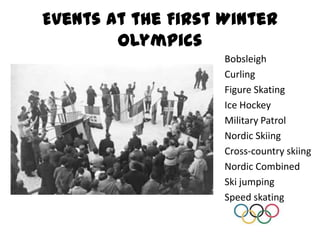
Events at the First Winter OlympicsBobsleighCurlingFigure SkatingIce HockeyMilitary PatrolNordic SkiingCross-country skiingNordic CombinedSki jumpingSpeed skating
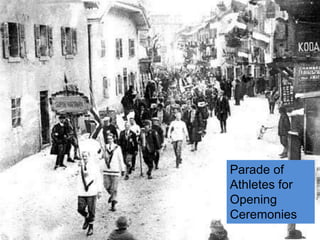
Parade of Athletes for Opening Ceremonies
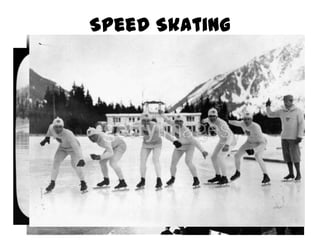
Speed Skating
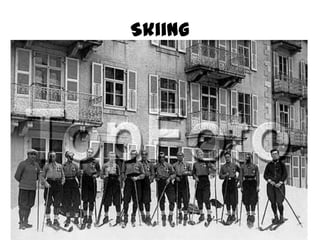
Skiing
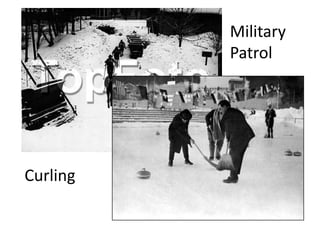
Military PatrolCurling
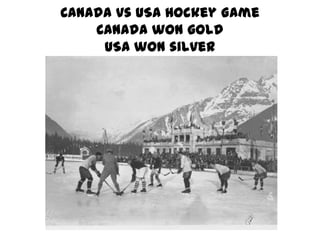
Canada vs USA Hockey GameCanada won goldUSA won silver
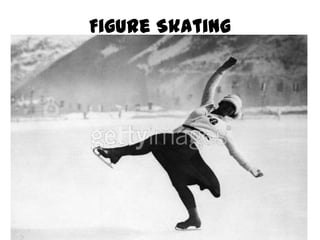
Figure Skating
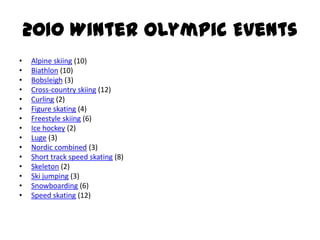
2010 Winter Olympic EventsAlpine skiing (10)Biathlon (10)Bobsleigh (3)Cross-country skiing (12)Curling (2)Figure skating (4)Freestyle skiing (6)Ice hockey (2)Luge (3)Nordic combined (3)Short track speed skating (8)Skeleton (2)Ski jumping (3)Snowboarding (6)Speed skating (12)
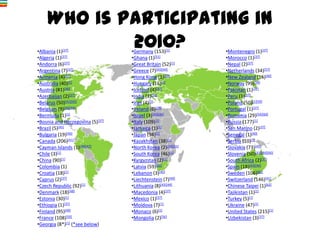
Who is Participating in 2010?
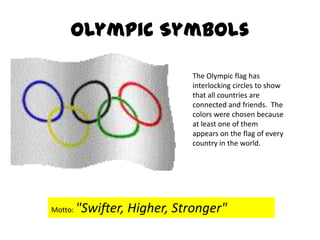
Olympic SymbolsThe Olympic flag has interlocking circles to show that all countries are connected and friends.  The colors were chosen because at least one of them appears on the flag of every country in the world.Motto: "Swifter, Higher, Stronger"
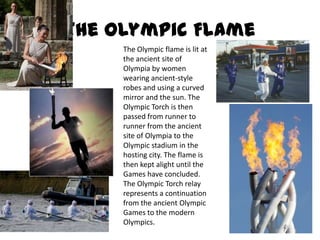
The Olympic FlameThe Olympic flame is lit at the ancient site of Olympia by women wearing ancient-style robes and using a curved mirror and the sun. The Olympic Torch is then passed from runner to runner from the ancient site of Olympia to the Olympic stadium in the hosting city. The flame is then kept alight until the Games have concluded. The Olympic Torch relay represents a continuation from the ancient Olympic Games to the modern Olympics.
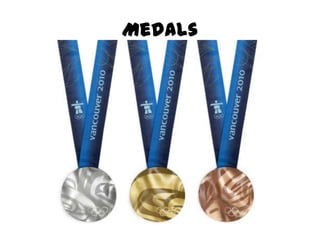
Medals

How much do you know about the winter

  • 1.
    How Much DoYou Know About The Winter Olympics?
  • 2.
    How did theOlympics Start?The first written records for the Olympic Games show that they were held in 776 BCE although historians believe they had been held for many years before that. The first winner of the Olympics was a naked runner, Coroebus (a cook from Elis) who won a run of about 210 yards. He was the first Olympic champion.The ancient games grew and continued to be played every four years for nearly 1200 years.In 393 CE the Roman emperor Theodosius 1 Abolished the Games because of their pagan influences.
  • 3.
    How did theWinter Olympics Start?About 1500 years later a young Frenchman named Pierre de Coubertin began to revive the games. He believed that France was overrun by the Germans during the War of 1870 in part because the soldiers lacked “vigor.” He examined the education of the German, British, and American Children and decided that it was exercise and sports that made a well-rounded and vigorous person. He spent several years working to convince people that the Olympics should begin again. He helped to form the IOC (International Olympic Committee) and the planning began. The first “modern” Summer Olympics were held in April 1896 in Athens Greece.People started thinking about winter games in 1908 when there was a figure skating even at theSummer Olympic Games in London. Ulrich Salchow of Sweden (one revolution backwardsjump) won for the men.The 1916 Olympics were supposed to be in Berlin and organizers were planning on having a “Skiing Olympia” up in the Black Forest in the mountains, but the Olympics were cancelled because WW1 broke out in 1914The Summer Olympics were back in 1920 in Belgium, and figure skating and Ice Hockey were included (Canada won gold, USA silver, Czechoslovakia Bronze)The first Olympic Committee sanctioned an “International Winter Sports Week” at Chamonix France was in 1924. Events included nordic skiing, speed skating, figure skating, ice hockey and bobsledding. This week later was called the first Winter Olympic Games.
  • 4.
    1924 Chamonix France1928St. Moritz Switzerland1932 Lake Placid USA1936 Garmisch Germany19401944 1948 St. Moritz Switzerland1952 Oslo Norway1956 Cortina d’Ampezzo Italy1960 Squaw Valley USA1964 Innsbruck Austria1968 Grenoble France1972 Sapporo Japan1976 Innsbruck Austria1980 Lake Placid USA1984 Sarajevo Yugoslavia1988 Calgary Canada1992 Albertville France1994 Lillehammer Norway1998 Nagano Japan2002 Sault Lake City US2006 Turin Italy2010 Vancouver Canada2012 Sochi RussiaHow Often?The Olympics were held every 4 years until 1992, except for the cancellation in 1940 and 1944 during World War II.In 1994 the Olympics began a new schedule where the summer and winter games would not take place in the same year, but would instead alternate every two years. This made only a two year gap between Winter Olympic games.
  • 5.
    Events at theFirst Winter OlympicsBobsleighCurlingFigure SkatingIce HockeyMilitary PatrolNordic SkiingCross-country skiingNordic CombinedSki jumpingSpeed skating
  • 6.
    Parade of Athletesfor Opening Ceremonies
  • 7.
  • 8.
  • 9.
  • 10.
    Canada vs USAHockey GameCanada won goldUSA won silver
  • 11.
  • 12.
    2010 Winter OlympicEventsAlpine skiing (10)Biathlon (10)Bobsleigh (3)Cross-country skiing (12)Curling (2)Figure skating (4)Freestyle skiing (6)Ice hockey (2)Luge (3)Nordic combined (3)Short track speed skating (8)Skeleton (2)Ski jumping (3)Snowboarding (6)Speed skating (12)
  • 13.
  • 14.
    Olympic SymbolsThe Olympicflag has interlocking circles to show that all countries are connected and friends. The colors were chosen because at least one of them appears on the flag of every country in the world.Motto: "Swifter, Higher, Stronger"
  • 15.
    The Olympic FlameTheOlympic flame is lit at the ancient site of Olympia by women wearing ancient-style robes and using a curved mirror and the sun. The Olympic Torch is then passed from runner to runner from the ancient site of Olympia to the Olympic stadium in the hosting city. The flame is then kept alight until the Games have concluded. The Olympic Torch relay represents a continuation from the ancient Olympic Games to the modern Olympics.
  • 16.