Public Produced by Luca Ferrari Version 0.9
How easy (or hard) it is to monitor
your GraphQL service performance
by Luca Ferrari
EMEA Solution Architect
in Red Hat
Public Prepared by Luca Ferrari Version 0.9
Agenda
graphql {
what {
challenges
solutions
}
possible {
demo
}
questions(limit: None) {
answers(0:N)
}
}
Graphql boring definition
GraphQL is a query language for APIs and a runtime for fulfilling those queries with your
existing data.
GraphQL provides a complete and understandable description of the data in your API as well
as gives clients the power to ask for exactly what they need and nothing more.
It simplifies evolving APIs over time and enables powerful developer tools
Reference: graphql.org/learn
Quote
With great power comes great responsibility
Reference: graphql.org/learn
Quote
With great power comes great responsibility
Voltaire
Reference: graphql.org/learn
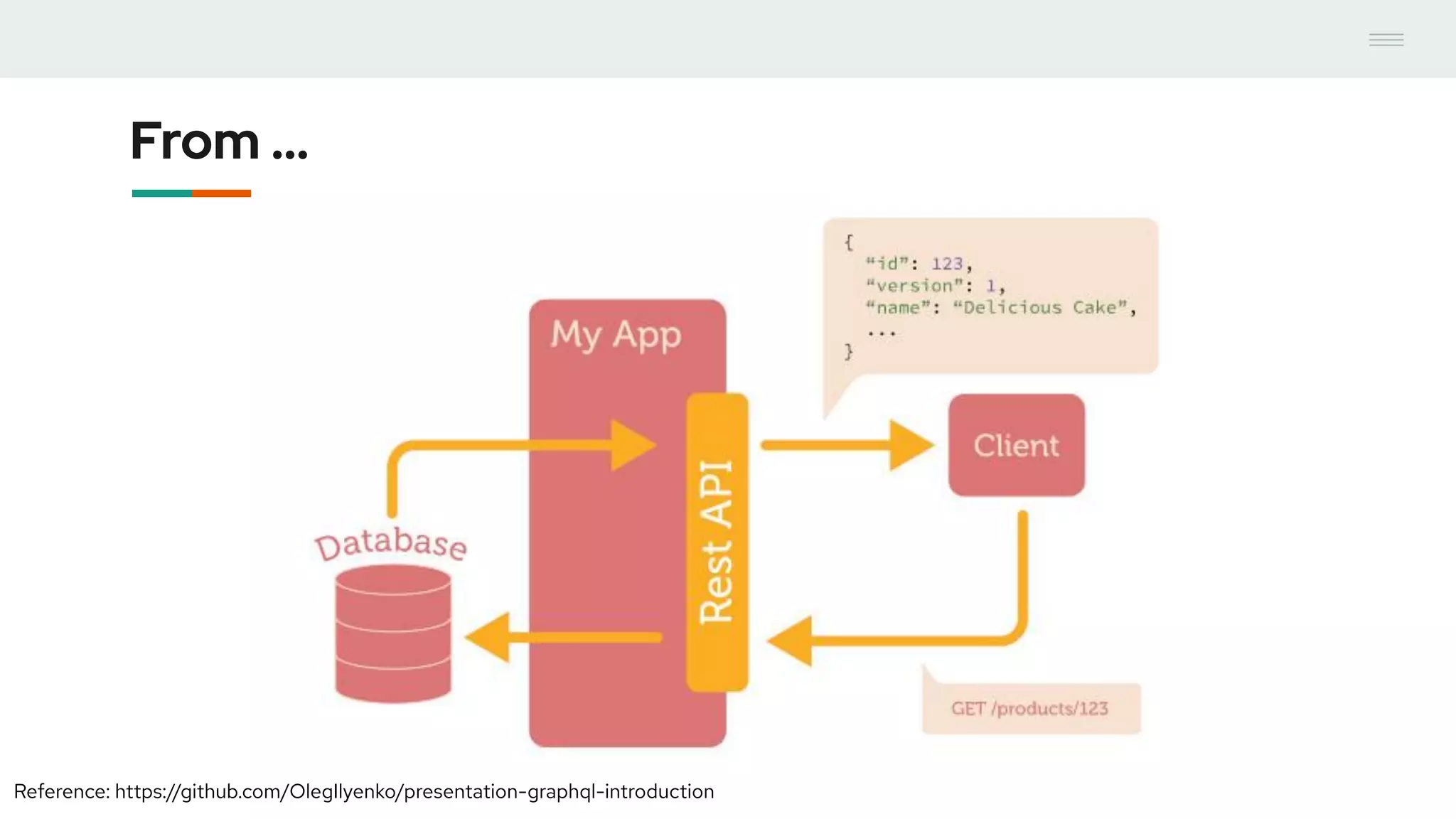
From ...
Reference: https://github.com/OlegIlyenko/presentation-graphql-introduction
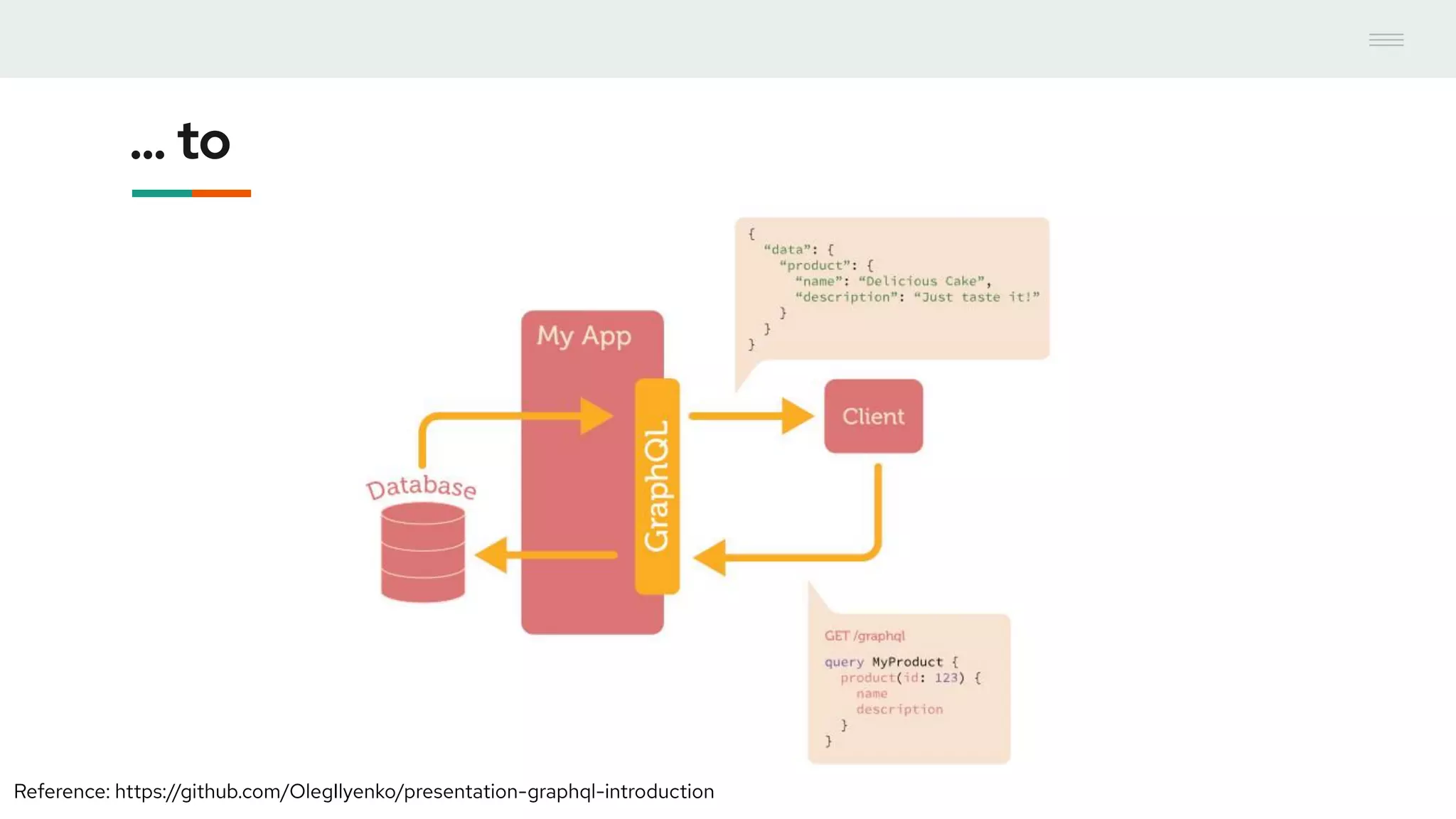
… to
Reference: https://github.com/OlegIlyenko/presentation-graphql-introduction
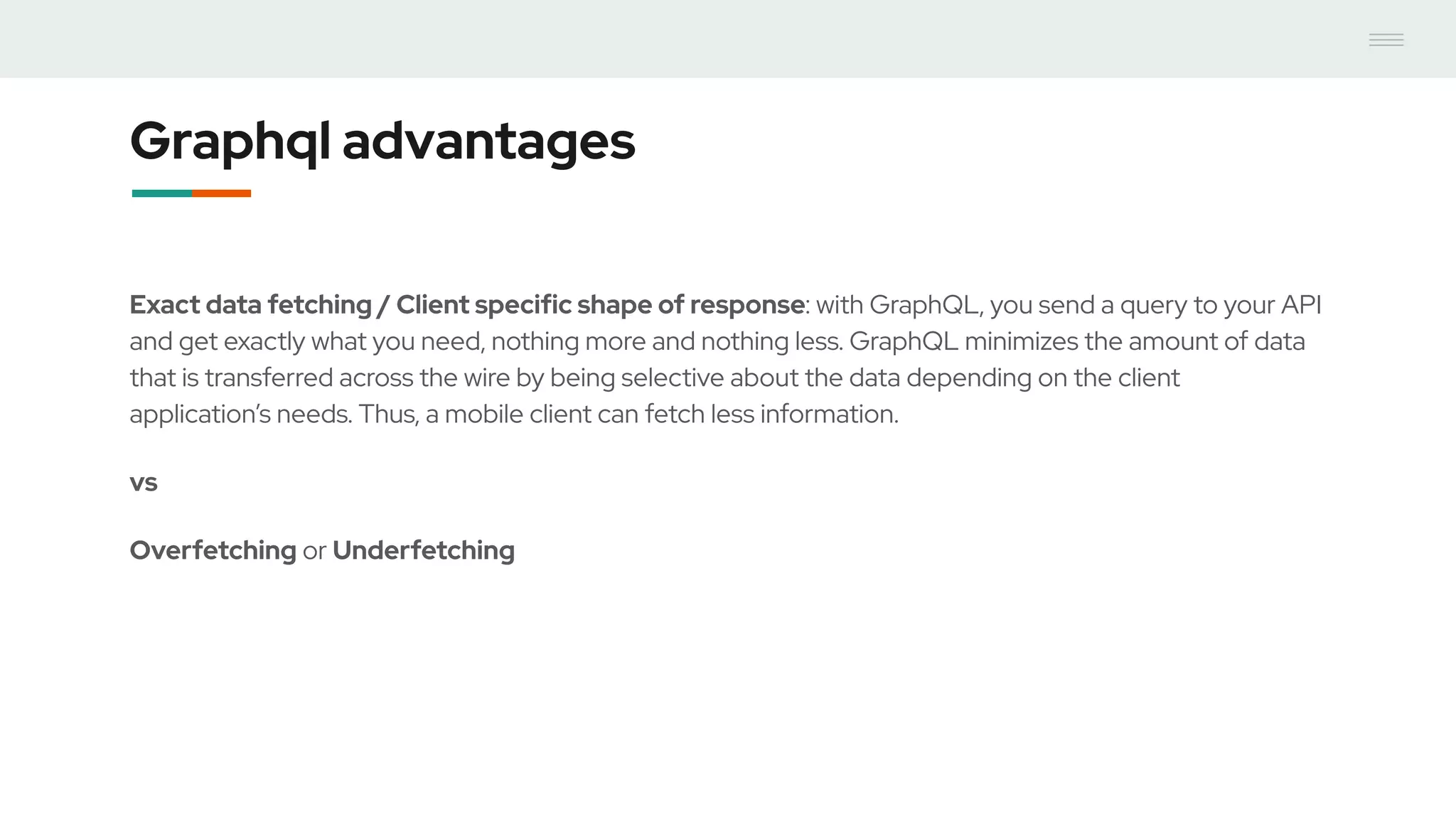
Graphql advantages
Exact data fetching / Client specific shape of response: with GraphQL, you send a query to your API
and get exactly what you need, nothing more and nothing less. GraphQL minimizes the amount of data
that is transferred across the wire by being selective about the data depending on the client
application’s needs. Thus, a mobile client can fetch less information.
vs
Overfetching or Underfetching
Graphql advantages
One request, many resources / network efficiency: it makes it simple to fetch all required data with
one single request. The structure of GraphQL servers makes it possible to declaratively fetch data as it
only exposes a single endpoint.
vs
Multiple requests to get a composite result and Using network as an unlimited resource /
Network inefficient
Graphql advantages
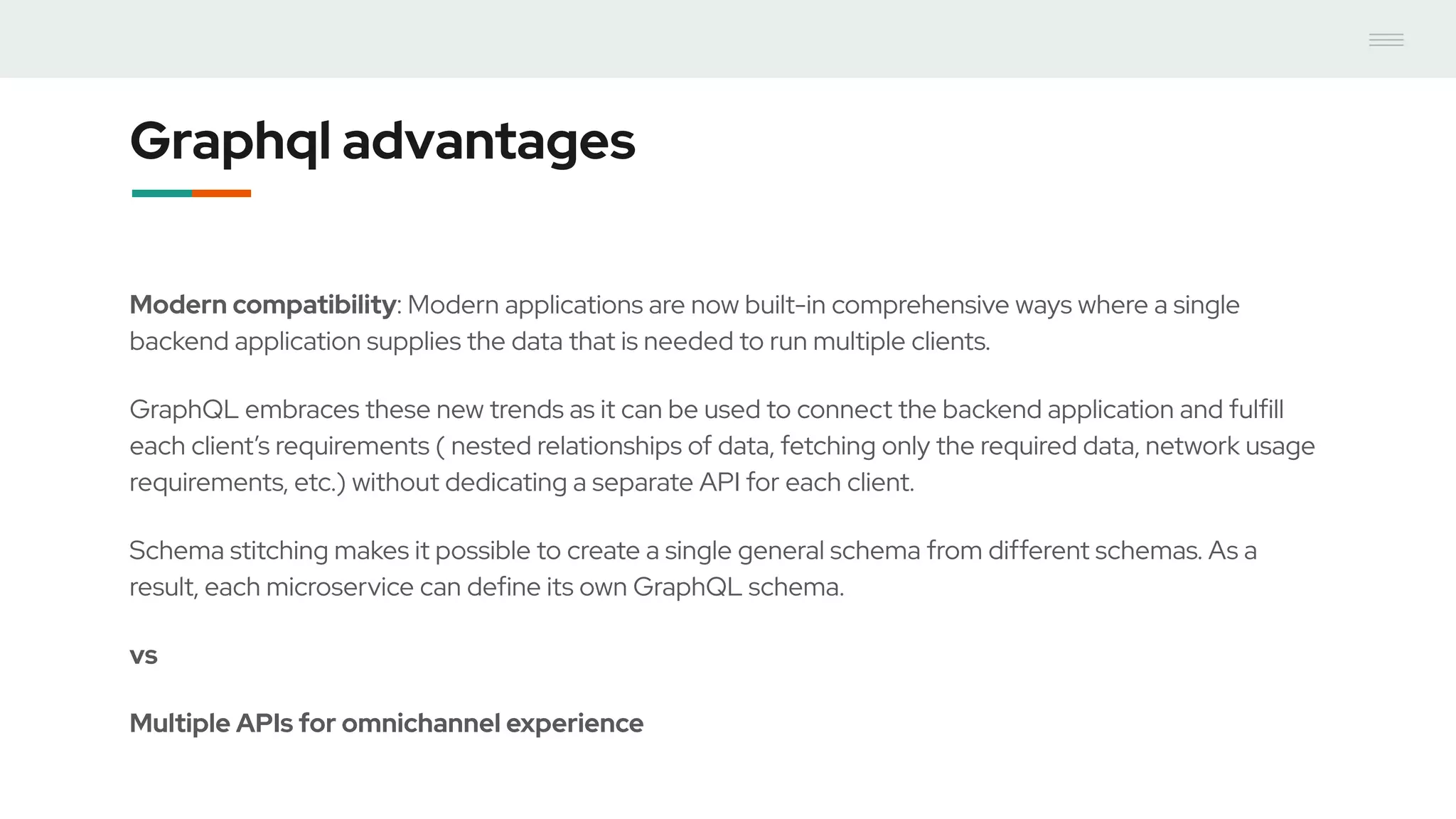
Modern compatibility: Modern applications are now built-in comprehensive ways where a single
backend application supplies the data that is needed to run multiple clients.
GraphQL embraces these new trends as it can be used to connect the backend application and fulfill
each client’s requirements ( nested relationships of data, fetching only the required data, network usage
requirements, etc.) without dedicating a separate API for each client.
Schema stitching makes it possible to create a single general schema from different schemas. As a
result, each microservice can define its own GraphQL schema.
vs
Multiple APIs for omnichannel experience
Graphql advantages
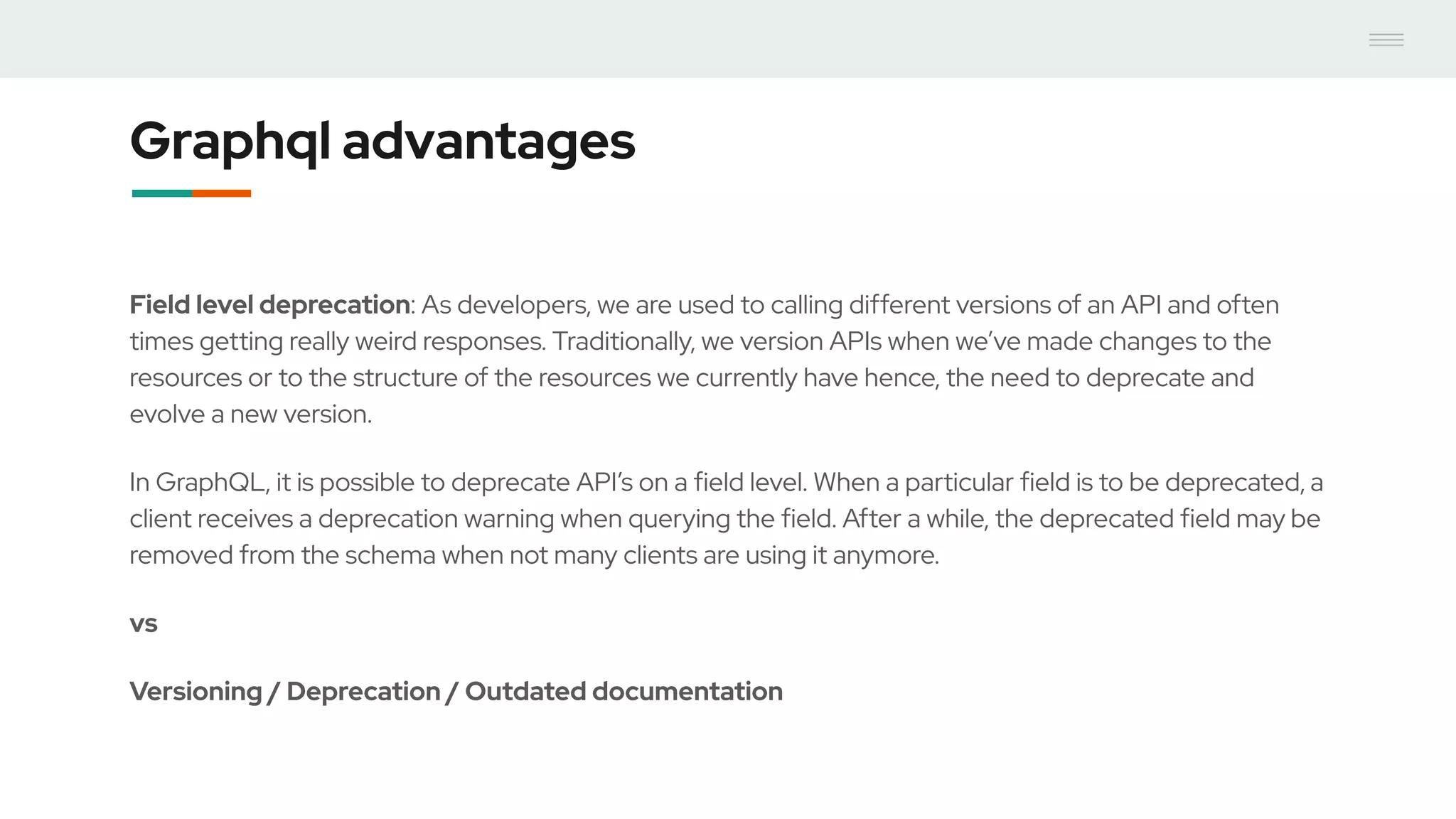
Field level deprecation: As developers, we are used to calling different versions of an API and often
times getting really weird responses. Traditionally, we version APIs when we’ve made changes to the
resources or to the structure of the resources we currently have hence, the need to deprecate and
evolve a new version.
In GraphQL, it is possible to deprecate API’s on a field level. When a particular field is to be deprecated, a
client receives a deprecation warning when querying the field. After a while, the deprecated field may be
removed from the schema when not many clients are using it anymore.
vs
Versioning / Deprecation / Outdated documentation
Possible issues
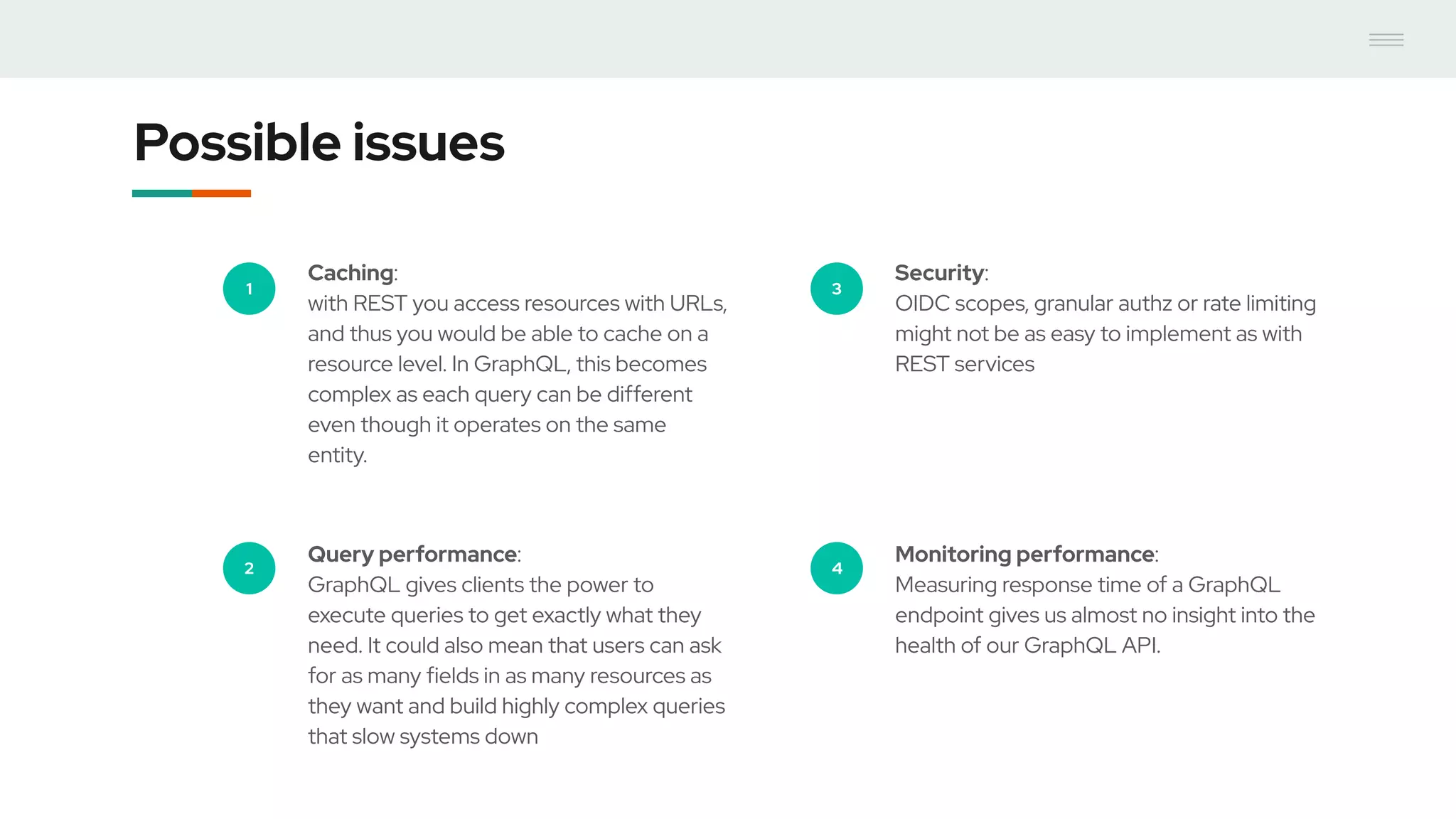
1
Caching:
with REST you access resources with URLs,
and thus you would be able to cache on a
resource level. In GraphQL, this becomes
complex as each query can be different
even though it operates on the same
entity.
2
Query performance:
GraphQL gives clients the power to
execute queries to get exactly what they
need. It could also mean that users can ask
for as many fields in as many resources as
they want and build highly complex queries
that slow systems down
3
Security:
OIDC scopes, granular authz or rate limiting
might not be as easy to implement as with
REST services
4
Monitoring performance:
Measuring response time of a GraphQL
endpoint gives us almost no insight into the
health of our GraphQL API.
Performance Monitoring
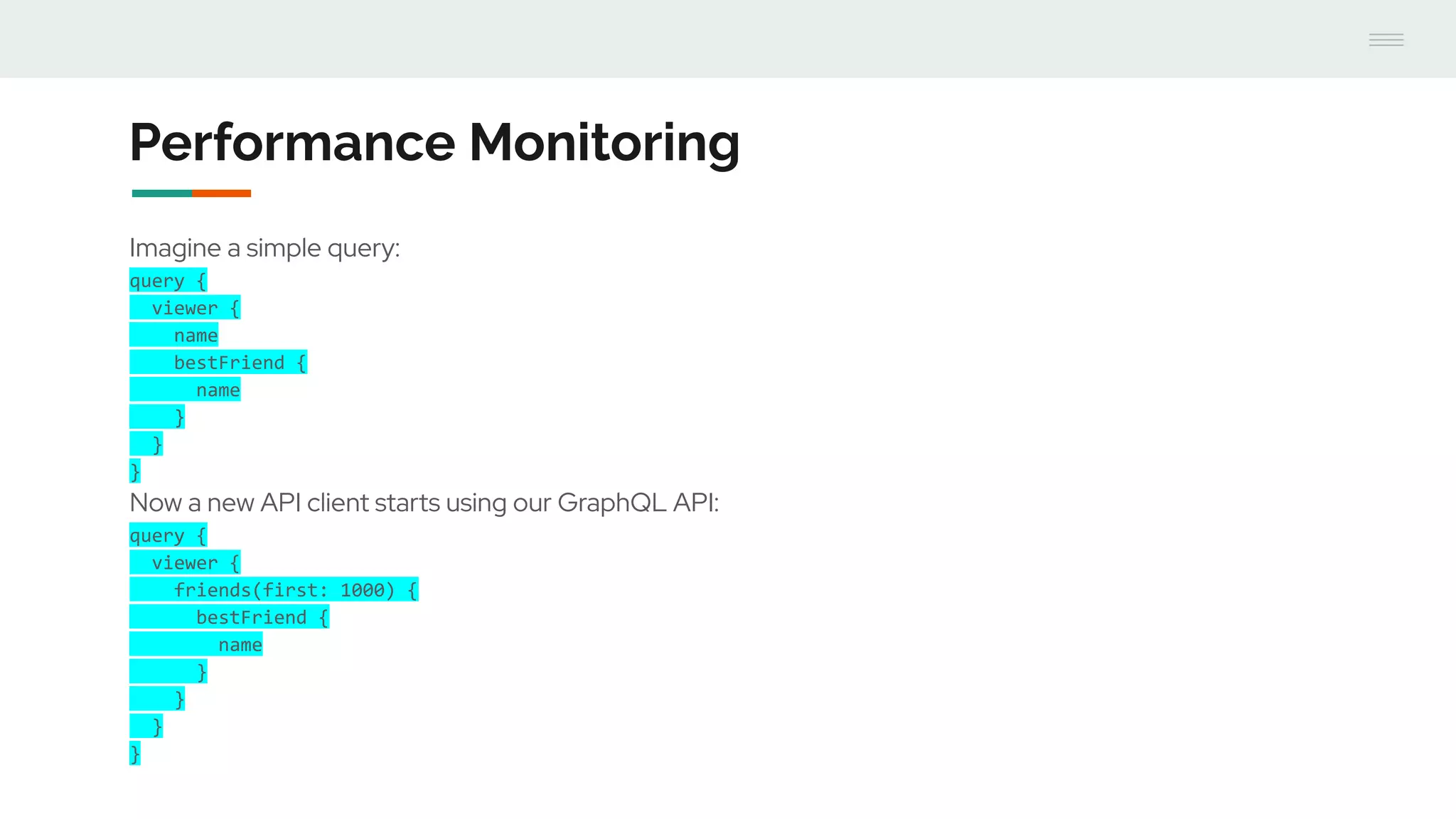
Imagine a simple query:
query {
viewer {
name
bestFriend {
name
}
}
}
Now a new API client starts using our GraphQL API:
query {
viewer {
friends(first: 1000) {
bestFriend {
name
}
}
}
}
Performance Monitoring
● The queries are not so different, but the second one will see a much higher response time
● Response are slower as we serve more and more complex queries
● But what we really would like to know is the general behaviour of our backend given a comparable
workload
● We are not interested in monitoring the endpoint, but the queries.
● If we are running a private Graphql API with known clients we can control the situation, but
otherwise ...
Performance
monitoring
Observability
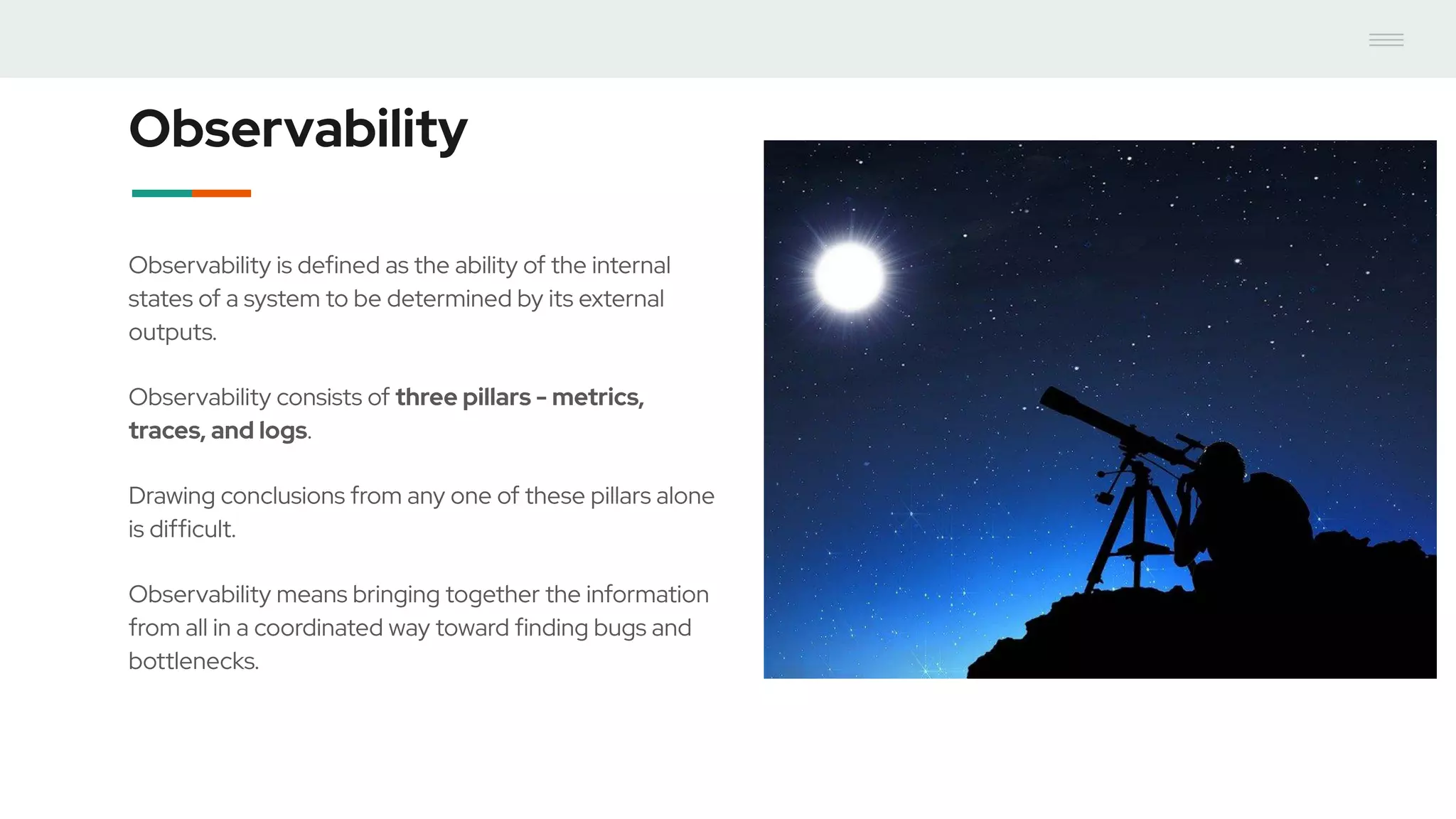
Observability is defined as the ability of the internal
states of a system to be determined by its external
outputs.
Observability consists of three pillars - metrics,
traces, and logs.
Drawing conclusions from any one of these pillars alone
is difficult.
Observability means bringing together the information
from all in a coordinated way toward finding bugs and
bottlenecks.
OpenTracing
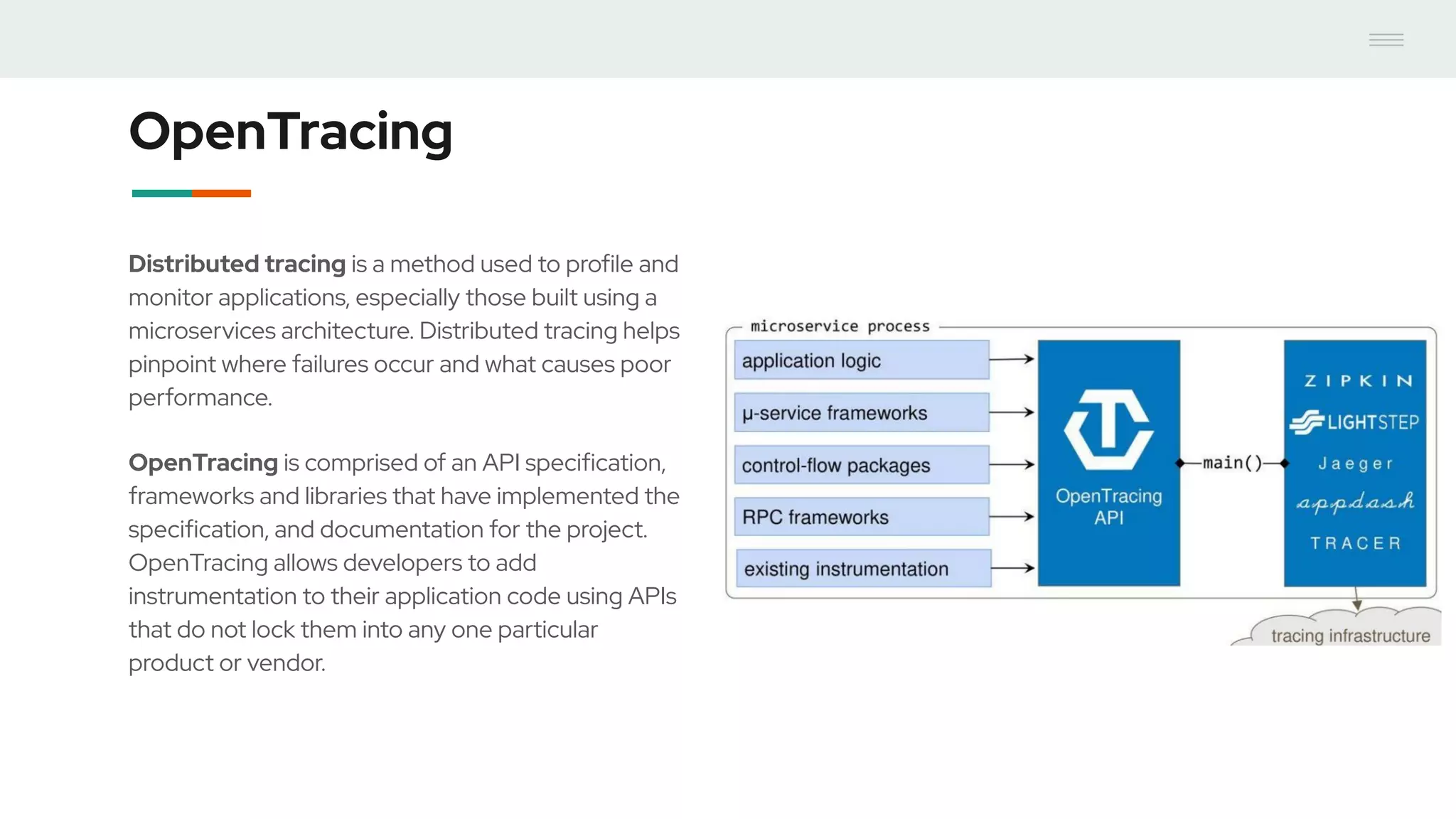
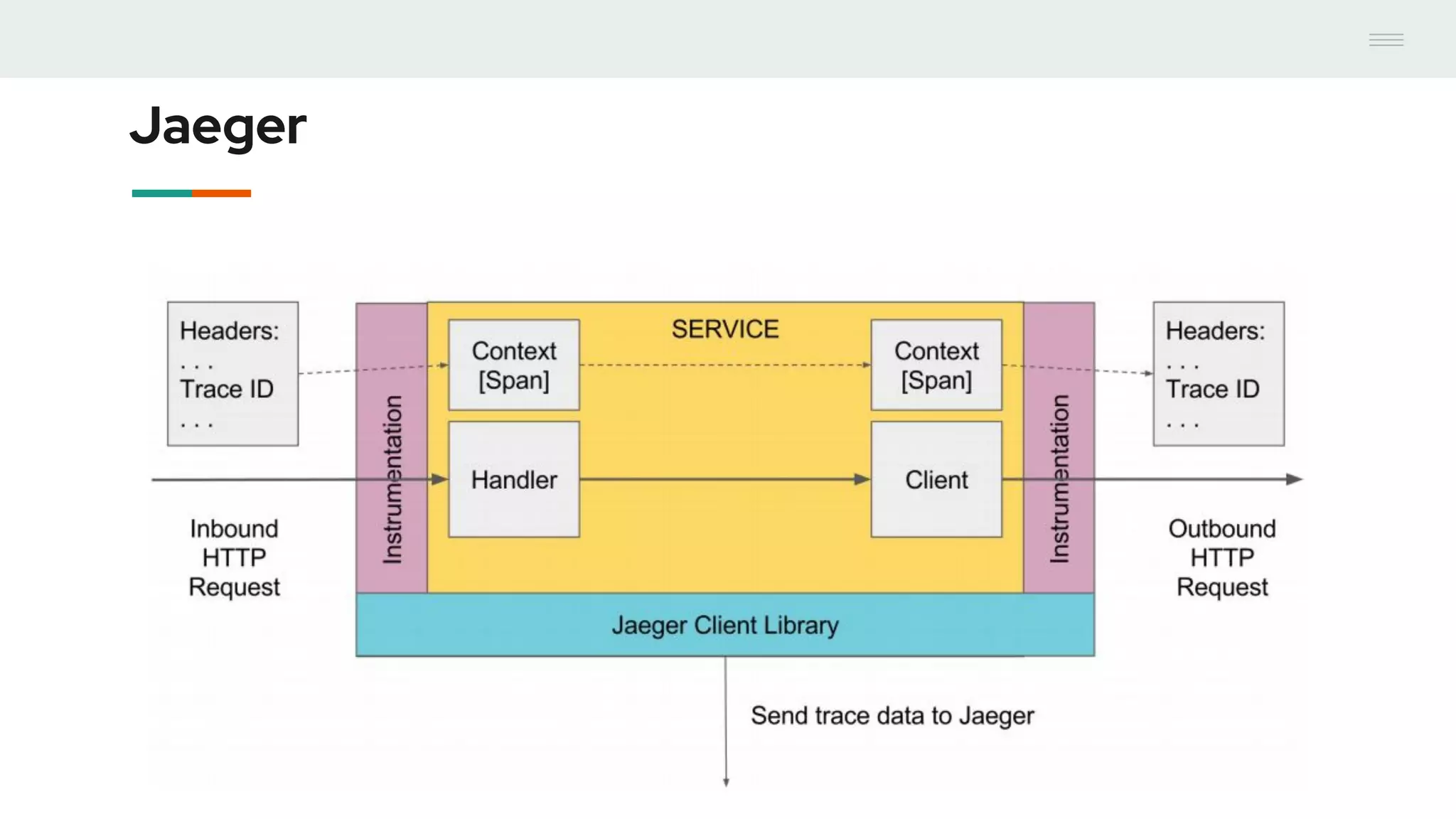
Distributed tracing is a method used to profile and
monitor applications, especially those built using a
microservices architecture. Distributed tracing helps
pinpoint where failures occur and what causes poor
performance.
OpenTracing is comprised of an API specification,
frameworks and libraries that have implemented the
specification, and documentation for the project.
OpenTracing allows developers to add
instrumentation to their application code using APIs
that do not lock them into any one particular
product or vendor.
OpenTracing and OpenCensus have merged to form
OpenTelemetry!
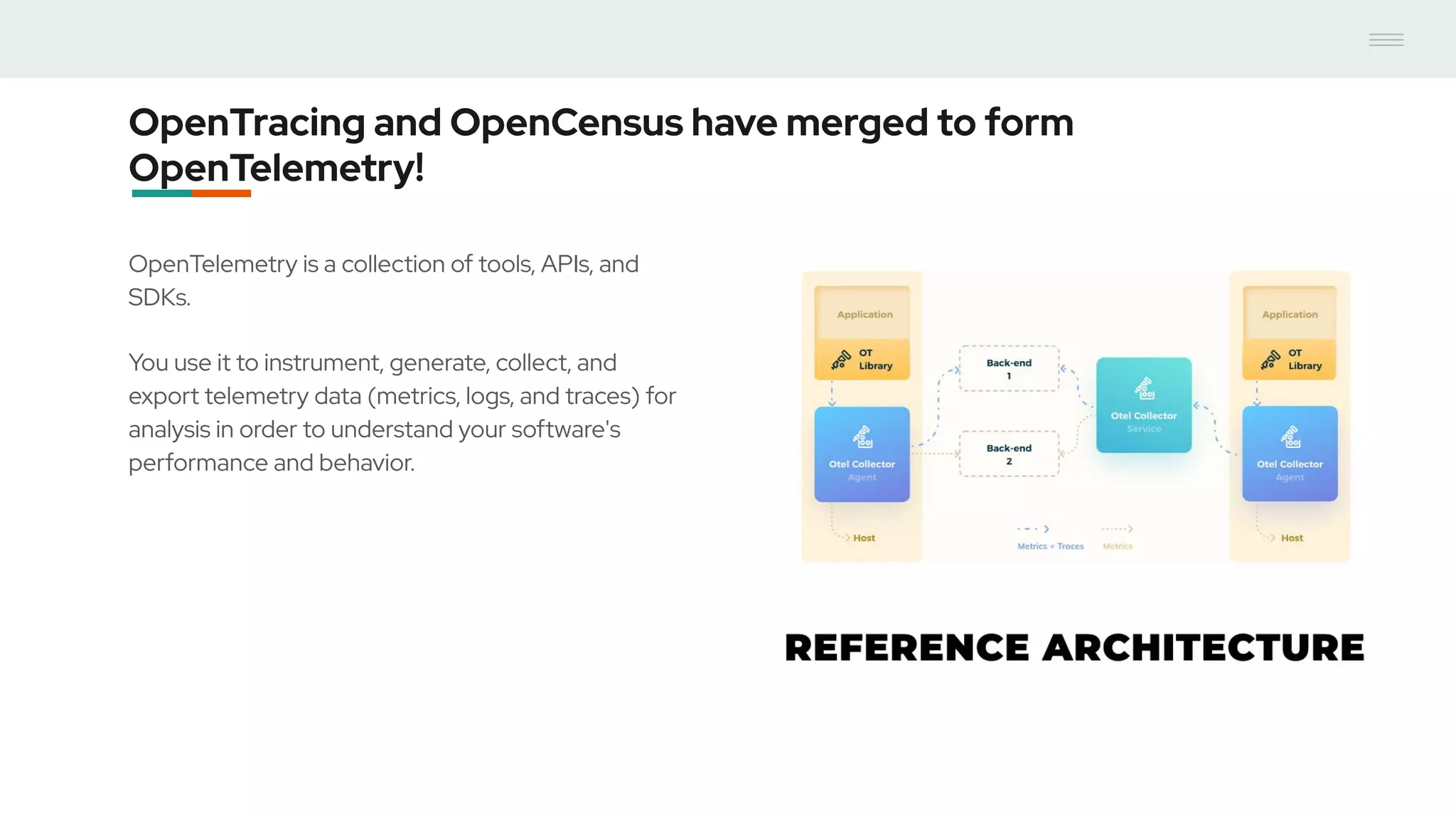
OpenTelemetry is a collection of tools, APIs, and
SDKs.
You use it to instrument, generate, collect, and
export telemetry data (metrics, logs, and traces) for
analysis in order to understand your software's
performance and behavior.
Jaeger
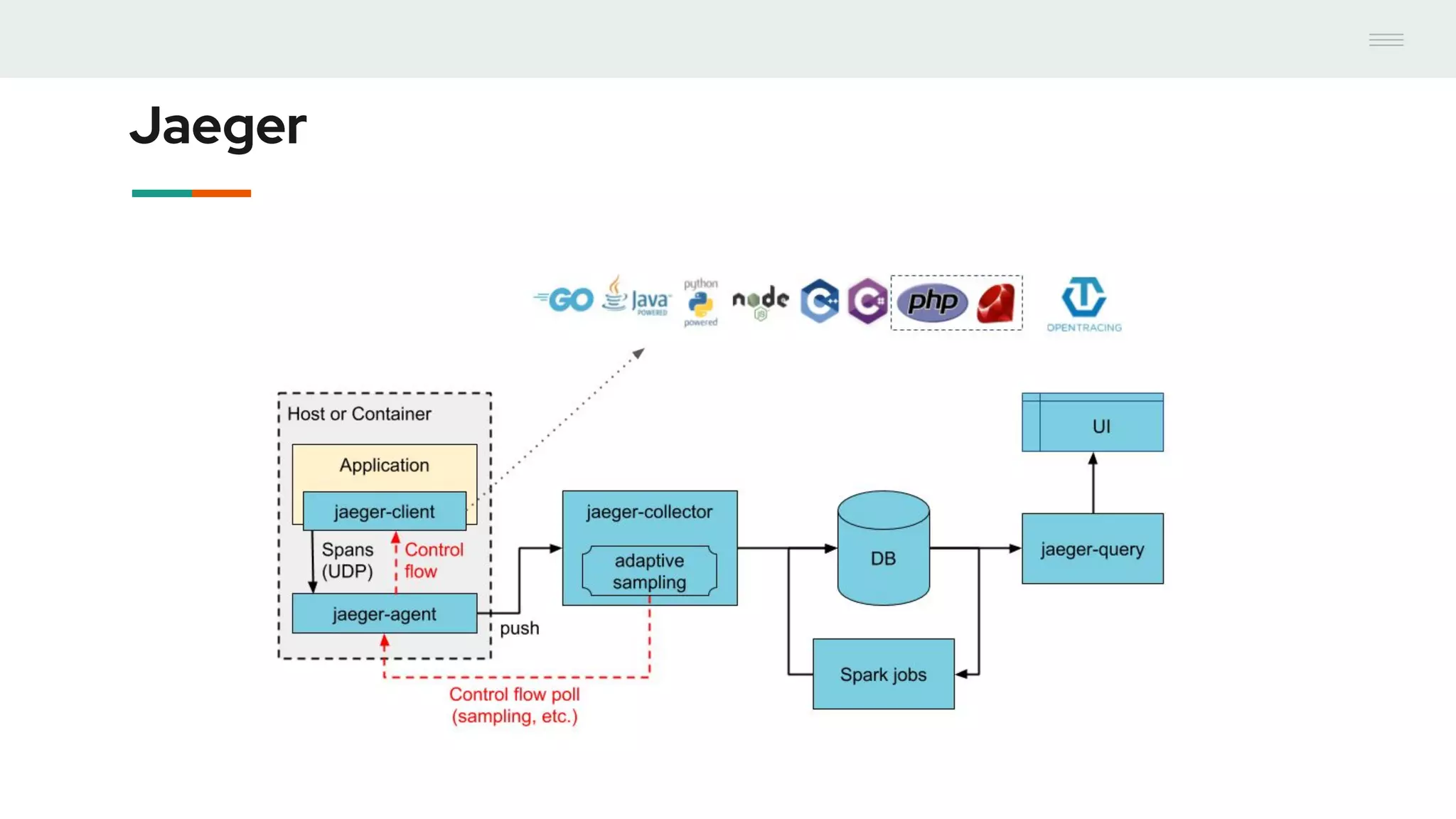
● A product built at Uber
● Inspired by Dapper from Google
● Donated to CNCF
● Supported libraries in Go, Java, Node.js, Python, C++, C#
● Accepts span in Zipkin format for backward compatibility
● Emit prometheus metrics
Jaeger
Jaeger
Possible
solutions
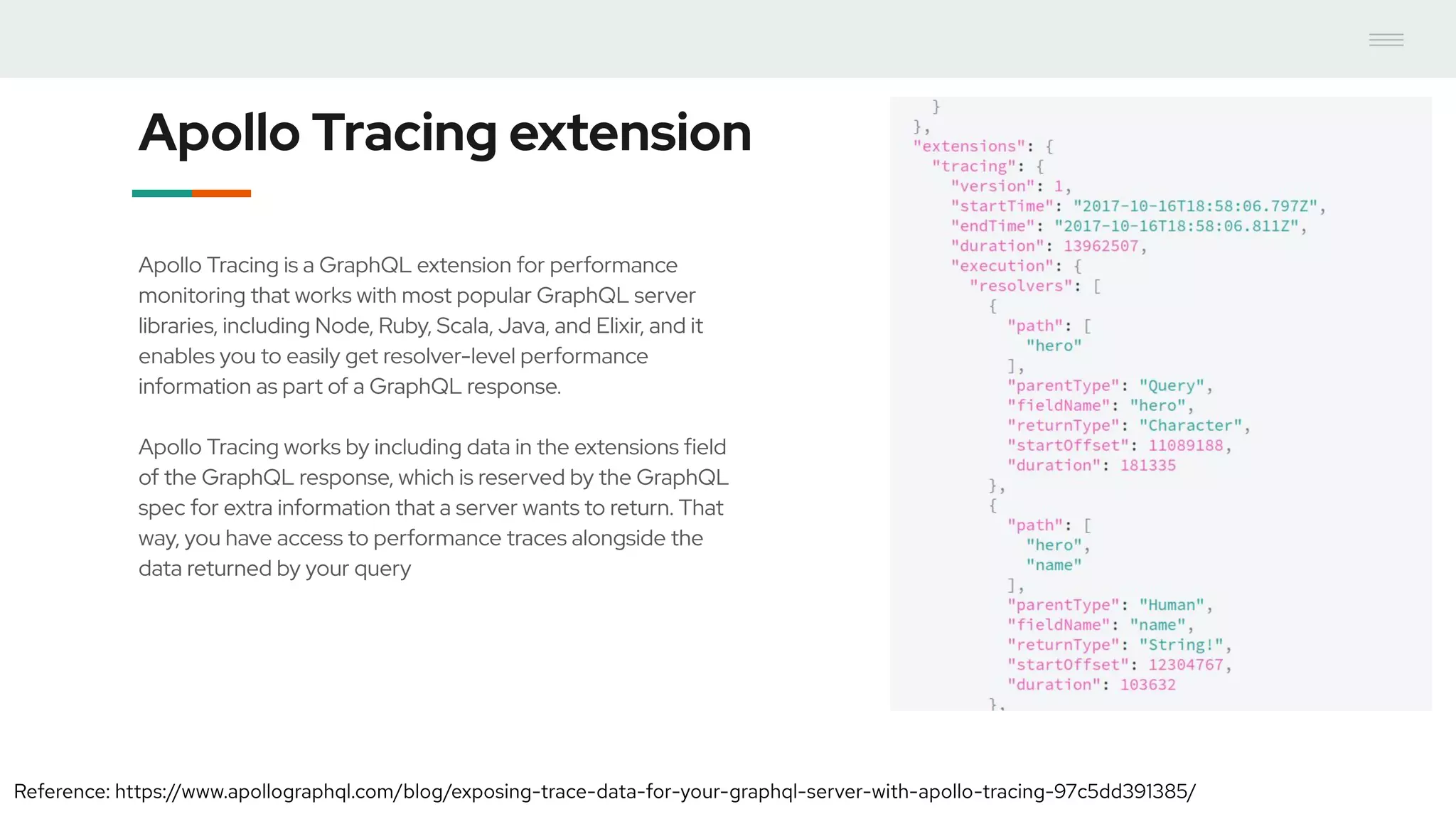
Apollo Tracing extension
Apollo Tracing is a GraphQL extension for performance
monitoring that works with most popular GraphQL server
libraries, including Node, Ruby, Scala, Java, and Elixir, and it
enables you to easily get resolver-level performance
information as part of a GraphQL response.
Apollo Tracing works by including data in the extensions field
of the GraphQL response, which is reserved by the GraphQL
spec for extra information that a server wants to return. That
way, you have access to performance traces alongside the
data returned by your query
Reference: https://www.apollographql.com/blog/exposing-trace-data-for-your-graphql-server-with-apollo-tracing-97c5dd391385/
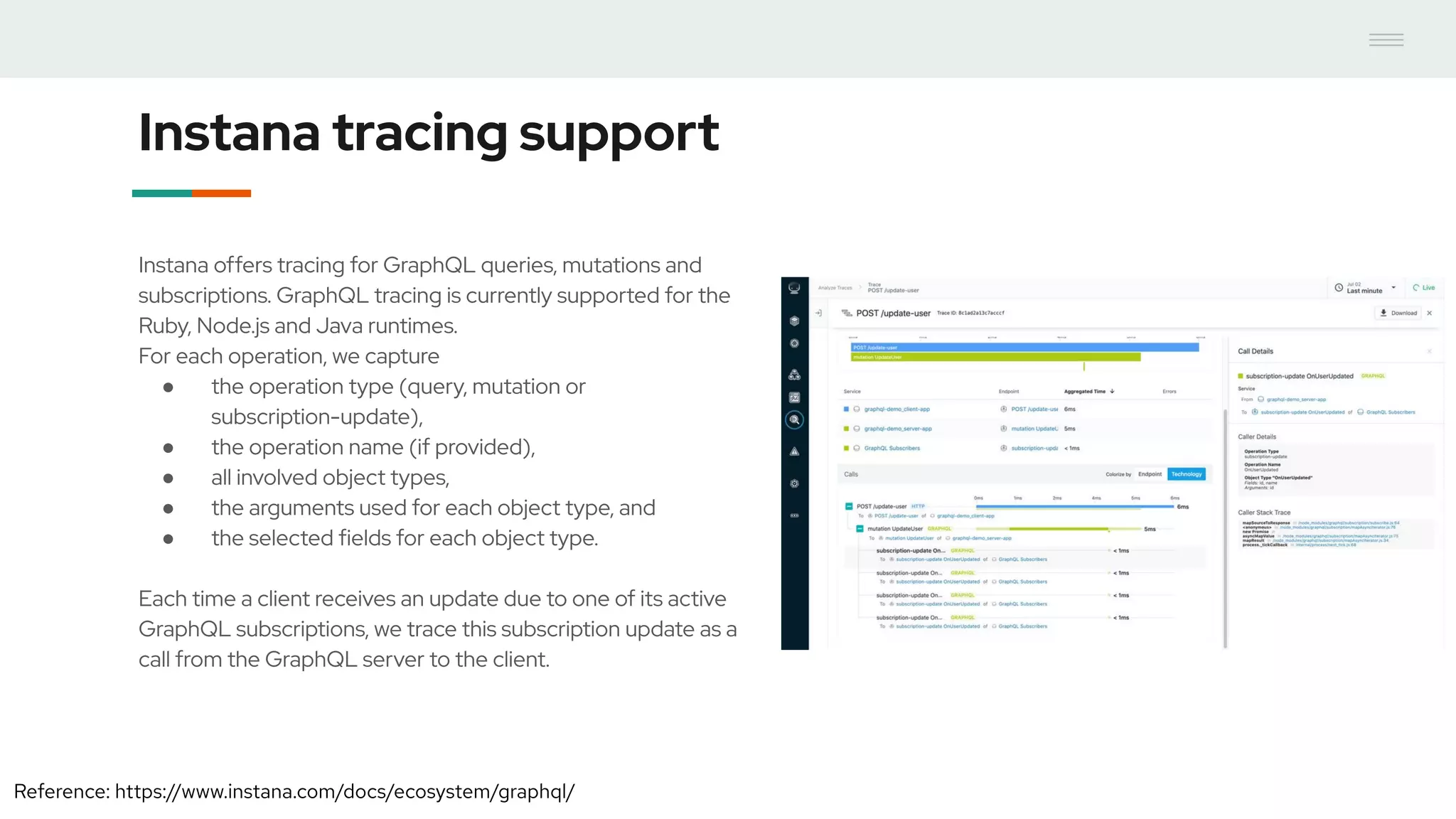
Instana tracing support
Instana offers tracing for GraphQL queries, mutations and
subscriptions. GraphQL tracing is currently supported for the
Ruby, Node.js and Java runtimes.
For each operation, we capture
● the operation type (query, mutation or
subscription-update),
● the operation name (if provided),
● all involved object types,
● the arguments used for each object type, and
● the selected fields for each object type.
Each time a client receives an update due to one of its active
GraphQL subscriptions, we trace this subscription update as a
call from the GraphQL server to the client.
Reference: https://www.instana.com/docs/ecosystem/graphql/
DataDog tracer plugin
DataDog Javascript Tracer provides out-of-the-box
instrumentation for many popular frameworks and libraries
by using a plugin system. By default all built-in plugins are
enabled.
This library is OpenTracing compliant. Use the OpenTracing
API and the Datadog Tracer (dd-trace) library to measure
execution times for specific pieces of code.
This plugin automatically instruments the graphql module.
The graphql integration uses the operation name as the span
resource name. If no operation name is set, the resource
name will always be just query, mutation or subscription.
Reference: https://datadoghq.dev/dd-trace-js/
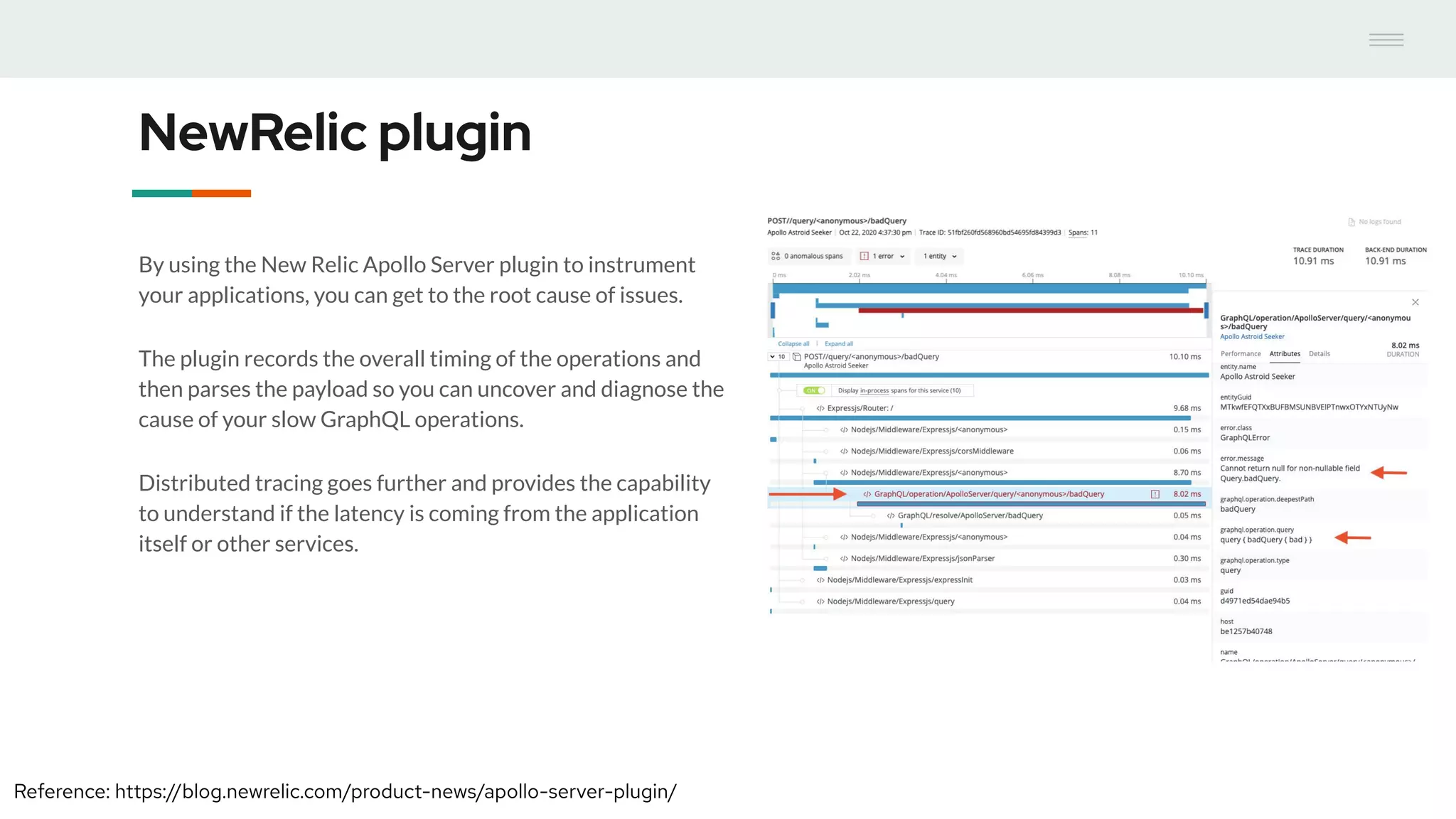
NewRelic plugin
By using the New Relic Apollo Server plugin to instrument
your applications, you can get to the root cause of issues.
The plugin records the overall timing of the operations and
then parses the payload so you can uncover and diagnose the
cause of your slow GraphQL operations.
Distributed tracing goes further and provides the capability
to understand if the latency is coming from the application
itself or other services.
Reference: https://blog.newrelic.com/product-news/apollo-server-plugin/
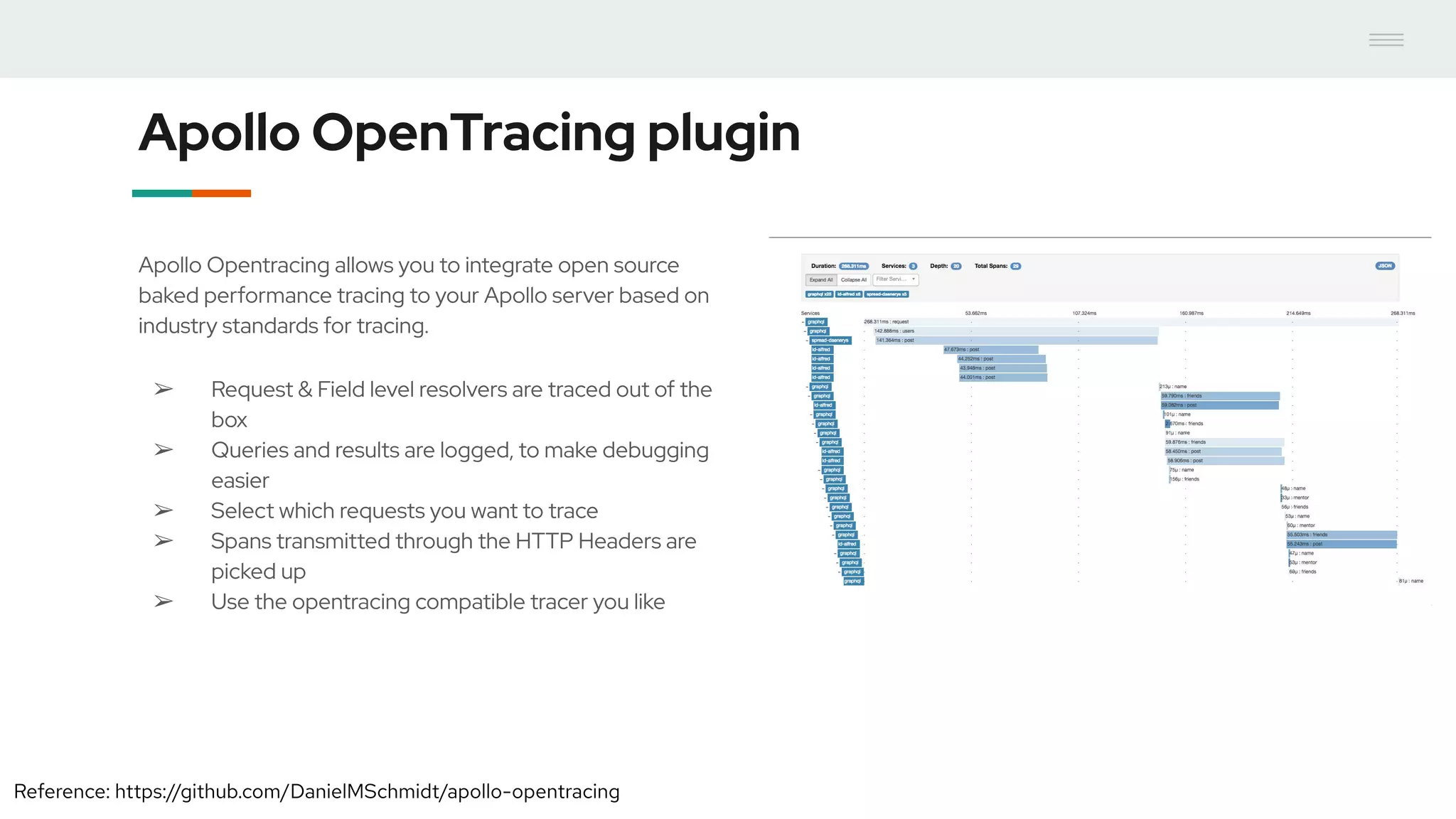
Apollo OpenTracing plugin
Apollo Opentracing allows you to integrate open source
baked performance tracing to your Apollo server based on
industry standards for tracing.
➢ Request & Field level resolvers are traced out of the
box
➢ Queries and results are logged, to make debugging
easier
➢ Select which requests you want to trace
➢ Spans transmitted through the HTTP Headers are
picked up
➢ Use the opentracing compatible tracer you like
Reference: https://github.com/DanielMSchmidt/apollo-opentracing
Demo
Apollo server
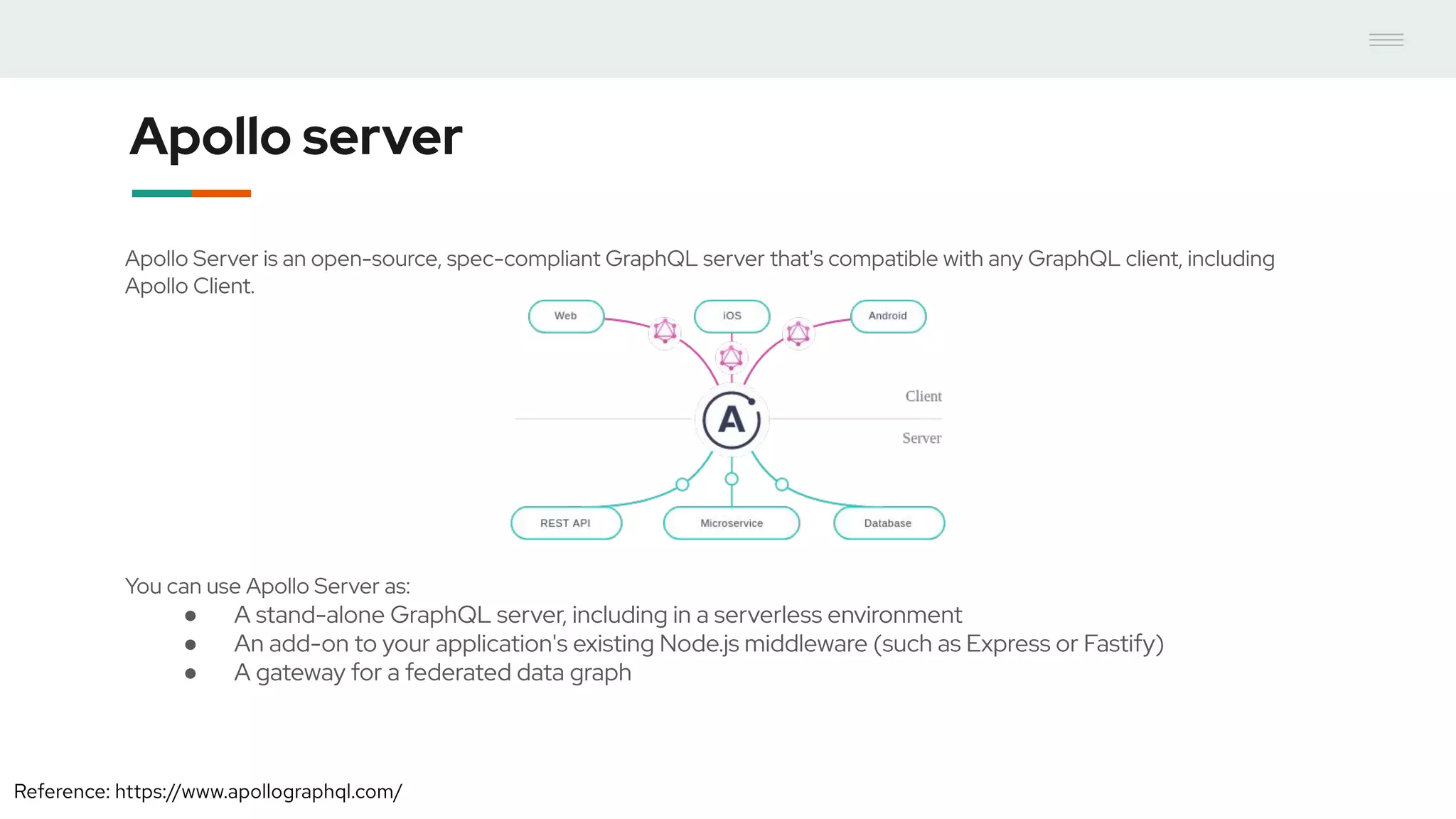
Apollo Server is an open-source, spec-compliant GraphQL server that's compatible with any GraphQL client, including
Apollo Client.
You can use Apollo Server as:
● A stand-alone GraphQL server, including in a serverless environment
● An add-on to your application's existing Node.js middleware (such as Express or Fastify)
● A gateway for a federated data graph
Reference: https://www.apollographql.com/
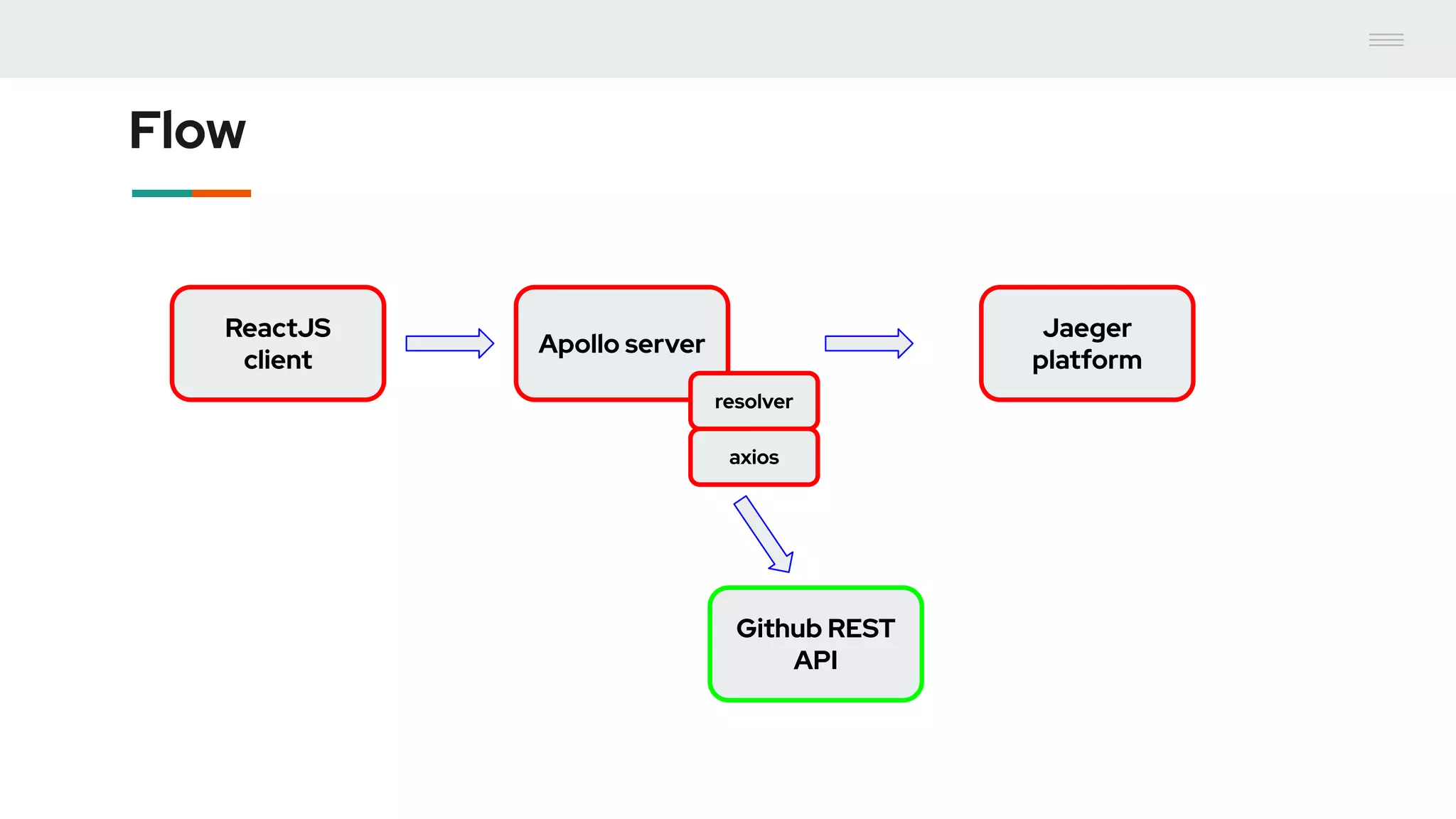
Components
1. Apollo server with OpenTracing plugin
2. ReactJS client
3. Jaeger platform
Flow
ReactJS
client
Apollo server
resolver
axios
Github REST
API
Jaeger
platform
Demo time!
Demo time!
What just happened?
Feedbacks ?
Comments ?
Thank you

How easy (or hard) it is to monitor your graph ql service performance

  • 1.
    Public Produced byLuca Ferrari Version 0.9 How easy (or hard) it is to monitor your GraphQL service performance by Luca Ferrari EMEA Solution Architect in Red Hat
  • 2.
    Public Prepared byLuca Ferrari Version 0.9 Agenda graphql { what { challenges solutions } possible { demo } questions(limit: None) { answers(0:N) } }
  • 3.
    Graphql boring definition GraphQLis a query language for APIs and a runtime for fulfilling those queries with your existing data. GraphQL provides a complete and understandable description of the data in your API as well as gives clients the power to ask for exactly what they need and nothing more. It simplifies evolving APIs over time and enables powerful developer tools Reference: graphql.org/learn
  • 4.
    Quote With great powercomes great responsibility Reference: graphql.org/learn
  • 5.
    Quote With great powercomes great responsibility Voltaire Reference: graphql.org/learn
  • 6.
  • 7.
  • 8.
    Graphql advantages Exact datafetching / Client specific shape of response: with GraphQL, you send a query to your API and get exactly what you need, nothing more and nothing less. GraphQL minimizes the amount of data that is transferred across the wire by being selective about the data depending on the client application’s needs. Thus, a mobile client can fetch less information. vs Overfetching or Underfetching
  • 9.
    Graphql advantages One request,many resources / network efficiency: it makes it simple to fetch all required data with one single request. The structure of GraphQL servers makes it possible to declaratively fetch data as it only exposes a single endpoint. vs Multiple requests to get a composite result and Using network as an unlimited resource / Network inefficient
  • 10.
    Graphql advantages Modern compatibility:Modern applications are now built-in comprehensive ways where a single backend application supplies the data that is needed to run multiple clients. GraphQL embraces these new trends as it can be used to connect the backend application and fulfill each client’s requirements ( nested relationships of data, fetching only the required data, network usage requirements, etc.) without dedicating a separate API for each client. Schema stitching makes it possible to create a single general schema from different schemas. As a result, each microservice can define its own GraphQL schema. vs Multiple APIs for omnichannel experience
  • 11.
    Graphql advantages Field leveldeprecation: As developers, we are used to calling different versions of an API and often times getting really weird responses. Traditionally, we version APIs when we’ve made changes to the resources or to the structure of the resources we currently have hence, the need to deprecate and evolve a new version. In GraphQL, it is possible to deprecate API’s on a field level. When a particular field is to be deprecated, a client receives a deprecation warning when querying the field. After a while, the deprecated field may be removed from the schema when not many clients are using it anymore. vs Versioning / Deprecation / Outdated documentation
  • 12.
    Possible issues 1 Caching: with RESTyou access resources with URLs, and thus you would be able to cache on a resource level. In GraphQL, this becomes complex as each query can be different even though it operates on the same entity. 2 Query performance: GraphQL gives clients the power to execute queries to get exactly what they need. It could also mean that users can ask for as many fields in as many resources as they want and build highly complex queries that slow systems down 3 Security: OIDC scopes, granular authz or rate limiting might not be as easy to implement as with REST services 4 Monitoring performance: Measuring response time of a GraphQL endpoint gives us almost no insight into the health of our GraphQL API.
  • 13.
    Performance Monitoring Imagine asimple query: query { viewer { name bestFriend { name } } } Now a new API client starts using our GraphQL API: query { viewer { friends(first: 1000) { bestFriend { name } } } }
  • 14.
    Performance Monitoring ● Thequeries are not so different, but the second one will see a much higher response time ● Response are slower as we serve more and more complex queries ● But what we really would like to know is the general behaviour of our backend given a comparable workload ● We are not interested in monitoring the endpoint, but the queries. ● If we are running a private Graphql API with known clients we can control the situation, but otherwise ...
  • 15.
  • 16.
    Observability Observability is definedas the ability of the internal states of a system to be determined by its external outputs. Observability consists of three pillars - metrics, traces, and logs. Drawing conclusions from any one of these pillars alone is difficult. Observability means bringing together the information from all in a coordinated way toward finding bugs and bottlenecks.
  • 17.
    OpenTracing Distributed tracing isa method used to profile and monitor applications, especially those built using a microservices architecture. Distributed tracing helps pinpoint where failures occur and what causes poor performance. OpenTracing is comprised of an API specification, frameworks and libraries that have implemented the specification, and documentation for the project. OpenTracing allows developers to add instrumentation to their application code using APIs that do not lock them into any one particular product or vendor.
  • 18.
    OpenTracing and OpenCensushave merged to form OpenTelemetry! OpenTelemetry is a collection of tools, APIs, and SDKs. You use it to instrument, generate, collect, and export telemetry data (metrics, logs, and traces) for analysis in order to understand your software's performance and behavior.
  • 19.
    Jaeger ● A productbuilt at Uber ● Inspired by Dapper from Google ● Donated to CNCF ● Supported libraries in Go, Java, Node.js, Python, C++, C# ● Accepts span in Zipkin format for backward compatibility ● Emit prometheus metrics
  • 20.
  • 21.
  • 22.
  • 23.
    Apollo Tracing extension ApolloTracing is a GraphQL extension for performance monitoring that works with most popular GraphQL server libraries, including Node, Ruby, Scala, Java, and Elixir, and it enables you to easily get resolver-level performance information as part of a GraphQL response. Apollo Tracing works by including data in the extensions field of the GraphQL response, which is reserved by the GraphQL spec for extra information that a server wants to return. That way, you have access to performance traces alongside the data returned by your query Reference: https://www.apollographql.com/blog/exposing-trace-data-for-your-graphql-server-with-apollo-tracing-97c5dd391385/
  • 24.
    Instana tracing support Instanaoffers tracing for GraphQL queries, mutations and subscriptions. GraphQL tracing is currently supported for the Ruby, Node.js and Java runtimes. For each operation, we capture ● the operation type (query, mutation or subscription-update), ● the operation name (if provided), ● all involved object types, ● the arguments used for each object type, and ● the selected fields for each object type. Each time a client receives an update due to one of its active GraphQL subscriptions, we trace this subscription update as a call from the GraphQL server to the client. Reference: https://www.instana.com/docs/ecosystem/graphql/
  • 25.
    DataDog tracer plugin DataDogJavascript Tracer provides out-of-the-box instrumentation for many popular frameworks and libraries by using a plugin system. By default all built-in plugins are enabled. This library is OpenTracing compliant. Use the OpenTracing API and the Datadog Tracer (dd-trace) library to measure execution times for specific pieces of code. This plugin automatically instruments the graphql module. The graphql integration uses the operation name as the span resource name. If no operation name is set, the resource name will always be just query, mutation or subscription. Reference: https://datadoghq.dev/dd-trace-js/
  • 26.
    NewRelic plugin By usingthe New Relic Apollo Server plugin to instrument your applications, you can get to the root cause of issues. The plugin records the overall timing of the operations and then parses the payload so you can uncover and diagnose the cause of your slow GraphQL operations. Distributed tracing goes further and provides the capability to understand if the latency is coming from the application itself or other services. Reference: https://blog.newrelic.com/product-news/apollo-server-plugin/
  • 27.
    Apollo OpenTracing plugin ApolloOpentracing allows you to integrate open source baked performance tracing to your Apollo server based on industry standards for tracing. ➢ Request & Field level resolvers are traced out of the box ➢ Queries and results are logged, to make debugging easier ➢ Select which requests you want to trace ➢ Spans transmitted through the HTTP Headers are picked up ➢ Use the opentracing compatible tracer you like Reference: https://github.com/DanielMSchmidt/apollo-opentracing
  • 28.
  • 29.
    Apollo server Apollo Serveris an open-source, spec-compliant GraphQL server that's compatible with any GraphQL client, including Apollo Client. You can use Apollo Server as: ● A stand-alone GraphQL server, including in a serverless environment ● An add-on to your application's existing Node.js middleware (such as Express or Fastify) ● A gateway for a federated data graph Reference: https://www.apollographql.com/
  • 30.
    Components 1. Apollo serverwith OpenTracing plugin 2. ReactJS client 3. Jaeger platform
  • 31.
  • 32.
  • 33.
  • 34.
  • 35.