How does your media
product represent
particular social groups?
How have you represented the characters
in your film?
The robber is a young person and Santa is shown as being old which
represents how age is shown in Christmas films and how Santa has always
classically been an older person. The Robber was able to kidnap Santa
because his age means he is a stronger person. Santa is funny and still
quite athletic for an older person which is not typical of a Christmas film.
The Elf is a female which represents gender differences and how the
main character is often a male and females were seen as sidekicks.
The Robber is not a traditional Christmas film character so is shown at the
beginning of our film so that the audience can tell straight away that our
film is different to other Christmas films. The Elf and Santa are shown in the
first scene because it allows us to portray our film as a Christmas film to
the audience.
Is it positive or negative
representation?
The representation of the Elf being a woman is negative because women are
often seen as sidekicks in films and men often play the lead role.
The Robber is wearing a hoodie which is a negative representation of crime
taking place by people wearing hoodies. There are many stereotypes of
teenagers in hoods committing crimes and our film is one many that fuels this
stereotype.
Although Santa is shown as being quite athletic for an older person which
represents older people in a positive way.
Did you use stereotypes?
We did use some stereotypes in our film because it helps the audience recognise
it as a Christmas film. Santa is always stereotyped as being quite an old, fat,
bearded man. We kept this stereotype as it is vital in a children’s Christmas film.
We did not keep the traditional stereotype of the elf idolising Santa and being
controlled by him but finding him a bit annoying instead. The elf is also dressed as
a traditional character because it allows the audience to identify that character.
We showed these stereotypes through costume but changed the props around
so that they are not as traditional, such as the elf wearing headphones.
We also kept the traditional Christmas setting of a middle-class family home.
How did you position the audience?
Our target audience is families because it is a family film and is suitable for
everyone. Specifically, we are aiming it at teenage boys and older children
because we thing the comedy, fight scenes and storyline will appeal to them
the most.
Our audience is positioned so that they sympathise with Santa and want to
save Christmas. Jack Frost and the Robber are portrayed as being the ‘bad
guys’ whilst Santa and the elves are the ‘goodies’.
What technical skills helped you
construct representation of your
characters?
We were able to use technical skills to construct representations of our
characters. We represented Santa and the Elf through traditional Santa and
Elf costumes by basing them on similar films from this genre.
We used dark clothes to represent the Robber as mysterious and used the
stereotype of him wearing a hoodie so that people can easily figure out that
he is a Robber and not one of the good people.
Similar films
We have compared our Santa with the Santa's in other films. In the film Santa
Clause and Miracle on 34th Street the Santa’s face a different problems,
not being captured by Jack Frost and a Robber. Santa is the main
character in both of these films, whereas Jack Frost is the main character
in ours.
Santa Clause is about proving that Santa is real and Miracle on 34th Street is
about proving that a character actually is Santa. Our film is completely
different to these because it is about saving Santa and not proving
whether he is real.
Similar characters
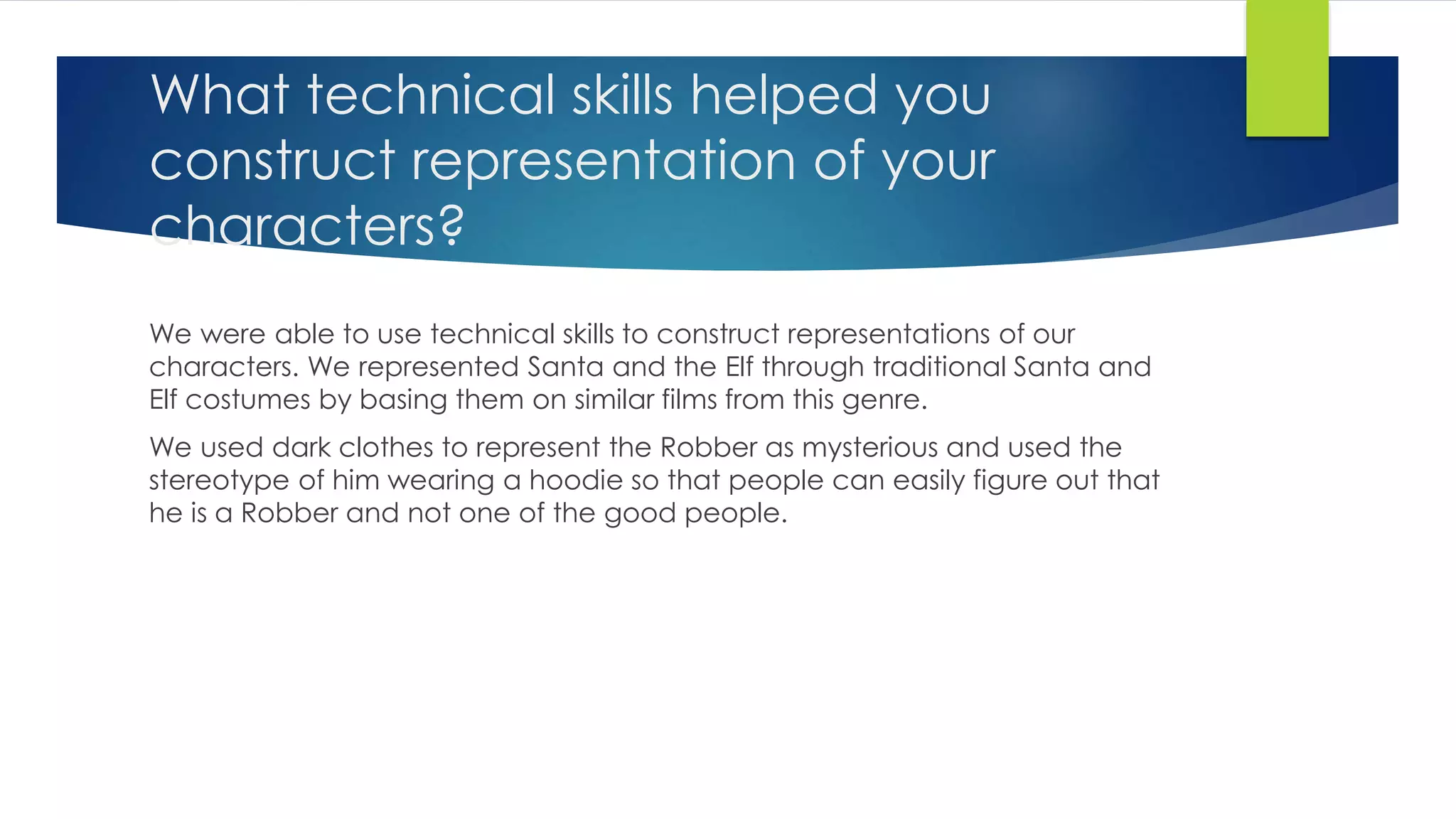
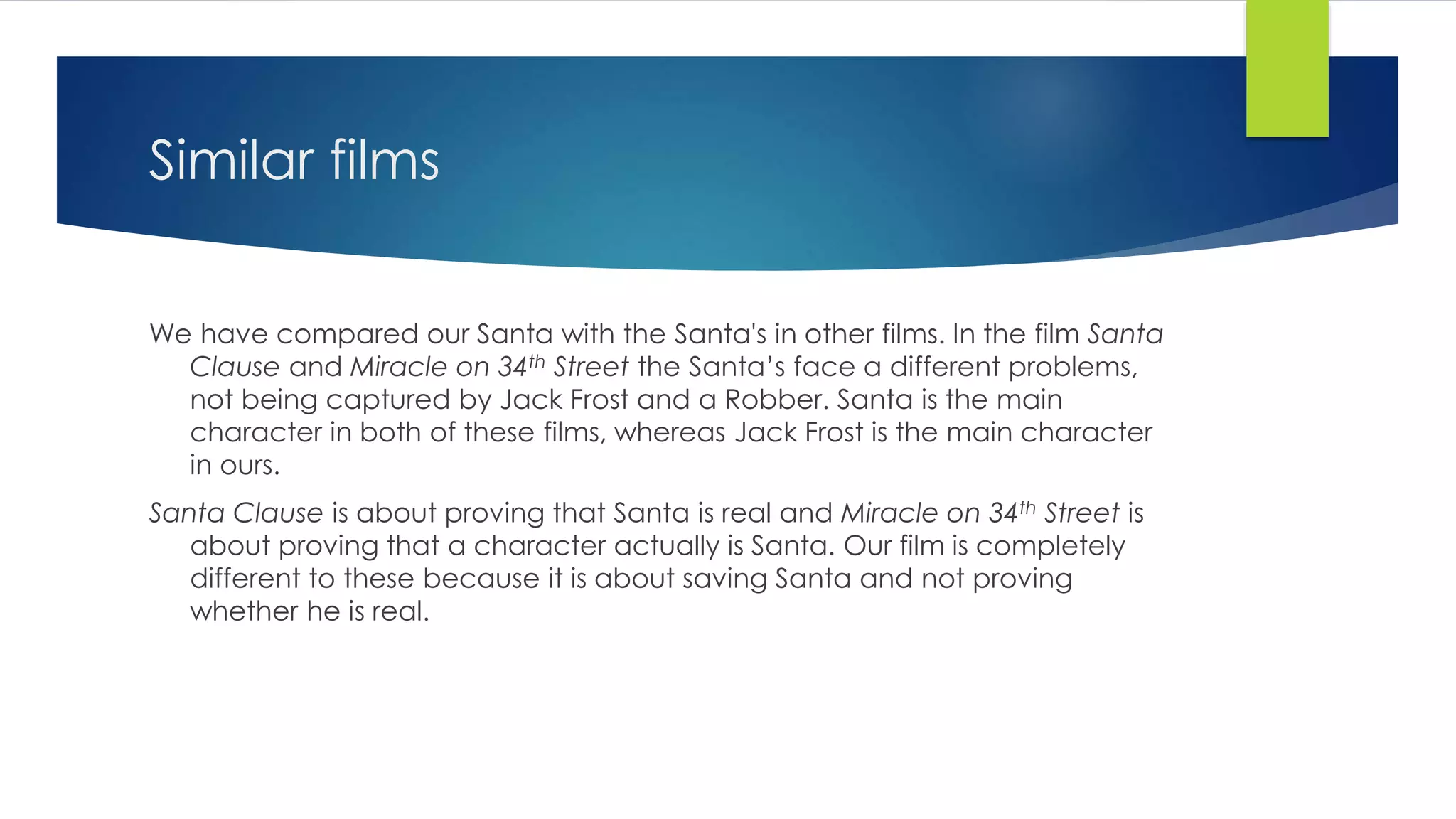
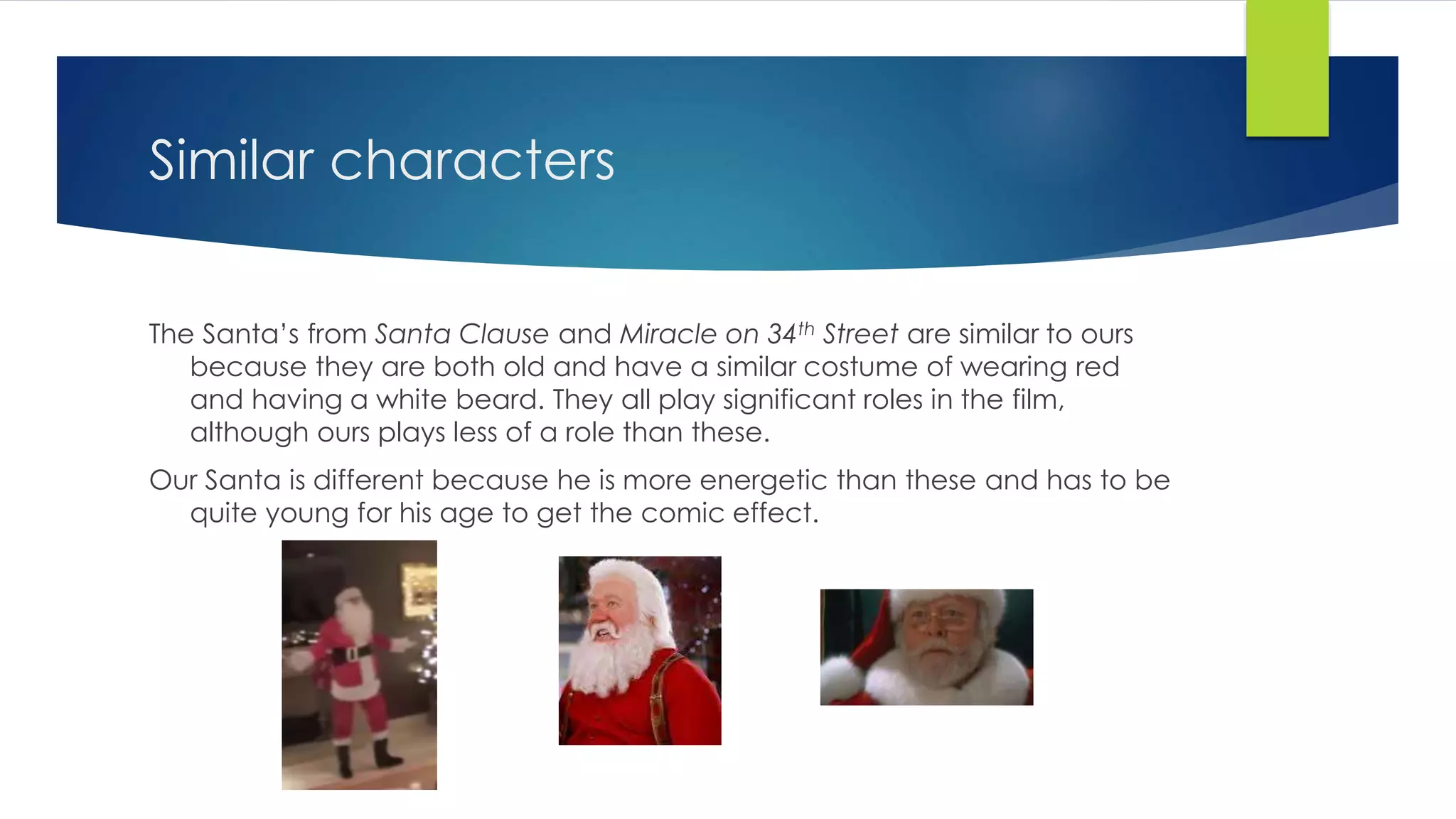
The Santa’s from Santa Clause and Miracle on 34th Street are similar to ours
because they are both old and have a similar costume of wearing red
and having a white beard. They all play significant roles in the film,
although ours plays less of a role than these.
Our Santa is different because he is more energetic than these and has to be
quite young for his age to get the comic effect.

How does your media product represent particular social

  • 1.
    How does yourmedia product represent particular social groups?
  • 2.
    How have yourepresented the characters in your film? The robber is a young person and Santa is shown as being old which represents how age is shown in Christmas films and how Santa has always classically been an older person. The Robber was able to kidnap Santa because his age means he is a stronger person. Santa is funny and still quite athletic for an older person which is not typical of a Christmas film. The Elf is a female which represents gender differences and how the main character is often a male and females were seen as sidekicks. The Robber is not a traditional Christmas film character so is shown at the beginning of our film so that the audience can tell straight away that our film is different to other Christmas films. The Elf and Santa are shown in the first scene because it allows us to portray our film as a Christmas film to the audience.
  • 3.
    Is it positiveor negative representation? The representation of the Elf being a woman is negative because women are often seen as sidekicks in films and men often play the lead role. The Robber is wearing a hoodie which is a negative representation of crime taking place by people wearing hoodies. There are many stereotypes of teenagers in hoods committing crimes and our film is one many that fuels this stereotype. Although Santa is shown as being quite athletic for an older person which represents older people in a positive way.
  • 4.
    Did you usestereotypes? We did use some stereotypes in our film because it helps the audience recognise it as a Christmas film. Santa is always stereotyped as being quite an old, fat, bearded man. We kept this stereotype as it is vital in a children’s Christmas film. We did not keep the traditional stereotype of the elf idolising Santa and being controlled by him but finding him a bit annoying instead. The elf is also dressed as a traditional character because it allows the audience to identify that character. We showed these stereotypes through costume but changed the props around so that they are not as traditional, such as the elf wearing headphones. We also kept the traditional Christmas setting of a middle-class family home.
  • 5.
    How did youposition the audience? Our target audience is families because it is a family film and is suitable for everyone. Specifically, we are aiming it at teenage boys and older children because we thing the comedy, fight scenes and storyline will appeal to them the most. Our audience is positioned so that they sympathise with Santa and want to save Christmas. Jack Frost and the Robber are portrayed as being the ‘bad guys’ whilst Santa and the elves are the ‘goodies’.
  • 6.
    What technical skillshelped you construct representation of your characters? We were able to use technical skills to construct representations of our characters. We represented Santa and the Elf through traditional Santa and Elf costumes by basing them on similar films from this genre. We used dark clothes to represent the Robber as mysterious and used the stereotype of him wearing a hoodie so that people can easily figure out that he is a Robber and not one of the good people.
  • 7.
    Similar films We havecompared our Santa with the Santa's in other films. In the film Santa Clause and Miracle on 34th Street the Santa’s face a different problems, not being captured by Jack Frost and a Robber. Santa is the main character in both of these films, whereas Jack Frost is the main character in ours. Santa Clause is about proving that Santa is real and Miracle on 34th Street is about proving that a character actually is Santa. Our film is completely different to these because it is about saving Santa and not proving whether he is real.
  • 8.
    Similar characters The Santa’sfrom Santa Clause and Miracle on 34th Street are similar to ours because they are both old and have a similar costume of wearing red and having a white beard. They all play significant roles in the film, although ours plays less of a role than these. Our Santa is different because he is more energetic than these and has to be quite young for his age to get the comic effect.