How does school choice work in other countries?
The Friedman Foundation for Educational Choice edchoice.org
Contrary to popular belief, the United States has far less school
choice than many other Western democracies. For example,
some European nations actually give students a constitutional
right to attend any private school at public expense.
Other nations’ experiences show school choice is beneficial to
students, and that it does not lead to the harms predicted by
some American commentators.
MYTH: The United States is unusual in having
school choice.
Some people believe that with the availability of vouchers in
some states, charter schools, and public school choice, the United
States has more school choice than other developed countries.
FACT: Many nations allow families to use
government funding to access private schools.
Scholar Charles Glenn noted that “governments in most Western
democracies provide partial or full funding for nongovernment
schools chosen by parents; the United States (apart from a few
scattered and small-scale programs) is the great exception, along
with Greece.”1
Or as Diane Ravitch pointed out in a 2001 article,
“The proportion of students in government-funded private
schools is sizable in countries such as Australia (25 percent),
Belgium (58 percent), Denmark (11 percent), France (16.8
percent), South Korea (21 percent), the Netherlands (76 percent),
Spain (24 percent), and the United Kingdom (30 percent).”
The Organisation for Economic Co-operation and Development
(OECD) surveyed its 34 member countries and partner countries
in 2008 and 2009 for its annual Education at a Glance reports. As
“the authoritative source for accurate and relevant information
on the state of education around the world,”2
the OECD’s reports
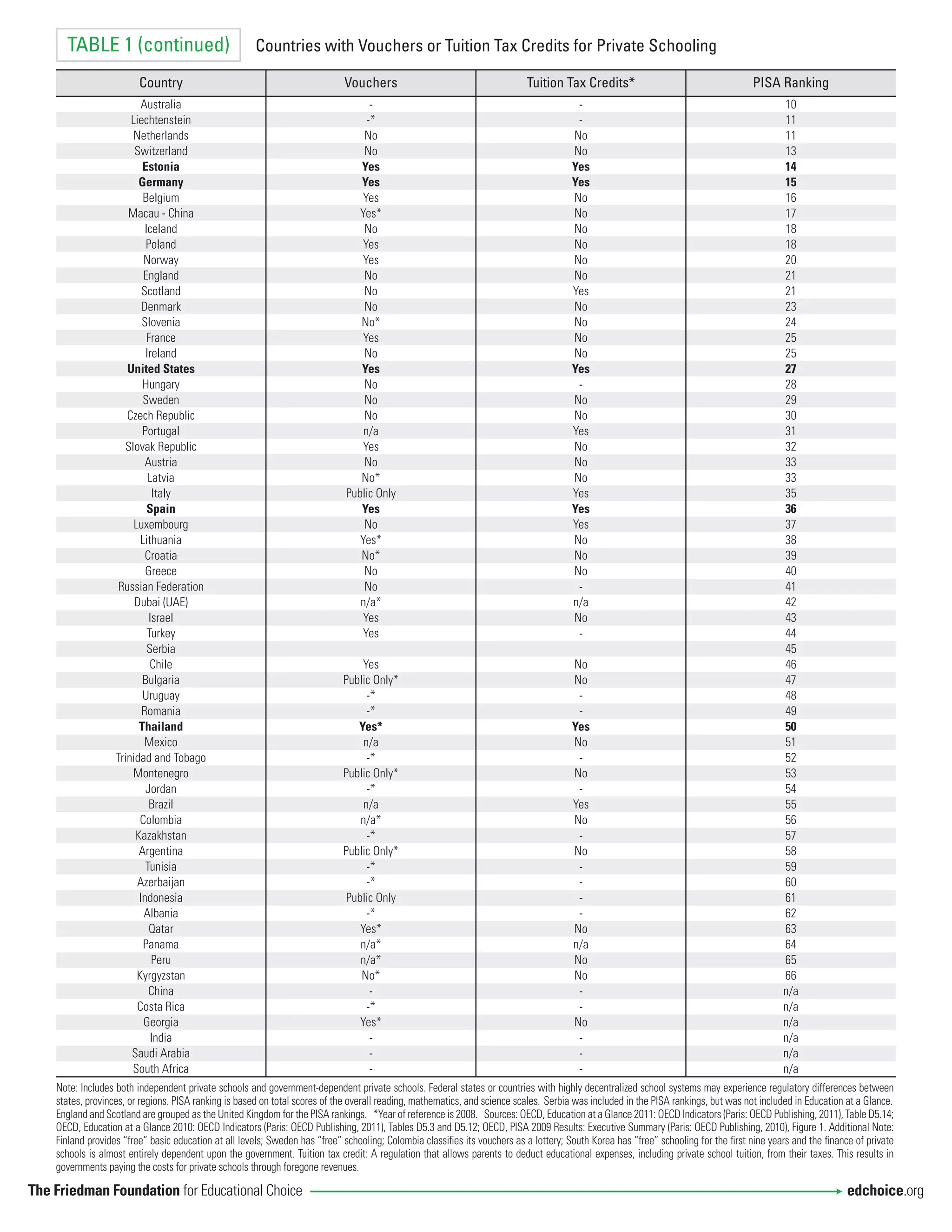
show that, of the 53 participants, 25 countries’ governments
(nine having top 20 PISA scores overall) provide vouchers and/
or tuition tax credits for students to attend private schools (see
accompanied table).
In Finland, the government provides funding for basic
education at all levels, and instruction is free of charge.2
In
Sweden, schooling is “free” and parents are able to choose their
children’s schools; funding even follows the student when they
change schools.3
In Portugal, the Ministry of Education finances
the public sector in its entirety and the state subsidizes each
student in private schools.4
In Chile, both municipal and private
subsidized schools are financed through vouchers.5
In Korea,
the first nine years of education are compulsory schooling “free”
of charge and the finance of private schools is almost entirely
dependent upon the government.6
In Germany, the Netherlands,
England, Northern Ireland, and Sweden, “public funding is
provided so that families can choose to send their children to
schools with a religious character.”7
InseveralEuropeancountries,suchasBelgium,theNetherlands,
and Ireland, school choice is a constitutional right. Article 24
of the Belgian constitution, for example, provides “all pupils
of school age have the right to moral or religious education at
the Community’s expense.” Belgium enacted universal school
choice in 1958 in what it termed the “School Pact”; school choice
was seen as a way of avoiding strife between Catholic and
Protestant schools.
Other nations’ experiences with robust school choice refute the
canards that are raised against vouchers in the United States.
Some have argued, for example, vouchers lead to balkanization
and to the funding of extremist schools. This has not been
the case in Europe. As Charles Glenn points out, “The Dutch
example is particularly telling since there is a constitutional
guarantee of freedom of the religious or philosophical character
of schools…and two-thirds of pupils in the country attend
nonpublic schools. Surely in the Netherlands, if anywhere, we
might expect to find weird or divisive education. But in fact the
rich variety of publicly funded schools…has neither divided
Dutch society nor resulted in groups of children being poorly
educated.”8
TABLE 1 Countries with Vouchers or Tuition Tax Credits for Private Schooling
53 (68 surveyed)
Shanghai - China
Hong Kong - China
Finland
Singapore
Korea
Japan
Canada
New Zealand
Chinese Taipei
Country
19
No*
No*
n/a
Public Only*
No
No
-
Yes
Yes*
Vouchers
11
No
No
No
No
Yes
No
-
No
No
Tuition Tax Credits*
-
1
2
3
4
5
6
7
8
9
PISA Ranking
(Table 1 continued on next page)
The Friedman Foundation for Educational Choice edchoice.org
TABLE 1 (continued) Countries with Vouchers or Tuition Tax Credits for Private Schooling
Australia
Liechtenstein
Netherlands
Switzerland
Estonia
Germany
Belgium
Macau - China
Iceland
Poland
Norway
England
Scotland
Denmark
Slovenia
France
Ireland
United States
Hungary
Sweden
Czech Republic
Portugal
Slovak Republic
Austria
Latvia
Italy
Spain
Luxembourg
Lithuania
Croatia
Greece
Russian Federation
Dubai (UAE)
Israel
Turkey
Serbia
Chile
Bulgaria
Uruguay
Romania
Thailand
Mexico
Trinidad and Tobago
Montenegro
Jordan
Brazil
Colombia
Kazakhstan
Argentina
Tunisia
Azerbaijan
Indonesia
Albania
Qatar
Panama
Peru
Kyrgyzstan
China
Costa Rica
Georgia
India
Saudi Arabia
South Africa
Country
-
-*
No
No
Yes
Yes
Yes
Yes*
No
Yes
Yes
No
No
No
No*
Yes
No
Yes
No
No
No
n/a
Yes
No
No*
Public Only
Yes
No
Yes*
No*
No
No
n/a*
Yes
Yes
Yes
Public Only*
-*
-*
Yes*
n/a
-*
Public Only*
-*
n/a
n/a*
-*
Public Only*
-*
-*
Public Only
-*
Yes*
n/a*
n/a*
No*
-
-*
Yes*
-
-
-
Vouchers
-
-
No
No
Yes
Yes
No
No
No
No
No
No
Yes
No
No
No
No
Yes
-
No
No
Yes
No
No
No
Yes
Yes
Yes
No
No
No
-
n/a
No
-
No
No
-
-
Yes
No
-
No
-
Yes
No
-
No
-
-
-
-
No
n/a
No
No
-
-
No
-
-
-
Tuition Tax Credits*
10
11
11
13
14
15
16
17
18
18
20
21
21
23
24
25
25
27
28
29
30
31
32
33
33
35
36
37
38
39
40
41
42
43
44
45
46
47
48
49
50
51
52
53
54
55
56
57
58
59
60
61
62
63
64
65
66
n/a
n/a
n/a
n/a
n/a
n/a
PISA Ranking
Note: Includes both independent private schools and government-dependent private schools. Federal states or countries with highly decentralized school systems may experience regulatory differences between
states, provinces, or regions. PISA ranking is based on total scores of the overall reading, mathematics, and science scales. Serbia was included in the PISA rankings, but was not included in Education at a Glance.
England and Scotland are grouped as the United Kingdom for the PISA rankings. *Year of reference is 2008. Sources: OECD, Education at a Glance 2011: OECD Indicators (Paris: OECD Publishing, 2011), Table D5.14;
OECD, Education at a Glance 2010: OECD Indicators (Paris: OECD Publishing, 2011), Tables D5.3 and D5.12; OECD, PISA 2009 Results: Executive Summary (Paris: OECD Publishing, 2010), Figure 1. Additional Note:
Finland provides “free” basic education at all levels; Sweden has “free” schooling; Colombia classifies its vouchers as a lottery; South Korea has “free” schooling for the first nine years and the finance of private
schools is almost entirely dependent upon the government. Tuition tax credit: A regulation that allows parents to deduct educational expenses, including private school tuition, from their taxes. This results in
governments paying the costs for private schools through foregone revenues.
The Friedman Foundation for Educational Choice edchoice.org
MYTH: School choice does not work in other
countries.
A few studies claim school choice has not led to academic
benefits in other countries. They claim the United States should
therefore learn from other countries’ experiences and refuse to
adopt school choice.
FACT: Most studies support school choice’s
effectiveness in other countries.
Most studies show school choice in other countries has led to
greater academic gains for students. Although many of those
studies may not be directly applicable to the American context,
they give further evidence school choice can and does work.
EVIDENCE: Studies show students making
academic gains through choice.
First, studies of worldwide scope have found school choice
produces greater educational achievement on average. Dronkers
and Robert found in a 2008 analysis of PISA scores from 22
countries that “pupils at private government dependent schools
have a higher net educational achievement than do comparable
pupils at public schools with the same social composition. The
explanation of these remaining net differences in scholastic
achievement seems to be their better school climate.”9
Similarly,
West and Woessman found in a major international analysis that
“private school competition attributable to past Catholic policies
generates higher student achievement in mathematics, reading,
and science today. [They] also show that competition between
thepublicandprivatesectorpositivelyaffectstheachievementof
students attending public schools. Spending on education is also
reduced, suggesting that school systems are more productive if
they are more competitive.”10
Second, many studies of particular countries have found benefits
from school choice. For instance, Sweden has guaranteed school
choice for all students since the early 1990s. Ahlin found “an
increase in the share of private school students by 10 percentage
points is associated with an improvement of mathematics
performance corresponding to about five percentiles in the
test score distribution.”11
Other recent work on Sweden came
to more equivocal conclusions, but acknowledged “there is no
evidence suggesting that students are hurt by competition from
private schools.”12
Chile has had one of the most robust school choice programs
in the world for the past few decades, and public school
enrollment is currently only about 52 percent. A recent study
using a sophisticated statistical technique called propensity
score matching found “students that move from public schools
to fee-charging private voucher schools due to a scholarship
perform better in language and science tests. The differences are
statistically significant, ranging from 17 percent to 22 percent
of one standard deviation.”13
Another study found voucher
effects “that are large in magnitude and statistically significant
(more than one-third of a standard deviation in test scores).”14
Importantly, these studies looked at individual student test
scores, whereas two other studies that are often cited for their
criticisms of the Chilean voucher system were based only on
school-level or community-level averages.15
Another study in Chile found, “On net, the voucher reforms
increased primary school graduation rates by 0.6 percentage
points, high school graduation rates by 3.6 percent, college-
going rates by 3.1 percent and the percent completing at least
four years of college by 1.8 percent for individuals exposed to
the reform during their entire schooling career.”16
Yet another
study of Chile found “for the ratio of voucher-to-public schools
in one are, one additional voucher school per public school
increases tests scores by about 0.14 standard deviations,” and
that this improvement affected students attending public and
voucher schools.17
Colombia also has had one of the largest voucher programs
in the world; it awards vouchers by random assignment. Two
quality studies have shown its voucher program is improving
student achievement and attainment. Economists from MIT
and Harvard, among other co-authors, found in one paper
voucher winners “were about 10 percentage points more likely
than (lottery) losers to have completed eighth grade, primarily
because they repeated fewer grades,” and that “on average,
lottery winners scored about 0.2 standard deviations higher than
losers.”18
In a follow-up paper, they found vouchers increased
high school graduation rates by five to seven percentage points,
compared to a baseline graduation rate of 25 percent to 30
percent.19
In Israel, Victor Lavy found a public school choice program
“significantly reduces the drop-out rate and increases the
cognitive achievements of high-school students. It also improves
behavioral outcomes such as teacher-student relationships and
students’ social acclimation and satisfaction at school, and
reduces the level of violence and classroom disruption.”20
In England, a team of scholars found religiously controlled
state-funded schools had a “sizeable and positive impact of
school competition on pupil achievement,” about 20 percent
of a standard deviation. They noted that “these findings
support the existence of a beneficial effect of competition on
pupil achievement in a setting in which schools combine more
responsive governance (mainly via institutional arrangements)
with greater autonomy in admission procedures.”21
Notably,
nonreligious choice schools did not have the same competitive
benefit.
In short, evidence from many countries shows school choice is
beneficial, just as is the case with randomized trials in the United
States.
The Friedman Foundation for Educational Choice edchoice.org
NOTES
1. Charles L. Glenn, “What the United States Can Learn from Other Countries,” in
What America Can Learn from School Choice in Other Countries, ed. David Salisbury and
James Tooley (Washington, D.C.: Cato Institute, 2005), p. 80.
2. Department for Education and Science Policy, Improving School Leadership: Country
Background Report for Finland (Finland: Ministry of Education, 2007).
3. Swedish National Agency for School Improvement, “Improving School
Leadership: Country Background Report for Sweden” (February 13, 2007).
4. Ministry of Education, Portugal, “Improving School Leadership: Country
Background Report for Portugal” (December 2007).
5. School Management and Educational Improvement Unity, “Improving School
Leadership: Country Background Report for Chile,” Ministry of Education, General
Education Division (2007).
6. Korean Educational Development Institute, Improving School Leadership: Country
Background Report for Korea (Seoul: 2007).
7. Charles L. Glenn, “Educational Freedom and Protestant Schools in Europe,” in
International Handbooks of Religion and Education 6 (2012), p. 139.
8. Charles L. Glenn, “What the United States Can Learn from Other Countries,” in
What America Can Learn from School Choice in Other Countries, ed. David Salisbury and
James Tooley (Washington, D.C.: Cato Institute, 2005), p. 84.
9. Jaap Dronkers and Peter Robert, “Differences in Scholastic Achievement of
Public, Private Government-Dependent, and Private Independent Schools: ACross-
National Analysis,” Educational Policy 22, no. 4 (July 2008), pp. 541-577.
10. Martin R. West and Ludger Woessman, “School Choice International: Higher
Private School Share Boosts National Test Scores,” Education Next 9, no. 1 (Winter
2009), pp. 54-61.
11. Åsa Ahlin, “Does School Competition Matter? Effects of a Large-Scale School
Choice Reform on Student Performance,” Uppsala University Department of
Economics Working Paper Series, pp. 12-13.
12. Anders Björklund, Per-Anders Edin, Peter Fredriksson, and Alan Krueger,
“Education, Equality, and Efficiency: An Analysis of Swedish School Reforms
During the 1990s,” Institute for Labour Market Policy Evaluation Report (2004), p.
117.
13. Priyanka Anand, Alejandra Mizala, and Andrea Repetto, “Using School
Scholarships to Estimate the Effect of Private Education on the Academic
Achievement of Low-income Students in Chile,” Economics of Education Review 28,
no. 3 (June 2009), p. 379.
14. Claudio Sapelli and Bernardita Vial, “Private vs Public Voucher Schools in Chile:
New Evidence on Efficiency and Peer Effects,” Pontificia Universidad Católica de
Chile Instituto de Economía working paper no. 289 (May 2005).
15. See Martin Carnoy and Patrick J. McEwan, “The Effectiveness and Efficiency
of Private Schools in Chile’s Voucher System,” Educational Evaluation and Policy
Analysis 22, no. 3 (Fall 2000), pp. 213-39; Chang-Tai Hsieh and Miguel Urquiola, “The
Effects of Generalized School Choice on Achievement and Stratification: Evidence
from Chile’s Voucher Program,” Journal of Public Economics 90, no. 8-9 (September
2006), pp. 1477-1503.
16. David Bravo, Sankar Mukhopadhyay, and Petra E. Todd, “Effects of School
Reform on Education and Labor Market Performance: Evidence from Chile’s
Universal Voucher System,” Quantitative Economics 1, no. 1 (July 2010), pp. 47-95.
17. Francisco A. Gallego, “Voucher-School Competition, Incentives, and Outcomes:
Evidence from Chile,” Pontificia Universidad Católica de Chile working paper
(2006).
18. Joshua Angrist, Eric Bettinger, Erik Bloom, Elizabeth King, and Michael Kremer,
“Vouchers for Private Schooling in Colombia: Evidence from a Randomized Natural
Experiment,” American Economic Review 92, no. 5 (December 2002), pp. 1535-58.
19. Joshua Angrist, Eric Bettinger, and Michael Kremer, “Long-Term Educational
Consequences of Secondary School Vouchers: Evidence from Administrative
Records in Colombia,” American Economic Review 96, no. 3 (June 2006), pp. 847-62.
20. Victor Lavy, “Effects of Free Choice Among Public Schools,” Review of Economic
Studies 77, no. 3 (2010), pp. 1164-91.
21. Stephen Gibbons, Stephen Machin, and Olmo Silva, “Choice, Competition, and
Pupil Achievement,” Journal of the European Economic Association 6, no. 4 (June 2008),
pp. 912-47.

How Does School-Choice Work in Othe Countries

  • 1.
    How does schoolchoice work in other countries? The Friedman Foundation for Educational Choice edchoice.org Contrary to popular belief, the United States has far less school choice than many other Western democracies. For example, some European nations actually give students a constitutional right to attend any private school at public expense. Other nations’ experiences show school choice is beneficial to students, and that it does not lead to the harms predicted by some American commentators. MYTH: The United States is unusual in having school choice. Some people believe that with the availability of vouchers in some states, charter schools, and public school choice, the United States has more school choice than other developed countries. FACT: Many nations allow families to use government funding to access private schools. Scholar Charles Glenn noted that “governments in most Western democracies provide partial or full funding for nongovernment schools chosen by parents; the United States (apart from a few scattered and small-scale programs) is the great exception, along with Greece.”1 Or as Diane Ravitch pointed out in a 2001 article, “The proportion of students in government-funded private schools is sizable in countries such as Australia (25 percent), Belgium (58 percent), Denmark (11 percent), France (16.8 percent), South Korea (21 percent), the Netherlands (76 percent), Spain (24 percent), and the United Kingdom (30 percent).” The Organisation for Economic Co-operation and Development (OECD) surveyed its 34 member countries and partner countries in 2008 and 2009 for its annual Education at a Glance reports. As “the authoritative source for accurate and relevant information on the state of education around the world,”2 the OECD’s reports show that, of the 53 participants, 25 countries’ governments (nine having top 20 PISA scores overall) provide vouchers and/ or tuition tax credits for students to attend private schools (see accompanied table). In Finland, the government provides funding for basic education at all levels, and instruction is free of charge.2 In Sweden, schooling is “free” and parents are able to choose their children’s schools; funding even follows the student when they change schools.3 In Portugal, the Ministry of Education finances the public sector in its entirety and the state subsidizes each student in private schools.4 In Chile, both municipal and private subsidized schools are financed through vouchers.5 In Korea, the first nine years of education are compulsory schooling “free” of charge and the finance of private schools is almost entirely dependent upon the government.6 In Germany, the Netherlands, England, Northern Ireland, and Sweden, “public funding is provided so that families can choose to send their children to schools with a religious character.”7 InseveralEuropeancountries,suchasBelgium,theNetherlands, and Ireland, school choice is a constitutional right. Article 24 of the Belgian constitution, for example, provides “all pupils of school age have the right to moral or religious education at the Community’s expense.” Belgium enacted universal school choice in 1958 in what it termed the “School Pact”; school choice was seen as a way of avoiding strife between Catholic and Protestant schools. Other nations’ experiences with robust school choice refute the canards that are raised against vouchers in the United States. Some have argued, for example, vouchers lead to balkanization and to the funding of extremist schools. This has not been the case in Europe. As Charles Glenn points out, “The Dutch example is particularly telling since there is a constitutional guarantee of freedom of the religious or philosophical character of schools…and two-thirds of pupils in the country attend nonpublic schools. Surely in the Netherlands, if anywhere, we might expect to find weird or divisive education. But in fact the rich variety of publicly funded schools…has neither divided Dutch society nor resulted in groups of children being poorly educated.”8 TABLE 1 Countries with Vouchers or Tuition Tax Credits for Private Schooling 53 (68 surveyed) Shanghai - China Hong Kong - China Finland Singapore Korea Japan Canada New Zealand Chinese Taipei Country 19 No* No* n/a Public Only* No No - Yes Yes* Vouchers 11 No No No No Yes No - No No Tuition Tax Credits* - 1 2 3 4 5 6 7 8 9 PISA Ranking (Table 1 continued on next page)
  • 2.
    The Friedman Foundationfor Educational Choice edchoice.org TABLE 1 (continued) Countries with Vouchers or Tuition Tax Credits for Private Schooling Australia Liechtenstein Netherlands Switzerland Estonia Germany Belgium Macau - China Iceland Poland Norway England Scotland Denmark Slovenia France Ireland United States Hungary Sweden Czech Republic Portugal Slovak Republic Austria Latvia Italy Spain Luxembourg Lithuania Croatia Greece Russian Federation Dubai (UAE) Israel Turkey Serbia Chile Bulgaria Uruguay Romania Thailand Mexico Trinidad and Tobago Montenegro Jordan Brazil Colombia Kazakhstan Argentina Tunisia Azerbaijan Indonesia Albania Qatar Panama Peru Kyrgyzstan China Costa Rica Georgia India Saudi Arabia South Africa Country - -* No No Yes Yes Yes Yes* No Yes Yes No No No No* Yes No Yes No No No n/a Yes No No* Public Only Yes No Yes* No* No No n/a* Yes Yes Yes Public Only* -* -* Yes* n/a -* Public Only* -* n/a n/a* -* Public Only* -* -* Public Only -* Yes* n/a* n/a* No* - -* Yes* - - - Vouchers - - No No Yes Yes No No No No No No Yes No No No No Yes - No No Yes No No No Yes Yes Yes No No No - n/a No - No No - - Yes No - No - Yes No - No - - - - No n/a No No - - No - - - Tuition Tax Credits* 10 11 11 13 14 15 16 17 18 18 20 21 21 23 24 25 25 27 28 29 30 31 32 33 33 35 36 37 38 39 40 41 42 43 44 45 46 47 48 49 50 51 52 53 54 55 56 57 58 59 60 61 62 63 64 65 66 n/a n/a n/a n/a n/a n/a PISA Ranking Note: Includes both independent private schools and government-dependent private schools. Federal states or countries with highly decentralized school systems may experience regulatory differences between states, provinces, or regions. PISA ranking is based on total scores of the overall reading, mathematics, and science scales. Serbia was included in the PISA rankings, but was not included in Education at a Glance. England and Scotland are grouped as the United Kingdom for the PISA rankings. *Year of reference is 2008. Sources: OECD, Education at a Glance 2011: OECD Indicators (Paris: OECD Publishing, 2011), Table D5.14; OECD, Education at a Glance 2010: OECD Indicators (Paris: OECD Publishing, 2011), Tables D5.3 and D5.12; OECD, PISA 2009 Results: Executive Summary (Paris: OECD Publishing, 2010), Figure 1. Additional Note: Finland provides “free” basic education at all levels; Sweden has “free” schooling; Colombia classifies its vouchers as a lottery; South Korea has “free” schooling for the first nine years and the finance of private schools is almost entirely dependent upon the government. Tuition tax credit: A regulation that allows parents to deduct educational expenses, including private school tuition, from their taxes. This results in governments paying the costs for private schools through foregone revenues.
  • 3.
    The Friedman Foundationfor Educational Choice edchoice.org MYTH: School choice does not work in other countries. A few studies claim school choice has not led to academic benefits in other countries. They claim the United States should therefore learn from other countries’ experiences and refuse to adopt school choice. FACT: Most studies support school choice’s effectiveness in other countries. Most studies show school choice in other countries has led to greater academic gains for students. Although many of those studies may not be directly applicable to the American context, they give further evidence school choice can and does work. EVIDENCE: Studies show students making academic gains through choice. First, studies of worldwide scope have found school choice produces greater educational achievement on average. Dronkers and Robert found in a 2008 analysis of PISA scores from 22 countries that “pupils at private government dependent schools have a higher net educational achievement than do comparable pupils at public schools with the same social composition. The explanation of these remaining net differences in scholastic achievement seems to be their better school climate.”9 Similarly, West and Woessman found in a major international analysis that “private school competition attributable to past Catholic policies generates higher student achievement in mathematics, reading, and science today. [They] also show that competition between thepublicandprivatesectorpositivelyaffectstheachievementof students attending public schools. Spending on education is also reduced, suggesting that school systems are more productive if they are more competitive.”10 Second, many studies of particular countries have found benefits from school choice. For instance, Sweden has guaranteed school choice for all students since the early 1990s. Ahlin found “an increase in the share of private school students by 10 percentage points is associated with an improvement of mathematics performance corresponding to about five percentiles in the test score distribution.”11 Other recent work on Sweden came to more equivocal conclusions, but acknowledged “there is no evidence suggesting that students are hurt by competition from private schools.”12 Chile has had one of the most robust school choice programs in the world for the past few decades, and public school enrollment is currently only about 52 percent. A recent study using a sophisticated statistical technique called propensity score matching found “students that move from public schools to fee-charging private voucher schools due to a scholarship perform better in language and science tests. The differences are statistically significant, ranging from 17 percent to 22 percent of one standard deviation.”13 Another study found voucher effects “that are large in magnitude and statistically significant (more than one-third of a standard deviation in test scores).”14 Importantly, these studies looked at individual student test scores, whereas two other studies that are often cited for their criticisms of the Chilean voucher system were based only on school-level or community-level averages.15 Another study in Chile found, “On net, the voucher reforms increased primary school graduation rates by 0.6 percentage points, high school graduation rates by 3.6 percent, college- going rates by 3.1 percent and the percent completing at least four years of college by 1.8 percent for individuals exposed to the reform during their entire schooling career.”16 Yet another study of Chile found “for the ratio of voucher-to-public schools in one are, one additional voucher school per public school increases tests scores by about 0.14 standard deviations,” and that this improvement affected students attending public and voucher schools.17 Colombia also has had one of the largest voucher programs in the world; it awards vouchers by random assignment. Two quality studies have shown its voucher program is improving student achievement and attainment. Economists from MIT and Harvard, among other co-authors, found in one paper voucher winners “were about 10 percentage points more likely than (lottery) losers to have completed eighth grade, primarily because they repeated fewer grades,” and that “on average, lottery winners scored about 0.2 standard deviations higher than losers.”18 In a follow-up paper, they found vouchers increased high school graduation rates by five to seven percentage points, compared to a baseline graduation rate of 25 percent to 30 percent.19 In Israel, Victor Lavy found a public school choice program “significantly reduces the drop-out rate and increases the cognitive achievements of high-school students. It also improves behavioral outcomes such as teacher-student relationships and students’ social acclimation and satisfaction at school, and reduces the level of violence and classroom disruption.”20 In England, a team of scholars found religiously controlled state-funded schools had a “sizeable and positive impact of school competition on pupil achievement,” about 20 percent of a standard deviation. They noted that “these findings support the existence of a beneficial effect of competition on pupil achievement in a setting in which schools combine more responsive governance (mainly via institutional arrangements) with greater autonomy in admission procedures.”21 Notably, nonreligious choice schools did not have the same competitive benefit. In short, evidence from many countries shows school choice is beneficial, just as is the case with randomized trials in the United States.
  • 4.
    The Friedman Foundationfor Educational Choice edchoice.org NOTES 1. Charles L. Glenn, “What the United States Can Learn from Other Countries,” in What America Can Learn from School Choice in Other Countries, ed. David Salisbury and James Tooley (Washington, D.C.: Cato Institute, 2005), p. 80. 2. Department for Education and Science Policy, Improving School Leadership: Country Background Report for Finland (Finland: Ministry of Education, 2007). 3. Swedish National Agency for School Improvement, “Improving School Leadership: Country Background Report for Sweden” (February 13, 2007). 4. Ministry of Education, Portugal, “Improving School Leadership: Country Background Report for Portugal” (December 2007). 5. School Management and Educational Improvement Unity, “Improving School Leadership: Country Background Report for Chile,” Ministry of Education, General Education Division (2007). 6. Korean Educational Development Institute, Improving School Leadership: Country Background Report for Korea (Seoul: 2007). 7. Charles L. Glenn, “Educational Freedom and Protestant Schools in Europe,” in International Handbooks of Religion and Education 6 (2012), p. 139. 8. Charles L. Glenn, “What the United States Can Learn from Other Countries,” in What America Can Learn from School Choice in Other Countries, ed. David Salisbury and James Tooley (Washington, D.C.: Cato Institute, 2005), p. 84. 9. Jaap Dronkers and Peter Robert, “Differences in Scholastic Achievement of Public, Private Government-Dependent, and Private Independent Schools: ACross- National Analysis,” Educational Policy 22, no. 4 (July 2008), pp. 541-577. 10. Martin R. West and Ludger Woessman, “School Choice International: Higher Private School Share Boosts National Test Scores,” Education Next 9, no. 1 (Winter 2009), pp. 54-61. 11. Åsa Ahlin, “Does School Competition Matter? Effects of a Large-Scale School Choice Reform on Student Performance,” Uppsala University Department of Economics Working Paper Series, pp. 12-13. 12. Anders Björklund, Per-Anders Edin, Peter Fredriksson, and Alan Krueger, “Education, Equality, and Efficiency: An Analysis of Swedish School Reforms During the 1990s,” Institute for Labour Market Policy Evaluation Report (2004), p. 117. 13. Priyanka Anand, Alejandra Mizala, and Andrea Repetto, “Using School Scholarships to Estimate the Effect of Private Education on the Academic Achievement of Low-income Students in Chile,” Economics of Education Review 28, no. 3 (June 2009), p. 379. 14. Claudio Sapelli and Bernardita Vial, “Private vs Public Voucher Schools in Chile: New Evidence on Efficiency and Peer Effects,” Pontificia Universidad Católica de Chile Instituto de Economía working paper no. 289 (May 2005). 15. See Martin Carnoy and Patrick J. McEwan, “The Effectiveness and Efficiency of Private Schools in Chile’s Voucher System,” Educational Evaluation and Policy Analysis 22, no. 3 (Fall 2000), pp. 213-39; Chang-Tai Hsieh and Miguel Urquiola, “The Effects of Generalized School Choice on Achievement and Stratification: Evidence from Chile’s Voucher Program,” Journal of Public Economics 90, no. 8-9 (September 2006), pp. 1477-1503. 16. David Bravo, Sankar Mukhopadhyay, and Petra E. Todd, “Effects of School Reform on Education and Labor Market Performance: Evidence from Chile’s Universal Voucher System,” Quantitative Economics 1, no. 1 (July 2010), pp. 47-95. 17. Francisco A. Gallego, “Voucher-School Competition, Incentives, and Outcomes: Evidence from Chile,” Pontificia Universidad Católica de Chile working paper (2006). 18. Joshua Angrist, Eric Bettinger, Erik Bloom, Elizabeth King, and Michael Kremer, “Vouchers for Private Schooling in Colombia: Evidence from a Randomized Natural Experiment,” American Economic Review 92, no. 5 (December 2002), pp. 1535-58. 19. Joshua Angrist, Eric Bettinger, and Michael Kremer, “Long-Term Educational Consequences of Secondary School Vouchers: Evidence from Administrative Records in Colombia,” American Economic Review 96, no. 3 (June 2006), pp. 847-62. 20. Victor Lavy, “Effects of Free Choice Among Public Schools,” Review of Economic Studies 77, no. 3 (2010), pp. 1164-91. 21. Stephen Gibbons, Stephen Machin, and Olmo Silva, “Choice, Competition, and Pupil Achievement,” Journal of the European Economic Association 6, no. 4 (June 2008), pp. 912-47.