Download to read offline
![behavior, substance use and abuse, and criminal conduct.
It happens in the following steps:
1)the adolescent is exposed to substance use, to individuals
committing crimes, or to risky sexual practices or any criminal activities.
(Attention & retention of the events)
2) the behaviour is repeated. (observational learning/reproduction)
[ during the teenage years, critical skills such as decisionmaking (including
optimal weighing of rewards versus risks) and emotional regulation remain
under construction (Modecki 2017)].
3) Once it is adopted, the behavior leads to consequences
that lead to some kind of positive outcomes (e.g., acceptance by the group,
sense of power, attention of peers, establishment of a group role that instills
a sense of pride, etc.). The degree of positive reinforcement will determine
whether the behavior is continued. Group norms become a power base for
this reinforcement. (motivation)
LITERATURE: Adolescents are more behaviourally disposed towards attaining emotional and
social rewards from crime than any other age group (Shulman & Cauffman 2013) and a growing
literature has identified the rewards of problem behaviour as having aparticularly strong
influence on youth delinquency.
> Transitional Teens Theory (Voas & Kelley,Baker,2008)
This theoretical framework focuses largely on the problems associated with
adolescent impaired driving, transitional teens theory also provides a
general framework for understanding trajectories into adolescent substance
abuse and criminal conduct.
The transitional teen model defines four key elements that significantly](https://image.slidesharecdn.com/socialpsych-200413233112/75/HOW-DOES-CRIMINAL-BEHAVIOUR-MANIFEST-IN-ADOLESCENT-AGE-2-2048.jpg)

![1. Illicit drug use is an example. The intention to use drug is
strengthened when individuals believe that nothing bad will happen
and that they can handle their drugs. Users expect to feel powerful
when experiencing the high (behavioral beliefs).
2. They perceive value in using with peers who adhere to a normative
belief that shared euphoria is worth everything. The behavior and
attitude toward the behavior is further strengthened when users
believe that peers expect them to function well (stay cool) in an
impaired condition (subjective norm).
3. The behavior of illicit drug abuse is further advanced and reinforced
when the outcome is "handling the situation okay" and the experience
of power (control belief).
FAMILY INFLUENCES ON DELINQUENCY
• Ciminal and antisocial parents usually tend to have antisocial and delinquent
children.
• poor parental supersvisions
• cold,rejecting parents usually have delinquent children.
[The parental monitoring, conflictive family interactions, and low intimacy, were related
with alcohol and drugs consumption (Obando et al., 2014).]
[Adolescents whose parents use harsh discipline tend to link with antisocial peers, as Li et
al. (2015)]
• Child abuse and neglect.](https://image.slidesharecdn.com/socialpsych-200413233112/75/HOW-DOES-CRIMINAL-BEHAVIOUR-MANIFEST-IN-ADOLESCENT-AGE-4-2048.jpg)
![• child victimization (lead to desensitization to pain; poor school perfomance and
poor problem solving avilities)
• Parental conflict and disrupted families
• interparental violance
• substance use by parents
ANTISOCIAL PEER GROUP AND CRIMINAL BEHAVIOUR
• Antisocal precocity "becomes a coveted social asset[greatly desired]"(Moffitt,1993)leading
some youths to mimic the antisocial behaviours and attitudes of the antisocial group.
[Van Ryzin and Dishion (2014), make a 7 years longitudinal study, found a strong relationship
between drug use and affiliation with deviant peers.]
• Peer pressure leads toward juvenile delinquency
• Group acceptance (conformity)
• To maintain self image infront of peers deviant adolescence commit crime
• Inadequate or strained peer relations might also lead to delinquincy.
• Delinquints tend to commit crime in small groups called "co offending" and
antisocial peer groups are ideal breeding grounds.
There are two types of groups influenced by peer group:
1. ADOLESCENCE LIMITED INDIVIDUALS: for them antisocial behavior is limited to the
teen years, onset is due to association with delinquent peers.](https://image.slidesharecdn.com/socialpsych-200413233112/75/HOW-DOES-CRIMINAL-BEHAVIOUR-MANIFEST-IN-ADOLESCENT-AGE-5-2048.jpg)


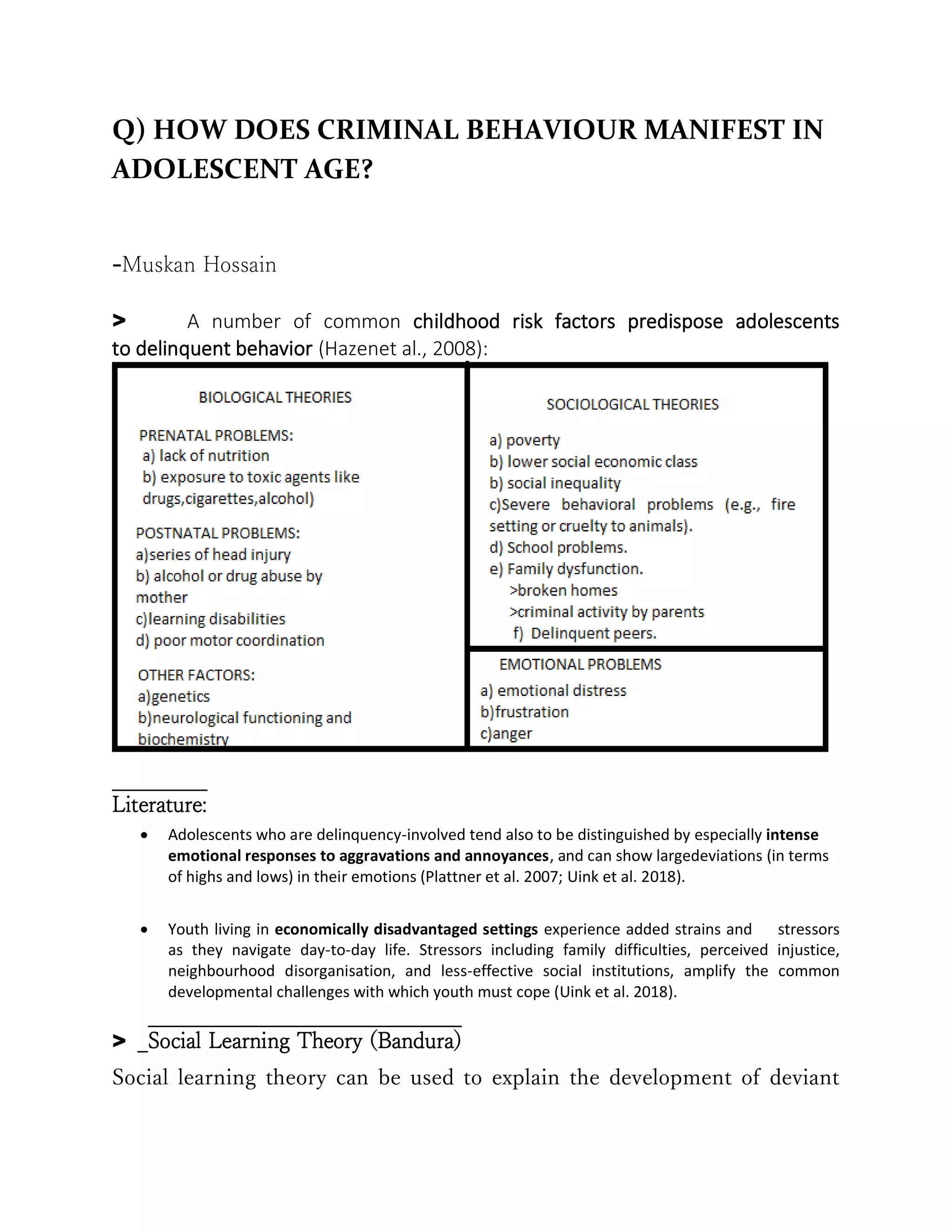
Criminal behavior in adolescents can manifest due to several risk factors. Adolescents who engage in delinquent acts tend to have intense emotional responses and fluctuations in mood. Those living in disadvantaged environments face additional stresses. Social learning theory posits that criminal behavior is learned through exposure to others committing crimes and is reinforced through positive outcomes like peer acceptance. The transitional teens theory identifies parental influence, environment, community, and peers as shaping adolescent behavior. The theory of planned behavior links intentions to engage in a behavior with attitudes and perceived social norms and control. Criminal behavior in adolescents can also stem from family influences like parental criminality, poor supervision, abuse/neglect, and parental conflict. Association with antisocial peers increases risk as


