Unit 8 Lesson 1 How Do Weathering and Erosion
Shape Earth’s Surface?
Copyright © Houghton Mifflin Harcourt Publishing Company
Unit 8 Lesson 1 How Do Weathering and Erosion Shape Earth’s Surface?
What Can Break a Boulder?
• The process of rock breaking apart is called
weathering.
• Many things cause weathering, such as gravity,
flowing water, blowing sand, living things, wind,
rain, and chemicals.
Copyright © Houghton Mifflin Harcourt Publishing Company
Rocks on the Move
• Weathering is the beginning of a series of changes
that often occurs to rocks on Earth’s surface.
• The process of moving weathered rock from one
place to another is called erosion.
• Moving water is one of the most common causes
of erosion.
Unit 8 Lesson 1 How Do Weathering and Erosion Shape Earth’s Surface?
Copyright © Houghton Mifflin Harcourt Publishing Company
Rocks on the Move
• Fast-moving water and gravity can cause rocks to
move downhill.
• As the water in a river slows down, it has less
energy and cannot move the largest rocks and
pebbles.
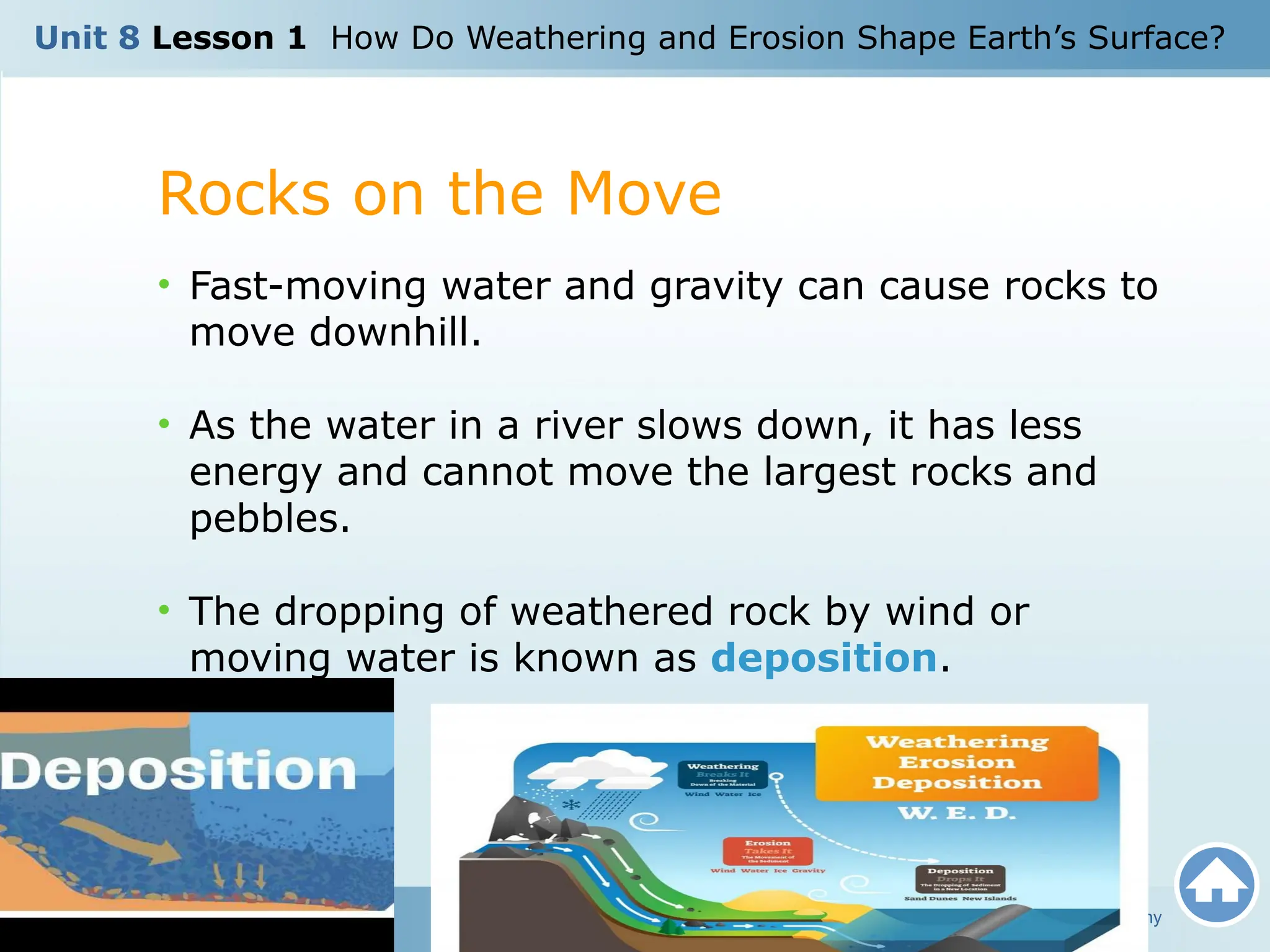
• The dropping of weathered rock by wind or
moving water is known as deposition.
Unit 8 Lesson 1 How Do Weathering and Erosion Shape Earth’s Surface?
Copyright © Houghton Mifflin Harcourt Publishing Company
Rocks on the Move
• Slow-moving water has less energy than fast-
moving water has. Thus, as water in a river
continues to slow down, more bits of weathered
rock are dropped.
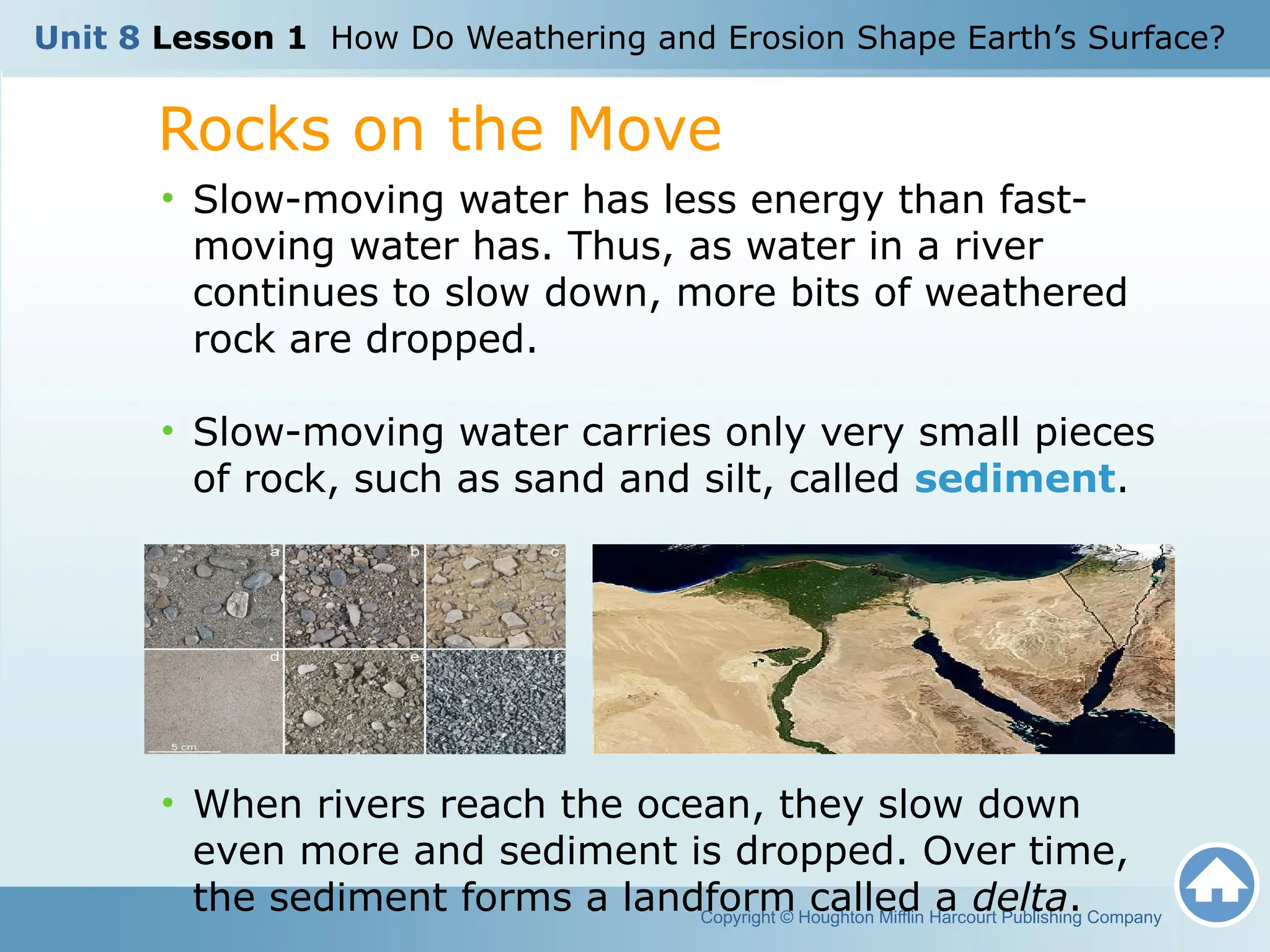
• Slow-moving water carries only very small pieces
of rock, such as sand and silt, called sediment.
• When rivers reach the ocean, they slow down
even more and sediment is dropped. Over time,
the sediment forms a landform called a delta.
Unit 8 Lesson 1 How Do Weathering and Erosion Shape Earth’s Surface?
Copyright © Houghton Mifflin Harcourt Publishing Company
Rocks on the Move
• What size of sediment drops out first? What size
drops out last?
Unit 8 Lesson 1 How Do Weathering and Erosion Shape Earth’s Surface?
Copyright © Houghton Mifflin Harcourt Publishing Company
Blowing in the Wind
• A landform is a natural land shape or feature.
Weathering and erosion by wind change
landforms.
• Wind can carry sediment from place to place.
When wind deposits a lot of sand in one area,
sand dunes form.
Unit 8 Lesson 1 How Do Weathering and Erosion Shape Earth’s Surface?
Copyright © Houghton Mifflin Harcourt Publishing Company
Blowing in the Wind
• Wind sweeps up one side of a dune and lifts sand
from its surface. Gravity pulls the sand down the
other slope.
Unit 8 Lesson 1 How Do Weathering and Erosion Shape Earth’s Surface?
Copyright © Houghton Mifflin Harcourt Publishing Company
Blowing in the Wind
• Blowing sediment can also cause changes to other
landforms as particles collide with exposed rock to
form interesting shapes.
• For instance, mushroom rocks and arches are
formed by water but shaped by the wind.
Eventually, gravity pulls these formations down.
Unit 8 Lesson 1 How Do Weathering and Erosion Shape Earth’s Surface?

How do weathering and erosion shaped earths surfas?.pptx

  • 1.
    Unit 8 Lesson1 How Do Weathering and Erosion Shape Earth’s Surface? Copyright © Houghton Mifflin Harcourt Publishing Company
  • 2.
    Copyright © HoughtonMifflin Harcourt Publishing Company Unit 8 Lesson 1 How Do Weathering and Erosion Shape Earth’s Surface? What Can Break a Boulder? • The process of rock breaking apart is called weathering. • Many things cause weathering, such as gravity, flowing water, blowing sand, living things, wind, rain, and chemicals.
  • 3.
    Copyright © HoughtonMifflin Harcourt Publishing Company Rocks on the Move • Weathering is the beginning of a series of changes that often occurs to rocks on Earth’s surface. • The process of moving weathered rock from one place to another is called erosion. • Moving water is one of the most common causes of erosion. Unit 8 Lesson 1 How Do Weathering and Erosion Shape Earth’s Surface?
  • 4.
    Copyright © HoughtonMifflin Harcourt Publishing Company Rocks on the Move • Fast-moving water and gravity can cause rocks to move downhill. • As the water in a river slows down, it has less energy and cannot move the largest rocks and pebbles. • The dropping of weathered rock by wind or moving water is known as deposition. Unit 8 Lesson 1 How Do Weathering and Erosion Shape Earth’s Surface?
  • 5.
    Copyright © HoughtonMifflin Harcourt Publishing Company Rocks on the Move • Slow-moving water has less energy than fast- moving water has. Thus, as water in a river continues to slow down, more bits of weathered rock are dropped. • Slow-moving water carries only very small pieces of rock, such as sand and silt, called sediment. • When rivers reach the ocean, they slow down even more and sediment is dropped. Over time, the sediment forms a landform called a delta. Unit 8 Lesson 1 How Do Weathering and Erosion Shape Earth’s Surface?
  • 6.
    Copyright © HoughtonMifflin Harcourt Publishing Company Rocks on the Move • What size of sediment drops out first? What size drops out last? Unit 8 Lesson 1 How Do Weathering and Erosion Shape Earth’s Surface?
  • 7.
    Copyright © HoughtonMifflin Harcourt Publishing Company Blowing in the Wind • A landform is a natural land shape or feature. Weathering and erosion by wind change landforms. • Wind can carry sediment from place to place. When wind deposits a lot of sand in one area, sand dunes form. Unit 8 Lesson 1 How Do Weathering and Erosion Shape Earth’s Surface?
  • 8.
    Copyright © HoughtonMifflin Harcourt Publishing Company Blowing in the Wind • Wind sweeps up one side of a dune and lifts sand from its surface. Gravity pulls the sand down the other slope. Unit 8 Lesson 1 How Do Weathering and Erosion Shape Earth’s Surface?
  • 9.
    Copyright © HoughtonMifflin Harcourt Publishing Company Blowing in the Wind • Blowing sediment can also cause changes to other landforms as particles collide with exposed rock to form interesting shapes. • For instance, mushroom rocks and arches are formed by water but shaped by the wind. Eventually, gravity pulls these formations down. Unit 8 Lesson 1 How Do Weathering and Erosion Shape Earth’s Surface?