How do Organisms
Reproduce ?
BY GIRISHA MAHESHWARI
Why do animals reproduce ?
Reproduction is the process by which the living organisms produce new individuals of the same
species.
Necessary for the survival and increase in the population of a species. If organisms do not
reproduce their population decreases and species will become extinct.
Do organisms create exact copies of
themselves ?
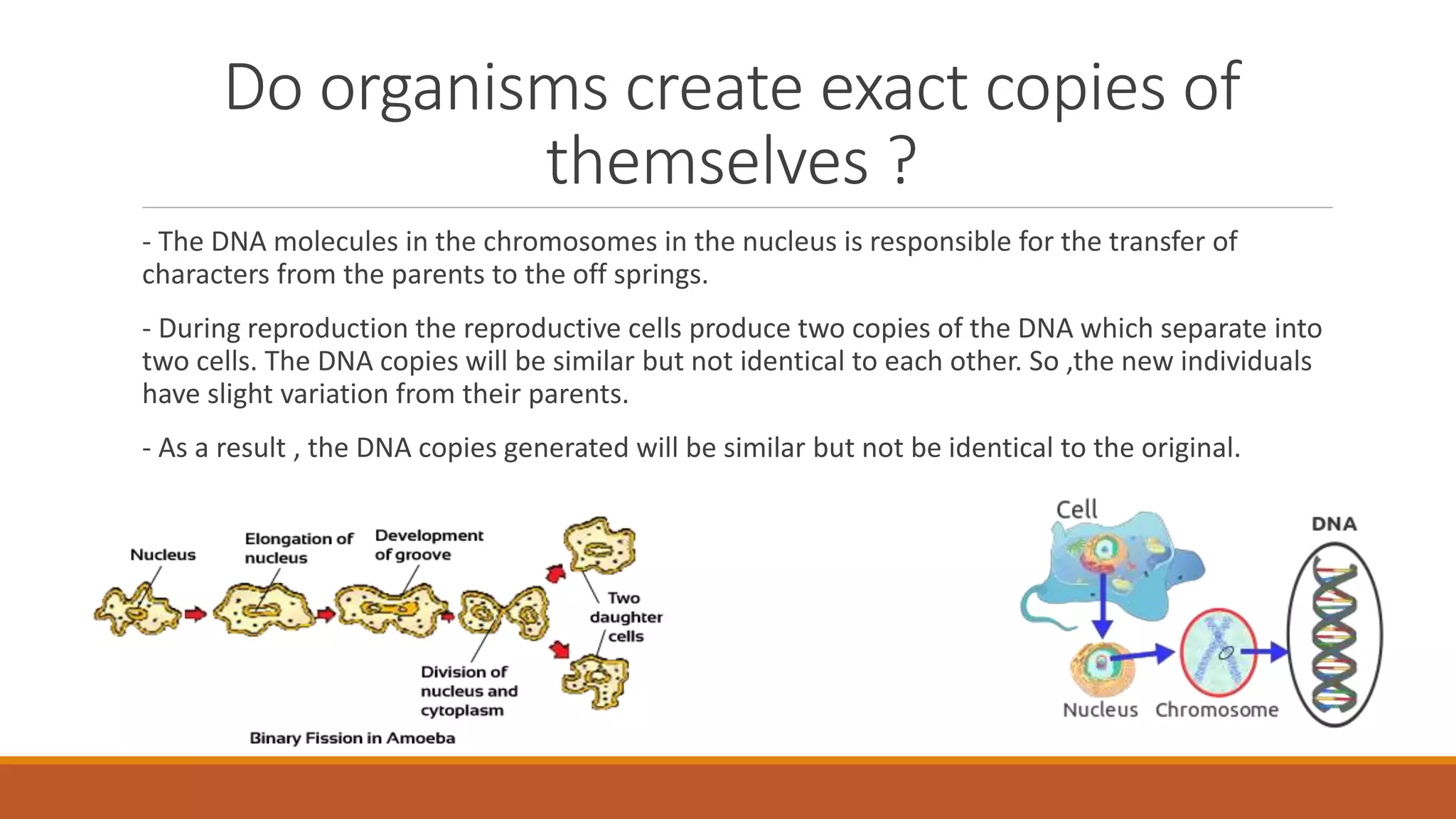
- The DNA molecules in the chromosomes in the nucleus is responsible for the transfer of
characters from the parents to the off springs.
- During reproduction the reproductive cells produce two copies of the DNA which separate into
two cells. The DNA copies will be similar but not identical to each other. So ,the new individuals
have slight variation from their parents.
- As a result , the DNA copies generated will be similar but not be identical to the original.
The importance of variation
- DNA copying during the reproduction is important for maintaining the body design of different
organisms to survive in the existing environment.
But the environment is constantly changing
- Change in temperature
- Climate
- Water levels.
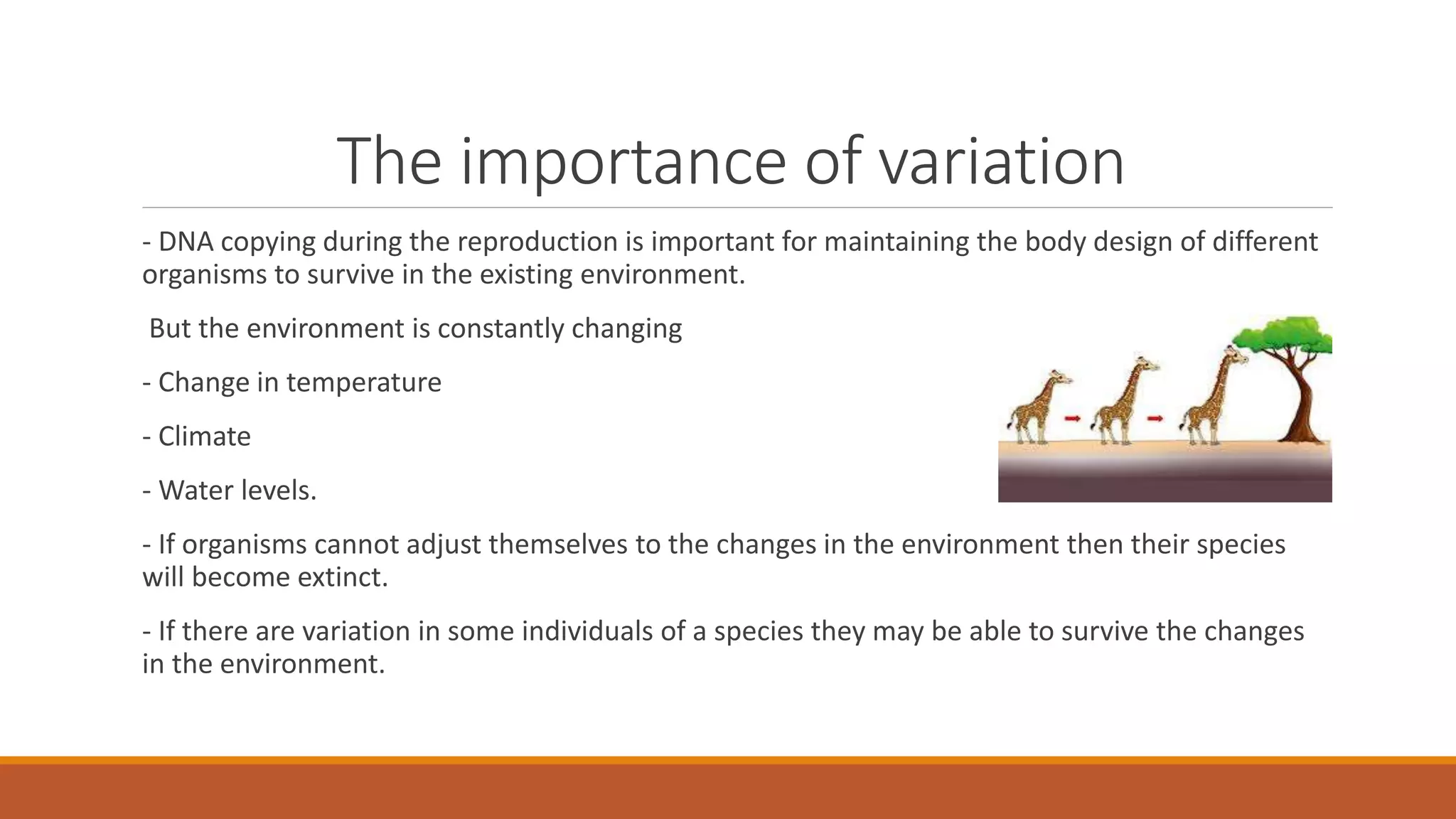
- If organisms cannot adjust themselves to the changes in the environment then their species
will become extinct.
- If there are variation in some individuals of a species they may be able to survive the changes
in the environment.
Types of Reproduction
Types of
reproduction
Sexual
Reproduction
Two parents are
involved to produce
new individual
Asexual
Reproduction
New Individuals are
produced from
single parent.
Fission : Asexual reproduction
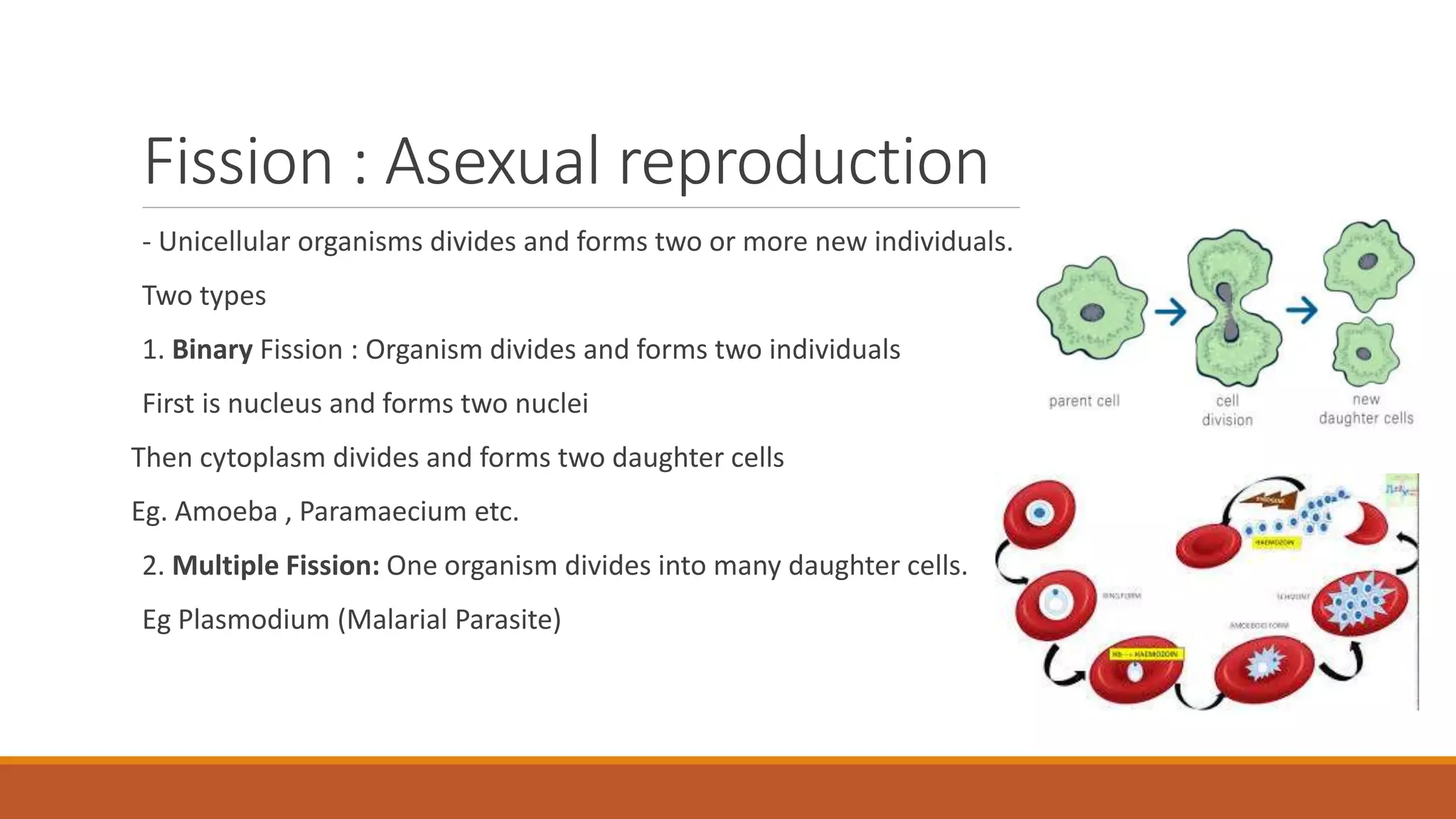
- Unicellular organisms divides and forms two or more new individuals.
Two types
1. Binary Fission : Organism divides and forms two individuals
First is nucleus and forms two nuclei
Then cytoplasm divides and forms two daughter cells
Eg. Amoeba , Paramaecium etc.
2. Multiple Fission: One organism divides into many daughter cells.
Eg Plasmodium (Malarial Parasite)
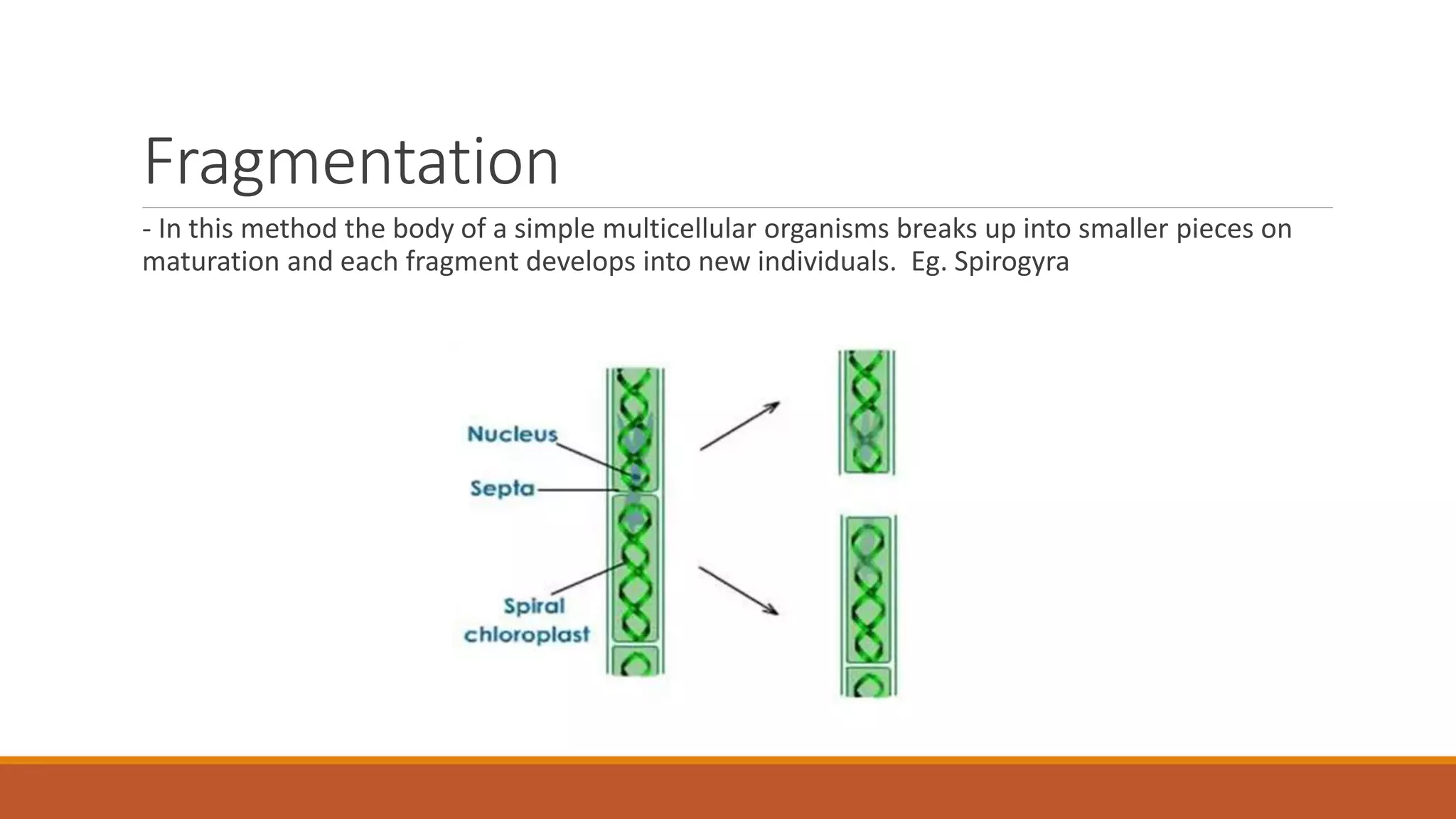
Fragmentation
- In this method the body of a simple multicellular organisms breaks up into smaller pieces on
maturation and each fragment develops into new individuals. Eg. Spirogyra
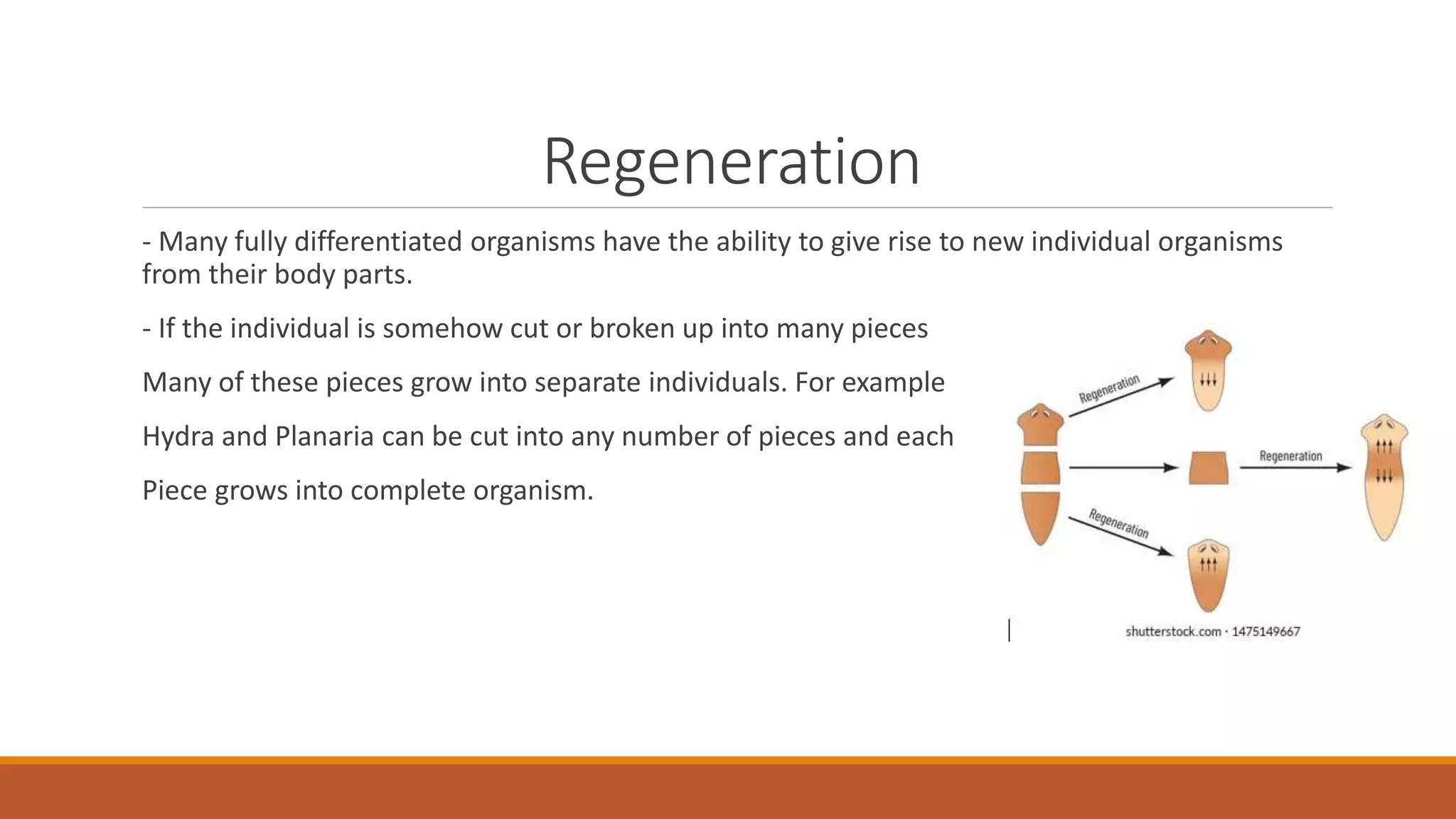
Regeneration
- Many fully differentiated organisms have the ability to give rise to new individual organisms
from their body parts.
- If the individual is somehow cut or broken up into many pieces
Many of these pieces grow into separate individuals. For example
Hydra and Planaria can be cut into any number of pieces and each
Piece grows into complete organism.
Budding
- Organism such as Hydra use regenerative cells for reproduction in the process of budding.
- A bud develops as an outgrowth due to repeated cell division at one specific site. These buds
develop into tiny individuals and when fully mature detach from the parent body and become
new independent individuals.
Vegetative Propagation
- In this method new plants are produced from the vegetative parts of the plant like root, stem
or leaf. Eg. From roots-dahlia, sweet potato , from stem- potato, ginger, from leaf-bryophyllum,
begonia.
Advantage :
1. All plants produced are genetically similar enough to the
Parent plant to have all its characteristics.
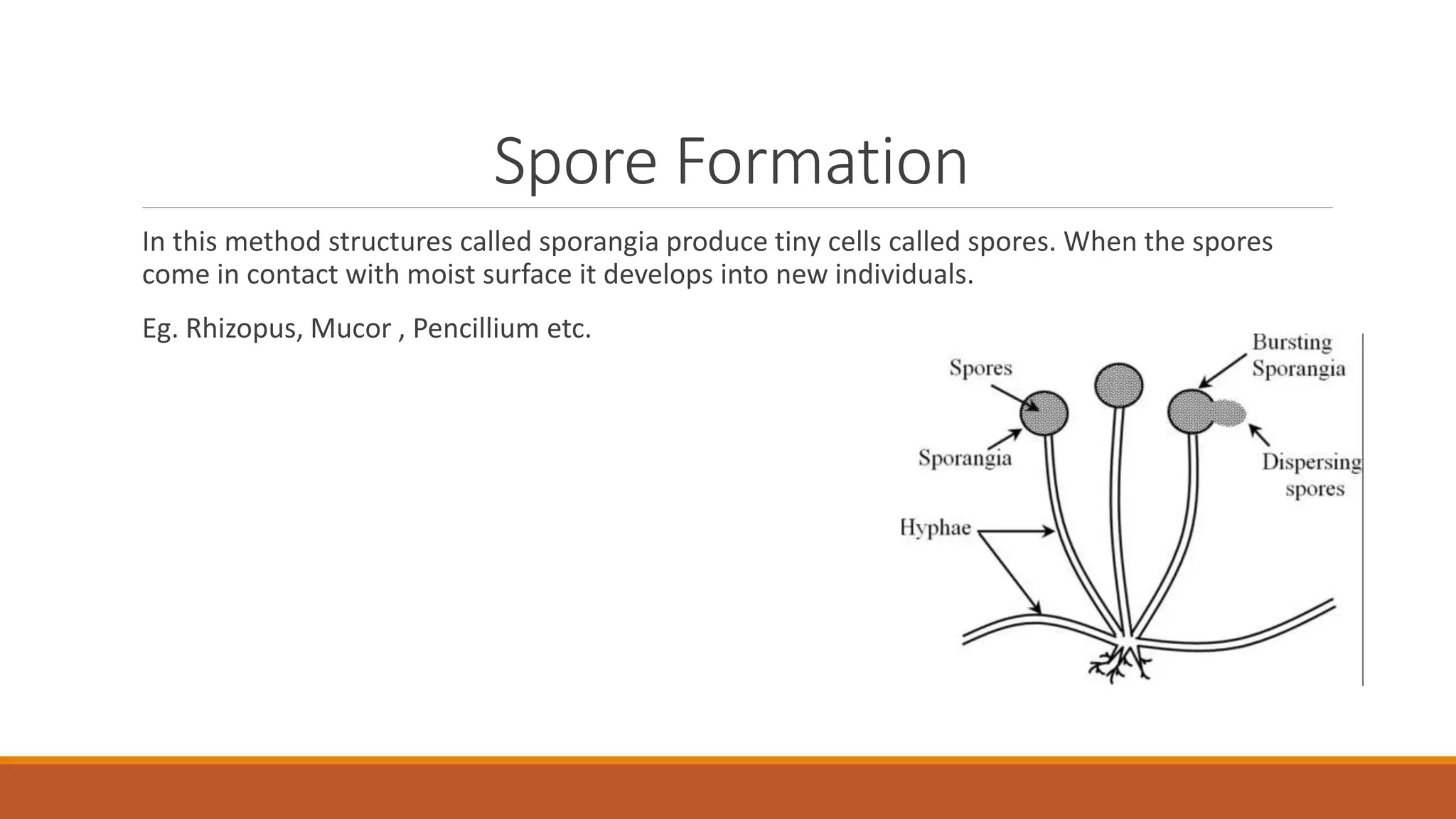
Spore Formation
In this method structures called sporangia produce tiny cells called spores. When the spores
come in contact with moist surface it develops into new individuals.
Eg. Rhizopus, Mucor , Pencillium etc.
Sexual Reproduction in Flowering Plants
- Stamen and pistils are the reproductive parts of a flower which contain the germ cells.
- Stamen : Male Reproductive part
Produces pollen grains that are yellowish in colour.
-Pistil : Centre of the flower and Female reproductive
part.
- Made up of three parts
Swollen bottom part is ovary
Middle elongate part style
Terminal part which may be sticky is stigma.
Contd..
- When the pollen grain is transferred to the stigma it produces a pollen tube which passes
through the style and enters the ovary and ovule.
- In ovule the male germ cell fuses with the female germ cell to form a zygote.
This process is called fertilization.
- After fertilization the zygote divides several times and forms the embryo which
Then develops into the seed and the ovary develops into the fruit.
Reference
- NCERT (Class X) Chapter 8. How do organisms reproduce ?

How do organisms reproduce ?

  • 1.
    How do Organisms Reproduce? BY GIRISHA MAHESHWARI
  • 2.
    Why do animalsreproduce ? Reproduction is the process by which the living organisms produce new individuals of the same species. Necessary for the survival and increase in the population of a species. If organisms do not reproduce their population decreases and species will become extinct.
  • 3.
    Do organisms createexact copies of themselves ? - The DNA molecules in the chromosomes in the nucleus is responsible for the transfer of characters from the parents to the off springs. - During reproduction the reproductive cells produce two copies of the DNA which separate into two cells. The DNA copies will be similar but not identical to each other. So ,the new individuals have slight variation from their parents. - As a result , the DNA copies generated will be similar but not be identical to the original.
  • 4.
    The importance ofvariation - DNA copying during the reproduction is important for maintaining the body design of different organisms to survive in the existing environment. But the environment is constantly changing - Change in temperature - Climate - Water levels. - If organisms cannot adjust themselves to the changes in the environment then their species will become extinct. - If there are variation in some individuals of a species they may be able to survive the changes in the environment.
  • 5.
    Types of Reproduction Typesof reproduction Sexual Reproduction Two parents are involved to produce new individual Asexual Reproduction New Individuals are produced from single parent.
  • 6.
    Fission : Asexualreproduction - Unicellular organisms divides and forms two or more new individuals. Two types 1. Binary Fission : Organism divides and forms two individuals First is nucleus and forms two nuclei Then cytoplasm divides and forms two daughter cells Eg. Amoeba , Paramaecium etc. 2. Multiple Fission: One organism divides into many daughter cells. Eg Plasmodium (Malarial Parasite)
  • 7.
    Fragmentation - In thismethod the body of a simple multicellular organisms breaks up into smaller pieces on maturation and each fragment develops into new individuals. Eg. Spirogyra
  • 8.
    Regeneration - Many fullydifferentiated organisms have the ability to give rise to new individual organisms from their body parts. - If the individual is somehow cut or broken up into many pieces Many of these pieces grow into separate individuals. For example Hydra and Planaria can be cut into any number of pieces and each Piece grows into complete organism.
  • 9.
    Budding - Organism suchas Hydra use regenerative cells for reproduction in the process of budding. - A bud develops as an outgrowth due to repeated cell division at one specific site. These buds develop into tiny individuals and when fully mature detach from the parent body and become new independent individuals.
  • 10.
    Vegetative Propagation - Inthis method new plants are produced from the vegetative parts of the plant like root, stem or leaf. Eg. From roots-dahlia, sweet potato , from stem- potato, ginger, from leaf-bryophyllum, begonia. Advantage : 1. All plants produced are genetically similar enough to the Parent plant to have all its characteristics.
  • 11.
    Spore Formation In thismethod structures called sporangia produce tiny cells called spores. When the spores come in contact with moist surface it develops into new individuals. Eg. Rhizopus, Mucor , Pencillium etc.
  • 13.
    Sexual Reproduction inFlowering Plants - Stamen and pistils are the reproductive parts of a flower which contain the germ cells. - Stamen : Male Reproductive part Produces pollen grains that are yellowish in colour. -Pistil : Centre of the flower and Female reproductive part. - Made up of three parts Swollen bottom part is ovary Middle elongate part style Terminal part which may be sticky is stigma.
  • 14.
    Contd.. - When thepollen grain is transferred to the stigma it produces a pollen tube which passes through the style and enters the ovary and ovule. - In ovule the male germ cell fuses with the female germ cell to form a zygote. This process is called fertilization. - After fertilization the zygote divides several times and forms the embryo which Then develops into the seed and the ovary develops into the fruit.
  • 16.
    Reference - NCERT (ClassX) Chapter 8. How do organisms reproduce ?