How did we get here? Where is here?
Regulatory distortions Deposit insurance leading savers to inappropriate levels of trust in banks,  Loose monetary policy leading to artificial demand for credit to fund bad projects (housing booms in the US, Ireland, Spain etc.) Government mandated loans to the unqualified homebuyers also distorting the demand for single family housing,  Fiat currency allowing governments to run massive fiscal deficits  … ..and on and on
What is a Bubble? We can define a bubble as activities that spring up on the back of loose monetary policy of the central bank. In other words, in the absence of monetary pumping these activities would not emerge.  Since bubble activities are not self-funded, their emergence must come at the expense of various self-funded or productive activities.  This means that less real funding is left for productive activities, which in turn undermines those activities. In short, monetary pumping gives rise to the misallocation of resources, which as a rule manifests itself through a relative increase in non-productive activities against productive activities.  Frank  Shostak  3/4/2003
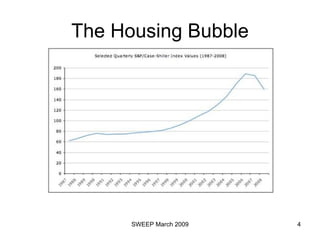
The Housing Bubble
What makes prices increase? General inflationary pressures-  Artificially low interest rates pushed by the central architects of this crisis – Alan Greenspan and his successor Ben Bernanke. Constraint in supply  – although this is an important factor in general in explaining rapid price increases I do not see it as a strong factor here. Increase in demand  -  Beginning in 1992 with Henry Cisneros as the secretary of Housing and Urban Development there was tremendous pressure put on banks and other housing market participants to make loans to unqualified buyers.  This pressure continued under Bush
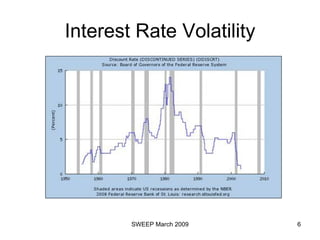
Interest Rate Volatility
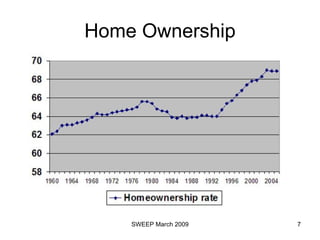
Home Ownership
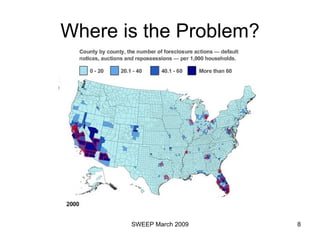
Where is the Problem?
Who Caused the Bubble? In July 1999, the Department of Housing and Urban Development proposed that by the year 2001, 50 percent of Fannie Mae's and Freddie Mac's portfolio be made up of loans to low and moderate-income borrowers. Last year (1998) 44 percent of the loans Fannie Mae purchased were from these groups.   The change in policy also comes at the same time (1999) that HUD is investigating allegations of racial discrimination in the automated underwriting systems used by Fannie Mae and Freddie Mac to determine the credit-worthiness of credit applicants.
No No No Loans made to individuals with  No savings for a down payment,  No credit history demonstrating responsible management of their financial affairs, and  No pattern of stable earnings suggesting an ongoing ability to service the debts.
Who saw this coming? When homes are abandoned, there will be no local lender to take care of them, or price them rationally, and get them sold. They will sit there, empty – the target of vandals. That day is coming. There will be motivated sellers. When you are an investor, always buy from a motivated seller. Buy the other guy’s disaster. I refer to the foreclosing lender. The overextended buyer is long gone. There is nothing like a house sitting empty for six months to motivate a lending institution. April 23, 2005 – Gary North – Author  Mises on Money
A Number Cruncher’s View "As a proportion of non-government GDP, housing has doubled from 1989-97’s 10.8% to a record estimate of 21.6% this quarter  "Whereas, in 1989–96, it took 12,000 hourly salaries to buy the transaction-weighted average house – 6 yrs and 11 months at the then-average work week – it now takes 15,855 hours – 9 yrs and 5 months at today’s workweek (50 week working years assumed in both cases) – for an increase of 36% per home in the ratio...  "Oh, I think we can call this a bubble, all right.“ Sean Corrigan quoted by Bill Bonner July 2004
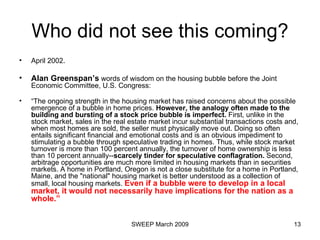
Who did not see this coming? April 2002. Alan Greenspan’s  words of wisdom on the housing bubble before the Joint Economic Committee, U.S. Congress: “ The ongoing strength in the housing market has raised concerns about the possible emergence of a bubble in home prices.  However, the analogy often made to the building and bursting of a stock price bubble is imperfect.  First, unlike in the stock market, sales in the real estate market incur substantial transactions costs and, when most homes are sold, the seller must physically move out. Doing so often entails significant financial and emotional costs and is an obvious impediment to stimulating a bubble through speculative trading in homes. Thus, while stock market turnover is more than 100 percent annually, the turnover of home ownership is less than 10 percent annually-- scarcely tinder for speculative conflagration.  Second, arbitrage opportunities are much more limited in housing markets than in securities markets. A home in Portland, Oregon is not a close substitute for a home in Portland, Maine, and the "national" housing market is better understood as a collection of small, local housing markets.  Even if a bubble were to develop in a local market, it would not necessarily have implications for the nation as a whole.”
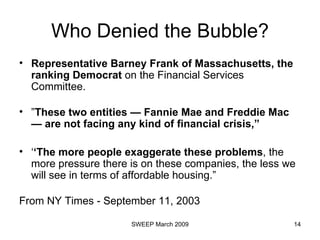
Who Denied the Bubble? Representative Barney Frank of Massachusetts, the ranking Democrat  on the Financial Services Committee. ” These two entities — Fannie Mae and Freddie Mac — are not facing any kind of financial crisis,”  ‘ ‘ The more people exaggerate these problems , the more pressure there is on these companies, the less we will see in terms of affordable housing.” From NY Times - September 11, 2003
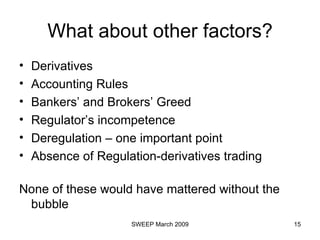
What about other factors? Derivatives  Accounting Rules  Bankers’ and Brokers’ Greed Regulator’s incompetence Deregulation – one important point Absence of Regulation-derivatives trading None of these would have mattered without the bubble
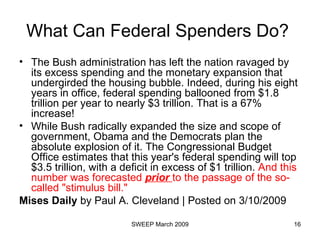
What Can Federal Spenders Do?  The Bush administration has left the nation ravaged by its excess spending and the monetary expansion that undergirded the housing bubble. Indeed, during his eight years in office, federal spending ballooned from $1.8 trillion per year to nearly $3 trillion. That is a 67% increase!  While Bush radically expanded the size and scope of government, Obama and the Democrats plan the absolute explosion of it. The Congressional Budget Office estimates that this year's federal spending will top $3.5 trillion, with a deficit in excess of $1 trillion.  And this number was forecasted  prior   to the passage of the   so-called "stimulus bill."  Mises Daily  by Paul A. Cleveland | Posted on 3/10/2009
What should we do now? Let housing prices fall rapidly Let interest rates rise quickly Cut government spending immediately Eliminate the capital gains tax for the next decade Reduce wasteful regulation None of this will happen – so be prepared for ??????
What can we expect? The direct consequences of this debacle are bad  Economic recession or depression Unemployment at 11% by Q4 2009 Ten years of economic stagnation which we desperately can not afford
Long term consequences The worse consequences will come in the future because intelligent people will be led by the naïve press and self-interested government power mongers to believe that all of this was the result of a failure of free market capitalism.   One goal of this presentation is to argue that nothing could be farther form the truth.   The government hacks who drove all of this can never admit their mistakes and as a result people will sit idly by while more power is handed over to the same incompetent mechanisms that caused the problems in the first place.
So… The government hacks who drove all of this can never admit their mistakes and as a result people will sit idly by while more power is handed over to the same incompetent mechanisms that caused the problems in the first place.
Why is this important to you? We are all citizens with economic interests and aspirations Economic ignorance and naïveté are ruling the public discussion and as respected community leaders we should be informed We do not have a decade to squander and someone must speak up.
Why is this a part of SWEEP All of the problems we now face are a direct result of the belief that “home ownership is a right.” The righteous sounding policy had profound unintended consequences Now healthcare is a “right.” What may be the unintended consequences of badly designed national healthcare policy?

How Did We Get Here

  • 1.
    How did weget here? Where is here?
  • 2.
    Regulatory distortions Depositinsurance leading savers to inappropriate levels of trust in banks, Loose monetary policy leading to artificial demand for credit to fund bad projects (housing booms in the US, Ireland, Spain etc.) Government mandated loans to the unqualified homebuyers also distorting the demand for single family housing, Fiat currency allowing governments to run massive fiscal deficits … ..and on and on
  • 3.
    What is aBubble? We can define a bubble as activities that spring up on the back of loose monetary policy of the central bank. In other words, in the absence of monetary pumping these activities would not emerge. Since bubble activities are not self-funded, their emergence must come at the expense of various self-funded or productive activities. This means that less real funding is left for productive activities, which in turn undermines those activities. In short, monetary pumping gives rise to the misallocation of resources, which as a rule manifests itself through a relative increase in non-productive activities against productive activities. Frank Shostak 3/4/2003
  • 4.
  • 5.
    What makes pricesincrease? General inflationary pressures- Artificially low interest rates pushed by the central architects of this crisis – Alan Greenspan and his successor Ben Bernanke. Constraint in supply – although this is an important factor in general in explaining rapid price increases I do not see it as a strong factor here. Increase in demand - Beginning in 1992 with Henry Cisneros as the secretary of Housing and Urban Development there was tremendous pressure put on banks and other housing market participants to make loans to unqualified buyers.  This pressure continued under Bush
  • 6.
  • 7.
  • 8.
    Where is theProblem?
  • 9.
    Who Caused theBubble? In July 1999, the Department of Housing and Urban Development proposed that by the year 2001, 50 percent of Fannie Mae's and Freddie Mac's portfolio be made up of loans to low and moderate-income borrowers. Last year (1998) 44 percent of the loans Fannie Mae purchased were from these groups. The change in policy also comes at the same time (1999) that HUD is investigating allegations of racial discrimination in the automated underwriting systems used by Fannie Mae and Freddie Mac to determine the credit-worthiness of credit applicants.
  • 10.
    No No NoLoans made to individuals with No savings for a down payment, No credit history demonstrating responsible management of their financial affairs, and No pattern of stable earnings suggesting an ongoing ability to service the debts.
  • 11.
    Who saw thiscoming? When homes are abandoned, there will be no local lender to take care of them, or price them rationally, and get them sold. They will sit there, empty – the target of vandals. That day is coming. There will be motivated sellers. When you are an investor, always buy from a motivated seller. Buy the other guy’s disaster. I refer to the foreclosing lender. The overextended buyer is long gone. There is nothing like a house sitting empty for six months to motivate a lending institution. April 23, 2005 – Gary North – Author Mises on Money
  • 12.
    A Number Cruncher’sView "As a proportion of non-government GDP, housing has doubled from 1989-97’s 10.8% to a record estimate of 21.6% this quarter "Whereas, in 1989–96, it took 12,000 hourly salaries to buy the transaction-weighted average house – 6 yrs and 11 months at the then-average work week – it now takes 15,855 hours – 9 yrs and 5 months at today’s workweek (50 week working years assumed in both cases) – for an increase of 36% per home in the ratio... "Oh, I think we can call this a bubble, all right.“ Sean Corrigan quoted by Bill Bonner July 2004
  • 13.
    Who did notsee this coming? April 2002. Alan Greenspan’s words of wisdom on the housing bubble before the Joint Economic Committee, U.S. Congress: “ The ongoing strength in the housing market has raised concerns about the possible emergence of a bubble in home prices. However, the analogy often made to the building and bursting of a stock price bubble is imperfect. First, unlike in the stock market, sales in the real estate market incur substantial transactions costs and, when most homes are sold, the seller must physically move out. Doing so often entails significant financial and emotional costs and is an obvious impediment to stimulating a bubble through speculative trading in homes. Thus, while stock market turnover is more than 100 percent annually, the turnover of home ownership is less than 10 percent annually-- scarcely tinder for speculative conflagration. Second, arbitrage opportunities are much more limited in housing markets than in securities markets. A home in Portland, Oregon is not a close substitute for a home in Portland, Maine, and the "national" housing market is better understood as a collection of small, local housing markets. Even if a bubble were to develop in a local market, it would not necessarily have implications for the nation as a whole.”
  • 14.
    Who Denied theBubble? Representative Barney Frank of Massachusetts, the ranking Democrat on the Financial Services Committee. ” These two entities — Fannie Mae and Freddie Mac — are not facing any kind of financial crisis,” ‘ ‘ The more people exaggerate these problems , the more pressure there is on these companies, the less we will see in terms of affordable housing.” From NY Times - September 11, 2003
  • 15.
    What about otherfactors? Derivatives Accounting Rules Bankers’ and Brokers’ Greed Regulator’s incompetence Deregulation – one important point Absence of Regulation-derivatives trading None of these would have mattered without the bubble
  • 16.
    What Can FederalSpenders Do? The Bush administration has left the nation ravaged by its excess spending and the monetary expansion that undergirded the housing bubble. Indeed, during his eight years in office, federal spending ballooned from $1.8 trillion per year to nearly $3 trillion. That is a 67% increase! While Bush radically expanded the size and scope of government, Obama and the Democrats plan the absolute explosion of it. The Congressional Budget Office estimates that this year's federal spending will top $3.5 trillion, with a deficit in excess of $1 trillion. And this number was forecasted prior to the passage of the so-called "stimulus bill." Mises Daily by Paul A. Cleveland | Posted on 3/10/2009
  • 17.
    What should wedo now? Let housing prices fall rapidly Let interest rates rise quickly Cut government spending immediately Eliminate the capital gains tax for the next decade Reduce wasteful regulation None of this will happen – so be prepared for ??????
  • 18.
    What can weexpect? The direct consequences of this debacle are bad Economic recession or depression Unemployment at 11% by Q4 2009 Ten years of economic stagnation which we desperately can not afford
  • 19.
    Long term consequencesThe worse consequences will come in the future because intelligent people will be led by the naïve press and self-interested government power mongers to believe that all of this was the result of a failure of free market capitalism.  One goal of this presentation is to argue that nothing could be farther form the truth.  The government hacks who drove all of this can never admit their mistakes and as a result people will sit idly by while more power is handed over to the same incompetent mechanisms that caused the problems in the first place.
  • 20.
    So… The governmenthacks who drove all of this can never admit their mistakes and as a result people will sit idly by while more power is handed over to the same incompetent mechanisms that caused the problems in the first place.
  • 21.
    Why is thisimportant to you? We are all citizens with economic interests and aspirations Economic ignorance and naïveté are ruling the public discussion and as respected community leaders we should be informed We do not have a decade to squander and someone must speak up.
  • 22.
    Why is thisa part of SWEEP All of the problems we now face are a direct result of the belief that “home ownership is a right.” The righteous sounding policy had profound unintended consequences Now healthcare is a “right.” What may be the unintended consequences of badly designed national healthcare policy?