How Data Will Replace Discounting:
Lessons From Uber, Point 93 and
Orchard Mile
JENNIE BAIK, CEO and Co-Founder, Orchard Mile
SAMANTHA ZIRKIN, CEO, Point 93
GARRETT VAN RYZIN, Head of Marketplace Optimization Advanced Development, Uber
SamanthaZirkin,CEO, Point 93
GarrettvanRyzin, Head of Marketplace Optimization Advanced
Development, Uber (Professor, Columbia Business School)
JennieBaik,CEO, Orchard Mile
What You Will Learn
 How to End Discounting by understanding your customers, what they want,
their urgency to purchase, and what they are willing to pay
 How to leverage shopper data to personalize content and increase sales
 The role of dynamic, equitable pricing in creating real-time, relevant,
shopping experiences
The rise of free market economics
• Reduced government intervention in the
economy
• Free trade policy
• Free capital flows and foreign investment
• Market-based wages and prices
• Property rights
Not without backlash….
Technology is accelerating this trend
• Information
– Increased quantity
– Lower cost
• Transaction costs
– Communication
– Payments
• Cognitive power
Approaching perfect competition ideal
Perfect information, zero transactions costs, full rationality, full factor mobility,
no exit/entrance barriers
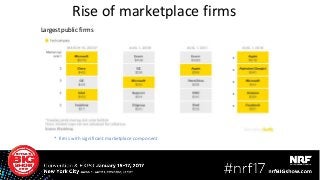
Rise of marketplace firms
Largest public firms
*
*
*
*
*
* firms with significant marketplace component
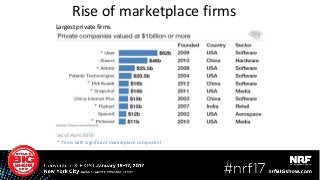
Rise of marketplace firms
Largest private firms
*
*
*
*
*
* firms with significant marketplace component
*
A transformational example
of marketplace technology
8
9
• NOT transportation technology
– New transport systems
– Vehicle technology
• BUT marketplace technology
– Mobile tech to track location of drivers and riders
– Marketplace tech to run an efficient transport market
• Dynamic pricing
• Intelligent dispatch
• Driver positioning
• Today Uber is heavily investing in autonomous vehicles and other transportation tech.
What was Uber’s initial innovation?
A marketplace technology that ensures high availability and efficient
allocation of service
Uber wouldn’t be Uber without surge pricing…..
“Push a button, get a ride”
“Transportation as reliable as running water”
Why does Uber use dynamic pricing?
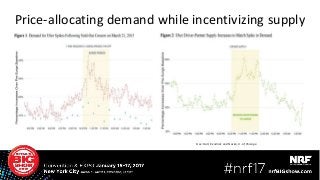
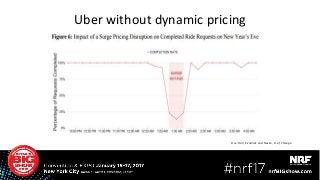
Price-allocating demand while incentivizing supply
Srce: Hall, Kendrick and Nasko, U. of Chicago
Uber without dynamic pricing
Srce: Hall, Kendrick and Nasko, U. of Chicago
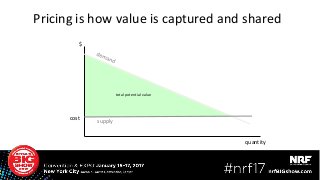
Pricing is how value is captured and shared
total potential value
supplycost
$
quantity
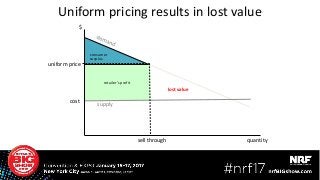
Uniform pricing results in lost value
retailer’s profit
$
supplycost
uniform price
sell through
consumer
surplus
lost value
quantity
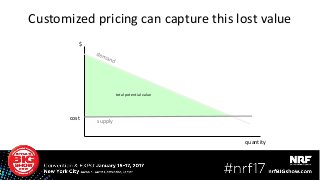
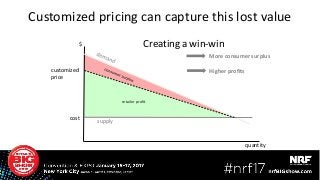
Customized pricing can capture this lost value
total potential value
supplycost
$
quantity
retailer profit
quantity
$
supply
More consumer surplus
Higher profits
cost
customized
price
Customized pricing can capture this lost value
Creating a win-win
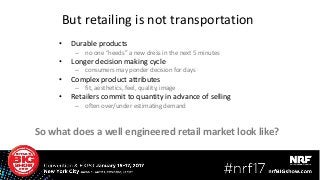
But retailing is not transportation
• Durable products
– no one “needs” a new dress in the next 5 minutes
• Longer decision making cycle
– consumers may ponder decision for days
• Complex product attributes
– fit, aesthetics, feel, quality, image
• Retailers commit to quantity in advance of selling
– often over/under estimating demand
So what does a well engineered retail market look like?
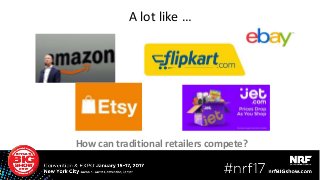
A lot like …
How can traditional retailers compete?
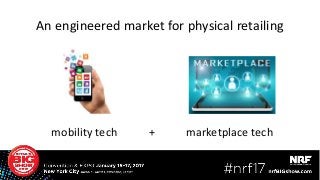
An engineered market for physical retailing
mobility tech + marketplace tech
A transformational example
of marketplace technology
21
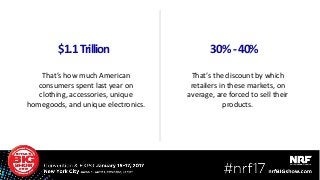
$1.1Trillion
That’s how much American
consumers spent last year on
clothing, accessories, unique
homegoods, and unique electronics.
30%-40%
That’s the discount by which
retailers in these markets, on
average, are forced to sell their
products.
22
23
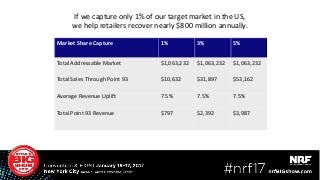
Market Share Capture 1% 3% 5%
Total Addressable Market $1,063,232 $1,063,232 $1,063,232
Total Sales Through Point 93 $10,632 $31,897 $53,162
Average Revenue Uplift 7.5% 7.5% 7.5%
Total Point 93 Revenue $797 $2,392 $3,987
Dollars in millions
If we capture only 1% of our target market in the US,
we help retailers recover nearly $800 million annually.
24
Retailers Are Leaving
Millions of Dollars
on the Table
Here’s How
to Reclaim It
(646) 912-2450
samantha@billionaired.co
͠
Beyond
the
Crystal Ball
Point 93
A Platform
that Enables Personalized
Conversation at Scale
Between Retailers and
Customers
When a customer walks into
a store, thousands of
monetizable data points
are lost.
26
They are lost because the
conversation is one-way
and the customer is an
unknown entity.
27
What She Would Have
Told You
if only she had a way to…
28
Who Walked In?
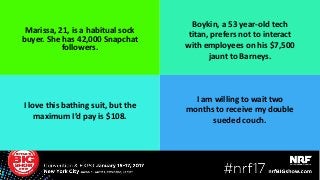
Marissa, 21, is a habitual sock
buyer. She has 42,000 Snapchat
followers.
Boykin, a 53 year-old tech
titan, prefers not to interact
with employees on his $7,500
jaunt to Barneys.
I love this bathing suit, but the
maximum I’d pay is $108.
I am willing to wait two
months to receive my double
sueded couch.
29
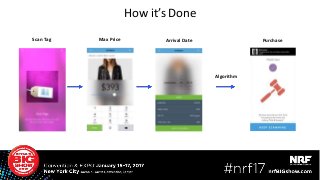
How it’s Done
30
Arrival DateMax Price
Algorithm
Scan Tag Purchase
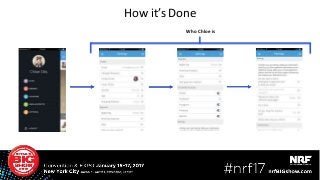
How it’s Done
31
Who Chloe is
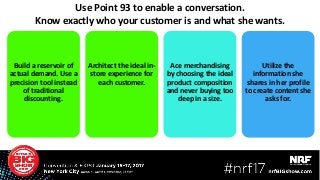
Use Point 93 to enable a conversation.
Know exactly who your customer is and what she wants.
Build a reservoir of
actual demand. Use a
precision tool instead
of traditional
discounting.
Architect the ideal in-
store experience for
each customer.
Ace merchandising
by choosing the ideal
product composition
and never buying too
deep in a size.
Utilize the
information she
shares in her profile
to create content she
asks for.
32
33
A transformational example
of marketplace technology
34
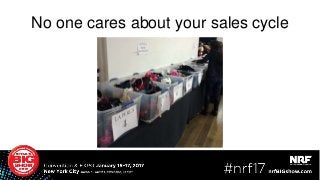
No one cares about your sales cycle
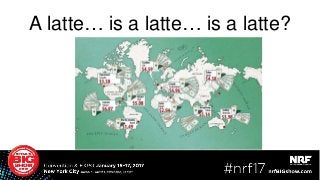
A latte… is a latte… is a latte?
You’re already playing this game…
...but kinda not that well.
What is the “time value” of fashion?
Are you sure about that?
Why can’t everyone be a Korean blogger?
39
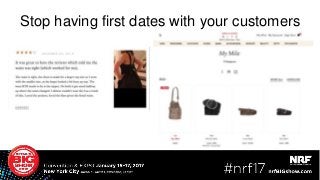
Stop having first dates with your customers
We aren’t trying to “convert,”
customers. We are cultivating and
consummating a relationship.
Key Takeaways
Customization, including equitable pricing,
captures value for both retailers and customers.

How Data Will Replace Discounting: Lessons From Uber, Point 93 and Orchard Mile

  • 1.
    How Data WillReplace Discounting: Lessons From Uber, Point 93 and Orchard Mile JENNIE BAIK, CEO and Co-Founder, Orchard Mile SAMANTHA ZIRKIN, CEO, Point 93 GARRETT VAN RYZIN, Head of Marketplace Optimization Advanced Development, Uber
  • 2.
    SamanthaZirkin,CEO, Point 93 GarrettvanRyzin,Head of Marketplace Optimization Advanced Development, Uber (Professor, Columbia Business School) JennieBaik,CEO, Orchard Mile
  • 3.
    What You WillLearn  How to End Discounting by understanding your customers, what they want, their urgency to purchase, and what they are willing to pay  How to leverage shopper data to personalize content and increase sales  The role of dynamic, equitable pricing in creating real-time, relevant, shopping experiences
  • 4.
    The rise offree market economics • Reduced government intervention in the economy • Free trade policy • Free capital flows and foreign investment • Market-based wages and prices • Property rights Not without backlash….
  • 5.
    Technology is acceleratingthis trend • Information – Increased quantity – Lower cost • Transaction costs – Communication – Payments • Cognitive power Approaching perfect competition ideal Perfect information, zero transactions costs, full rationality, full factor mobility, no exit/entrance barriers
  • 6.
    Rise of marketplacefirms Largest public firms * * * * * * firms with significant marketplace component
  • 7.
    Rise of marketplacefirms Largest private firms * * * * * * firms with significant marketplace component *
  • 8.
    A transformational example ofmarketplace technology 8
  • 9.
  • 10.
    • NOT transportationtechnology – New transport systems – Vehicle technology • BUT marketplace technology – Mobile tech to track location of drivers and riders – Marketplace tech to run an efficient transport market • Dynamic pricing • Intelligent dispatch • Driver positioning • Today Uber is heavily investing in autonomous vehicles and other transportation tech. What was Uber’s initial innovation?
  • 11.
    A marketplace technologythat ensures high availability and efficient allocation of service Uber wouldn’t be Uber without surge pricing….. “Push a button, get a ride” “Transportation as reliable as running water” Why does Uber use dynamic pricing?
  • 12.
    Price-allocating demand whileincentivizing supply Srce: Hall, Kendrick and Nasko, U. of Chicago
  • 13.
    Uber without dynamicpricing Srce: Hall, Kendrick and Nasko, U. of Chicago
  • 14.
    Pricing is howvalue is captured and shared total potential value supplycost $ quantity
  • 15.
    Uniform pricing resultsin lost value retailer’s profit $ supplycost uniform price sell through consumer surplus lost value quantity
  • 16.
    Customized pricing cancapture this lost value total potential value supplycost $ quantity
  • 17.
    retailer profit quantity $ supply More consumersurplus Higher profits cost customized price Customized pricing can capture this lost value Creating a win-win
  • 18.
    But retailing isnot transportation • Durable products – no one “needs” a new dress in the next 5 minutes • Longer decision making cycle – consumers may ponder decision for days • Complex product attributes – fit, aesthetics, feel, quality, image • Retailers commit to quantity in advance of selling – often over/under estimating demand So what does a well engineered retail market look like?
  • 19.
    A lot like… How can traditional retailers compete?
  • 20.
    An engineered marketfor physical retailing mobility tech + marketplace tech
  • 21.
    A transformational example ofmarketplace technology 21
  • 22.
    $1.1Trillion That’s how muchAmerican consumers spent last year on clothing, accessories, unique homegoods, and unique electronics. 30%-40% That’s the discount by which retailers in these markets, on average, are forced to sell their products. 22
  • 23.
  • 24.
    Market Share Capture1% 3% 5% Total Addressable Market $1,063,232 $1,063,232 $1,063,232 Total Sales Through Point 93 $10,632 $31,897 $53,162 Average Revenue Uplift 7.5% 7.5% 7.5% Total Point 93 Revenue $797 $2,392 $3,987 Dollars in millions If we capture only 1% of our target market in the US, we help retailers recover nearly $800 million annually. 24
  • 25.
    Retailers Are Leaving Millionsof Dollars on the Table Here’s How to Reclaim It (646) 912-2450 samantha@billionaired.co ͠ Beyond the Crystal Ball Point 93 A Platform that Enables Personalized Conversation at Scale Between Retailers and Customers
  • 26.
    When a customerwalks into a store, thousands of monetizable data points are lost. 26
  • 27.
    They are lostbecause the conversation is one-way and the customer is an unknown entity. 27
  • 28.
    What She WouldHave Told You if only she had a way to… 28 Who Walked In?
  • 29.
    Marissa, 21, isa habitual sock buyer. She has 42,000 Snapchat followers. Boykin, a 53 year-old tech titan, prefers not to interact with employees on his $7,500 jaunt to Barneys. I love this bathing suit, but the maximum I’d pay is $108. I am willing to wait two months to receive my double sueded couch. 29
  • 30.
    How it’s Done 30 ArrivalDateMax Price Algorithm Scan Tag Purchase
  • 31.
  • 32.
    Use Point 93to enable a conversation. Know exactly who your customer is and what she wants. Build a reservoir of actual demand. Use a precision tool instead of traditional discounting. Architect the ideal in- store experience for each customer. Ace merchandising by choosing the ideal product composition and never buying too deep in a size. Utilize the information she shares in her profile to create content she asks for. 32
  • 33.
  • 34.
    A transformational example ofmarketplace technology 34
  • 35.
    No one caresabout your sales cycle
  • 36.
    A latte… isa latte… is a latte?
  • 37.
    You’re already playingthis game… ...but kinda not that well. What is the “time value” of fashion? Are you sure about that?
  • 38.
    Why can’t everyonebe a Korean blogger?
  • 39.
    39 Stop having firstdates with your customers
  • 40.
    We aren’t tryingto “convert,” customers. We are cultivating and consummating a relationship. Key Takeaways Customization, including equitable pricing, captures value for both retailers and customers.

Editor's Notes

  • #36 At any given moment something is on sale at Orchard Mile. AND….people, yes even those who buy luxury or even full price most of the time, are still apt to be in deal hunting mode at least some of the time. And even if it’s not on sale in your owned channels, more often than not, 3rd party retailers, wholesalers etc are discounting before you do. Markdown season isn’t a season anymore. People just expect ot have sales all the time or they expect it none of the time- and you’ve seen some pretty successful strategies from teh luxury houses to never discount and never put things in outlet- it’s difficult to maintain and to stick with – but it’s a real strategy. But that assumes an extrememly high demand to sustain your business. There are entire businesses built around signing up for sales alerts. Remember the site- Hukkster? It was a site backed by the Winklevoss twins but It shut down in 2014. Why can’t you buy a good bikini in July? Therefore, if someone is always selling your product and it’s difficult to control discounts- how can you sell your product without devaluing the brand that capitalizes/ recognizes this shift?
  • #38 Actually, the retail industry is already doing dynamic pricing- but they are doing it wrong.  The 1-1 “personalized” marketing tactics that retailers use today are still falling short of the mark.    (Department store example) Analogy: Going to a restaurant and having the waiter spill a drink on you.  They offer you $20 off your next meal- is that great service?
  • #39 SLIDE 3:  1-1 marketing is understanding the value of your customer- and value underpins the personalized rewards? Dynamic pricing can be a part of that strategy.  Create a personal relationship with your customer- doesn’t erode the brand.  Everyone has different currency and sale.  Celebrities and editors have gotten this for every.  Korean blogger- everyone is a microinfluencer- so make it work for them: Where does she go? How many friends does she have? Is she a leader of a follower? What’s the climate in her town? Is she short or tall? Curvy or slim? Is she a mom? And if so, what kind of mom is she? Does she like talking to you? How? What would make her like talking to you? What kind of style does she have; what are her influences? What is gangnam style? Fifty-eight percent of consumers say a personalized experience is very important when purchasing from a company,
  • #40 1) 58%of consumers say a personalized experience is very important when purchasing from a company 2) More than half (52%) of consumers are somewhat likely to switch brands if a company doesn't make an effort to personalize their communications to them. 3) High performers are 7.2x more likely than underperformers to extensively use web personalization. Top teams are also 4.2x more likely to leverage predictive intelligence or data science to personalize emails to customers. START to get feedback loops from your customer (ratings, clickstream data, surveys, customer service reports), and that can inform pricing and loyalty rewards. If you’re just doing google analytics- that’s not enough. Make it a good date. Not a first date. And yes, that may mean different prices for different people. you must double-down on the personal. exampel: Bonobos, No. 270 in the Internet Retailer 2015 Top 500 Guide, has produced significant results by divvying up its customers into segments based on such variables as what colors and sizes they’ve bought and looked at, where customers are located and how recently they’ve made a purchase, and then targeting those groups with relevant messages.
  • #41 Customers have been trained wrong; they look for deep discounts and don’t offer feedback about the product, price, or their in-store experience. We re-train customers to work with retailers. By employing gamification and rewarding positive customer behaviors with slight decreases in price, we re-train customers to exhibit behaviors that save everyone money: buy in bulk,shop during times of low foot traffic, share personal data, and serve as an affiliate marketer. Customers have been trained wrong; they look for deep discounts and don’t offer feedback about the product, price, or their in-store experience. One-way, antagonistic relationship where where she is racing to the bottom and you have to “convert” her. Leverage equitable dynamic pricing to enable a two-way conversation that allows her to work with you and reward positive behaviors with slight decreases in price or loyalty rewards or experiences. Re-train customers to exhibit behaviors that save everyone money: buy in bulk, shop during times of low foot traffic, share personal data, and serve as an affiliate marketer. Let her share who she is, her urgency to purchase, and what she is willing to pay.