HOW CLOSE IS
Your Organisation
to being
Breached?
S A F E S C O R E W H I T E P A P E R
PROPOSED BY
SAFE SECURITY
W W W . S A F E . S E C U R I T Y
TABLE
OF CONTENT
1. Executive summary
2. The global business concern
3. How can cybersecurity be understood by every stakeholder
4. Why opt for Digital Business Risk Quantification?
• Advantages of mathematical models over
subjective analysis to provide business context
• Different Mathematical scoring models
currently use
• SAFE - a unique method to measure an
organisation’s digital business risk
5. How a mathematical scoring could have helped an
organisation that was recently breached?
01
03
04
06
11
Cybersecurity is all about answering one
simple question - How secure are you right
now? Unfortunately, most security and risk
management professionals cannot answer
this question with deliberate confidence.
Whether it is a start-up, a large enterprise
or government bodies across the world, the
conversations around cybersecurity have
essentially remained stagnant. The
technology forming the backbone of
cybersecurity is becoming more advanced,
yet we do not show any significant victory
over cybercriminals who continue to exploit
the basics of security alongside newer,
more sophisticated ones. Any organisation,
irrespective of their cybersecurity maturity
should be assessing the cyber risk posture
across people, processes and technology,
thereby assess their enterprise-wide
cybersecurity and be able to answer:
Are they secure?
If yes, HOW SECURE?
Your answer to these questions could be
influenced by multiple factors such as the
strength of your security team, the
investment in cyber-security or even the
number of cybersecurity products you
have. Today, businesses are basing their
critical cybersecurity decisions on multiple
abstractions from different subjective
sources. Moreover, the traditional approach
has been to perform a point-in-time
cross-sectional evaluation of sample sets
or feedback to gauge your organisation’s
cyber risk posture. Is this enough?
EXECUTIVE
SUMMARY
PAGE 01 OF 12
Traditional methods are certainly limited in
their capabilities and this is easily proven by
the multitude of breaches businesses were a
victim of, across the globe. The 2020 Q3 Data
Breach QuickView Report revealed that the
number of records exposed in 2020 has
increased to 36 billion globally. The report
stated that there were 2,953 publicly
reported breaches in the first three quarters
of 2020 itself! 2020 is already named the
“worst year on record” by the end of Q2 in
terms of the total number of records
exposed. With the growing sophistication of
cyber-attacks and global damages related
to cybercrime reaching $6 trillion by 2021, we
need a solution which simplifies
cybersecurity.
The advantage of basing cybersecurity
decisions after reviewing information using
an objective and consistent metric is that it
will enable your board, customers and
security teams to understand the siloed
technicalities of cybersecurity, thereby,
bringing everyone to the same page in
conversations surrounding cybersecurity.
Further, this objective and consistent metric
needs to depict the probability/possibility of
a breach happening in your organization in
the next twelve months by assessing
cybersecurity signals across people, process
and technology along with external threat
intelligence.
PAGE 02 OF 12
For the past decade, there has been a
steady increase in cybersecurity
investments across the world. To put this in
perspective, there has been a ransomware
attack every 14 seconds and is predicted to
increase in frequency to 11 seconds by 2021,
according to a report by Cybersecurity
Ventures. That is an increase of 715%
year-over-year, according to the Threat
Landscape Report 2020. Such attacks have
targeted large, medium and small
organisations across industries and
geography, indiscriminately...and this is just
one of the many ways to paralyse a
business.
Cybersecurity risks have reached its critical
threshold, so much so that the CEOs of
Citigroup, JP Morgan Chase & Co., Morgan
Stanley, the Bank of America, State Street
Corporation, Bank of New York Mellon, and
Goldman Sachs have recognised it in the
House Financial Services Committee
Hearing, April 10th 2019. These large banks
have invested billions of dollars in
cybersecurity, yet consider cybersecurity as
“one of the greatest threats to our [their]
financial system today”
It isn’t just financial organisations which
are disrupted by data breaches. Let us
take an example of the recent Twitter
hack. With the number of resources, time
and energy dedicated to cybersecurity,
a tech-first, billion-dollar and
silicon-valley based corporation such as
Twitter still became a victim of a
phishing attack of global proportions.
Why is this the case?
The answer to this can be brought down
to a simple solution: Organisations are
unaware of where they stand with or
without the cybersecurity practices and
investments they’ve undertaken. As of
today, with the traditional methods,
organisations only get a ‘sense of
security’ which is not necessarily
equivalent to true cybersecurity. This
placebo effect will not just impact the
business and its finances/balance sheet,
but also have reputational and
regulatory repercussions on the
organisation and directly hold the CEO
liable, as per the latest General Data
Protection Regulation guidelines.
PAGE 03 OF 12
THE GLOBAL
BUSINESS
CONCERN
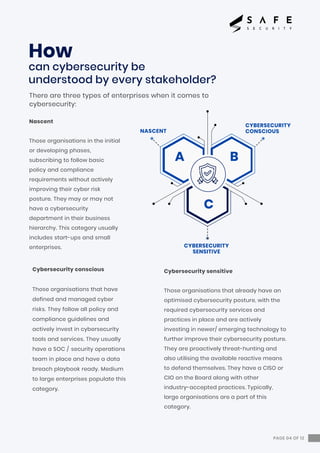
Nascent
Those organisations in the initial
or developing phases,
subscribing to follow basic
policy and compliance
requirements without actively
improving their cyber risk
posture. They may or may not
have a cybersecurity
department in their business
hierarchy. This category usually
includes start-ups and small
enterprises.
Cybersecurity conscious
Those organisations that have
defined and managed cyber
risks. They follow all policy and
compliance guidelines and
actively invest in cybersecurity
tools and services. They usually
have a SOC / security operations
team in place and have a data
breach playbook ready. Medium
to large enterprises populate this
category.
Cybersecurity sensitive
Those organisations that already have an
optimised cybersecurity posture, with the
required cybersecurity services and
practices in place and are actively
investing in newer/ emerging technology to
further improve their cybersecurity posture.
They are proactively threat-hunting and
also utilising the available reactive means
to defend themselves. They have a CISO or
CIO on the Board along with other
industry-accepted practices. Typically,
large organisations are a part of this
category.
There are three types of enterprises when it comes to
cybersecurity:
How
can cybersecurity be
understood by every stakeholder?
PAGE 04 OF 12
NASCENT
CYBERSECURITY
SENSITIVE
CYBERSECURITY
CONSCIOUS
A B
C
Irrespective of the cybersecurity maturity, organisations are being breached at the drop of a
hat, which is why each organisation is looking to upgrade to a better cybersecurity posture,
with better (or more) cybersecurity products and services, higher compliance and
adherence to policies or increased cyber insurance coverage.
Growth in cybersecurity posture can only be truly appreciated when it is measured and not
based on subjective abstractions. Barring the security & IT team in any organisation, the
other members (Board, Employees, Customers or Stakeholders) are not always technology or
cybersecurity experts. There is a dense fog of “everyone’s responsibility is no one’s
responsibility” that clouds enterprise-wide cybersecurity.
To know how the cybersecurity services, tools,
XDRs, EDRs and outside-in or inside-out
protocols are improving your cybersecurity,
you need to know your cyber risk status before
and after implementing these steps. This
de-mystification involving the siloed technical
details can be easily performed with the help
of a consistent risk metric - a definitive and
succinct objective score between 0 to 5 that is
enterprise-wide, objective, assessed (and
reported) in real-time on a single dashboard.
This score will translate into a consistent
language across the Board, Security teams,
Customers and all stakeholders as the
ultimate answer to the question - How secure
are we, now?
PAGE 05 OF 12
Mathematical models have historically
been the go-to method to prioritise pain
points in various fields. The Glasgow Coma
Scale has been used to measure the
responsiveness of patients after any head
trauma with 15 being the highest score.
Similarly, the Apgar scale is used in the
neonatal intensive care to measure the
health of a newborn infant. This too is
measured out of 10.
(1.00)365
= 1.00 whereas, (1.01)365
= 37.7
This goes to show how doing nothing at all,
versus small yet consistent changes, can
bring about unthinkable transformations.
This example embodies two principles that
should be instilled in the DNA of every
member of any organisation:
Some of the advantages of using a
mathematical representation of the
real-time cyber risk posture of an
organisation are:
A. Data integrity is not compromised,
ensuring that representation is devoid of
subjective influences, interpretation and
manipulation.
B. Unlike data represented in the form of a
range (low-medium-high), mathematical
representation is real-time, precise and
contextual.
C. The confidence of the output is directly
proportional to the number of input
signals, thereby ensuring higher accuracy
with increase in number of feeds.
D. It is a standardised representation of
complex data that is simple to understand
for every stakeholder.
Advantages of mathematical models
over subjective analysis to provide
business context
PAGE 06 OF 12
Quantificationmakes
explanations easier
Consistency is key
Why
opt for Digital Business
Risk Quantification?
a. Bayesian Network
b. Weighted Average
c. Log Odds
d. MaRiQ (Manage Risks Quantitatively)
e. Logistic Regression
f. Multilayer neural networks
In this whitepaper, we will focus on the Bayesian Network model. It is defined as “a method for
taking an event that has occurred and predicting the likelihood that one of the several
possible known causes was a contributing factor.” For example, if the Network is provided
with a set of symptoms, it can be used to compute the probabilities of the presence of
various diseases. Efficient algorithms can perform inference and learn in Bayesian networks.
Dynamic Bayesian networks model sequences of variables that are constantly changing/
evolving.
Bayesian Network in cybersecurity:
A Bayesian Network can be used to continuously integrate cybersecurity signals from people,
processes, technology, cybersecurity products and third-parties, and generate a probability
of a breach occurring in the next twelve months.
The beauty of the Bayesian network is that it generates a result even with a single input.
However, the ‘confidence metric’ of the result is directly proportional to the number of input
parameters. In other words, an increase in the number of signals being fed into the network
will directly influence the accuracy of the generated probability of breach.
Different Mathematical scoring
models currently used
PAGE 07 OF 12
SAFE - Security Assessment Framework for Enterprise - is a game-changer in the
“Cybersecurity and Digital Business Risk Quantification” (CRQ) space. The Supervised Machine
Learning engine of SAFE gives an output both in the form of a Breach Likelihood Score
(between 0-5) and the dollar value risk the organization faces along with providing prioritized
actionable insights based on technical cybersecurity signals, external threat intelligence,
and business context of what and where are the "weakest links" across people, process and
technology. This will enable an organization to measure and mitigate its cyber risk in
real-time.
SAFE allows an organization to get an Enterprise-Wide, Objective, Consistent & Real-Time
Visibility of it’s overall Cyber Risk Posture that can be decomposed into 5 vectors:
(Micro: Score per Cyber Security Policy | Macro: Score for All Policies
Combined and % adherence to Cybersecurity Compliances)
Based on inputs of each cybersecurity policy deployed across an
enterprise, a score is generated per policy. These policies are
mapped to popular compliance frameworks such as NIST CSF, NIST
SP800-53, PCI DSS 3.2, ISO 27001 among others.
SAFE - a unique method to measure
an organisation’s digital business risk
PAGE 08 OF 12
(Micro: Score per Employee | Macro: Score for All Employees Combined)
A zero-permission mobile application to be downloaded by every employee of the
organization that helps them assess their cybersecurity awareness, protect their mobile
devices (by monitoring cybersecurity controls of their phones) and monitor their deep and
dark web exposures. It allows the organization to run cybersecurity awareness campaigns
from a library of over a hundred multi-language nano (3-minute) cybersecurity courses
and quiz along with monitoring daily of the employee's personal information/password
that is leaked to the deep and dark web and put this together in our Scoring Engine to give
a score per employee.
1. People Assessment (via SAFE Me)
2. Process /
Policies
Assessment
SAFE Scoring Model:
The SAFE scoring model has been built as joint research at Massachusetts Institute of
Technology (MIT) that incorporates cybersecurity sensors data, external threat intelligence,
and business context and places it together in a Bayesian Network of a Supervised Machine
Learning risk quantification engine to give out scores and dollar value risk that the
organization is facing. The scores are calculated both at a macro and micro level and can
also be measured for particular Lines of Business (LoB) / Crown Jewels / Departments. The
SAFE score output is essentially a function of how likely an enterprise is to get breached in the
next twelve months based on their real-time cyber risk posture.
(Micro: Score per IP | Outside-In & Inside-Out Assessment - Macro: Score for
All IPs Combined)
Daily Security Configuration (Hardening) Controls Scanning of every
IP Address along with taking API feeds of vulnerability scanners in the
IT/Cloud Network of the organization and it's data ingested into our
scoring engine to give output as a score per IP address / Application
or each Cloud Instance. The technology stack is also assessed from
outside-in that not only scans the organizations themselves but also
all registered third parties in the SAFE Platform.
(Micro: Score per CSP | Macro: Score of all CSPs Combined)
Score per cybersecurity product on how they are implemented within
the network. Some of it (e.g. NGFW, EDR, SIEM) will be based on API
feeds while other categories of products will be objective
questionnaire-based.
PAGE 09 OF 12
3. Technology
4. Cybersecurity
Products
PAGE 10 OF 12
On September 28th 2020, CMA CGM - a
French company and the fourth-largest
container shipping enterprise in the world
- was a victim of a Ragnar Locker
ransomware attack.
The attacker sent an email to the
company where they mentioned the
following message:
“YOU HAVE TO CONTACT US via LIVE CHAT
IMMEDIATELY TO RESOLVE THIS CASE AND
MAKE A DEAL” and pay for the special
decryption key. They warned that if CMA
CGM failed to comply with their demand
within two days, the contact link for the
live chat would be deleted and they would
lose all access. This ransomware is a data
encryption malware which locked out the
company’s data. Their peripheral server
was also segregated from its parent IT
system.
Impact: As a result of this cyberattack,
CMA CGM’s online services were impacted,
including their e-commerce System and
other Peripheral Servers. A number of the
company’s websites also had to be taken
down temporarily and customers could
not access their profiles.
How
a mathematical scoring could
have helped an organisation that
was recently breached?
PAGE 11 OF 12
• A real-time view of CMA-CGM’s breach
probability would be depicted by their
SAFE score.
• SAFE would have alerted them as soon
as a new threat was identified in the
form of a sudden drop in the SAFE score.
This can be immediately correlated to
failing configuration assessments and
vulnerability controls, thereby identifying
the breach likelihood of one or more
servers.
• SAFE provides useful cybersecurity
product recommendations as per the
Geography, industry and Size of an
organization. It would have suggested
must-have products/ services such as
Data Backup solution for Ransomware.
• SAFE also assesses the Backup and
Recovery capabilities of the organization
which can help them recover from a
ransomware attack. In case the backup
activity is below par, it reflects as a lower
SAFE score.
• Ransomware controls are specifically
mapped in SAFE using the ATT&CK MITRE
framework.
• SAFE assessments also include policy
level assessments where the
organization is able to track whether the
organization has implemented
password and access policies for its user
which defines who can access the
information and systems. Good
compliance adherence reflects as a high
SAFE score which implies lower breach
probability.
How could SAFE have detected the
probability of this hack?
www.safe.security | info@safe.security
Standford Research Park,
3260 Hillview Avenue,
Palo Alto, CA - 94304

How close is your organization to being breached | Safe Security

  • 1.
    HOW CLOSE IS YourOrganisation to being Breached? S A F E S C O R E W H I T E P A P E R PROPOSED BY SAFE SECURITY W W W . S A F E . S E C U R I T Y
  • 2.
    TABLE OF CONTENT 1. Executivesummary 2. The global business concern 3. How can cybersecurity be understood by every stakeholder 4. Why opt for Digital Business Risk Quantification? • Advantages of mathematical models over subjective analysis to provide business context • Different Mathematical scoring models currently use • SAFE - a unique method to measure an organisation’s digital business risk 5. How a mathematical scoring could have helped an organisation that was recently breached? 01 03 04 06 11
  • 3.
    Cybersecurity is allabout answering one simple question - How secure are you right now? Unfortunately, most security and risk management professionals cannot answer this question with deliberate confidence. Whether it is a start-up, a large enterprise or government bodies across the world, the conversations around cybersecurity have essentially remained stagnant. The technology forming the backbone of cybersecurity is becoming more advanced, yet we do not show any significant victory over cybercriminals who continue to exploit the basics of security alongside newer, more sophisticated ones. Any organisation, irrespective of their cybersecurity maturity should be assessing the cyber risk posture across people, processes and technology, thereby assess their enterprise-wide cybersecurity and be able to answer: Are they secure? If yes, HOW SECURE? Your answer to these questions could be influenced by multiple factors such as the strength of your security team, the investment in cyber-security or even the number of cybersecurity products you have. Today, businesses are basing their critical cybersecurity decisions on multiple abstractions from different subjective sources. Moreover, the traditional approach has been to perform a point-in-time cross-sectional evaluation of sample sets or feedback to gauge your organisation’s cyber risk posture. Is this enough? EXECUTIVE SUMMARY PAGE 01 OF 12
  • 4.
    Traditional methods arecertainly limited in their capabilities and this is easily proven by the multitude of breaches businesses were a victim of, across the globe. The 2020 Q3 Data Breach QuickView Report revealed that the number of records exposed in 2020 has increased to 36 billion globally. The report stated that there were 2,953 publicly reported breaches in the first three quarters of 2020 itself! 2020 is already named the “worst year on record” by the end of Q2 in terms of the total number of records exposed. With the growing sophistication of cyber-attacks and global damages related to cybercrime reaching $6 trillion by 2021, we need a solution which simplifies cybersecurity. The advantage of basing cybersecurity decisions after reviewing information using an objective and consistent metric is that it will enable your board, customers and security teams to understand the siloed technicalities of cybersecurity, thereby, bringing everyone to the same page in conversations surrounding cybersecurity. Further, this objective and consistent metric needs to depict the probability/possibility of a breach happening in your organization in the next twelve months by assessing cybersecurity signals across people, process and technology along with external threat intelligence. PAGE 02 OF 12
  • 5.
    For the pastdecade, there has been a steady increase in cybersecurity investments across the world. To put this in perspective, there has been a ransomware attack every 14 seconds and is predicted to increase in frequency to 11 seconds by 2021, according to a report by Cybersecurity Ventures. That is an increase of 715% year-over-year, according to the Threat Landscape Report 2020. Such attacks have targeted large, medium and small organisations across industries and geography, indiscriminately...and this is just one of the many ways to paralyse a business. Cybersecurity risks have reached its critical threshold, so much so that the CEOs of Citigroup, JP Morgan Chase & Co., Morgan Stanley, the Bank of America, State Street Corporation, Bank of New York Mellon, and Goldman Sachs have recognised it in the House Financial Services Committee Hearing, April 10th 2019. These large banks have invested billions of dollars in cybersecurity, yet consider cybersecurity as “one of the greatest threats to our [their] financial system today” It isn’t just financial organisations which are disrupted by data breaches. Let us take an example of the recent Twitter hack. With the number of resources, time and energy dedicated to cybersecurity, a tech-first, billion-dollar and silicon-valley based corporation such as Twitter still became a victim of a phishing attack of global proportions. Why is this the case? The answer to this can be brought down to a simple solution: Organisations are unaware of where they stand with or without the cybersecurity practices and investments they’ve undertaken. As of today, with the traditional methods, organisations only get a ‘sense of security’ which is not necessarily equivalent to true cybersecurity. This placebo effect will not just impact the business and its finances/balance sheet, but also have reputational and regulatory repercussions on the organisation and directly hold the CEO liable, as per the latest General Data Protection Regulation guidelines. PAGE 03 OF 12 THE GLOBAL BUSINESS CONCERN
  • 6.
    Nascent Those organisations inthe initial or developing phases, subscribing to follow basic policy and compliance requirements without actively improving their cyber risk posture. They may or may not have a cybersecurity department in their business hierarchy. This category usually includes start-ups and small enterprises. Cybersecurity conscious Those organisations that have defined and managed cyber risks. They follow all policy and compliance guidelines and actively invest in cybersecurity tools and services. They usually have a SOC / security operations team in place and have a data breach playbook ready. Medium to large enterprises populate this category. Cybersecurity sensitive Those organisations that already have an optimised cybersecurity posture, with the required cybersecurity services and practices in place and are actively investing in newer/ emerging technology to further improve their cybersecurity posture. They are proactively threat-hunting and also utilising the available reactive means to defend themselves. They have a CISO or CIO on the Board along with other industry-accepted practices. Typically, large organisations are a part of this category. There are three types of enterprises when it comes to cybersecurity: How can cybersecurity be understood by every stakeholder? PAGE 04 OF 12 NASCENT CYBERSECURITY SENSITIVE CYBERSECURITY CONSCIOUS A B C
  • 7.
    Irrespective of thecybersecurity maturity, organisations are being breached at the drop of a hat, which is why each organisation is looking to upgrade to a better cybersecurity posture, with better (or more) cybersecurity products and services, higher compliance and adherence to policies or increased cyber insurance coverage. Growth in cybersecurity posture can only be truly appreciated when it is measured and not based on subjective abstractions. Barring the security & IT team in any organisation, the other members (Board, Employees, Customers or Stakeholders) are not always technology or cybersecurity experts. There is a dense fog of “everyone’s responsibility is no one’s responsibility” that clouds enterprise-wide cybersecurity. To know how the cybersecurity services, tools, XDRs, EDRs and outside-in or inside-out protocols are improving your cybersecurity, you need to know your cyber risk status before and after implementing these steps. This de-mystification involving the siloed technical details can be easily performed with the help of a consistent risk metric - a definitive and succinct objective score between 0 to 5 that is enterprise-wide, objective, assessed (and reported) in real-time on a single dashboard. This score will translate into a consistent language across the Board, Security teams, Customers and all stakeholders as the ultimate answer to the question - How secure are we, now? PAGE 05 OF 12
  • 8.
    Mathematical models havehistorically been the go-to method to prioritise pain points in various fields. The Glasgow Coma Scale has been used to measure the responsiveness of patients after any head trauma with 15 being the highest score. Similarly, the Apgar scale is used in the neonatal intensive care to measure the health of a newborn infant. This too is measured out of 10. (1.00)365 = 1.00 whereas, (1.01)365 = 37.7 This goes to show how doing nothing at all, versus small yet consistent changes, can bring about unthinkable transformations. This example embodies two principles that should be instilled in the DNA of every member of any organisation: Some of the advantages of using a mathematical representation of the real-time cyber risk posture of an organisation are: A. Data integrity is not compromised, ensuring that representation is devoid of subjective influences, interpretation and manipulation. B. Unlike data represented in the form of a range (low-medium-high), mathematical representation is real-time, precise and contextual. C. The confidence of the output is directly proportional to the number of input signals, thereby ensuring higher accuracy with increase in number of feeds. D. It is a standardised representation of complex data that is simple to understand for every stakeholder. Advantages of mathematical models over subjective analysis to provide business context PAGE 06 OF 12 Quantificationmakes explanations easier Consistency is key Why opt for Digital Business Risk Quantification?
  • 9.
    a. Bayesian Network b.Weighted Average c. Log Odds d. MaRiQ (Manage Risks Quantitatively) e. Logistic Regression f. Multilayer neural networks In this whitepaper, we will focus on the Bayesian Network model. It is defined as “a method for taking an event that has occurred and predicting the likelihood that one of the several possible known causes was a contributing factor.” For example, if the Network is provided with a set of symptoms, it can be used to compute the probabilities of the presence of various diseases. Efficient algorithms can perform inference and learn in Bayesian networks. Dynamic Bayesian networks model sequences of variables that are constantly changing/ evolving. Bayesian Network in cybersecurity: A Bayesian Network can be used to continuously integrate cybersecurity signals from people, processes, technology, cybersecurity products and third-parties, and generate a probability of a breach occurring in the next twelve months. The beauty of the Bayesian network is that it generates a result even with a single input. However, the ‘confidence metric’ of the result is directly proportional to the number of input parameters. In other words, an increase in the number of signals being fed into the network will directly influence the accuracy of the generated probability of breach. Different Mathematical scoring models currently used PAGE 07 OF 12
  • 10.
    SAFE - SecurityAssessment Framework for Enterprise - is a game-changer in the “Cybersecurity and Digital Business Risk Quantification” (CRQ) space. The Supervised Machine Learning engine of SAFE gives an output both in the form of a Breach Likelihood Score (between 0-5) and the dollar value risk the organization faces along with providing prioritized actionable insights based on technical cybersecurity signals, external threat intelligence, and business context of what and where are the "weakest links" across people, process and technology. This will enable an organization to measure and mitigate its cyber risk in real-time. SAFE allows an organization to get an Enterprise-Wide, Objective, Consistent & Real-Time Visibility of it’s overall Cyber Risk Posture that can be decomposed into 5 vectors: (Micro: Score per Cyber Security Policy | Macro: Score for All Policies Combined and % adherence to Cybersecurity Compliances) Based on inputs of each cybersecurity policy deployed across an enterprise, a score is generated per policy. These policies are mapped to popular compliance frameworks such as NIST CSF, NIST SP800-53, PCI DSS 3.2, ISO 27001 among others. SAFE - a unique method to measure an organisation’s digital business risk PAGE 08 OF 12 (Micro: Score per Employee | Macro: Score for All Employees Combined) A zero-permission mobile application to be downloaded by every employee of the organization that helps them assess their cybersecurity awareness, protect their mobile devices (by monitoring cybersecurity controls of their phones) and monitor their deep and dark web exposures. It allows the organization to run cybersecurity awareness campaigns from a library of over a hundred multi-language nano (3-minute) cybersecurity courses and quiz along with monitoring daily of the employee's personal information/password that is leaked to the deep and dark web and put this together in our Scoring Engine to give a score per employee. 1. People Assessment (via SAFE Me) 2. Process / Policies Assessment
  • 11.
    SAFE Scoring Model: TheSAFE scoring model has been built as joint research at Massachusetts Institute of Technology (MIT) that incorporates cybersecurity sensors data, external threat intelligence, and business context and places it together in a Bayesian Network of a Supervised Machine Learning risk quantification engine to give out scores and dollar value risk that the organization is facing. The scores are calculated both at a macro and micro level and can also be measured for particular Lines of Business (LoB) / Crown Jewels / Departments. The SAFE score output is essentially a function of how likely an enterprise is to get breached in the next twelve months based on their real-time cyber risk posture. (Micro: Score per IP | Outside-In & Inside-Out Assessment - Macro: Score for All IPs Combined) Daily Security Configuration (Hardening) Controls Scanning of every IP Address along with taking API feeds of vulnerability scanners in the IT/Cloud Network of the organization and it's data ingested into our scoring engine to give output as a score per IP address / Application or each Cloud Instance. The technology stack is also assessed from outside-in that not only scans the organizations themselves but also all registered third parties in the SAFE Platform. (Micro: Score per CSP | Macro: Score of all CSPs Combined) Score per cybersecurity product on how they are implemented within the network. Some of it (e.g. NGFW, EDR, SIEM) will be based on API feeds while other categories of products will be objective questionnaire-based. PAGE 09 OF 12 3. Technology 4. Cybersecurity Products
  • 12.
    PAGE 10 OF12 On September 28th 2020, CMA CGM - a French company and the fourth-largest container shipping enterprise in the world - was a victim of a Ragnar Locker ransomware attack. The attacker sent an email to the company where they mentioned the following message: “YOU HAVE TO CONTACT US via LIVE CHAT IMMEDIATELY TO RESOLVE THIS CASE AND MAKE A DEAL” and pay for the special decryption key. They warned that if CMA CGM failed to comply with their demand within two days, the contact link for the live chat would be deleted and they would lose all access. This ransomware is a data encryption malware which locked out the company’s data. Their peripheral server was also segregated from its parent IT system. Impact: As a result of this cyberattack, CMA CGM’s online services were impacted, including their e-commerce System and other Peripheral Servers. A number of the company’s websites also had to be taken down temporarily and customers could not access their profiles. How a mathematical scoring could have helped an organisation that was recently breached?
  • 13.
    PAGE 11 OF12 • A real-time view of CMA-CGM’s breach probability would be depicted by their SAFE score. • SAFE would have alerted them as soon as a new threat was identified in the form of a sudden drop in the SAFE score. This can be immediately correlated to failing configuration assessments and vulnerability controls, thereby identifying the breach likelihood of one or more servers. • SAFE provides useful cybersecurity product recommendations as per the Geography, industry and Size of an organization. It would have suggested must-have products/ services such as Data Backup solution for Ransomware. • SAFE also assesses the Backup and Recovery capabilities of the organization which can help them recover from a ransomware attack. In case the backup activity is below par, it reflects as a lower SAFE score. • Ransomware controls are specifically mapped in SAFE using the ATT&CK MITRE framework. • SAFE assessments also include policy level assessments where the organization is able to track whether the organization has implemented password and access policies for its user which defines who can access the information and systems. Good compliance adherence reflects as a high SAFE score which implies lower breach probability. How could SAFE have detected the probability of this hack?
  • 14.
    www.safe.security | info@safe.security StandfordResearch Park, 3260 Hillview Avenue, Palo Alto, CA - 94304