


How Big Companies Contribute to
OpenStack
Stefano Maffulli, OpenStack Community Manager
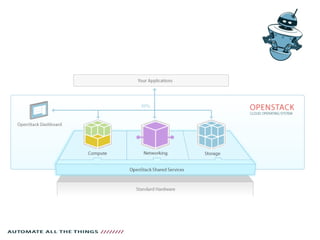
OpenStack Mission
To produce the
ubiquitous open source cloud computing
platform
that will meet the needs of public and private
clouds regardless of size, by being simple to
implement and massively scalable.
Four years in
 More than 70 OpenStack User Groups exist and 9,400+
new members have joined in the last year
 Community members are located in 139 different
countries around the world
 More than 1,200 user surveys have been completed,
detailing OpenStack deployments
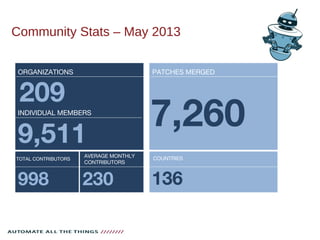
Community Stats – May 2013
ORGANIZATIONS
TOTAL CONTRIBUTORS
AVERAGE MONTHLY
CONTRIBUTORS
COUNTRIES
998 230 136
209
9,511
INDIVIDUAL MEMBERS
PATCHES MERGED
7,260
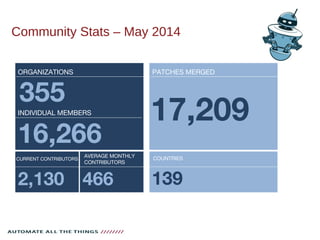
Community Stats – May 2014
ORGANIZATIONS
CURRENT CONTRIBUTORS
AVERAGE MONTHLY
CONTRIBUTORS
COUNTRIES
2,130 466 139
355
16,266
INDIVIDUAL MEMBERS
PATCHES MERGED
17,209
Trends and Themes in Year Four
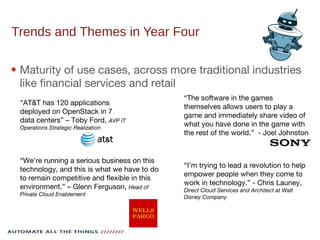
 Maturity of use cases, across more traditional industries
like financial services and retail
“The software in the games
themselves allows users to play a
game and immediately share video of
what you have done in the game with
the rest of the world.” - Joel Johnston
“AT&T has 120 applications
deployed on OpenStack in 7
data centers” – Toby Ford, AVP IT
Operations Strategic Realization
“We’re running a serious business on this
technology, and this is what we have to do
to remain competitive and flexible in this
environment.” – Glenn Ferguson, Head of
Private Cloud Enablement
“I’m trying to lead a revolution to help
empower people when they come to
work in technology.” - Chris Launey,
Direct Cloud Services and Architect at Walt
Disney Company
Trends and Themes in Year Four
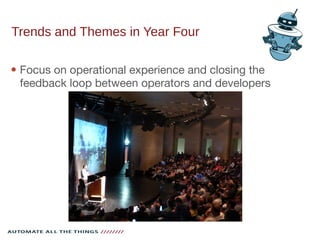
 Focus on operational experience and closing the
feedback loop between operators and developers
Trends and Themes in Year Four
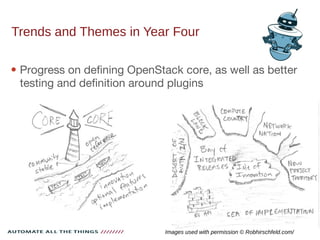
 Progress on defining OpenStack core, as well as better
testing and definition around plugins
Images used with permission © Robhirschfeld.com/
Trends and Themes in Year Four
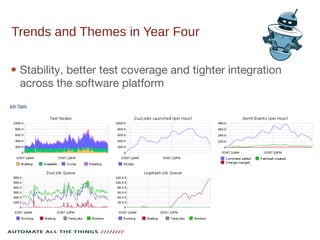
 Stability, better test coverage and tighter integration
across the software platform
Facts
 Big
 169 git repositories
 2.0M+ LOC
 22 Official Programs (Integrated and Incubated)
 Moving fast
 A new release every 6 months
 Programs and projects coming in every release
 Complex
 Hard to deploy and to test
 Lots of people from different countries and companies
How Is OpenStack Lead?
 No traditional management structure
 No 'dictator', no 'architect', no 'product manager'
 Representative democracy
 Technical leaders elected by developers
 Technical Committee also elected
 Board of Directors mostly elected
How Is OpenStack Lead?
 Time-based releases, every 6 months
 The cadence keeps people focused
 Milestones to maintain the rhythm
 Roadmap defined via blueprints
 Best proposed at the beginning of the cycle
 Should have specifications attached
 Approved for milestones by PTLs
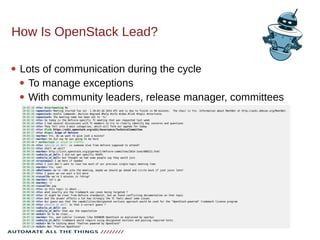
How Is OpenStack Lead?
 Lots of communication during the cycle
 To manage exceptions
 With community leaders, release manager, committees
How Is OpenStack Lead?
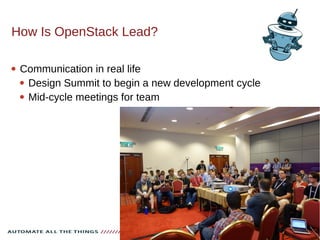
 Communication in real life
 Design Summit to begin a new development cycle
 Mid-cycle meetings for team
How Is OpenStack Lead?
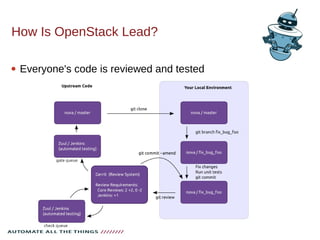
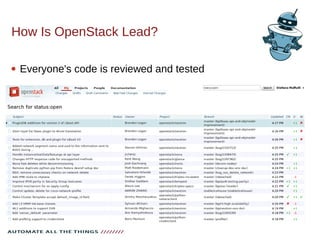
 Everyone's code is reviewed and tested
How Is OpenStack Lead?
 Everyone's code is reviewed and tested
How Do People Do This?
 In theory there is no difference between theory and
practice. In practice there is.
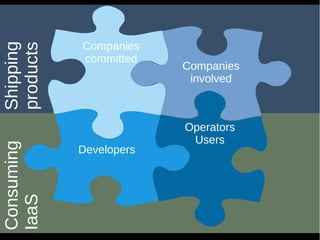
Consuming
IaaS
Shipping
products
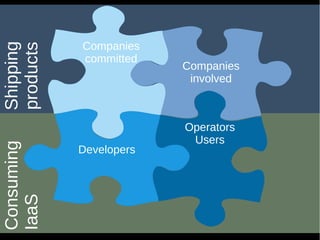
Companies
involved
Companies
committed
Operators
Users
Developers
Committed Companies
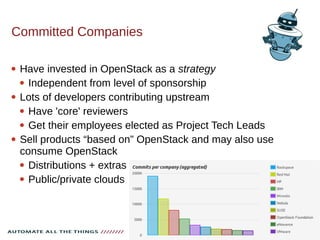
 Have invested in OpenStack as a strategy
 Independent from level of sponsorship
 Lots of developers contributing upstream
 Have 'core' reviewers
 Get their employees elected as Project Tech Leads
 Sell products “based on” OpenStack and may also use
consume OpenStack
 Distributions + extras
 Public/private clouds
Committed Companies
 Development teams are organized around OpenStack
Release Cycle
 Are deeply involved in the decision making process
 Know how and with whom to communicate
 Do a lot of code reviews
 Help fix things when they break
 Provide resources to the community
 Give back a lot and visibly, get good karma
 Spend karma to get things done, faster
Example Agile Teams
 Face-to-Face and occasional conversations
 Only online conversations are valued
 Standup meetings with audio/video, even for in-office
people
 Use internal mailing lists, wiki, instant messaging
 Regular meetups in person to socialize, outside work
 In-person sprints to develop code
Example Agile Teams
 Product backlog vs Blueprints
 Keep the pace, releases scheduled around 6months cycle
 Upstream first, avoid maintaining a fork
 Define “done” as “patch submitted”, requires keeping a fork
until patch is “merged”
 Workflow development very similar to OpenStack's
 Code review and automated testing, similar setup
 Added stakeholder: community
 Requires paying attention to what happens there
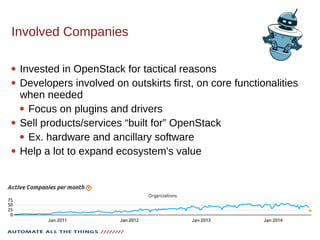
Involved Companies
 Invested in OpenStack for tactical reasons
 Developers involved on outskirts first, on core functionalities
when needed
 Focus on plugins and drivers
 Sell products/services “built for” OpenStack
 Ex. hardware and ancillary software
 Help a lot to expand ecosystem's value
Involved Companies
 Development teams organized around internal release cycles
 Marginally involved in decision making
 Don't know exactly how and with whom to communicate
 Focusing on plugins and drivers
 Get less karma, have less to spend to speed things up
Consuming
IaaS
Shipping
products
Companies
involved
Companies
committed
Operators
Users
Developers
How To Mitigate Friction
 Organize Teams around the open source model
 Coordinate with release cycle
 Get to know the relevant actors
 Participate in conversations, online and in real life
 Join Summits and mid-cycle meetings
How To Mitigate Friction
 Adopt OpenStack's constraints in your team
 Favor electronic communication, avoid watercooler talks
 Make all work visible and exposed
 If it doesn't have a URL, it doesn't exist
 Favor asynchronous communication
 Even if your team is in the same timezone, expect you'll
have to interact with people somewhere else
 Avoid locking points
 Push code for review early and at any time, use the WIP
to get early comments before it's even ready to merge
Too Much To Handle?
 Get developers exposed to OpenStack way of doing things
 Upstream University, two days free training in Paris
 Give mandate to your devs to do work upstream
 Makes your team more aware of surroundings
 Give them free time to spend upstream, 80/20
 If nothing else, do code reviews to get karma
What You Gain
 Less “your contribution is late or missing tests”
 Your developers will know deadlines and best practices
 Less “thank you but we don't like how you implemented it”
 Your developers will have circulated design ideas before
proposing code
 More “Well done, we wish someone did this before”
 Your team will fix issues proactively
 More karma to get past the dreaded Feature Freeze
 PTLs will know that your developers know how to deliver
good code in time and be more willing to grant exceptions
November 3-7, 2014 – Paris!
Registration and sponsorships now open!
Call for speakers is open.
Book your travel early, room blocks will fill up
fast!
Travel Assistance Program available.
More details at openstack.org/summit
All text and image content in this document is licensed under the Creative Commons Attribution-Share Alike 3.0 License
(unless otherwise specified). "OpenStack" is a registered trademark. The logos, wordmark and icons are subject to
international laws and its use is subject to the trademark policy.
Thank you …
 Stefano@openstack.org
 http://maffulli.net
 @smaffulli
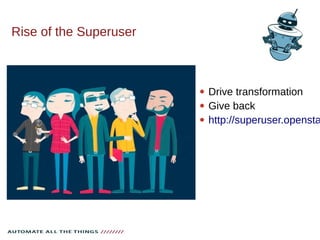
Rise of the Superuser
 Drive transformation
 Give back
 http://superuser.opensta
All text and image content in this document is licensed under the Creative Commons Attribution-Share Alike 3.0 License
(unless otherwise specified). "OpenStack" is a registered trademark. The logos, wordmark and icons are subject to
international laws and its use is subject to the trademark policy.
Credits and More Content
 https://www.openstack.org/summit/openstack-summit-atlanta-2014/session-videos/presentation/
 http://upload.wikimedia.org/wikipedia/commons/4/4a/Artist%27s_concept_of_collision_at_HD_1
 http://upload.wikimedia.org/wikipedia/commons/c/c8/Shinkansen_tokyo.jpg
 http://activity.openstack.org/dash/browser/scm-companies.html

How Big Companies Contribute to OpenStack

  • 1.
    How Big CompaniesContribute to OpenStack Stefano Maffulli, OpenStack Community Manager
  • 3.
    OpenStack Mission To producethe ubiquitous open source cloud computing platform that will meet the needs of public and private clouds regardless of size, by being simple to implement and massively scalable.
  • 5.
    Four years in More than 70 OpenStack User Groups exist and 9,400+ new members have joined in the last year  Community members are located in 139 different countries around the world  More than 1,200 user surveys have been completed, detailing OpenStack deployments
  • 6.
    Community Stats –May 2013 ORGANIZATIONS TOTAL CONTRIBUTORS AVERAGE MONTHLY CONTRIBUTORS COUNTRIES 998 230 136 209 9,511 INDIVIDUAL MEMBERS PATCHES MERGED 7,260
  • 7.
    Community Stats –May 2014 ORGANIZATIONS CURRENT CONTRIBUTORS AVERAGE MONTHLY CONTRIBUTORS COUNTRIES 2,130 466 139 355 16,266 INDIVIDUAL MEMBERS PATCHES MERGED 17,209
  • 8.
    Trends and Themesin Year Four  Maturity of use cases, across more traditional industries like financial services and retail “The software in the games themselves allows users to play a game and immediately share video of what you have done in the game with the rest of the world.” - Joel Johnston “AT&T has 120 applications deployed on OpenStack in 7 data centers” – Toby Ford, AVP IT Operations Strategic Realization “We’re running a serious business on this technology, and this is what we have to do to remain competitive and flexible in this environment.” – Glenn Ferguson, Head of Private Cloud Enablement “I’m trying to lead a revolution to help empower people when they come to work in technology.” - Chris Launey, Direct Cloud Services and Architect at Walt Disney Company
  • 9.
    Trends and Themesin Year Four  Focus on operational experience and closing the feedback loop between operators and developers
  • 10.
    Trends and Themesin Year Four  Progress on defining OpenStack core, as well as better testing and definition around plugins Images used with permission © Robhirschfeld.com/
  • 11.
    Trends and Themesin Year Four  Stability, better test coverage and tighter integration across the software platform
  • 12.
    Facts  Big  169git repositories  2.0M+ LOC  22 Official Programs (Integrated and Incubated)  Moving fast  A new release every 6 months  Programs and projects coming in every release  Complex  Hard to deploy and to test  Lots of people from different countries and companies
  • 15.
    How Is OpenStackLead?  No traditional management structure  No 'dictator', no 'architect', no 'product manager'  Representative democracy  Technical leaders elected by developers  Technical Committee also elected  Board of Directors mostly elected
  • 16.
    How Is OpenStackLead?  Time-based releases, every 6 months  The cadence keeps people focused  Milestones to maintain the rhythm  Roadmap defined via blueprints  Best proposed at the beginning of the cycle  Should have specifications attached  Approved for milestones by PTLs
  • 17.
    How Is OpenStackLead?  Lots of communication during the cycle  To manage exceptions  With community leaders, release manager, committees
  • 18.
    How Is OpenStackLead?  Communication in real life  Design Summit to begin a new development cycle  Mid-cycle meetings for team
  • 19.
    How Is OpenStackLead?  Everyone's code is reviewed and tested
  • 20.
    How Is OpenStackLead?  Everyone's code is reviewed and tested
  • 22.
    How Do PeopleDo This?  In theory there is no difference between theory and practice. In practice there is.
  • 23.
  • 24.
    Committed Companies  Haveinvested in OpenStack as a strategy  Independent from level of sponsorship  Lots of developers contributing upstream  Have 'core' reviewers  Get their employees elected as Project Tech Leads  Sell products “based on” OpenStack and may also use consume OpenStack  Distributions + extras  Public/private clouds
  • 26.
    Committed Companies  Developmentteams are organized around OpenStack Release Cycle  Are deeply involved in the decision making process  Know how and with whom to communicate  Do a lot of code reviews  Help fix things when they break  Provide resources to the community  Give back a lot and visibly, get good karma  Spend karma to get things done, faster
  • 27.
    Example Agile Teams Face-to-Face and occasional conversations  Only online conversations are valued  Standup meetings with audio/video, even for in-office people  Use internal mailing lists, wiki, instant messaging  Regular meetups in person to socialize, outside work  In-person sprints to develop code
  • 28.
    Example Agile Teams Product backlog vs Blueprints  Keep the pace, releases scheduled around 6months cycle  Upstream first, avoid maintaining a fork  Define “done” as “patch submitted”, requires keeping a fork until patch is “merged”  Workflow development very similar to OpenStack's  Code review and automated testing, similar setup  Added stakeholder: community  Requires paying attention to what happens there
  • 29.
    Involved Companies  Investedin OpenStack for tactical reasons  Developers involved on outskirts first, on core functionalities when needed  Focus on plugins and drivers  Sell products/services “built for” OpenStack  Ex. hardware and ancillary software  Help a lot to expand ecosystem's value
  • 30.
    Involved Companies  Developmentteams organized around internal release cycles  Marginally involved in decision making  Don't know exactly how and with whom to communicate  Focusing on plugins and drivers  Get less karma, have less to spend to speed things up
  • 32.
  • 33.
    How To MitigateFriction  Organize Teams around the open source model  Coordinate with release cycle  Get to know the relevant actors  Participate in conversations, online and in real life  Join Summits and mid-cycle meetings
  • 34.
    How To MitigateFriction  Adopt OpenStack's constraints in your team  Favor electronic communication, avoid watercooler talks  Make all work visible and exposed  If it doesn't have a URL, it doesn't exist  Favor asynchronous communication  Even if your team is in the same timezone, expect you'll have to interact with people somewhere else  Avoid locking points  Push code for review early and at any time, use the WIP to get early comments before it's even ready to merge
  • 35.
    Too Much ToHandle?  Get developers exposed to OpenStack way of doing things  Upstream University, two days free training in Paris  Give mandate to your devs to do work upstream  Makes your team more aware of surroundings  Give them free time to spend upstream, 80/20  If nothing else, do code reviews to get karma
  • 36.
    What You Gain Less “your contribution is late or missing tests”  Your developers will know deadlines and best practices  Less “thank you but we don't like how you implemented it”  Your developers will have circulated design ideas before proposing code  More “Well done, we wish someone did this before”  Your team will fix issues proactively  More karma to get past the dreaded Feature Freeze  PTLs will know that your developers know how to deliver good code in time and be more willing to grant exceptions
  • 37.
    November 3-7, 2014– Paris! Registration and sponsorships now open! Call for speakers is open. Book your travel early, room blocks will fill up fast! Travel Assistance Program available. More details at openstack.org/summit
  • 38.
    All text andimage content in this document is licensed under the Creative Commons Attribution-Share Alike 3.0 License (unless otherwise specified). "OpenStack" is a registered trademark. The logos, wordmark and icons are subject to international laws and its use is subject to the trademark policy. Thank you …  Stefano@openstack.org  http://maffulli.net  @smaffulli
  • 39.
    Rise of theSuperuser  Drive transformation  Give back  http://superuser.opensta
  • 40.
    All text andimage content in this document is licensed under the Creative Commons Attribution-Share Alike 3.0 License (unless otherwise specified). "OpenStack" is a registered trademark. The logos, wordmark and icons are subject to international laws and its use is subject to the trademark policy. Credits and More Content  https://www.openstack.org/summit/openstack-summit-atlanta-2014/session-videos/presentation/  https://www.openstack.org/summit/openstack-summit-atlanta-2014/session-videos/presentation/  http://upload.wikimedia.org/wikipedia/commons/4/4a/Artist%27s_concept_of_collision_at_HD_1  http://upload.wikimedia.org/wikipedia/commons/c/c8/Shinkansen_tokyo.jpg  http://activity.openstack.org/dash/browser/scm-companies.html

Editor's Notes

  • #5 Identity, Image and artifacts, Telemetry, Orchestration, Database And incubated: data processing (hadoop), DNS as a service, Bare metal, Deployment, Key management
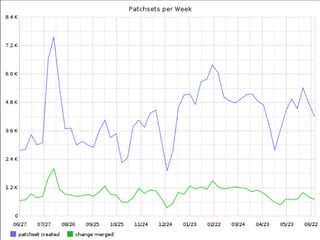
  • #14 http://graphite.openstack.org/render/?from=00:00_20130627&height=480&until=00:00_20140702&width=640&target=alias%28summarize%28stats_counts.gerrit.event.patchset-created,%20%271w%27%29,%20%27patchset%20created%27%29&target=alias%28summarize%28stats_counts.gerrit.event.change-merged,%20%271w%27%29,%20%27change%20merged%27%29&title=Patchsets%20per%20Week
  • #15 OpenStack is big and fast, joining it is like hopping on a Running Train
  • #16 Design summits regularly to Celebrate last release Brainstorm early ideas Discuss and approve implementation Make parallel efforts converge
  • #17 Design summits regularly to Celebrate last release Brainstorm early ideas Discuss and approve implementation Make parallel efforts converge
  • #18 Design summits regularly to Celebrate last release Brainstorm early ideas Discuss and approve implementation Make parallel efforts converge
  • #19 Design summits regularly to Celebrate last release Brainstorm early ideas Discuss and approve implementation Make parallel efforts converge
  • #20 Design summits regularly to Celebrate last release Brainstorm early ideas Discuss and approve implementation Make parallel efforts converge
  • #21 Design summits regularly to Celebrate last release Brainstorm early ideas Discuss and approve implementation Make parallel efforts converge
  • #22 http://graphite.openstack.org/render/?from=00:00_20130627&height=480&until=00:00_20140702&width=640&target=alias%28summarize%28stats_counts.gerrit.event.patchset-created,%20%271w%27%29,%20%27patchset%20created%27%29&target=alias%28summarize%28stats_counts.gerrit.event.change-merged,%20%271w%27%29,%20%27change%20merged%27%29&title=Patchsets%20per%20Week
  • #26 Identity, Image and artifacts, Telemetry, Orchestration, Database And incubated: data processing (hadoop), DNS as a service, Bare metal, Deployment, Key management
  • #30 The long tail of those 75 companies committing code in a given month
  • #32 This is what pundits have been predicting for OpenStack in the past 4 years... it hasn't happened and it won't happen.
  • #35 Not every company can be Red Hat or IBM or HP or Mirantis and companies selling hardware, developing drivers for OpenStack have value to bring to the table. Some things that these can do to make things less hard for your developers: This may require a major shift in corporate culture. Change is hard.
  • #36 Knowing how OpenStack does things is the first step to manage expectations. Developers will learn how things are done and why.
  • #40 They are not only transforming their infrastructure, but their business processes and culture They give back to the community, share knowledge with peers across their industries and help shape the future of OpenStack