
How Agile Can Make You a Better
Executive
Hala Saleh
Agile Coach, Product Manager, Entrepreneur
http://www.halasaleh.com
@HalaSaleh1
Who Am I?
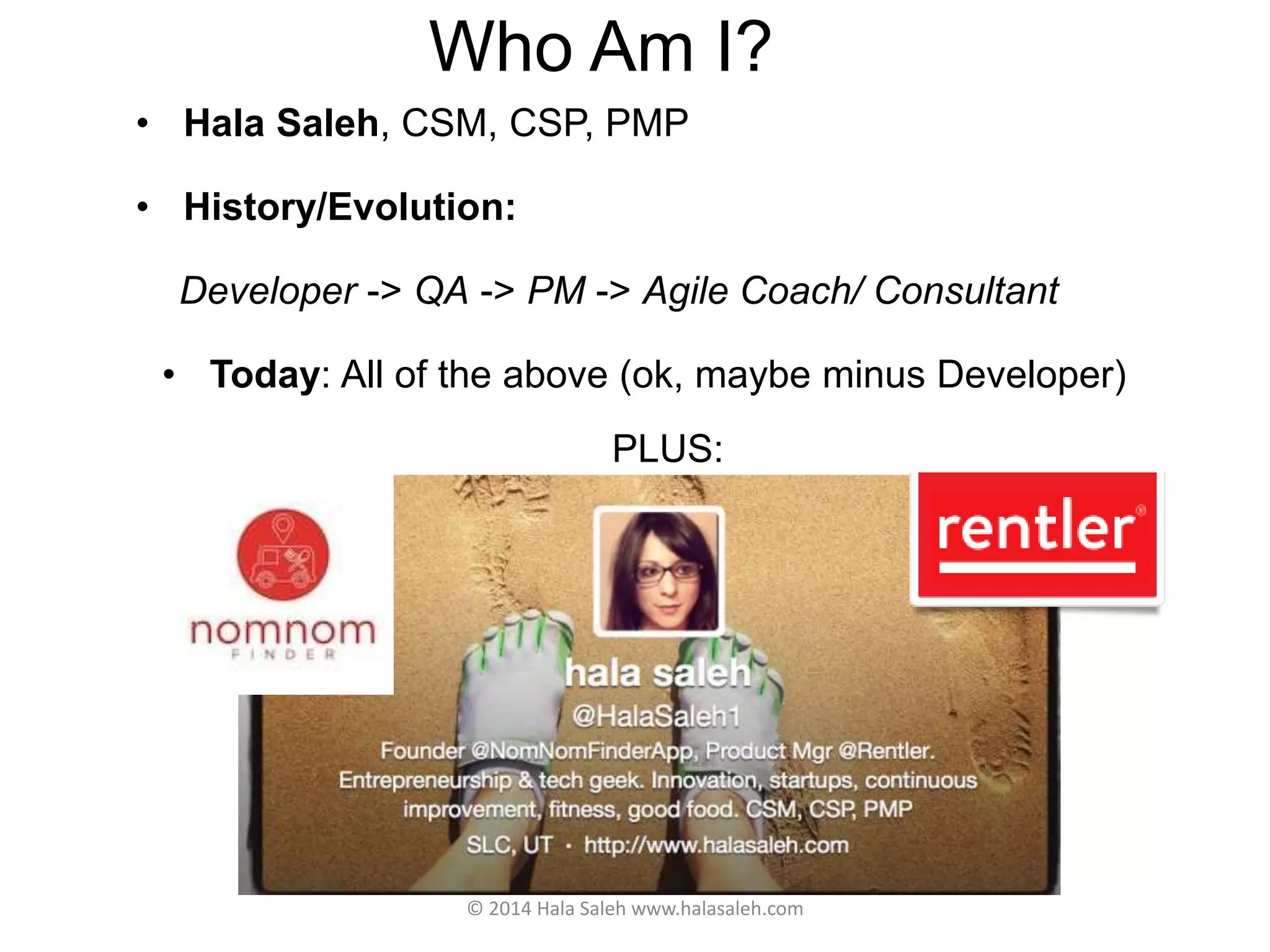
• Hala Saleh, CSM, CSP, PMP
• History/Evolution:
Developer -> QA -> PM -> Agile Coach/ Consultant
• Today: All of the above (ok, maybe minus Developer)
PLUS:
© 2014 Hala Saleh www.halasaleh.com
Agile Whaaat?
© 2013 Hala Saleh www.halasaleh.com
• Show of hands: On a scale of 1 – 5, how
familiar are you with “agile” development?
1. Not familiar with agile at all
2. Heard about it, not familiar with details of any specific
methodology
3. Moderately familiar, can name/describe at least 1 agile
methodology/framework at a high level
4. Familiar, can explain details of at least 1 agile
methodology & can name others
5. Very familiar, can explain details of more than 1 agile
methodology & have experience implementing at least 1
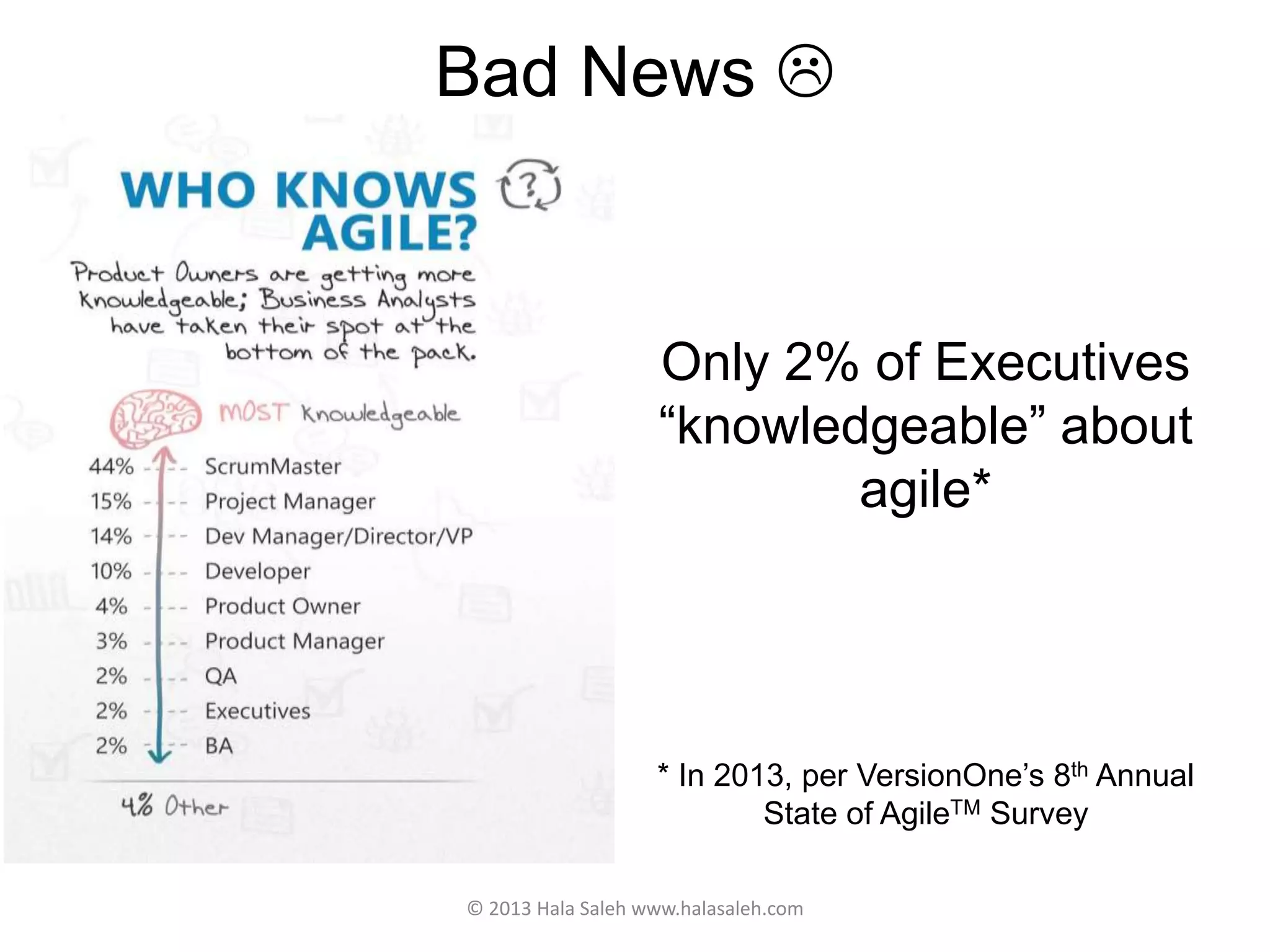
Bad News 
© 2013 Hala Saleh www.halasaleh.com
Only 2% of Executives
“knowledgeable” about
agile*
* In 2013, per VersionOne’s 8th Annual
State of AgileTM Survey
Good News 
© 2013 Hala Saleh www.halasaleh.com
Together, we can change that
statistic.
(And heal the world! And make it a better place!)
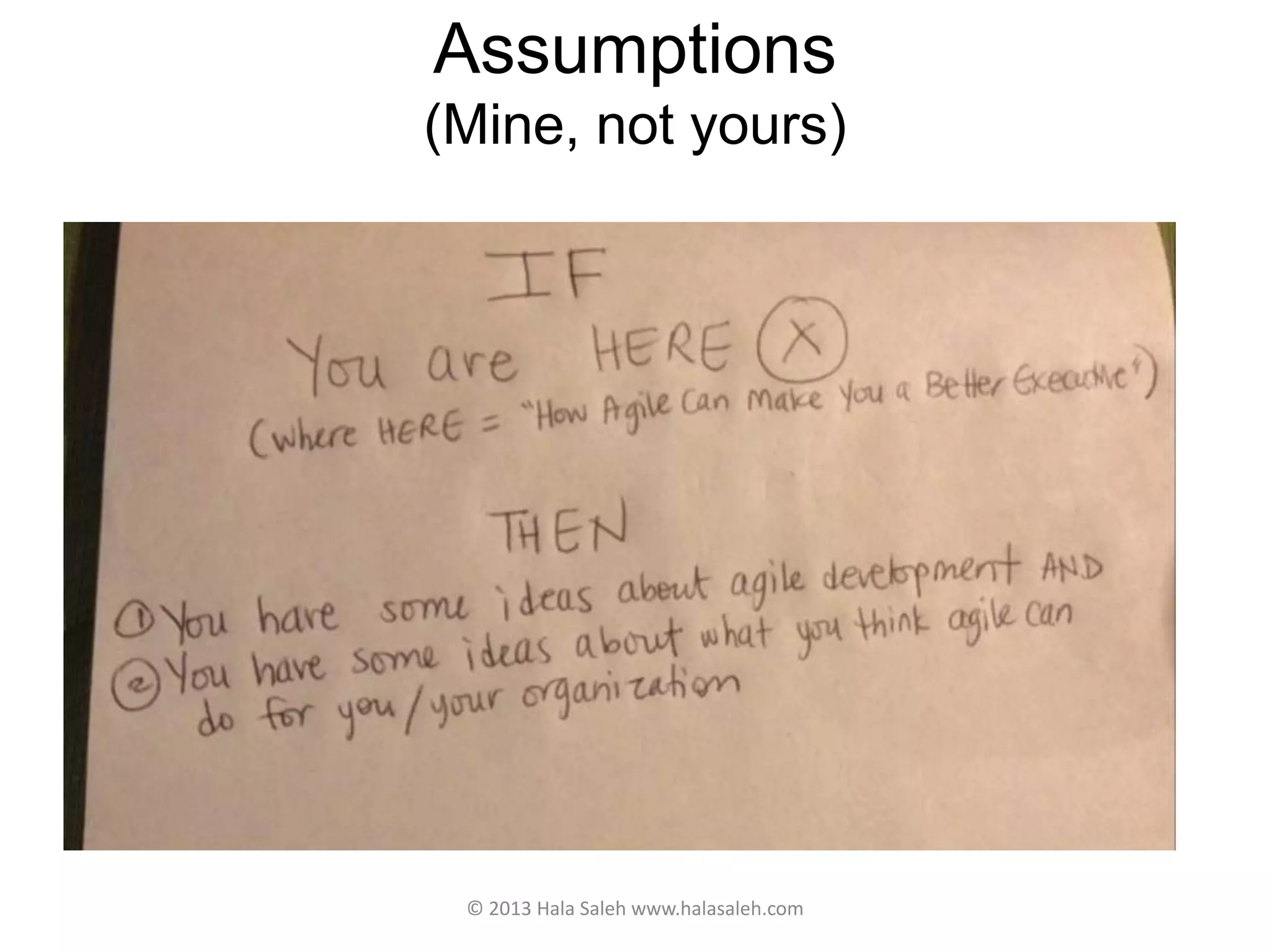
Assumptions
(Mine, not yours)
© 2013 Hala Saleh www.halasaleh.com
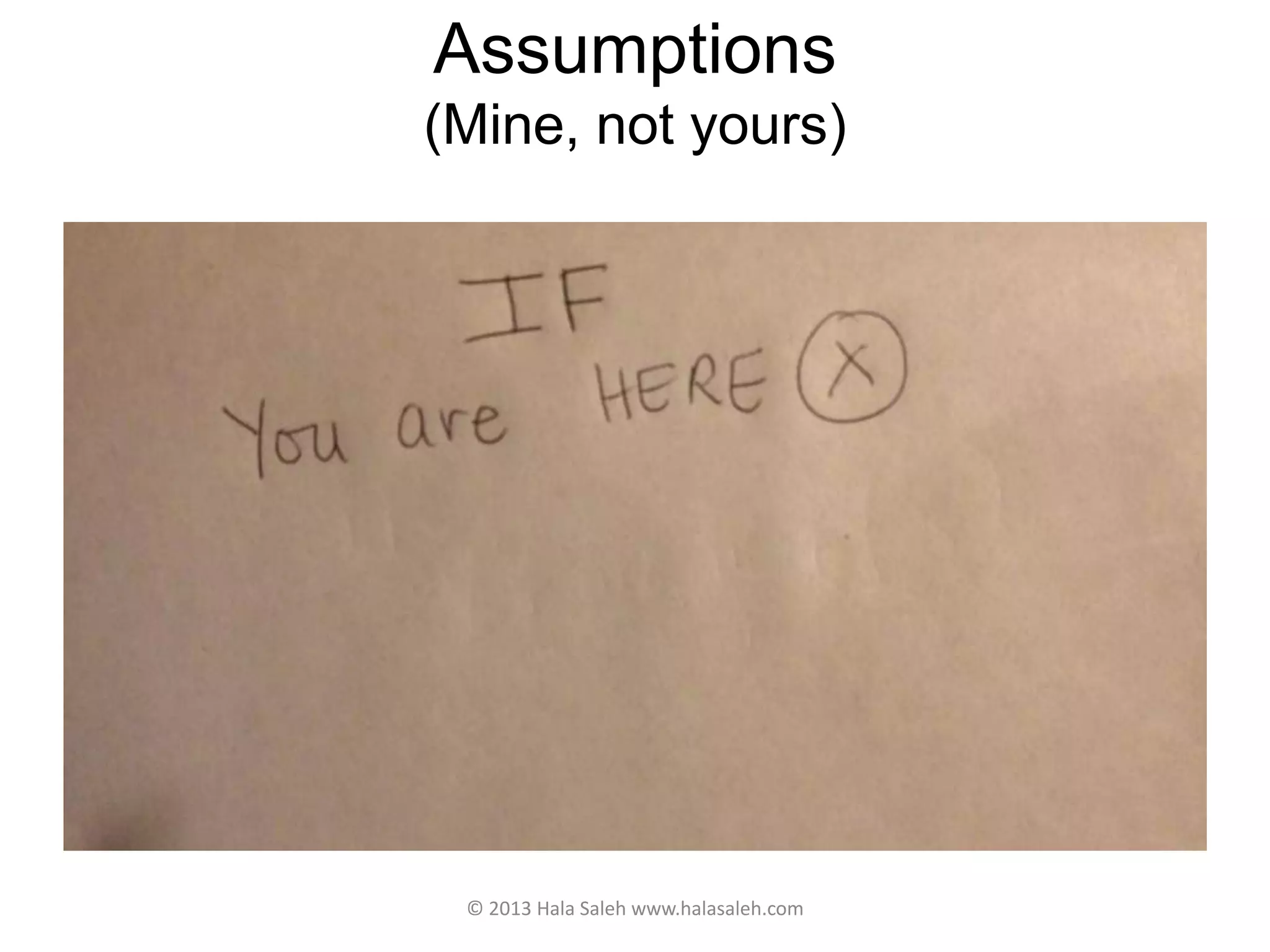
Assumptions
(Mine, not yours)
© 2013 Hala Saleh www.halasaleh.com
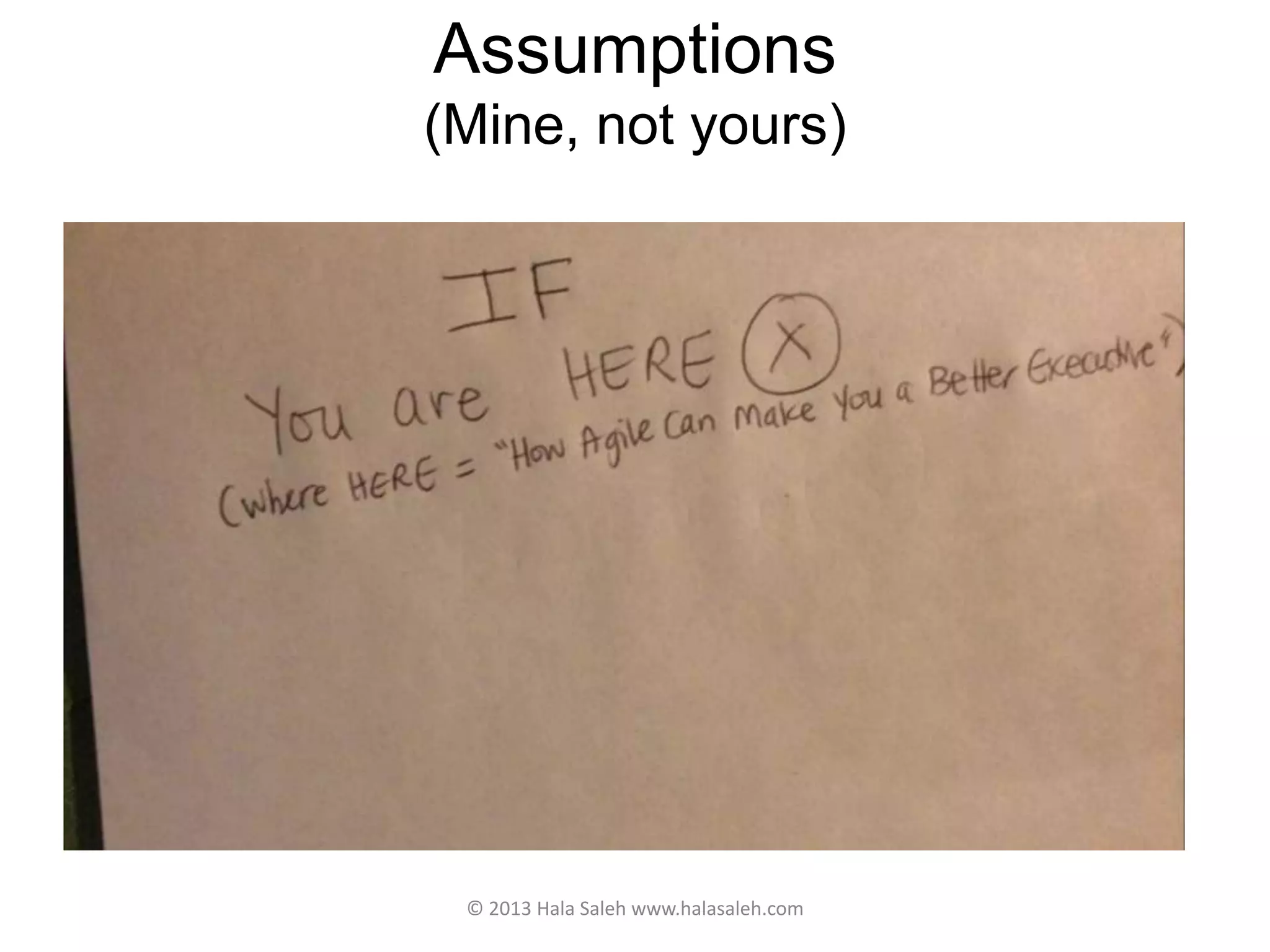
Assumptions
(Mine, not yours)
© 2013 Hala Saleh www.halasaleh.com
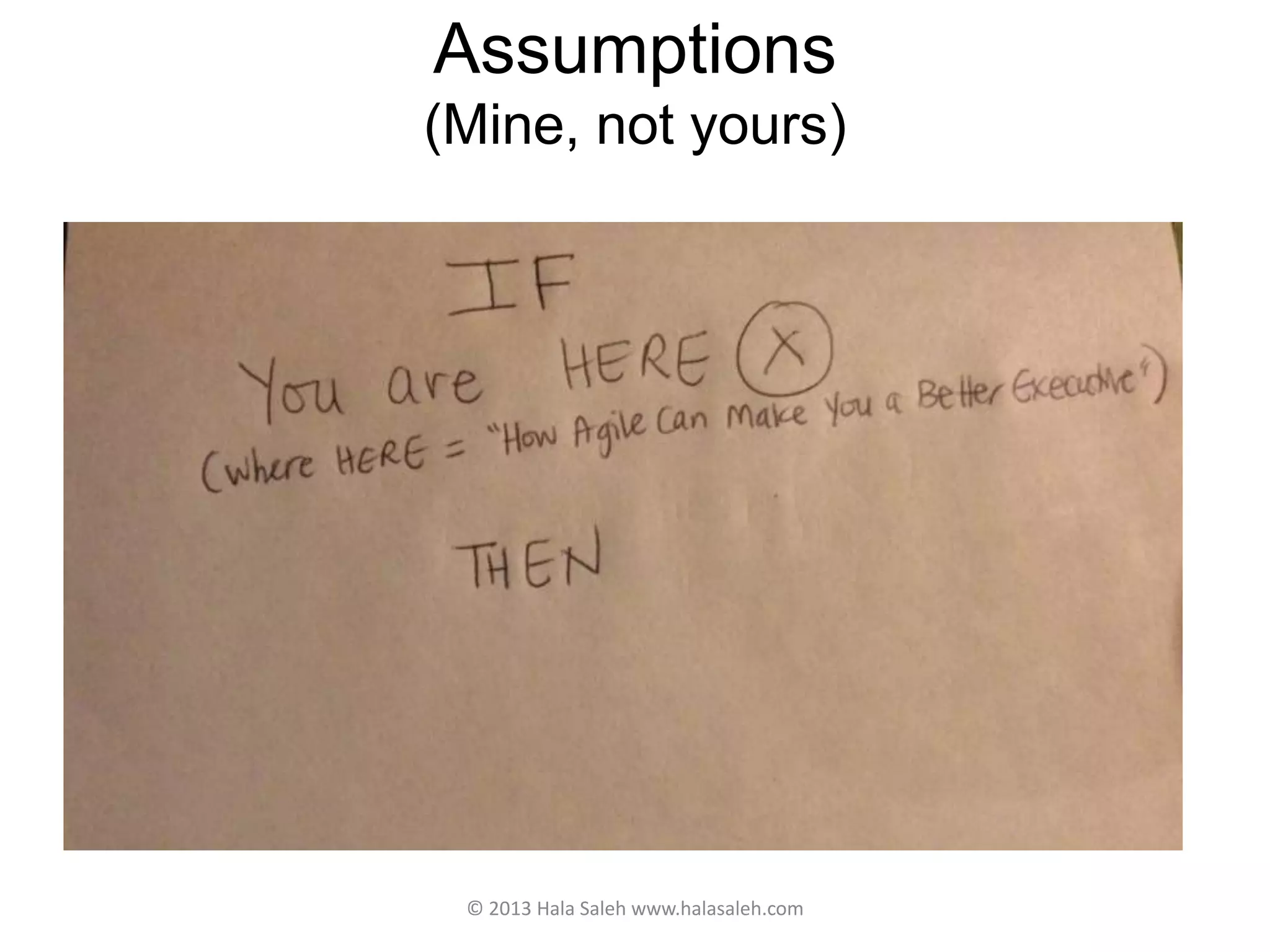
Assumptions
(Mine, not yours)
© 2013 Hala Saleh www.halasaleh.com
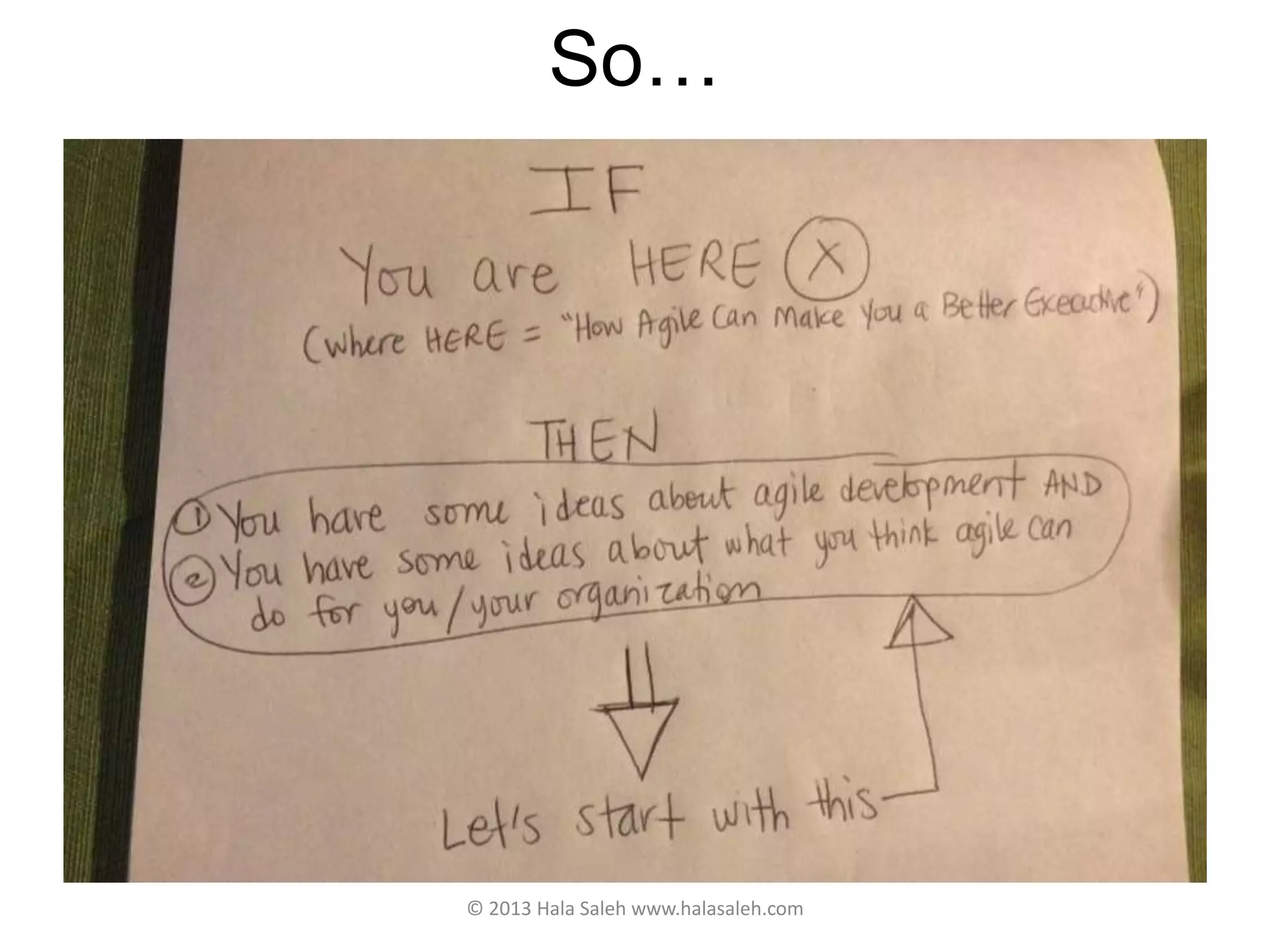
So…
© 2013 Hala Saleh www.halasaleh.com
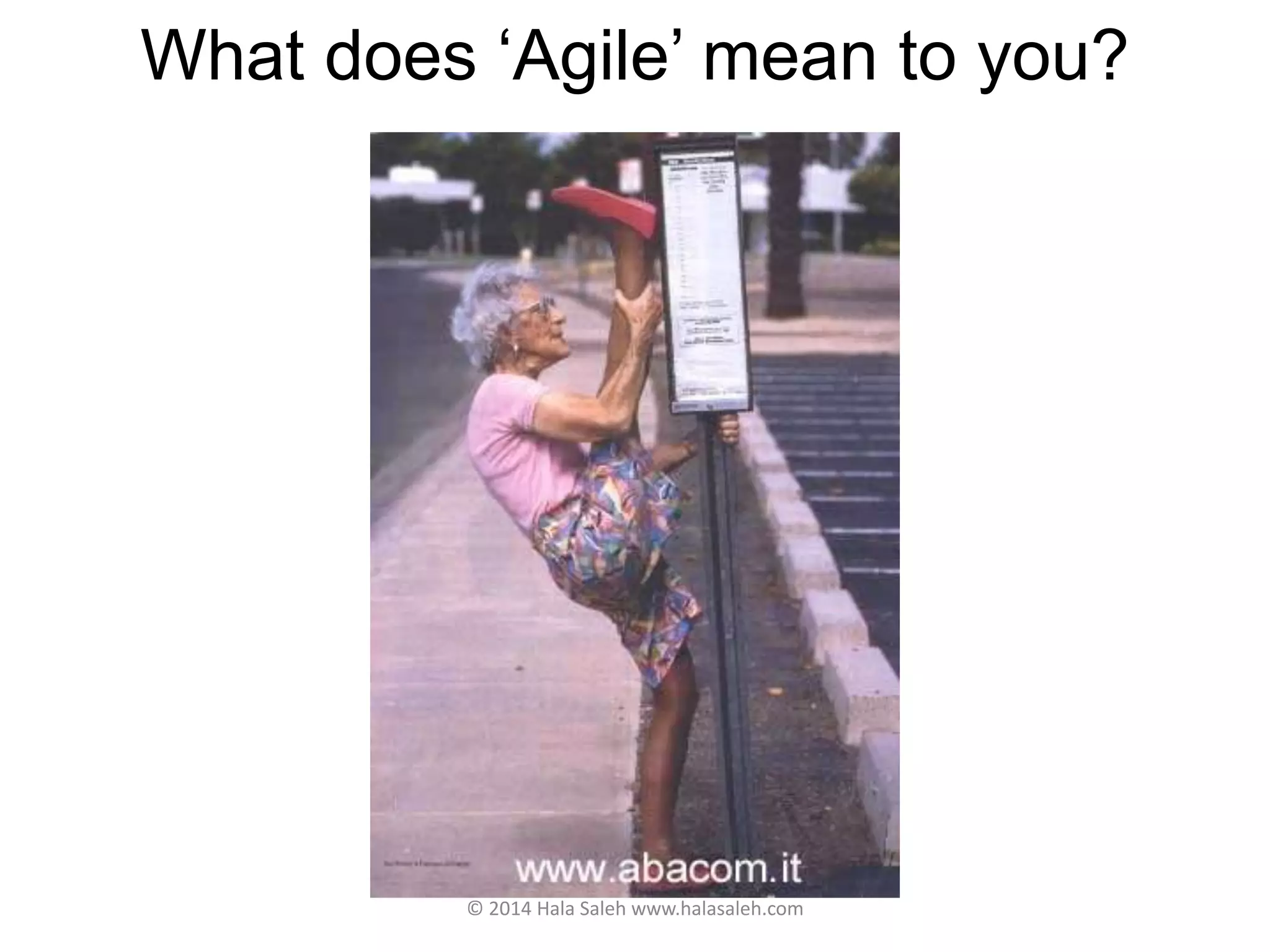
What does ‘Agile’ mean to you?
© 2014 Hala Saleh www.halasaleh.com
Exercise: Define Agile/Agility
• Working in groups of 3 – 4 (5 minutes):
– Brainstorm: What is “Agile”
– Define “Agile” (in 2 – 3 sentences)
– Discuss
• Share!
© 2013 Hala Saleh www.halasaleh.com
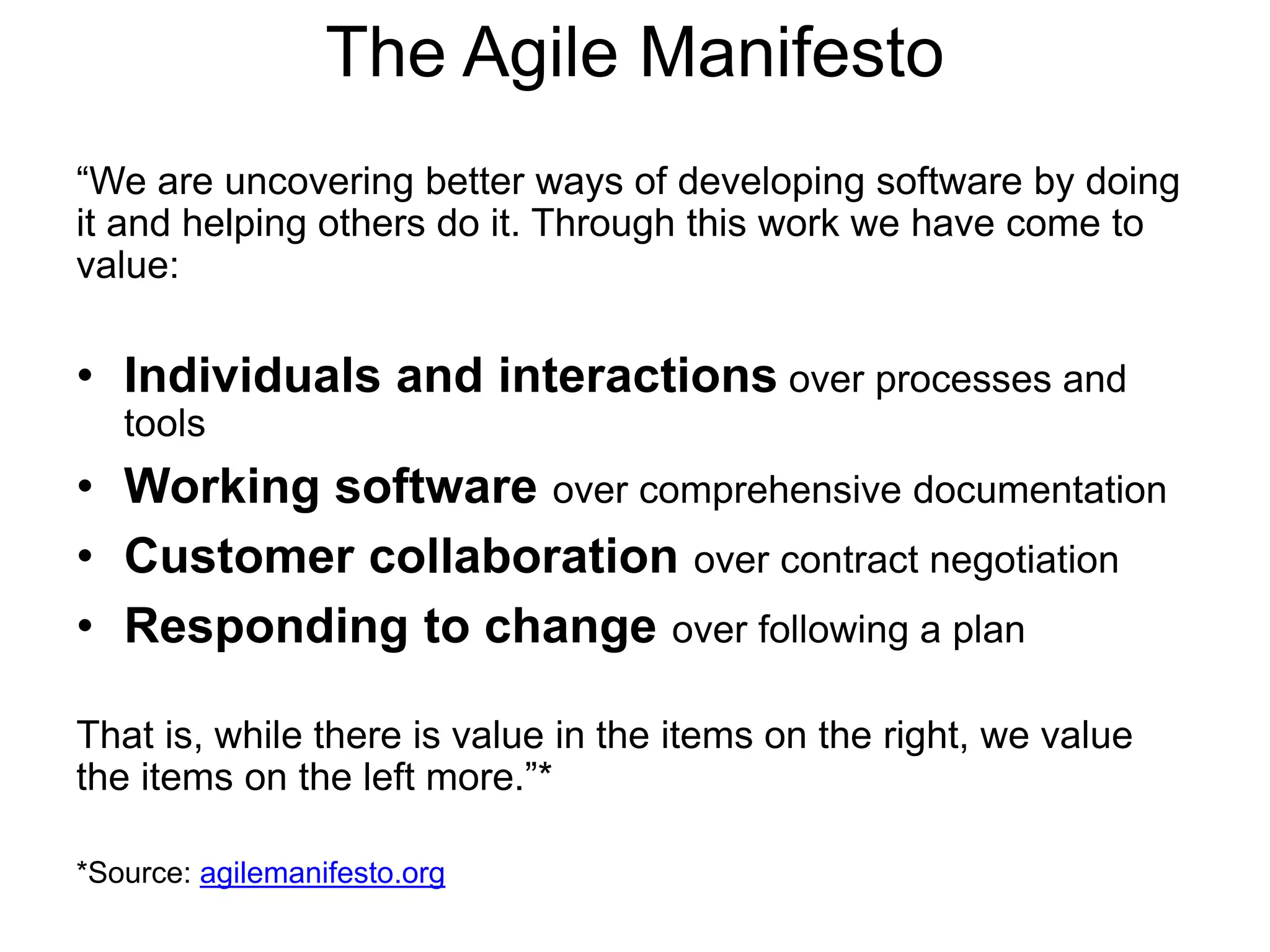
The Agile Manifesto
“We are uncovering better ways of developing software by doing
it and helping others do it. Through this work we have come to
value:
• Individuals and interactions over processes and
tools
• Working software over comprehensive documentation
• Customer collaboration over contract negotiation
• Responding to change over following a plan
That is, while there is value in the items on the right, we value
the items on the left more.”*
*Source: agilemanifesto.org
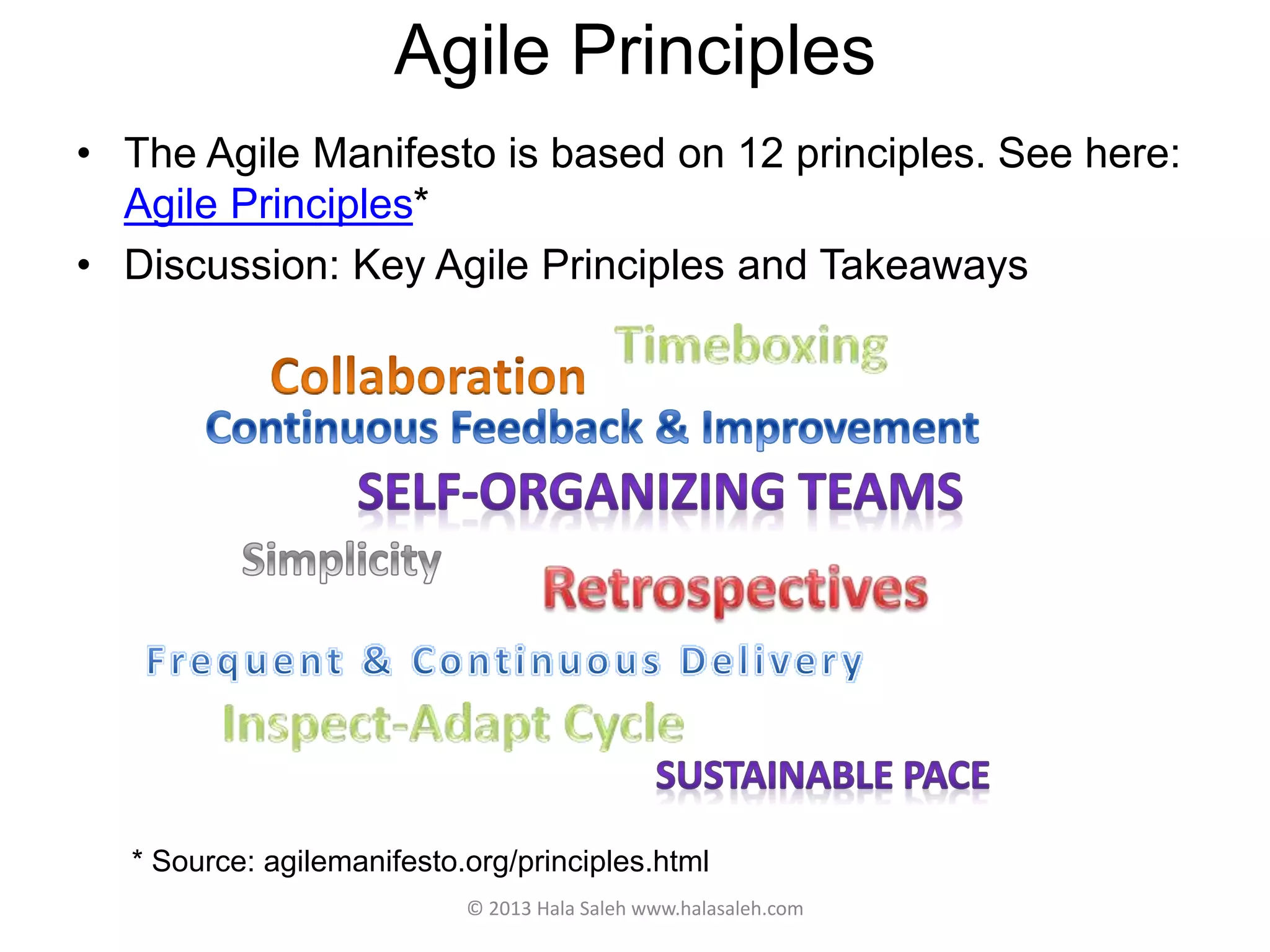
Agile Principles
• The Agile Manifesto is based on 12 principles. See here:
Agile Principles*
• Discussion: Key Agile Principles and Takeaways
© 2013 Hala Saleh www.halasaleh.com
* Source: agilemanifesto.org/principles.html
Let’s Talk About Agile
Agile development: An iterative and incremental
approach to developing software that incorporates
continuous feedback loops, adaptability, and
collaboration.
© 2013 Hala Saleh www.halasaleh.com
BUT, agile is not only for software!
Agility: An iterative and incremental approach to
achieving an end-result (product, project, goal) that
incorporates continuous feedback loops,
adaptability, and collaboration.
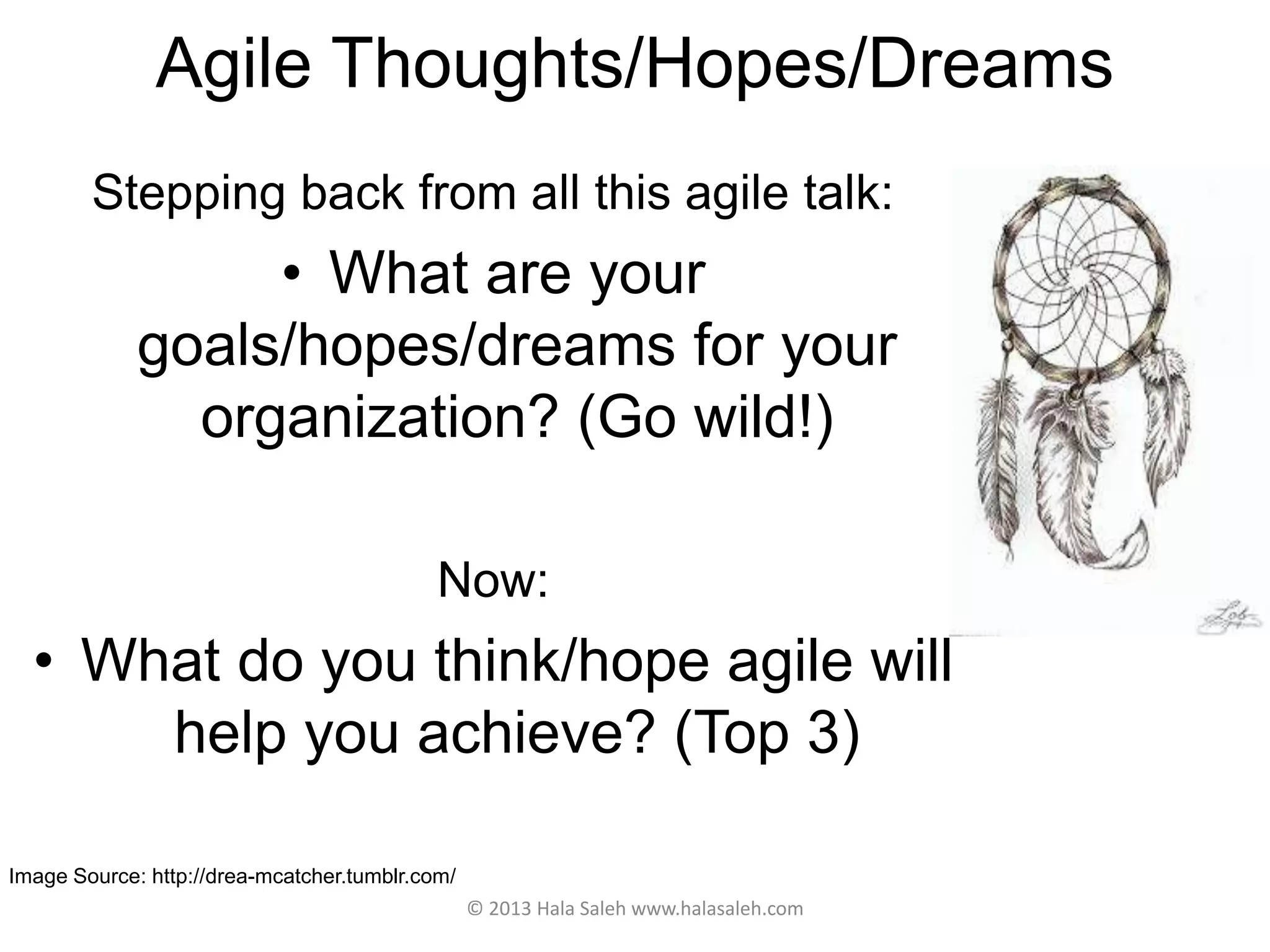
Agile Thoughts/Hopes/Dreams
Stepping back from all this agile talk:
• What are your
goals/hopes/dreams for your
organization? (Go wild!)
Now:
• What do you think/hope agile will
help you achieve? (Top 3)
Image Source: http://drea-mcatcher.tumblr.com/
© 2013 Hala Saleh www.halasaleh.com
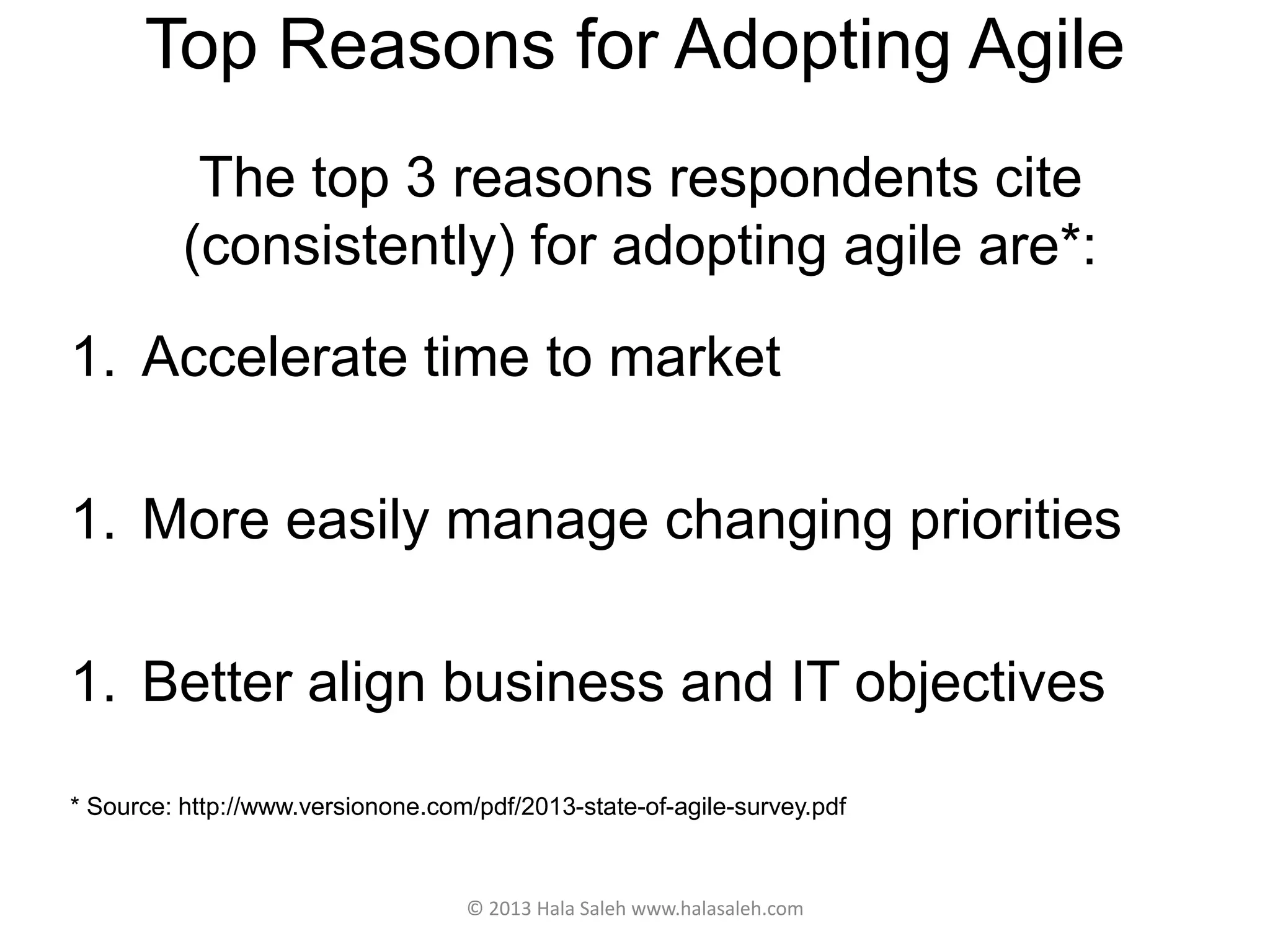
Top Reasons for Adopting Agile
The top 3 reasons respondents cite
(consistently) for adopting agile are*:
1. Accelerate time to market
1. More easily manage changing priorities
1. Better align business and IT objectives
* Source: http://www.versionone.com/pdf/2013-state-of-agile-survey.pdf
© 2013 Hala Saleh www.halasaleh.com
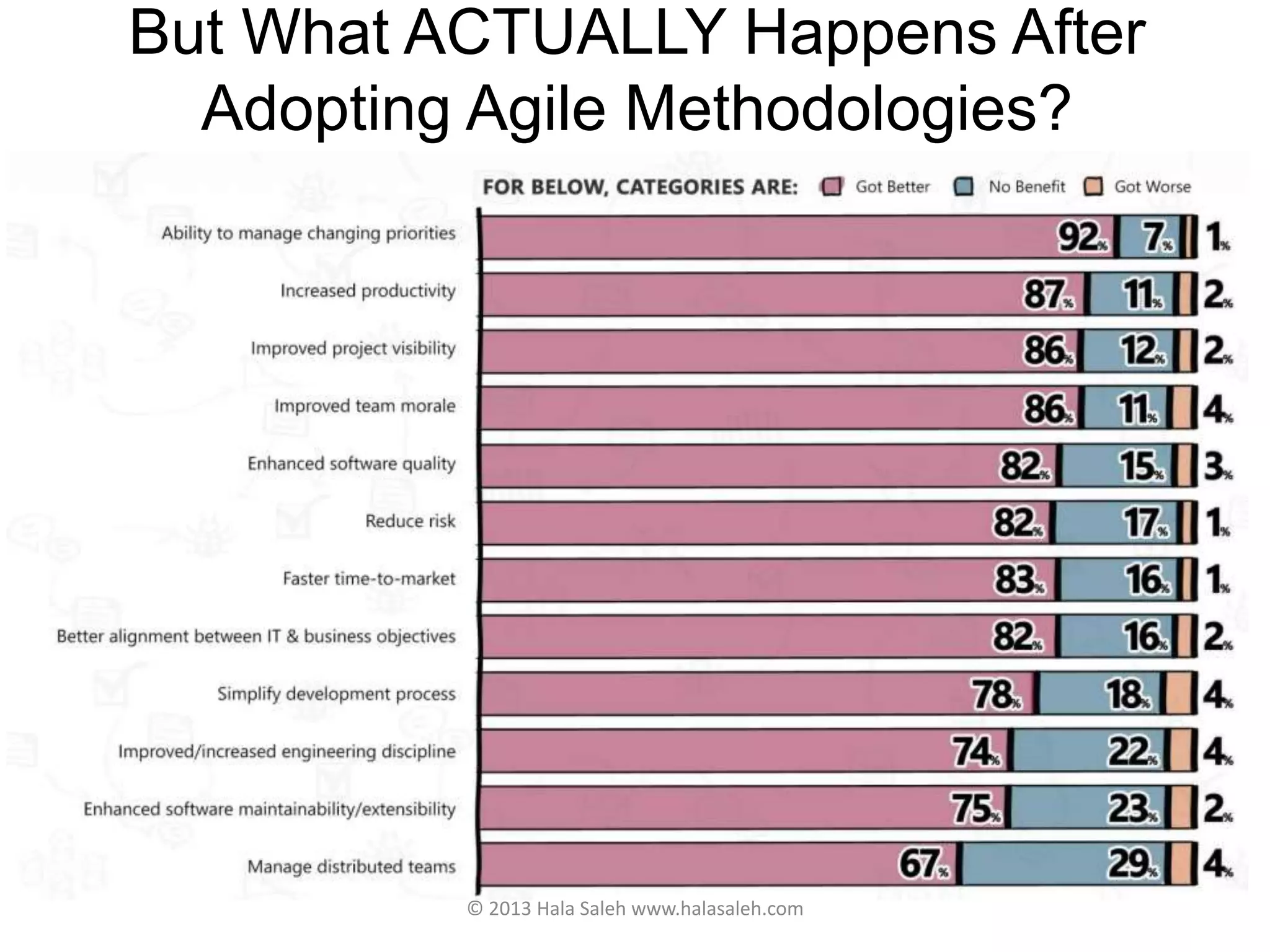
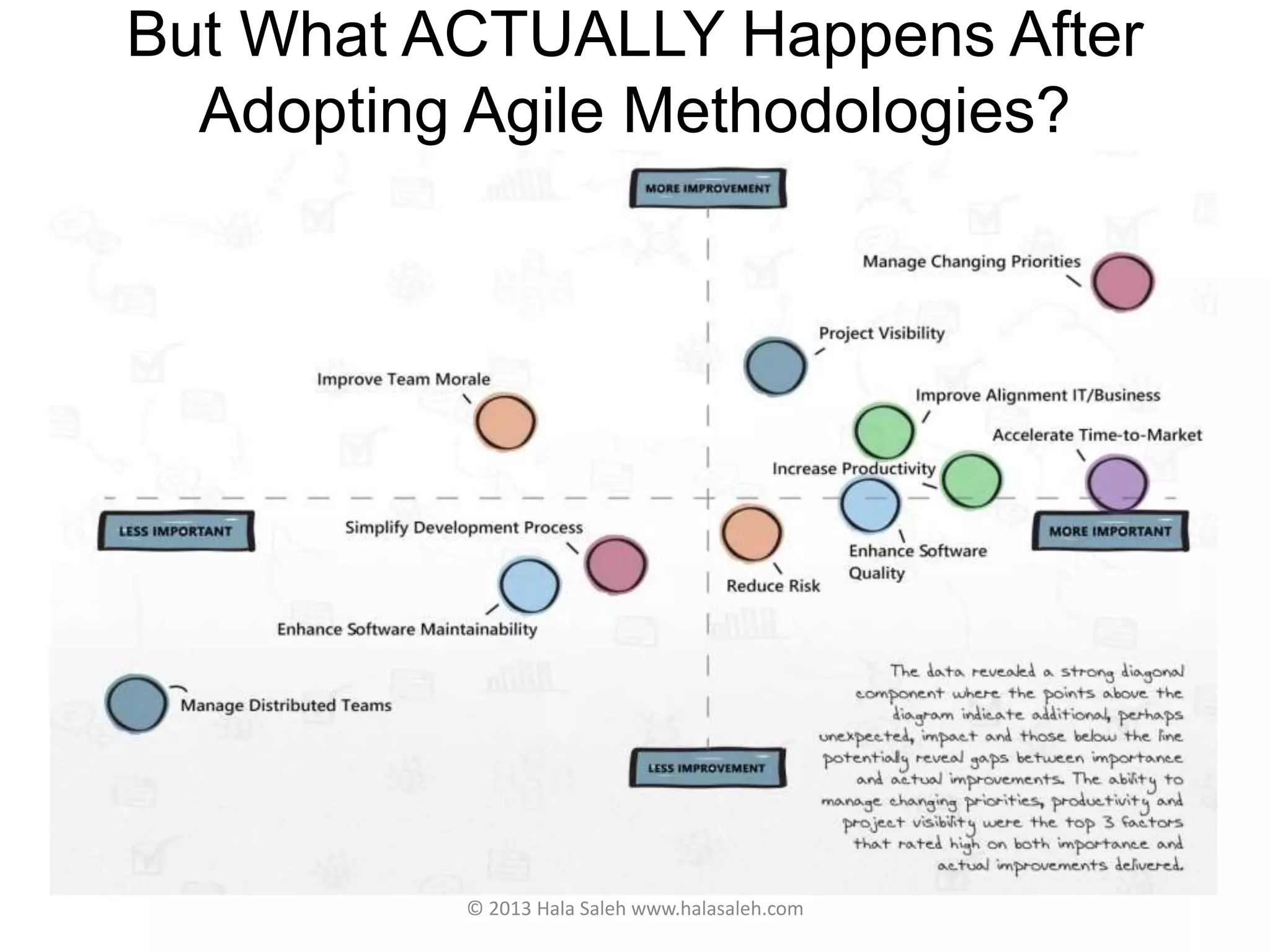
But What ACTUALLY Happens After
Adopting Agile Methodologies?
© 2013 Hala Saleh www.halasaleh.com
But What ACTUALLY Happens After
Adopting Agile Methodologies?
© 2013 Hala Saleh www.halasaleh.com
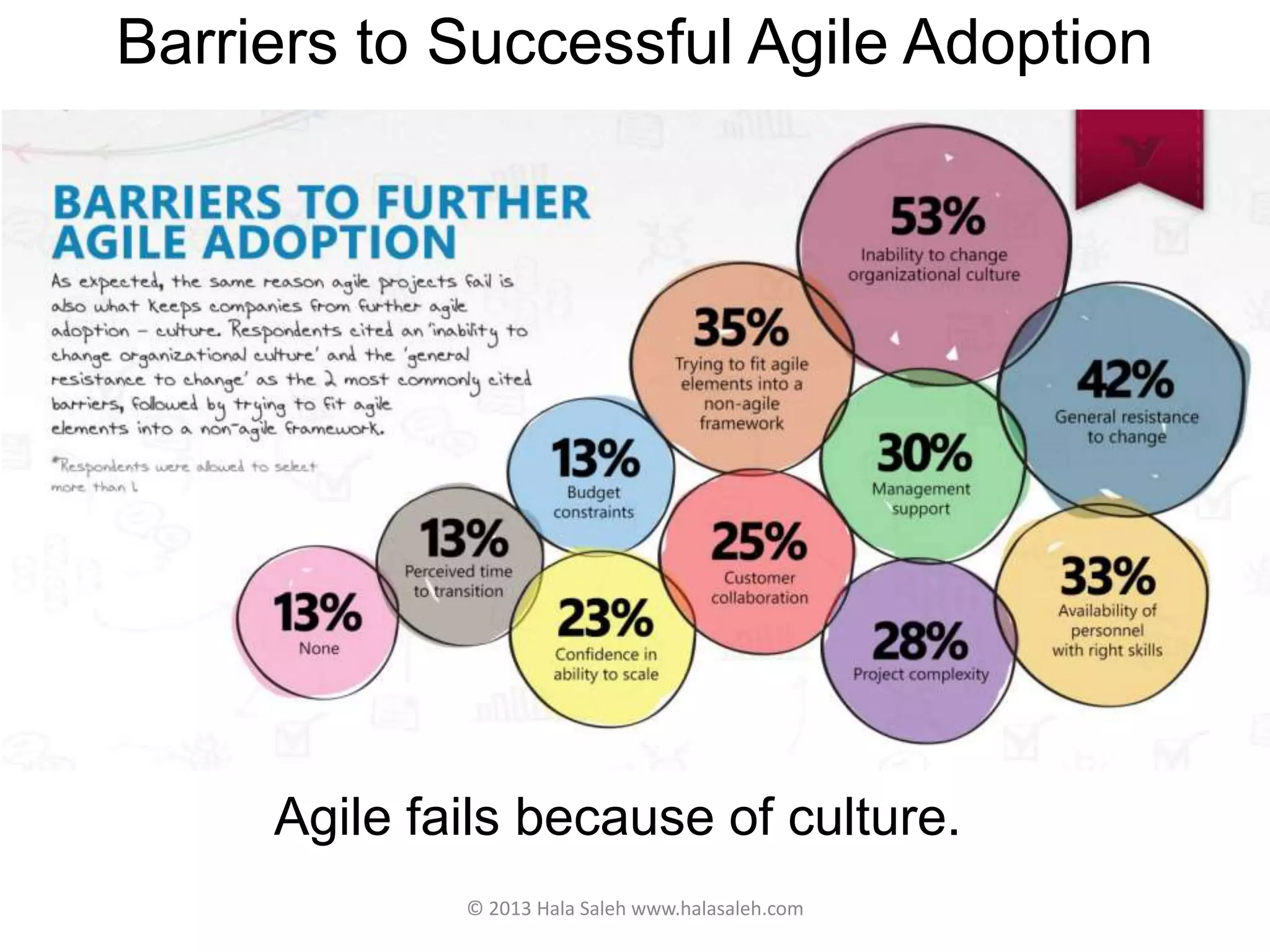
Barriers to Successful Agile Adoption
© 2013 Hala Saleh www.halasaleh.com
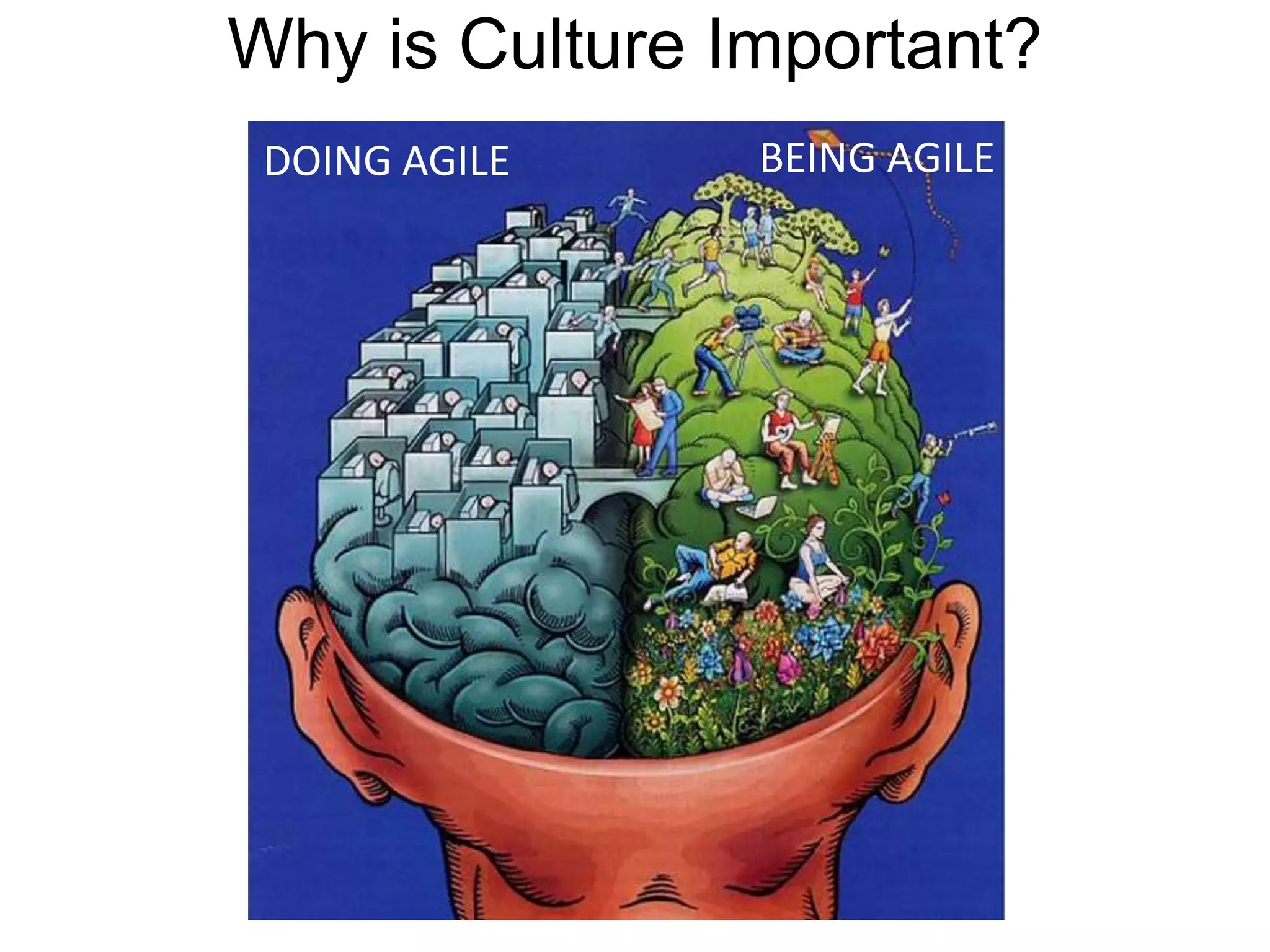
Agile fails because of culture.
Why is Culture Important?
© 2013 Hala Saleh www.halasaleh.com
DOING AGILE BEING AGILE
Ready to Work?
Step 1: Identify the Problem
• Before committing to an agile
transformation, or even starting to adopt
agile practices into your organization,
clearly identify the WHY:
What problem are you trying to solve?
© 2013 Hala Saleh www.halasaleh.com
Step 2: Is Agile the Answer?
• If your culture is not compatible with “Being
Agile”:
– Start with processes, and “Doing agile”
– Implement incremental changes (e.g. start
doing daily standups, or retrospectives
• Some great resources:
– “Agile Adoption Patterns: A Roadmap to
Organizational Success” by Amr Elssamadisy
– “Becoming Agile in an Imperfect World” by
Smith & Sidky
© 2013 Hala Saleh www.halasaleh.com
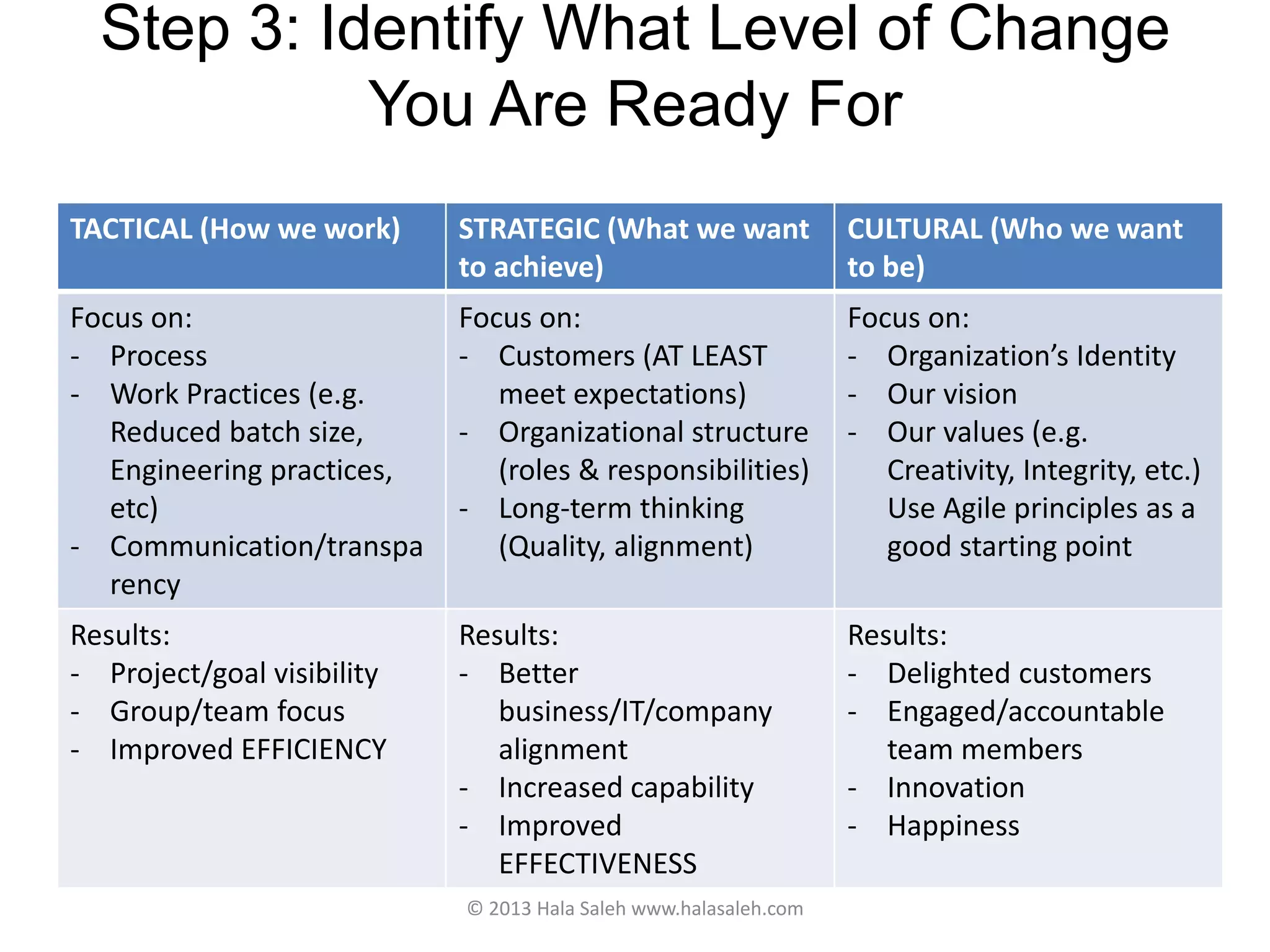
Step 3: Identify What Level of Change
You Are Ready For
TACTICAL (How we work) STRATEGIC (What we want
to achieve)
CULTURAL (Who we want
to be)
Focus on:
- Process
- Work Practices (e.g.
Reduced batch size,
Engineering practices,
etc)
- Communication/transpa
rency
Focus on:
- Customers (AT LEAST
meet expectations)
- Organizational structure
(roles & responsibilities)
- Long-term thinking
(Quality, alignment)
Focus on:
- Organization’s Identity
- Our vision
- Our values (e.g.
Creativity, Integrity, etc.)
Use Agile principles as a
good starting point
Results:
- Project/goal visibility
- Group/team focus
- Improved EFFICIENCY
Results:
- Better
business/IT/company
alignment
- Increased capability
- Improved
EFFECTIVENESS
Results:
- Delighted customers
- Engaged/accountable
team members
- Innovation
- Happiness
© 2013 Hala Saleh www.halasaleh.com
In Conclusion
1. Agile can’t make you a better executive.
• News flash: Agile is not a silver bullet.
• But it can give you the tools to work and live better.
• Combined with real organizational culture change, it
can help you achieve:
– More delighted customers
– More innovation
– A culture of self-organization and accountability
– Faster time to market
© 2013 Hala Saleh www.halasaleh.com
In Conclusion
2. Get involved
• Learn it
• Understand it
• Do it (WELL!)
© 2013 Hala Saleh www.halasaleh.com
In Conclusion
3. Learn from others’ failures AND successes
• Look up: Spotify Engineering Culture video
© 2013 Hala Saleh www.halasaleh.com
In Conclusion
4. Cultivate a tolerance for Failing Fast
• On the condition that you learn from it
© 2013 Hala Saleh www.halasaleh.com
In Conclusion
5. Ask for, and get HELP
• There’s a lot involved in succeeding at this stuff.
• Get trained, coached, and make sure to hire people
who have experience.
© 2013 Hala Saleh www.halasaleh.com
Addendum (Bonus)
• Don’t call people “resources” (unless you
want to be called “overhead”) 
– Suggestions: Team members, developers,
technical wizards, people.
• Participate in retrospectives (and make
sure they happen!)
– You will be amazed by what you learn!
© 2013 Hala Saleh www.halasaleh.com
Q&A
© 2013 Hala Saleh www.halasaleh.com
Thank You!
Twitter: @HalaSaleh1
Email: hala.saleh@gmail.com
Contact me for any Qs, resources,
or help!
© 2013 Hala Saleh www.halasaleh.com

How Agile Can Make You a Better Executive (or not)

  • 1.
    How Agile CanMake You a Better Executive Hala Saleh Agile Coach, Product Manager, Entrepreneur http://www.halasaleh.com @HalaSaleh1
  • 2.
    Who Am I? •Hala Saleh, CSM, CSP, PMP • History/Evolution: Developer -> QA -> PM -> Agile Coach/ Consultant • Today: All of the above (ok, maybe minus Developer) PLUS: © 2014 Hala Saleh www.halasaleh.com
  • 3.
    Agile Whaaat? © 2013Hala Saleh www.halasaleh.com • Show of hands: On a scale of 1 – 5, how familiar are you with “agile” development? 1. Not familiar with agile at all 2. Heard about it, not familiar with details of any specific methodology 3. Moderately familiar, can name/describe at least 1 agile methodology/framework at a high level 4. Familiar, can explain details of at least 1 agile methodology & can name others 5. Very familiar, can explain details of more than 1 agile methodology & have experience implementing at least 1
  • 4.
    Bad News  ©2013 Hala Saleh www.halasaleh.com Only 2% of Executives “knowledgeable” about agile* * In 2013, per VersionOne’s 8th Annual State of AgileTM Survey
  • 5.
    Good News  ©2013 Hala Saleh www.halasaleh.com Together, we can change that statistic. (And heal the world! And make it a better place!)
  • 6.
    Assumptions (Mine, not yours) ©2013 Hala Saleh www.halasaleh.com
  • 7.
    Assumptions (Mine, not yours) ©2013 Hala Saleh www.halasaleh.com
  • 8.
    Assumptions (Mine, not yours) ©2013 Hala Saleh www.halasaleh.com
  • 9.
    Assumptions (Mine, not yours) ©2013 Hala Saleh www.halasaleh.com
  • 10.
    So… © 2013 HalaSaleh www.halasaleh.com
  • 11.
    What does ‘Agile’mean to you? © 2014 Hala Saleh www.halasaleh.com
  • 12.
    Exercise: Define Agile/Agility •Working in groups of 3 – 4 (5 minutes): – Brainstorm: What is “Agile” – Define “Agile” (in 2 – 3 sentences) – Discuss • Share! © 2013 Hala Saleh www.halasaleh.com
  • 13.
    The Agile Manifesto “Weare uncovering better ways of developing software by doing it and helping others do it. Through this work we have come to value: • Individuals and interactions over processes and tools • Working software over comprehensive documentation • Customer collaboration over contract negotiation • Responding to change over following a plan That is, while there is value in the items on the right, we value the items on the left more.”* *Source: agilemanifesto.org
  • 14.
    Agile Principles • TheAgile Manifesto is based on 12 principles. See here: Agile Principles* • Discussion: Key Agile Principles and Takeaways © 2013 Hala Saleh www.halasaleh.com * Source: agilemanifesto.org/principles.html
  • 15.
    Let’s Talk AboutAgile Agile development: An iterative and incremental approach to developing software that incorporates continuous feedback loops, adaptability, and collaboration. © 2013 Hala Saleh www.halasaleh.com BUT, agile is not only for software! Agility: An iterative and incremental approach to achieving an end-result (product, project, goal) that incorporates continuous feedback loops, adaptability, and collaboration.
  • 16.
    Agile Thoughts/Hopes/Dreams Stepping backfrom all this agile talk: • What are your goals/hopes/dreams for your organization? (Go wild!) Now: • What do you think/hope agile will help you achieve? (Top 3) Image Source: http://drea-mcatcher.tumblr.com/ © 2013 Hala Saleh www.halasaleh.com
  • 17.
    Top Reasons forAdopting Agile The top 3 reasons respondents cite (consistently) for adopting agile are*: 1. Accelerate time to market 1. More easily manage changing priorities 1. Better align business and IT objectives * Source: http://www.versionone.com/pdf/2013-state-of-agile-survey.pdf © 2013 Hala Saleh www.halasaleh.com
  • 18.
    But What ACTUALLYHappens After Adopting Agile Methodologies? © 2013 Hala Saleh www.halasaleh.com
  • 19.
    But What ACTUALLYHappens After Adopting Agile Methodologies? © 2013 Hala Saleh www.halasaleh.com
  • 20.
    Barriers to SuccessfulAgile Adoption © 2013 Hala Saleh www.halasaleh.com Agile fails because of culture.
  • 21.
    Why is CultureImportant? © 2013 Hala Saleh www.halasaleh.com DOING AGILE BEING AGILE
  • 22.
    Ready to Work? Step1: Identify the Problem • Before committing to an agile transformation, or even starting to adopt agile practices into your organization, clearly identify the WHY: What problem are you trying to solve? © 2013 Hala Saleh www.halasaleh.com
  • 23.
    Step 2: IsAgile the Answer? • If your culture is not compatible with “Being Agile”: – Start with processes, and “Doing agile” – Implement incremental changes (e.g. start doing daily standups, or retrospectives • Some great resources: – “Agile Adoption Patterns: A Roadmap to Organizational Success” by Amr Elssamadisy – “Becoming Agile in an Imperfect World” by Smith & Sidky © 2013 Hala Saleh www.halasaleh.com
  • 24.
    Step 3: IdentifyWhat Level of Change You Are Ready For TACTICAL (How we work) STRATEGIC (What we want to achieve) CULTURAL (Who we want to be) Focus on: - Process - Work Practices (e.g. Reduced batch size, Engineering practices, etc) - Communication/transpa rency Focus on: - Customers (AT LEAST meet expectations) - Organizational structure (roles & responsibilities) - Long-term thinking (Quality, alignment) Focus on: - Organization’s Identity - Our vision - Our values (e.g. Creativity, Integrity, etc.) Use Agile principles as a good starting point Results: - Project/goal visibility - Group/team focus - Improved EFFICIENCY Results: - Better business/IT/company alignment - Increased capability - Improved EFFECTIVENESS Results: - Delighted customers - Engaged/accountable team members - Innovation - Happiness © 2013 Hala Saleh www.halasaleh.com
  • 25.
    In Conclusion 1. Agilecan’t make you a better executive. • News flash: Agile is not a silver bullet. • But it can give you the tools to work and live better. • Combined with real organizational culture change, it can help you achieve: – More delighted customers – More innovation – A culture of self-organization and accountability – Faster time to market © 2013 Hala Saleh www.halasaleh.com
  • 26.
    In Conclusion 2. Getinvolved • Learn it • Understand it • Do it (WELL!) © 2013 Hala Saleh www.halasaleh.com
  • 27.
    In Conclusion 3. Learnfrom others’ failures AND successes • Look up: Spotify Engineering Culture video © 2013 Hala Saleh www.halasaleh.com
  • 28.
    In Conclusion 4. Cultivatea tolerance for Failing Fast • On the condition that you learn from it © 2013 Hala Saleh www.halasaleh.com
  • 29.
    In Conclusion 5. Askfor, and get HELP • There’s a lot involved in succeeding at this stuff. • Get trained, coached, and make sure to hire people who have experience. © 2013 Hala Saleh www.halasaleh.com
  • 30.
    Addendum (Bonus) • Don’tcall people “resources” (unless you want to be called “overhead”)  – Suggestions: Team members, developers, technical wizards, people. • Participate in retrospectives (and make sure they happen!) – You will be amazed by what you learn! © 2013 Hala Saleh www.halasaleh.com
  • 31.
    Q&A © 2013 HalaSaleh www.halasaleh.com
  • 32.
    Thank You! Twitter: @HalaSaleh1 Email:hala.saleh@gmail.com Contact me for any Qs, resources, or help! © 2013 Hala Saleh www.halasaleh.com