Unit 7
Linen and Uniform
• 7.1. Introduction of Linen
In term of hotel, linen refers to all washable fabrics. Linen
refers to cloth used in hotel. It consist of all the fabrics used
in the hotel such as bed sheets, pillow cases, towels, table
cloths, napkin, etc. The materials and tidiness of the linen
used in hotel represents the goodwill and standard of the
hotel.
The selection criteria of linen depends upon the price,
durability and laundry cost.
Linen are expensive therefore, its washing at right
temperature, using correct chemicals, ironing, mending and
storing is most important.
• 7.2. Types of linen and its standard size
They are basically divided into different groups and they are
identified by their size, design, color and patterns:
• Standard size of linen
• Bed room/ guest room Linen: These linens are used in
rooms, for bedding, for example: bed cover, bed sheet,
pillow cover, mattress protector, curtains, blanket etc.
• Bathroom Linen: It refers to all the linens which are used in
a bathroom such as bath towels, hand towels, face towels,
bath mats, shower curtain etc.
• Napery (Table linen) : Linen used on the restaurant table
referred to as table linen or napery. Table linen includes
table cloths, napkins, slip cloths and underlay.
• Restaurant/ Food & Beverage linen: It refers to all those
linen which are used within the restaurant and on the tables
such as table cloth, napkins, buffet cloth, trays cloth, frill,
cloth, service cloth like waiter’s cloth, etc.
• Upholstery and special furnishing fabrics: It usually
refers to woven and tufted item. It includes mattress cover,
cushion cover, bed cover, curtains etc. They also come in
leathers and resins.
• 7.3. Uniform used by hotel staff
Uniform is the special set of clothes designed by
management for its staff to be worn while on duty.
The uniform help to identify, distinguish the staff from
customer to staff and help to differentiate between the
different departments.
It helps to command, supervise and control the staff on duty.
It is true that “Dress speaks itself”.
The dress worn by individual staff leave a different
impression on the customer.
So many hotels depending upon their class or category and
financial strength provided uniforms to their staffs.
• Importance of uniform
 Uniform identify employees as well as enhance them.
 It allows the guest to quickly identify employees for
assistance.
 It helps to identify the hierarchy of the employees.
 Uniform develops sense of pride and responsibility towards
job and sense of belonging towards the organization.
• 7.4. Inventory control and types of inventory
The term ‘inventory’ refers to the stocks, of purchased
operating supplies, equipments and other items held for
future use in housekeeping operations.
Linens and uniforms includes heavy investments, it is
necessary to keep a close control on this very important
asset.
Effective control is possible through the following practices:
• Control on misuse, shortages and mix-ups.
• Proper storage.
• Regular stock-taking.
• Spots checks.
• Proper supervision
The executive housekeeper is responsible for two types of
inventories.
• Recycled inventory items which are recycled during the
course of hotel operations. It is used over and over again in
housekeeping operations.
These include linen, uniforms, most machinery and large
pieces of equipment, guest loan items such as hot water
bottles, heating pads irons and ironing boards and so on.
• Non-recycled inventory items that are consumed or used
up during the routine activities of the housekeeping
operations.
These include most guest amenities, cleaning supplies and
small equipment such as brooms, mops, cleaning cloths, and
so on.
• 7.5. Par stock
Par stock is the minimum linens and uniforms required to
meet the daily demands of hotel so as to ensure a smooth
operations.
Importance of par stock
• To ensure proper supply at all time.
• To help in effective budgeting.
• To simplify inventory taking.
• To bring about manageable control.
• To prevent over stocking, so thereby avoid chances of
spoilage during storage, storage space problems, etc.
• To make correct and efficient investment of capital.
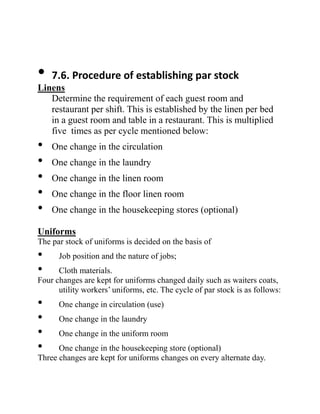
• 7.6. Procedure of establishing par stock
Linens
Determine the requirement of each guest room and
restaurant per shift. This is established by the linen per bed
in a guest room and table in a restaurant. This is multiplied
five times as per cycle mentioned below:
• One change in the circulation
• One change in the laundry
• One change in the linen room
• One change in the floor linen room
• One change in the housekeeping stores (optional)
Uniforms
The par stock of uniforms is decided on the basis of
• Job position and the nature of jobs;
• Cloth materials.
Four changes are kept for uniforms changed daily such as waiters coats,
utility workers’ uniforms, etc. The cycle of par stock is as follows:
• One change in circulation (use)
• One change in the laundry
• One change in the uniform room
• One change in the housekeeping store (optional)
Three changes are kept for uniforms changes on every alternate day.
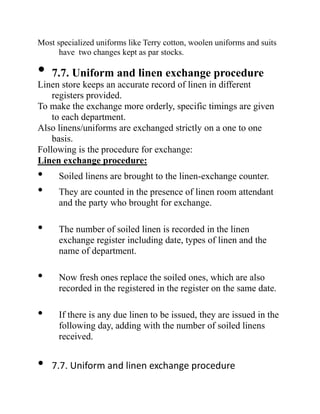
Most specialized uniforms like Terry cotton, woolen uniforms and suits
have two changes kept as par stocks.
• 7.7. Uniform and linen exchange procedure
Linen store keeps an accurate record of linen in different
registers provided.
To make the exchange more orderly, specific timings are given
to each department.
Also linens/uniforms are exchanged strictly on a one to one
basis.
Following is the procedure for exchange:
Linen exchange procedure:
• Soiled linens are brought to the linen-exchange counter.
• They are counted in the presence of linen room attendant
and the party who brought for exchange.
• The number of soiled linen is recorded in the linen
exchange register including date, types of linen and the
name of department.
• Now fresh ones replace the soiled ones, which are also
recorded in the registered in the register on the same date.
• If there is any due linen to be issued, they are issued in the
following day, adding with the number of soiled linens
received.
• 7.7. Uniform and linen exchange procedure
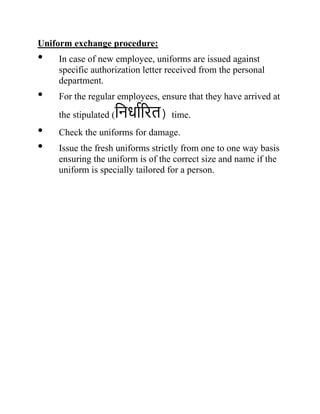
Uniform exchange procedure:
• In case of new employee, uniforms are issued against
specific authorization letter received from the personal
department.
• For the regular employees, ensure that they have arrived at
the stipulated (निर्धारित) time.
• Check the uniforms for damage.
• Issue the fresh uniforms strictly from one to one way basis
ensuring the uniform is of the correct size and name if the
uniform is specially tailored for a person.

House keeping. hotel management slide shere

  • 1.
    Unit 7 Linen andUniform • 7.1. Introduction of Linen In term of hotel, linen refers to all washable fabrics. Linen refers to cloth used in hotel. It consist of all the fabrics used in the hotel such as bed sheets, pillow cases, towels, table cloths, napkin, etc. The materials and tidiness of the linen used in hotel represents the goodwill and standard of the hotel. The selection criteria of linen depends upon the price, durability and laundry cost. Linen are expensive therefore, its washing at right temperature, using correct chemicals, ironing, mending and storing is most important. • 7.2. Types of linen and its standard size They are basically divided into different groups and they are identified by their size, design, color and patterns: • Standard size of linen • Standard size of linen • Bed room/ guest room Linen: These linens are used in rooms, for bedding, for example: bed cover, bed sheet, pillow cover, mattress protector, curtains, blanket etc. • Bathroom Linen: It refers to all the linens which are used in a bathroom such as bath towels, hand towels, face towels, bath mats, shower curtain etc.
  • 2.
    • Napery (Tablelinen) : Linen used on the restaurant table referred to as table linen or napery. Table linen includes table cloths, napkins, slip cloths and underlay. • Restaurant/ Food & Beverage linen: It refers to all those linen which are used within the restaurant and on the tables such as table cloth, napkins, buffet cloth, trays cloth, frill, cloth, service cloth like waiter’s cloth, etc. • Upholstery and special furnishing fabrics: It usually refers to woven and tufted item. It includes mattress cover, cushion cover, bed cover, curtains etc. They also come in leathers and resins. • 7.3. Uniform used by hotel staff Uniform is the special set of clothes designed by management for its staff to be worn while on duty. The uniform help to identify, distinguish the staff from customer to staff and help to differentiate between the different departments. It helps to command, supervise and control the staff on duty. It is true that “Dress speaks itself”. The dress worn by individual staff leave a different impression on the customer. So many hotels depending upon their class or category and financial strength provided uniforms to their staffs. • Importance of uniform
  • 3.
     Uniform identifyemployees as well as enhance them.  It allows the guest to quickly identify employees for assistance.  It helps to identify the hierarchy of the employees.  Uniform develops sense of pride and responsibility towards job and sense of belonging towards the organization. • 7.4. Inventory control and types of inventory The term ‘inventory’ refers to the stocks, of purchased operating supplies, equipments and other items held for future use in housekeeping operations. Linens and uniforms includes heavy investments, it is necessary to keep a close control on this very important asset. Effective control is possible through the following practices: • Control on misuse, shortages and mix-ups. • Proper storage. • Regular stock-taking. • Spots checks. • Proper supervision The executive housekeeper is responsible for two types of inventories.
  • 4.
    • Recycled inventoryitems which are recycled during the course of hotel operations. It is used over and over again in housekeeping operations. These include linen, uniforms, most machinery and large pieces of equipment, guest loan items such as hot water bottles, heating pads irons and ironing boards and so on. • Non-recycled inventory items that are consumed or used up during the routine activities of the housekeeping operations. These include most guest amenities, cleaning supplies and small equipment such as brooms, mops, cleaning cloths, and so on. • 7.5. Par stock Par stock is the minimum linens and uniforms required to meet the daily demands of hotel so as to ensure a smooth operations. Importance of par stock • To ensure proper supply at all time. • To help in effective budgeting. • To simplify inventory taking. • To bring about manageable control. • To prevent over stocking, so thereby avoid chances of spoilage during storage, storage space problems, etc. • To make correct and efficient investment of capital.
  • 5.
    • 7.6. Procedureof establishing par stock Linens Determine the requirement of each guest room and restaurant per shift. This is established by the linen per bed in a guest room and table in a restaurant. This is multiplied five times as per cycle mentioned below: • One change in the circulation • One change in the laundry • One change in the linen room • One change in the floor linen room • One change in the housekeeping stores (optional) Uniforms The par stock of uniforms is decided on the basis of • Job position and the nature of jobs; • Cloth materials. Four changes are kept for uniforms changed daily such as waiters coats, utility workers’ uniforms, etc. The cycle of par stock is as follows: • One change in circulation (use) • One change in the laundry • One change in the uniform room • One change in the housekeeping store (optional) Three changes are kept for uniforms changes on every alternate day.
  • 6.
    Most specialized uniformslike Terry cotton, woolen uniforms and suits have two changes kept as par stocks. • 7.7. Uniform and linen exchange procedure Linen store keeps an accurate record of linen in different registers provided. To make the exchange more orderly, specific timings are given to each department. Also linens/uniforms are exchanged strictly on a one to one basis. Following is the procedure for exchange: Linen exchange procedure: • Soiled linens are brought to the linen-exchange counter. • They are counted in the presence of linen room attendant and the party who brought for exchange. • The number of soiled linen is recorded in the linen exchange register including date, types of linen and the name of department. • Now fresh ones replace the soiled ones, which are also recorded in the registered in the register on the same date. • If there is any due linen to be issued, they are issued in the following day, adding with the number of soiled linens received. • 7.7. Uniform and linen exchange procedure
  • 7.
    Uniform exchange procedure: •In case of new employee, uniforms are issued against specific authorization letter received from the personal department. • For the regular employees, ensure that they have arrived at the stipulated (निर्धारित) time. • Check the uniforms for damage. • Issue the fresh uniforms strictly from one to one way basis ensuring the uniform is of the correct size and name if the uniform is specially tailored for a person.