
HOT FROM BRAZIL!
7 insights into the Brazilian Consumer and Market
THE GIANT AWAKES?
Brazil’s rise has been one of the successes of
the last decade. Millions lifted out of poverty, a
booming middle class & record foreign
investment have helped make it South America's
most influential country - a vibrant marketplace
for global brands. 
Forecasts show Brazil will be one of the world’s
five largest consumer markets by 2020. Before
that it will hold the attention of global audiences
with 2014 FIFA World Cup & 2016 Rio Olympics.
Brazil is hot!
But recent events suggest a more complex story
– Brazil still has huge income disparities, and
these are now coupled with slowing growth and
growing unrest. The future looks far from clear.
For brands to succeed requires insight into the
factors driving consumer behaviour in Brazil – we
hope this brief snapshot will prove both thought
provoking & useful. 

http://www.youtube.com/watch?v=o38xx3yMvek
7 INSIGHTS – WITH SUGGESTED IMPLICATIONS – TO
HELP YOU SUCCEED IN BRAZIL:!


INTRO - A brief word on the recent protests
1.  ‘No Rain, No Rainbow’
2.  Horizontal, not Vertical
3.  Fusion Culture
4.  Cleanliness = Brazilian-ness
5.  Sociable Commerce
6.  A Very Mixed Middle
7.  Growth Spreads
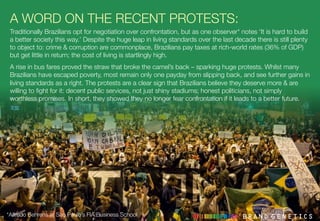
A WORD ON THE RECENT PROTESTS:
Traditionally Brazilians opt for negotiation over confrontation, but as one observer* notes ‘It is hard to build
a better society this way.’ Despite the huge leap in living standards over the last decade there is still plenty
to object to: crime & corruption are commonplace, Brazilians pay taxes at rich-world rates (36% of GDP)
but get little in return; the cost of living is startlingly high. 
A rise in bus fares proved the straw that broke the camel’s back – sparking huge protests. Whilst many
Brazilians have escaped poverty, most remain only one payday from slipping back, and see further gains in
living standards as a right. The protests are a clear sign that Brazilians believe they deserve more & are
willing to fight for it: decent public services, not just shiny stadiums; honest politicians, not simply
worthless promises. In short, they showed they no longer fear confrontation if it leads to a better future.
*Alfredo Behrens at Sao Paulo’s FIA Business School
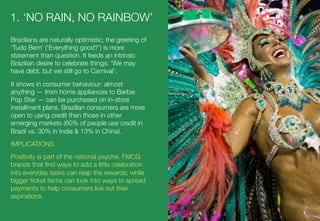
1. ‘NO RAIN, NO RAINBOW’
Brazilians are naturally optimistic; the greeting of
‘Tudo Bem’ (‘Everything good?’) is more
statement than question. It feeds an intrinsic
Brazilian desire to celebrate things: ‘We may
have debt, but we still go to Carnival’. 
It shows in consumer behaviour: almost
anything — from home appliances to Barbie
Pop Star — can be purchased on in-store
installment plans. Brazilian consumers are more
open to using credit than those in other
emerging markets (60% of people use credit in
Brazil vs. 30% in India & 13% in China). 
IMPLICATIONS
Positivity is part of the national psyche. FMCG
brands that find ways to add a little celebration
into everyday tasks can reap the rewards; while
bigger ticket items can look into ways to spread
payments to help consumers live out their
aspirations.
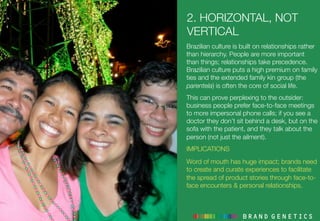
2. HORIZONTAL, NOT
VERTICAL
Brazilian culture is built on relationships rather
than hierarchy. People are more important
than things; relationships take precedence.
Brazilian culture puts a high premium on family
ties and the extended family kin group (the
parentela) is often the core of social life.
This can prove perplexing to the outsider:
business people prefer face-to-face meetings
to more impersonal phone calls; if you see a
doctor they don’t sit behind a desk, but on the
sofa with the patient, and they talk about the
person (not just the ailment).
IMPLICATIONS
Word of mouth has huge impact; brands need
to create and curate experiences to facilitate
the spread of product stories through face-to-
face encounters & personal relationships.
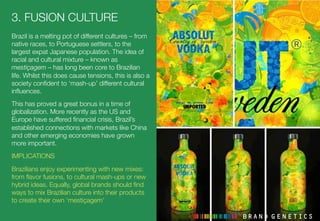
3. FUSION CULTURE
Brazil is a melting pot of different cultures – from
native races, to Portuguese settlers, to the
largest expat Japanese population. The idea of
racial and cultural mixture – known as
mestiçagem – has long been core to Brazilian
life. Whilst this does cause tensions, this is also a
society confident to ‘mash-up’ different cultural
influences. 
This has proved a great bonus in a time of
globalization. More recently as the US and
Europe have suffered financial crisis, Brazil’s
established connections with markets like China
and other emerging economies have grown
more important.
IMPLICATIONS
Brazilians enjoy experimenting with new mixes:
from flavor fusions, to cultural mash-ups or new
hybrid ideas. Equally, global brands should find
ways to mix Brazilian culture into their products
to create their own ‘mestiçagem’
4. CLEANLINESS = BRAZILIAN-NESS 
Rich or poor, Brazilians take great pride in how they present
themselves. It is the 3rd biggest market for beauty products.
People can shower 5 times a day and, notes Ricardo
Patrocínio, marketing director at Avon, “It’s hard to find a
woman who would leave the house without lipstick &
fragrance.”
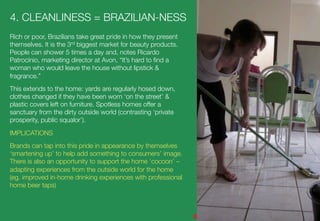
This extends to the home: yards are regularly hosed down,
clothes changed if they have been worn ‘on the street’ &
plastic covers left on furniture. Spotless homes offer a
sanctuary from the dirty outside world (contrasting ‘private
prosperity, public squalor’).
IMPLICATIONS
Brands can tap into this pride in appearance by themselves
‘smartening up’ to help add something to consumers’ image.
There is also an opportunity to support the home ‘cocoon’ –
adapting experiences from the outside world for the home
(eg. improved in-home drinking experiences with professional
home beer taps)
5. SOCIABLE COMMERCE
While the internet has reached more than half the
population, mobile broadband is expected to reach
85% by 2015. Given Brazilians’ natural sociability
it’s no surprise 86% of Internet users belong to at
least one social network (the global average is
70%), and Brazil is the world’s 2nd largest market
for both Facebook & Twitter. 
This is important for both communications and
retail: retailing in Brazil is more socially networked
than anywhere else in the world. About 30% of
Internet users “follow” retailers (vs. 12% in Britain)
and use social media to identify and share deals
and purchases.
IMPLICATIONS
To succeed in Brazil every brand needs a social
commerce strategy - actively engaging consumers
through online promotions and delivering services
that help them in their lives. This can generate both
new revenue streams & build consumer loyalty/
advocacy.
6. A VERY MIXED MIDDLE 
More of Brazil's growth is now going to those on
modest incomes and the middle class is growing
rapidly (by 36m people in the past 10 years). But this
‘C-class’ is hugely diverse – ranging from the
established middle class (often professionals) to
those earning just !
R$291 [£85] per month (the working poor).
So although the latter may have some trappings of
wealth (eg. TVs / fridges bought on credit) they
cannot escape poor public services by going private.
Equally, they shop differently; making up half the
consumers of traditional ‘mom-and-pop’ shops,
while richer consumers do most of their shopping at
super- and hypermarkets.
IMPLICATIONS
Brands that support areas where public services
struggle (eg. improved health through soaps or
functional foods) can gain traction. Equally, to reach
this diverse middle means being adaptable to a
range of retail environments rather than one-size-fits-
all.
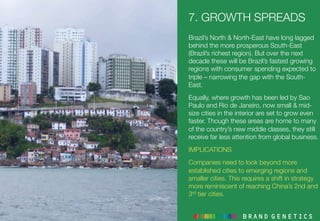
7. GROWTH SPREADS
Brazil’s North & North-East have long lagged
behind the more prosperous South-East
(Brazil’s richest region). But over the next
decade these will be Brazil’s fastest growing
regions with consumer spending expected to
triple – narrowing the gap with the South-
East. 
Equally, where growth has been led by Sao
Paulo and Rio de Janeiro, now small & mid-
size cities in the interior are set to grow even
faster. Though these areas are home to many
of the country’s new middle classes, they still
receive far less attention from global business.
IMPLICATIONS
Companies need to look beyond more
established cities to emerging regions and
smaller cities. This requires a shift in strategy
more reminiscent of reaching China’s 2nd and
3rd tier cities.
12
Brand Genetics – uncovering next generation opportunities
We work with international brands to understand how markets are evolving & what this means for their business.
By identifying the insights & implications, we help brands clarify, cut through & capture new growth opportunities

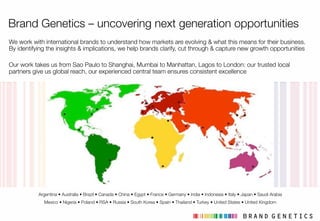
Our work takes us from Sao Paulo to Shanghai, Mumbai to Manhattan, Lagos to London: our trusted local
partners give us global reach, our experienced central team ensures consistent excellence
Argentina • Australia • Brazil • Canada • China • Egypt • France • Germany • India • Indonesia • Italy • Japan • Saudi Arabia!
Mexico • Nigeria • Poland • RSA • Russia • South Korea • Spain • Thailand • Turkey • United States • United Kingdom
12
13
If you're interested in how we can help you understand how global markets are changing
& what this means for your brands, we'd be delighted to talk further
www.brandgenetics.com
Tom Ellis
tom.ellis@brandgenetics.com
+44 (0) 7815 896 098
Andrew Christophers
andrew.christophers@brandgenetics.com
+44 (0) 7967 175 623
13
With thanks to our Brazilian partners In Tune Research for
their support & collaboration
www.intuneresearch.com

Hot from Brazil: 7 insights into the world of the Brazilian consumer

  • 1.
    HOT FROM BRAZIL! 7insights into the Brazilian Consumer and Market
  • 2.
    THE GIANT AWAKES? Brazil’srise has been one of the successes of the last decade. Millions lifted out of poverty, a booming middle class & record foreign investment have helped make it South America's most influential country - a vibrant marketplace for global brands. Forecasts show Brazil will be one of the world’s five largest consumer markets by 2020. Before that it will hold the attention of global audiences with 2014 FIFA World Cup & 2016 Rio Olympics. Brazil is hot! But recent events suggest a more complex story – Brazil still has huge income disparities, and these are now coupled with slowing growth and growing unrest. The future looks far from clear. For brands to succeed requires insight into the factors driving consumer behaviour in Brazil – we hope this brief snapshot will prove both thought provoking & useful. http://www.youtube.com/watch?v=o38xx3yMvek
  • 3.
    7 INSIGHTS –WITH SUGGESTED IMPLICATIONS – TO HELP YOU SUCCEED IN BRAZIL:! INTRO - A brief word on the recent protests 1.  ‘No Rain, No Rainbow’ 2.  Horizontal, not Vertical 3.  Fusion Culture 4.  Cleanliness = Brazilian-ness 5.  Sociable Commerce 6.  A Very Mixed Middle 7.  Growth Spreads
  • 4.
    A WORD ONTHE RECENT PROTESTS: Traditionally Brazilians opt for negotiation over confrontation, but as one observer* notes ‘It is hard to build a better society this way.’ Despite the huge leap in living standards over the last decade there is still plenty to object to: crime & corruption are commonplace, Brazilians pay taxes at rich-world rates (36% of GDP) but get little in return; the cost of living is startlingly high. A rise in bus fares proved the straw that broke the camel’s back – sparking huge protests. Whilst many Brazilians have escaped poverty, most remain only one payday from slipping back, and see further gains in living standards as a right. The protests are a clear sign that Brazilians believe they deserve more & are willing to fight for it: decent public services, not just shiny stadiums; honest politicians, not simply worthless promises. In short, they showed they no longer fear confrontation if it leads to a better future. *Alfredo Behrens at Sao Paulo’s FIA Business School
  • 5.
    1. ‘NO RAIN,NO RAINBOW’ Brazilians are naturally optimistic; the greeting of ‘Tudo Bem’ (‘Everything good?’) is more statement than question. It feeds an intrinsic Brazilian desire to celebrate things: ‘We may have debt, but we still go to Carnival’. It shows in consumer behaviour: almost anything — from home appliances to Barbie Pop Star — can be purchased on in-store installment plans. Brazilian consumers are more open to using credit than those in other emerging markets (60% of people use credit in Brazil vs. 30% in India & 13% in China). IMPLICATIONS Positivity is part of the national psyche. FMCG brands that find ways to add a little celebration into everyday tasks can reap the rewards; while bigger ticket items can look into ways to spread payments to help consumers live out their aspirations.
  • 6.
    2. HORIZONTAL, NOT VERTICAL Brazilianculture is built on relationships rather than hierarchy. People are more important than things; relationships take precedence. Brazilian culture puts a high premium on family ties and the extended family kin group (the parentela) is often the core of social life. This can prove perplexing to the outsider: business people prefer face-to-face meetings to more impersonal phone calls; if you see a doctor they don’t sit behind a desk, but on the sofa with the patient, and they talk about the person (not just the ailment). IMPLICATIONS Word of mouth has huge impact; brands need to create and curate experiences to facilitate the spread of product stories through face-to- face encounters & personal relationships.
  • 7.
    3. FUSION CULTURE Brazilis a melting pot of different cultures – from native races, to Portuguese settlers, to the largest expat Japanese population. The idea of racial and cultural mixture – known as mestiçagem – has long been core to Brazilian life. Whilst this does cause tensions, this is also a society confident to ‘mash-up’ different cultural influences. This has proved a great bonus in a time of globalization. More recently as the US and Europe have suffered financial crisis, Brazil’s established connections with markets like China and other emerging economies have grown more important. IMPLICATIONS Brazilians enjoy experimenting with new mixes: from flavor fusions, to cultural mash-ups or new hybrid ideas. Equally, global brands should find ways to mix Brazilian culture into their products to create their own ‘mestiçagem’
  • 8.
    4. CLEANLINESS =BRAZILIAN-NESS Rich or poor, Brazilians take great pride in how they present themselves. It is the 3rd biggest market for beauty products. People can shower 5 times a day and, notes Ricardo Patrocínio, marketing director at Avon, “It’s hard to find a woman who would leave the house without lipstick & fragrance.” This extends to the home: yards are regularly hosed down, clothes changed if they have been worn ‘on the street’ & plastic covers left on furniture. Spotless homes offer a sanctuary from the dirty outside world (contrasting ‘private prosperity, public squalor’). IMPLICATIONS Brands can tap into this pride in appearance by themselves ‘smartening up’ to help add something to consumers’ image. There is also an opportunity to support the home ‘cocoon’ – adapting experiences from the outside world for the home (eg. improved in-home drinking experiences with professional home beer taps)
  • 9.
    5. SOCIABLE COMMERCE Whilethe internet has reached more than half the population, mobile broadband is expected to reach 85% by 2015. Given Brazilians’ natural sociability it’s no surprise 86% of Internet users belong to at least one social network (the global average is 70%), and Brazil is the world’s 2nd largest market for both Facebook & Twitter. This is important for both communications and retail: retailing in Brazil is more socially networked than anywhere else in the world. About 30% of Internet users “follow” retailers (vs. 12% in Britain) and use social media to identify and share deals and purchases. IMPLICATIONS To succeed in Brazil every brand needs a social commerce strategy - actively engaging consumers through online promotions and delivering services that help them in their lives. This can generate both new revenue streams & build consumer loyalty/ advocacy.
  • 10.
    6. A VERYMIXED MIDDLE More of Brazil's growth is now going to those on modest incomes and the middle class is growing rapidly (by 36m people in the past 10 years). But this ‘C-class’ is hugely diverse – ranging from the established middle class (often professionals) to those earning just ! R$291 [£85] per month (the working poor). So although the latter may have some trappings of wealth (eg. TVs / fridges bought on credit) they cannot escape poor public services by going private. Equally, they shop differently; making up half the consumers of traditional ‘mom-and-pop’ shops, while richer consumers do most of their shopping at super- and hypermarkets. IMPLICATIONS Brands that support areas where public services struggle (eg. improved health through soaps or functional foods) can gain traction. Equally, to reach this diverse middle means being adaptable to a range of retail environments rather than one-size-fits- all.
  • 11.
    7. GROWTH SPREADS Brazil’sNorth & North-East have long lagged behind the more prosperous South-East (Brazil’s richest region). But over the next decade these will be Brazil’s fastest growing regions with consumer spending expected to triple – narrowing the gap with the South- East. Equally, where growth has been led by Sao Paulo and Rio de Janeiro, now small & mid- size cities in the interior are set to grow even faster. Though these areas are home to many of the country’s new middle classes, they still receive far less attention from global business. IMPLICATIONS Companies need to look beyond more established cities to emerging regions and smaller cities. This requires a shift in strategy more reminiscent of reaching China’s 2nd and 3rd tier cities.
  • 12.
    12 Brand Genetics –uncovering next generation opportunities We work with international brands to understand how markets are evolving & what this means for their business. By identifying the insights & implications, we help brands clarify, cut through & capture new growth opportunities Our work takes us from Sao Paulo to Shanghai, Mumbai to Manhattan, Lagos to London: our trusted local partners give us global reach, our experienced central team ensures consistent excellence Argentina • Australia • Brazil • Canada • China • Egypt • France • Germany • India • Indonesia • Italy • Japan • Saudi Arabia! Mexico • Nigeria • Poland • RSA • Russia • South Korea • Spain • Thailand • Turkey • United States • United Kingdom 12
  • 13.
    13 If you're interestedin how we can help you understand how global markets are changing & what this means for your brands, we'd be delighted to talk further www.brandgenetics.com Tom Ellis tom.ellis@brandgenetics.com +44 (0) 7815 896 098 Andrew Christophers andrew.christophers@brandgenetics.com +44 (0) 7967 175 623 13 With thanks to our Brazilian partners In Tune Research for their support & collaboration www.intuneresearch.com