
My Favorite City –
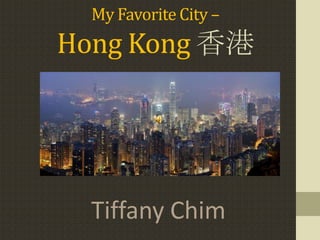
Hong Kong 香港


  Tiffany Chim
About me and Hong Kong
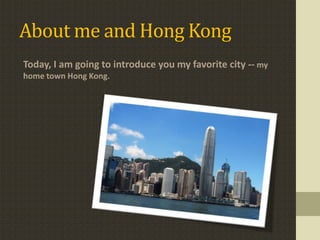
Today, I am going to introduce you my favorite city -- my
home town Hong Kong.
Geography


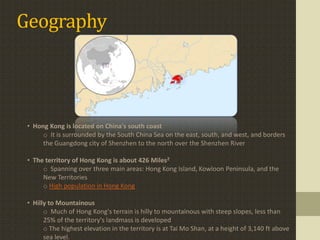
 • Hong Kong is located on China's south coast
      o It is surrounded by the South China Sea on the east, south, and west, and borders
      the Guangdong city of Shenzhen to the north over the Shenzhen River

 • The territory of Hong Kong is about 426 Miles2
      o Spanning over three main areas: Hong Kong Island, Kowloon Peninsula, and the
      New Territories
      o High population in Hong Kong

 • Hilly to Mountainous
       o Much of Hong Kong's terrain is hilly to mountainous with steep slopes, less than
       25% of the territory's landmass is developed
       o The highest elevation in the territory is at Tai Mo Shan, at a height of 3,140 ft above
       sea level.
People
          Demographics
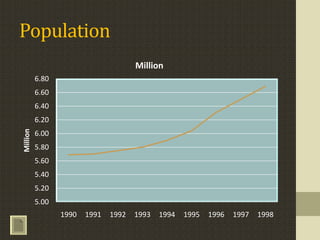
             Population: 7.03 million.
             Hong Kong continues to grow due to
              the influx of immigrants from
              mainland China, approximating 45,000
              per year.
             Life expectancy in Hong Kong is 79.8
              years for males and 86.1 years for
              females. Among the highest in the
              world.
             About 95% of the people of Hong
              Kong are of Chinese descent
                      Major ethnicities are:
                    Cantonese, Taishanese, Hakka
                    and Chiu Chow
             Residents from Mainland China are
              not allowed to enter, or relocate to
              Hong Kong freely
                     A daily quota of 150 people
                    from Mainland China with family
                    ties in Hong Kong are granted a
                    'one way permit'.
People (Cont.)

• Languages
     o Hong Kong's de facto official language is
     Cantonese
     o English is an official language
          o 3.1% of the population use English
          as an everyday language and by 34.9%
          of the population as a second
          language.
     o Mandarin is becoming more common, as
     more people come from the mainland

• Denonym: Hong Konger
     o People who live in Hong Kong can be
     referred to as “Hong Kongers”
Population
                                      Million
          6.80
          6.60
          6.40
          6.20
Million


          6.00
          5.80
          5.60
          5.40
          5.20
          5.00
                 1990   1991   1992   1993   1994   1995   1996   1997   1998
Culture
• Religion
      o Freedom of Religion in Hong Kong, unlike in Mainland
      China
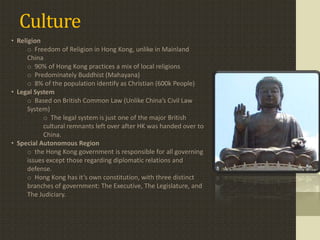
      o 90% of Hong Kong practices a mix of local religions
      o Predominately Buddhist (Mahayana)
      o 8% of the population identify as Christian (600k People)
• Legal System
      o Based on British Common Law (Unlike China’s Civil Law
      System)
            o The legal system is just one of the major British
            cultural remnants left over after HK was handed over to
            China.
• Special Autonomous Region
      o the Hong Kong government is responsible for all governing
      issues except those regarding diplomatic relations and
      defense.
      o Hong Kong has it’s own constitution, with three distinct
      branches of government: The Executive, The Legislature, and
      The Judiciary.
Culture (Cont.)
• Food
    o Hong Kong is truly an international city, and
    the diverse cuisine is a reflection of this.
    o East + West = Fusion
    o From the roadside stalls to the most
    upscale restaurants, Hong Kong provides an
    unlimited variety of food in every class.
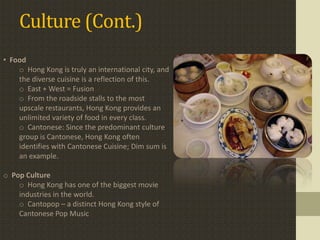
    o Cantonese: Since the predominant culture
    group is Cantonese, Hong Kong often
    identifies with Cantonese Cuisine; Dim sum is
    an example.

o Pop Culture
    o Hong Kong has one of the biggest movie
    industries in the world.
    o Cantopop – a distinct Hong Kong style of
    Cantonese Pop Music
History
• In 1839, the refusal by Qing Dynasty authorities to import opium resulted in the First Opium
War between China and Britain.
• Hong Kong Island became occupied by British forces in 1841, and was formally ceded to
Britain under the Treaty of Nanking at the end of the war.
• In 1860, after China's defeat in the Second Opium War, the Kowloon Peninsula and
Stonecutter's Island were ceded to Britain under the Convention of Peking
• When the People's Republic of China was proclaimed in 1949, more migrants fled to Hong
Kong in fear of persecution by the Communist Party.
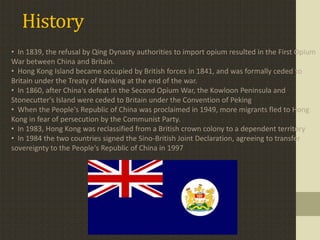
• In 1983, Hong Kong was reclassified from a British crown colony to a dependent territory
• In 1984 the two countries signed the Sino-British Joint Declaration, agreeing to transfer
sovereignty to the People's Republic of China in 1997
History (Cont.)
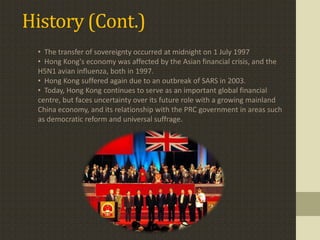
 • The transfer of sovereignty occurred at midnight on 1 July 1997
 • Hong Kong's economy was affected by the Asian financial crisis, and the
 H5N1 avian influenza, both in 1997.
 • Hong Kong suffered again due to an outbreak of SARS in 2003.
 • Today, Hong Kong continues to serve as an important global financial
 centre, but faces uncertainty over its future role with a growing mainland
 China economy, and its relationship with the PRC government in areas such
 as democratic reform and universal suffrage.
Thank You

Hongkong

  • 1.
    My Favorite City– Hong Kong 香港 Tiffany Chim
  • 2.
    About me andHong Kong Today, I am going to introduce you my favorite city -- my home town Hong Kong.
  • 3.
    Geography • HongKong is located on China's south coast o It is surrounded by the South China Sea on the east, south, and west, and borders the Guangdong city of Shenzhen to the north over the Shenzhen River • The territory of Hong Kong is about 426 Miles2 o Spanning over three main areas: Hong Kong Island, Kowloon Peninsula, and the New Territories o High population in Hong Kong • Hilly to Mountainous o Much of Hong Kong's terrain is hilly to mountainous with steep slopes, less than 25% of the territory's landmass is developed o The highest elevation in the territory is at Tai Mo Shan, at a height of 3,140 ft above sea level.
  • 4.
    People  Demographics  Population: 7.03 million.  Hong Kong continues to grow due to the influx of immigrants from mainland China, approximating 45,000 per year.  Life expectancy in Hong Kong is 79.8 years for males and 86.1 years for females. Among the highest in the world.  About 95% of the people of Hong Kong are of Chinese descent Major ethnicities are: Cantonese, Taishanese, Hakka and Chiu Chow  Residents from Mainland China are not allowed to enter, or relocate to Hong Kong freely A daily quota of 150 people from Mainland China with family ties in Hong Kong are granted a 'one way permit'.
  • 5.
    People (Cont.) • Languages o Hong Kong's de facto official language is Cantonese o English is an official language o 3.1% of the population use English as an everyday language and by 34.9% of the population as a second language. o Mandarin is becoming more common, as more people come from the mainland • Denonym: Hong Konger o People who live in Hong Kong can be referred to as “Hong Kongers”
  • 6.
    Population Million 6.80 6.60 6.40 6.20 Million 6.00 5.80 5.60 5.40 5.20 5.00 1990 1991 1992 1993 1994 1995 1996 1997 1998
  • 7.
    Culture • Religion o Freedom of Religion in Hong Kong, unlike in Mainland China o 90% of Hong Kong practices a mix of local religions o Predominately Buddhist (Mahayana) o 8% of the population identify as Christian (600k People) • Legal System o Based on British Common Law (Unlike China’s Civil Law System) o The legal system is just one of the major British cultural remnants left over after HK was handed over to China. • Special Autonomous Region o the Hong Kong government is responsible for all governing issues except those regarding diplomatic relations and defense. o Hong Kong has it’s own constitution, with three distinct branches of government: The Executive, The Legislature, and The Judiciary.
  • 8.
    Culture (Cont.) • Food o Hong Kong is truly an international city, and the diverse cuisine is a reflection of this. o East + West = Fusion o From the roadside stalls to the most upscale restaurants, Hong Kong provides an unlimited variety of food in every class. o Cantonese: Since the predominant culture group is Cantonese, Hong Kong often identifies with Cantonese Cuisine; Dim sum is an example. o Pop Culture o Hong Kong has one of the biggest movie industries in the world. o Cantopop – a distinct Hong Kong style of Cantonese Pop Music
  • 9.
    History • In 1839,the refusal by Qing Dynasty authorities to import opium resulted in the First Opium War between China and Britain. • Hong Kong Island became occupied by British forces in 1841, and was formally ceded to Britain under the Treaty of Nanking at the end of the war. • In 1860, after China's defeat in the Second Opium War, the Kowloon Peninsula and Stonecutter's Island were ceded to Britain under the Convention of Peking • When the People's Republic of China was proclaimed in 1949, more migrants fled to Hong Kong in fear of persecution by the Communist Party. • In 1983, Hong Kong was reclassified from a British crown colony to a dependent territory • In 1984 the two countries signed the Sino-British Joint Declaration, agreeing to transfer sovereignty to the People's Republic of China in 1997
  • 10.
    History (Cont.) •The transfer of sovereignty occurred at midnight on 1 July 1997 • Hong Kong's economy was affected by the Asian financial crisis, and the H5N1 avian influenza, both in 1997. • Hong Kong suffered again due to an outbreak of SARS in 2003. • Today, Hong Kong continues to serve as an important global financial centre, but faces uncertainty over its future role with a growing mainland China economy, and its relationship with the PRC government in areas such as democratic reform and universal suffrage.
  • 11.