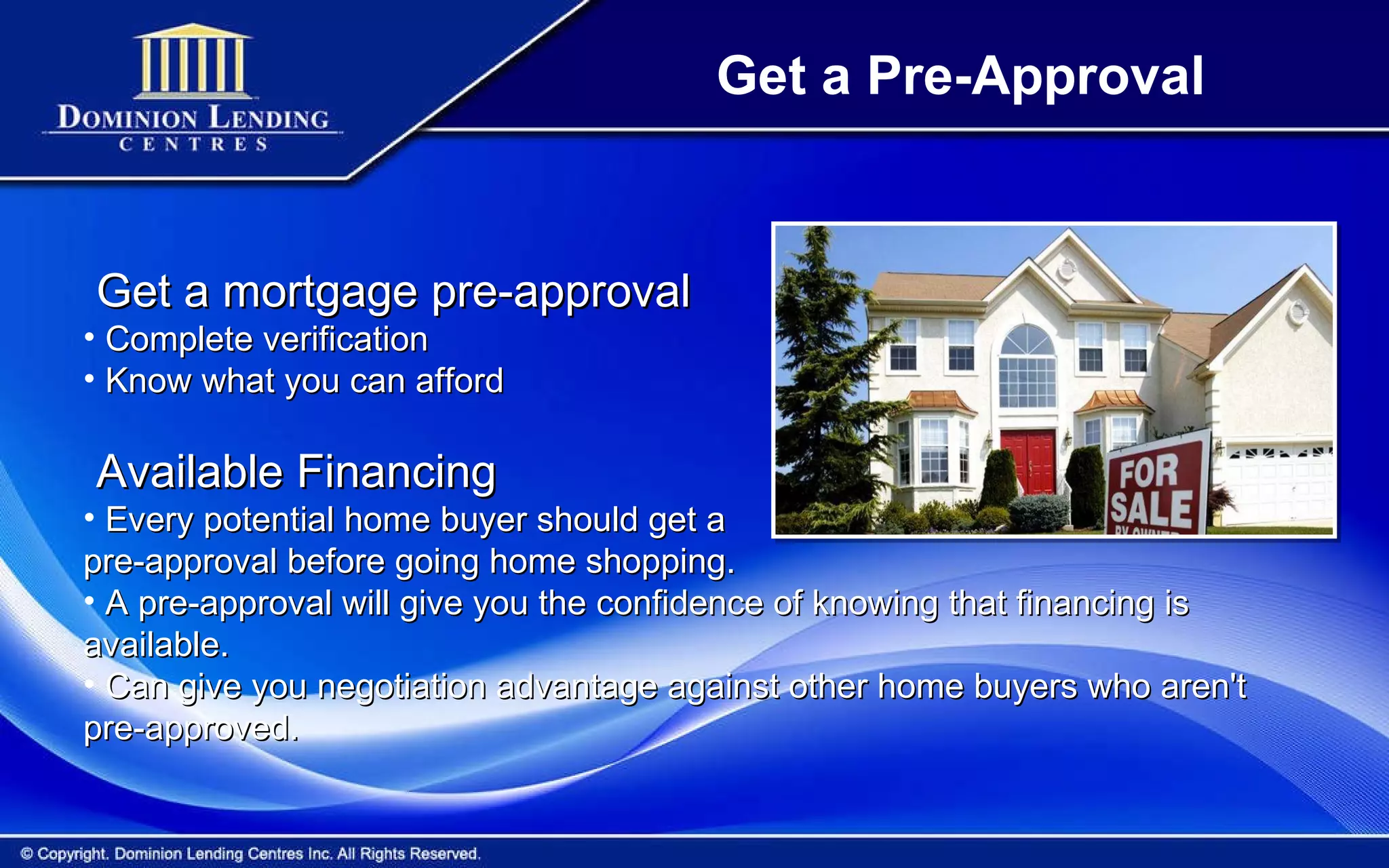
Get a Pre-Approval Get a mortgage pre-approval Complete verification  Know what you can afford Available Financing  Every potential home buyer should get a pre-approval before going home shopping.  A pre-approval will give you the confidence of knowing that financing is available. Can give you negotiation advantage against other home buyers who aren't pre-approved.
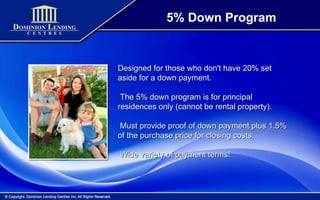
5% Down Program Designed for those who don't have 20% set aside for a down payment. The 5% down program is for principal residences only (cannot be rental property). Must provide proof of down payment plus 1.5% of the purchase price for closing costs. Wide variety of payment terms!
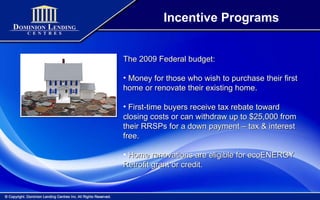
Incentive Programs The 2009 Federal budget: Money for those who wish to purchase their first home or renovate their existing home. First-time buyers receive tax rebate toward closing costs or can withdraw up to $25,000 from their RRSPs for a down payment – tax & interest free. Home renovations are eligible for ecoENERGY Retrofit grant or credit.
RRSP First-time Buyers Program Maximum $25,000 tax-free withdrawal Must be first-time buyer Must intend to occupy the home as a principal residence within 1 year. Minimum repayment schedule is 15 equal annual installments. The funds must have been invested into the RRSP for 90 days.
Self-Employed Program Programs for Self-Employed & Commissioned Sales Borrowers There are many programs for self-employed & those with unverifiable income to qualify for a mortgage with a low down payment. Purchasers must have a minimum of 5% down Purchasers must be able to demonstrate that have been self-employed for 2 or more years. Self-employed purchasers must provide most recent tax year’s Income Tax Notice of Assessment confirming that they have filed income tax returns. Self-employed purchasers must have a very good credit rating
Closing Costs Description Amount Appraisal $350 Home Inspection  (approx.) $350 Legal Fees  (approx.)  $900 TOTAL: $1,600 Survey, Tax Adjustment, Interest Adjustment & Property Transfer Tax fees may apply. Additional costs involved above the minimum down payment, include:
What is a Credit Score? A credit score is a rating used by a lender to help determine whether you qualify for a particular credit card, loan, or service. Based on information in your credit file, the credit reporting company analyzes your information using a complex mathematical model to yield your credit score. Most credit scores estimate the risk a company incurs by lending you money or providing you with a service, specifically, the likelihood that you'll fail to make payments in the next two to three years. The higher the score, the less risk you represent. Your score is calculated by a mathematical equation that evaluates many types of information found in the credit file.
What is a Credit Score? What Factors Affect a Score and by How much? Past Payment Performance – 35% The fewer late payments, judgments, liens or collections the better.  Credit Utilization – 30% Low balances on several cards is worse than high balances on a few cards. Balance should be at or below 30% of your available credit. Credit History – 15% The longer that accounts have been open and in good standing, the better. Avoid ‘credit surfing.’ Opening new accounts and closing established accounts will lower a credit score. Types of Credit in Use – 10% Finance company accounts score lower than traditional banking or retail accounts. Deferred payment options funded by finance companies impact the score accordingly. Inquiries – 10% Looking for new credit over a short period of time can be indicative of higher risk. Promotional or administrative inquiries (i.e. credit grantor updates) will show on the report but do not affect the credit score.

Homebuyers Presentation

  • 1.
    Get a Pre-ApprovalGet a mortgage pre-approval Complete verification Know what you can afford Available Financing Every potential home buyer should get a pre-approval before going home shopping. A pre-approval will give you the confidence of knowing that financing is available. Can give you negotiation advantage against other home buyers who aren't pre-approved.
  • 2.
    5% Down ProgramDesigned for those who don't have 20% set aside for a down payment. The 5% down program is for principal residences only (cannot be rental property). Must provide proof of down payment plus 1.5% of the purchase price for closing costs. Wide variety of payment terms!
  • 3.
    Incentive Programs The2009 Federal budget: Money for those who wish to purchase their first home or renovate their existing home. First-time buyers receive tax rebate toward closing costs or can withdraw up to $25,000 from their RRSPs for a down payment – tax & interest free. Home renovations are eligible for ecoENERGY Retrofit grant or credit.
  • 4.
    RRSP First-time BuyersProgram Maximum $25,000 tax-free withdrawal Must be first-time buyer Must intend to occupy the home as a principal residence within 1 year. Minimum repayment schedule is 15 equal annual installments. The funds must have been invested into the RRSP for 90 days.
  • 5.
    Self-Employed Program Programsfor Self-Employed & Commissioned Sales Borrowers There are many programs for self-employed & those with unverifiable income to qualify for a mortgage with a low down payment. Purchasers must have a minimum of 5% down Purchasers must be able to demonstrate that have been self-employed for 2 or more years. Self-employed purchasers must provide most recent tax year’s Income Tax Notice of Assessment confirming that they have filed income tax returns. Self-employed purchasers must have a very good credit rating
  • 6.
    Closing Costs DescriptionAmount Appraisal $350 Home Inspection (approx.) $350 Legal Fees (approx.) $900 TOTAL: $1,600 Survey, Tax Adjustment, Interest Adjustment & Property Transfer Tax fees may apply. Additional costs involved above the minimum down payment, include:
  • 7.
    What is aCredit Score? A credit score is a rating used by a lender to help determine whether you qualify for a particular credit card, loan, or service. Based on information in your credit file, the credit reporting company analyzes your information using a complex mathematical model to yield your credit score. Most credit scores estimate the risk a company incurs by lending you money or providing you with a service, specifically, the likelihood that you'll fail to make payments in the next two to three years. The higher the score, the less risk you represent. Your score is calculated by a mathematical equation that evaluates many types of information found in the credit file.
  • 8.
    What is aCredit Score? What Factors Affect a Score and by How much? Past Payment Performance – 35% The fewer late payments, judgments, liens or collections the better. Credit Utilization – 30% Low balances on several cards is worse than high balances on a few cards. Balance should be at or below 30% of your available credit. Credit History – 15% The longer that accounts have been open and in good standing, the better. Avoid ‘credit surfing.’ Opening new accounts and closing established accounts will lower a credit score. Types of Credit in Use – 10% Finance company accounts score lower than traditional banking or retail accounts. Deferred payment options funded by finance companies impact the score accordingly. Inquiries – 10% Looking for new credit over a short period of time can be indicative of higher risk. Promotional or administrative inquiries (i.e. credit grantor updates) will show on the report but do not affect the credit score.