The Dialectic between Global
Gender Goals and Local
Empowerment:
girls’ education in Southern Sudan
and South Africa


Holmarsdottir at al., 2011
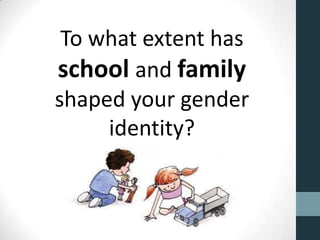
To what extent has
school and family
shaped your gender
     identity?
Key issues
• How is gender equality and equity
  understood at grassroot level? And how
  does it relate to the national policies of
  ”global governance”?

• How to research gender equality in
  education, not in a numerical way, but
  going beyond parity?
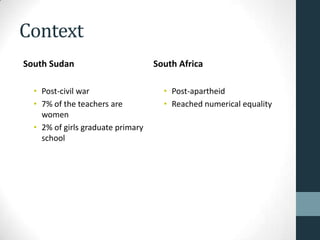
Context
South Sudan                        South Africa

  • Post-civil war                   • Post-apartheid
  • 7% of the teachers are           • Reached numerical equality
    women
  • 2% of girls graduate primary
    school
Post-structuralist approach
• Examines the construction of meaning and power
  relations as they affect the contemporary educational
  decisions
• Seeks to identify and expose biases that marginalize the
  educational needs of women and contribute to
  educational disparities
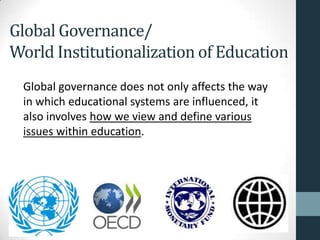
Global Governance/
World Institutionalization of Education
 Global governance does not only affects the way
 in which educational systems are influenced, it
 also involves how we view and define various
 issues within education.
Empowerment
A process by which people, organizations, or groups, who
are powerless become aware of the power dynamics at
work in their life context, develop the skills and capacity
for gaining some reasonable control over their lives,
exersice this control without infringing upon the rights of
others and support the empowerment of others in the
community.
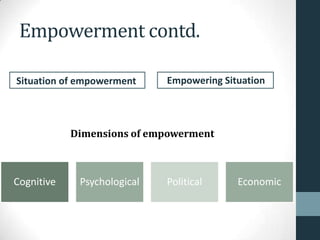
Empowerment contd.

Situation of empowerment     Empowering Situation


            Dimensions of empowerment


Cognitive    Psychological   Political     Economic
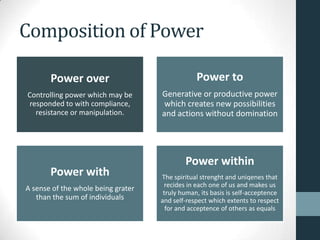
Composition of Power

       Power over                               Power to
Controlling power which may be      Generative or productive power
 responded to with compliance,       which creates new possibilities
   resistance or manipulation.      and actions without domination


                                            Power within
       Power with                   The spiritual strenght and uniqenes that
                                     recides in each one of us and makes us
A sense of the whole being grater
                                     truly human, its basis is self-acceptence
   than the sum of individuals      and self-respect which extents to respect
                                      for and acceptence of others as equals
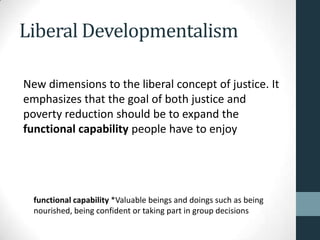
Liberal Developmentalism

New dimensions to the liberal concept of justice. It
emphasizes that the goal of both justice and
poverty reduction should be to expand the
functional capability people have to enjoy


  functional capability *Valuable beings and doings such as being
  nourished, being confident or taking part in group decisions
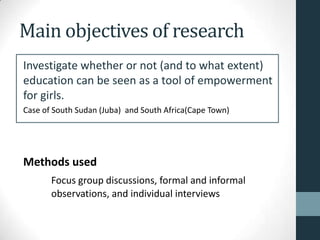
Main objectives of research
Investigate whether or not (and to what extent)
education can be seen as a tool of empowerment
for girls.
Case of South Sudan (Juba) and South Africa(Cape Town)


Methods used
       Focus group discussions, formal and informal
       observations, and individual interviews
Findings
• Gap between policy and local practice in education
• High desire of girls to have control over their own life
  choices, to be autonomous, to make a contribution to
  the community
• Education represents hope for the future and change
• Peer group culture within the school environment
• Lack of correlation between the community and
  school
• The NGO’s and the government in South Sudan do not
  collaborate as equal partners
Solutions
• The government needs to be an active partner in
  implementing gender equality projects
• Schools that challenge traditional sex roles
• Female teachers as role models and agents of
  change
• Pedagogical structural tools to achieve gender
  equity (fairness)
• Seeing gender equality as a part of the larger
  vision of a democratic society
• What about the boys?
Conclusions
• “Go beyond the numbers”

• A post-structural approach focusing on qualitative studies
 of the nature of power, discrimination and exclusion

• Parity doesn’t necessarily bring about empowerment

• Access to meaningful education (that provides epistemic
 access)

• Development of fair gender practices, pedagogical content
 and social settings at school
To what extent can education
contribute to gender equality
and equity?

Holmarsdottir at al., 2011 presentation (1)

  • 1.
    The Dialectic betweenGlobal Gender Goals and Local Empowerment: girls’ education in Southern Sudan and South Africa Holmarsdottir at al., 2011
  • 2.
    To what extenthas school and family shaped your gender identity?
  • 3.
    Key issues • Howis gender equality and equity understood at grassroot level? And how does it relate to the national policies of ”global governance”? • How to research gender equality in education, not in a numerical way, but going beyond parity?
  • 4.
    Context South Sudan South Africa • Post-civil war • Post-apartheid • 7% of the teachers are • Reached numerical equality women • 2% of girls graduate primary school
  • 5.
    Post-structuralist approach • Examinesthe construction of meaning and power relations as they affect the contemporary educational decisions • Seeks to identify and expose biases that marginalize the educational needs of women and contribute to educational disparities
  • 6.
    Global Governance/ World Institutionalizationof Education Global governance does not only affects the way in which educational systems are influenced, it also involves how we view and define various issues within education.
  • 7.
    Empowerment A process bywhich people, organizations, or groups, who are powerless become aware of the power dynamics at work in their life context, develop the skills and capacity for gaining some reasonable control over their lives, exersice this control without infringing upon the rights of others and support the empowerment of others in the community.
  • 8.
    Empowerment contd. Situation ofempowerment Empowering Situation Dimensions of empowerment Cognitive Psychological Political Economic
  • 9.
    Composition of Power Power over Power to Controlling power which may be Generative or productive power responded to with compliance, which creates new possibilities resistance or manipulation. and actions without domination Power within Power with The spiritual strenght and uniqenes that recides in each one of us and makes us A sense of the whole being grater truly human, its basis is self-acceptence than the sum of individuals and self-respect which extents to respect for and acceptence of others as equals
  • 10.
    Liberal Developmentalism New dimensionsto the liberal concept of justice. It emphasizes that the goal of both justice and poverty reduction should be to expand the functional capability people have to enjoy functional capability *Valuable beings and doings such as being nourished, being confident or taking part in group decisions
  • 11.
    Main objectives ofresearch Investigate whether or not (and to what extent) education can be seen as a tool of empowerment for girls. Case of South Sudan (Juba) and South Africa(Cape Town) Methods used Focus group discussions, formal and informal observations, and individual interviews
  • 12.
    Findings • Gap betweenpolicy and local practice in education • High desire of girls to have control over their own life choices, to be autonomous, to make a contribution to the community • Education represents hope for the future and change • Peer group culture within the school environment • Lack of correlation between the community and school • The NGO’s and the government in South Sudan do not collaborate as equal partners
  • 13.
    Solutions • The governmentneeds to be an active partner in implementing gender equality projects • Schools that challenge traditional sex roles • Female teachers as role models and agents of change • Pedagogical structural tools to achieve gender equity (fairness) • Seeing gender equality as a part of the larger vision of a democratic society • What about the boys?
  • 14.
    Conclusions • “Go beyondthe numbers” • A post-structural approach focusing on qualitative studies of the nature of power, discrimination and exclusion • Parity doesn’t necessarily bring about empowerment • Access to meaningful education (that provides epistemic access) • Development of fair gender practices, pedagogical content and social settings at school
  • 15.
    To what extentcan education contribute to gender equality and equity?

Editor's Notes

  • #5 Gender equality can be understood as